Google has recently published a comprehensive new help document within its Google Ads support section, titled "About commerce audience sharing through Google Ads." This pivotal resource introduces a significant enhancement designed to foster deeper collaboration between commerce entities and their advertising partners. The core premise of this new functionality, as outlined by Google, is to enable "commerce partners, such as retailers or marketplaces, to share first-party data segments with their advertising partners, such as brands or sellers." This strategic move underscores a broader industry shift towards leveraging proprietary data assets in an increasingly privacy-centric digital advertising landscape.
The initiative aims to address a critical need within the e-commerce ecosystem: facilitating more effective and targeted advertising while upholding stringent privacy standards. Google elaborates that "This collaboration allows advertising partners to reach new consumers and helps to drive increased sales of their goods sold through their commerce partners platforms." Crucially, Google emphasizes the robust controls in place, stating, "Commerce partners have controls that enable the safe and secure sharing of their audiences. Any campaign utilizing a commerce partner’s audience can only direct traffic back to the commerce partner’s website." This ensures that the primary beneficiary of the advertising activity remains the commerce partner’s platform, reinforcing their central role in the transaction funnel.
The Evolving Landscape of Digital Advertising and First-Party Data
The introduction of Commerce Audience Sharing by Google Ads arrives at a transformative period for digital advertising. The industry is grappling with the impending deprecation of third-party cookies across major browsers, most notably Google Chrome, which is slated to phase them out entirely by late 2024. This shift, driven by growing consumer demand for privacy and stricter regulatory frameworks like the General Data Protection Regulation (GDPR) in Europe and the California Consumer Privacy Act (CCPA) in the United States, has necessitated a fundamental re-evaluation of how advertisers identify, target, and measure their audiences.
In this evolving environment, first-party data – information collected directly by a company from its customers – has emerged as the bedrock of effective and privacy-compliant advertising strategies. Retailers and marketplaces, by their very nature, possess vast troves of invaluable first-party data: purchase histories, browsing behaviors on their platforms, loyalty program memberships, and demographic information. This data offers unparalleled insights into consumer preferences and intent, far surpassing the often-generalized profiles derived from third-party cookies. However, until now, the secure and scalable sharing of this data between commerce platforms and the brands that sell through them has presented significant operational and technical hurdles.
Google’s Commerce Audience Sharing is a direct response to these challenges, providing a standardized and secure mechanism for this vital data exchange. It positions Google Ads as a central facilitator in the emerging "retail media" ecosystem, where retailers are increasingly monetizing their digital shelf space and customer data by offering advertising opportunities directly to brands. This move also aligns with Google’s broader "Privacy Sandbox" initiatives, which seek to develop new privacy-preserving technologies that support key advertising use cases without relying on cross-site tracking via third-party cookies.
Understanding the Mechanics of Commerce Audience Sharing
At its core, Commerce Audience Sharing is designed to bridge the data gap between commerce platforms and their advertising partners. The process involves a structured, controlled sharing of audience segments, enabling brands to leverage the rich insights held by retailers to enhance their advertising campaigns.
Key Definitions:
- Commerce Partners: These are typically retailers, e-commerce platforms, or online marketplaces that host multiple brands or sellers. They are the custodians of extensive first-party customer data generated through interactions on their platforms. Examples include large department store chains with online presences, major e-commerce marketplaces, or specialized online retailers.
- Advertising Partners: These are the brands, manufacturers, or individual sellers who market and sell their products through the commerce partners’ platforms. They seek to reach relevant consumers to drive sales and brand awareness for their specific products.
The mechanism is twofold, catering to different operational models:
- Commerce Partner-Led Campaigns: In this scenario, the commerce partner (e.g., a large online retailer) runs advertising campaigns on behalf of their advertising partners (the brands selling on their site). The commerce partner utilizes their own first-party data segments to target these campaigns, ensuring optimal reach and relevance for the brand’s products. The campaigns direct traffic back to the commerce partner’s website, reinforcing the platform’s role. This model allows brands to benefit from the commerce partner’s data expertise and direct access to their customer base without needing to manage the campaigns themselves.
- Self-Service Advertising Partner Campaigns: This more empowering model allows advertising partners to directly access and utilize shared audience segments for campaigns they manage themselves within Google Ads. The commerce partner grants access to specific, pre-defined first-party data segments. This gives brands greater autonomy and flexibility in their targeting strategies while still operating within the secure framework established by the commerce partner. Again, all traffic generated from these campaigns is explicitly directed back to the commerce partner’s website, maintaining the integrity of the ecosystem. This option is particularly beneficial for brands with in-house advertising teams or those working with agencies that prefer direct control over their ad spend.
The emphasis on "safe and secure sharing" is paramount. Google’s documentation suggests that commerce partners retain significant control over which data segments are shared, with whom, and under what conditions. This granular control is vital for maintaining trust with both the brands and, crucially, the end consumers whose data is being utilized. The limitation that campaigns must direct traffic back to the commerce partner’s website serves as a fundamental safeguard, preventing the shared data from being used to siphon traffic away from the platform that generated the data in the first place, thus protecting the commerce partner’s investment in data collection and customer loyalty.
Tangible Benefits for Key Stakeholders
Google explicitly outlines the distinct advantages for both commerce partners and advertising partners, underscoring the mutual value proposition of this new functionality.
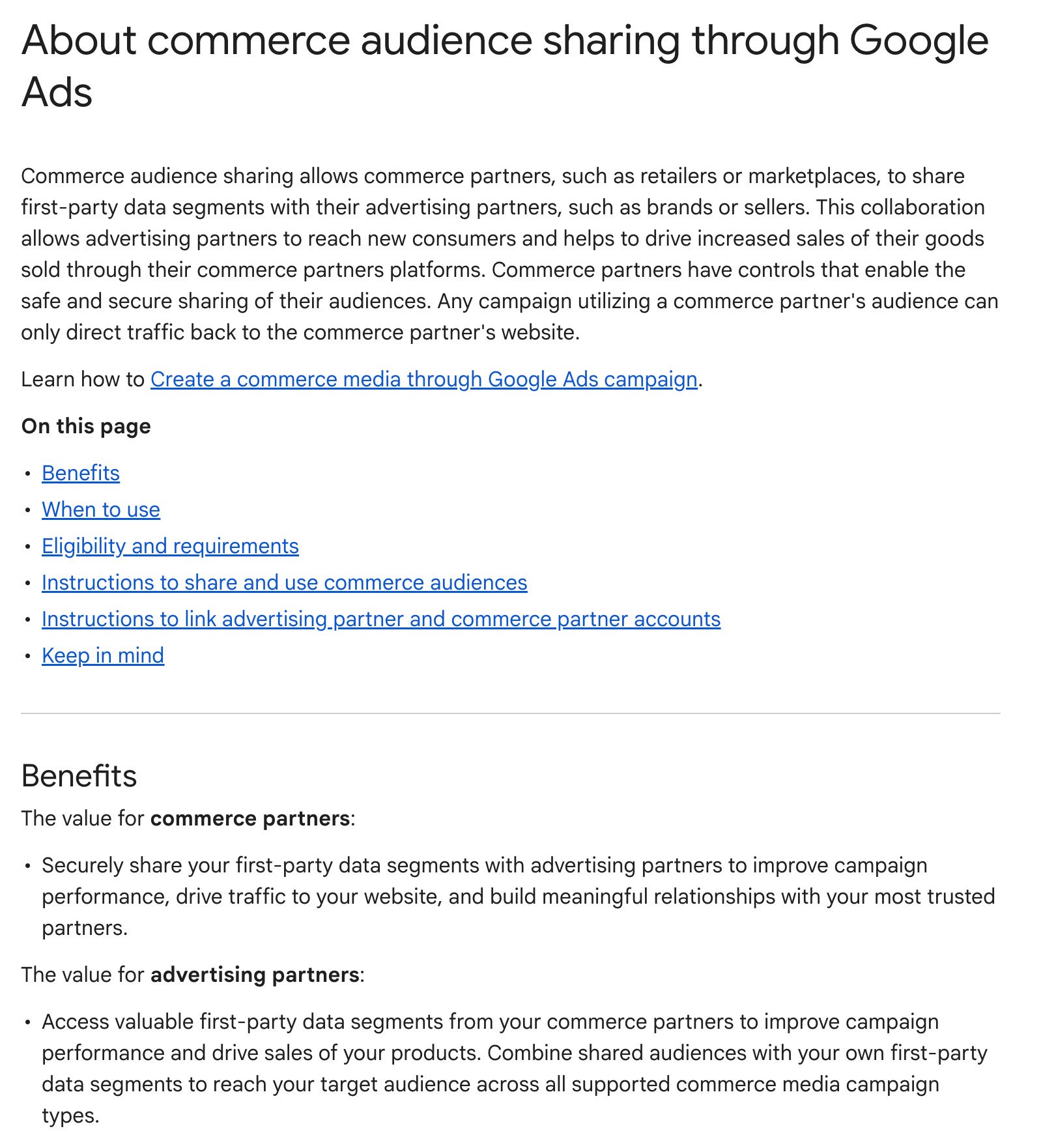
Value for Commerce Partners: Elevating Platform Value and Relationships
For retailers and marketplaces, the benefits extend beyond mere data utilization; they encompass strategic platform enhancement and strengthened relationships with their brand ecosystem.
- Improved Campaign Performance: By securely sharing their first-party data segments with advertising partners, commerce partners can directly contribute to the efficacy of marketing campaigns run on their behalf or by their brands. This translates into more relevant ads, higher click-through rates, and ultimately, increased sales volume through their platform. This mutual success solidifies the platform’s value proposition.
- Increased Traffic and Sales to Their Website: When advertising partners leverage these shared audiences, the resulting campaigns are designed to drive traffic specifically back to the commerce partner’s website. This creates a virtuous cycle: better targeting leads to more effective ads, which drives more qualified traffic, and subsequently, more sales directly on the commerce partner’s platform. This is a crucial element, ensuring the data sharing directly benefits the data originator, fostering growth within their own digital storefront.
- Building Meaningful Relationships with Trusted Partners: Offering brands access to valuable first-party data is a powerful incentive for them to invest more heavily in the commerce partner’s platform. It fosters a deeper, more collaborative relationship, positioning the commerce partner as a strategic ally in the brand’s growth rather than just a sales channel. This can lead to increased loyalty from brands and a greater willingness to participate in joint marketing initiatives, potentially leading to exclusive partnerships or preferential terms.
- Monetization of Data Assets (Indirectly): While not a direct data sale, enabling brands to advertise more effectively on their platform effectively monetizes the commerce partner’s data assets. Increased sales for brands translate into increased commissions, transaction fees, or subscription revenue for the marketplace. It enhances the overall value proposition of the commerce platform as an advertising channel, turning data into a strategic asset that attracts and retains high-value brands.
- Enhanced Control and Security: The framework provides robust controls, allowing commerce partners to define precisely how their data is used. This includes specifying which segments are shared, with which partners, and for what campaign types. This level of governance is critical for compliance with privacy regulations (like GDPR and CCPA) and maintaining consumer trust, assuring them that their data is handled responsibly.
Value for Advertising Partners: Precision Targeting and Sales Growth
Brands and sellers stand to gain significant competitive advantages by accessing these valuable first-party data segments, particularly in a privacy-constrained advertising environment.
- Access to Valuable First-Party Data: This is perhaps the most significant benefit. In a world moving away from third-party cookies, direct access to high-quality, intent-rich first-party data from major retailers is a game-changer. It allows brands to move beyond broad demographic targeting to precise behavioral and purchase-intent-based targeting, reaching consumers who are most likely to convert.
- Improved Campaign Performance and Sales: With more accurate audience targeting, advertising campaigns become inherently more efficient. Brands can reach consumers who have already demonstrated interest in similar products or have a history of purchasing from the commerce partner, leading to higher conversion rates and a direct impact on sales figures for their products. This translates into better return on ad spend (ROAS).
- Reach New Consumers Effectively: By tapping into the commerce partner’s extensive customer base, brands can identify and engage with new consumer segments that might be difficult to reach through their own data or general targeting methods. This expands their market reach and customer acquisition potential, opening up new growth avenues.
- Combine Shared Audiences with Own First-Party Data: Advertising partners are not limited to only using the shared data. They can combine these valuable segments with their own proprietary first-party data (e.g., website visitor lists, CRM data). This creates highly refined and powerful custom audience segments, enabling multi-faceted targeting strategies across various supported commerce media campaign types within Google Ads. For instance, a brand could target a commerce partner’s "recent purchasers of athletic wear" who are also "subscribers to the brand’s email newsletter."
- Diversification of Audience Strategy: This capability adds a crucial layer to a brand’s overall audience strategy, complementing existing targeting methods and providing a robust alternative in the post-cookie era. It reduces reliance on less effective, broad targeting and future-proofs their advertising efforts against further privacy changes.
Broader Implications and Industry Impact
Google’s Commerce Audience Sharing initiative is more than just a new feature; it represents a strategic pivot with significant implications for the digital advertising ecosystem, the future of retail media, and the ongoing dialogue around data privacy.
The Acceleration of Retail Media Networks
This move solidifies Google’s position as a key enabler in the burgeoning retail media space. Retail media networks, where retailers leverage their first-party data and digital properties to offer advertising opportunities to brands, are rapidly growing. Companies like Amazon, Walmart, and Instacart have already established formidable retail media businesses. Google’s initiative democratizes access to this model, making it more accessible and integrated within the Google Ads platform for a wider array of commerce partners, from large marketplaces to individual online retailers. This could significantly increase ad spend within Google Ads as brands seek to leverage these new targeting capabilities, potentially shifting budgets from other ad channels. Industry reports consistently project retail media to be one of the fastest-growing segments of digital advertising, and Google’s new offering is set to capture a significant share of this expansion.
Navigating the Privacy-First Future
The strict stipulation that campaigns using shared audiences must direct traffic back to the commerce partner’s website is a crucial element for privacy and trust. It ensures that the shared data is used to enhance the commerce partner’s ecosystem, rather than enabling broader, potentially less transparent, cross-site tracking. This approach aligns with Google’s commitment to developing privacy-preserving solutions as part of its Privacy Sandbox initiative. It emphasizes utility for advertisers while attempting to maintain user trust by limiting data leakage and ensuring a clear value exchange. However, ongoing scrutiny regarding data governance and user consent will remain paramount, requiring continuous vigilance from both Google and its partners. This framework provides a model for how data sharing can occur responsibly in a post-cookie world.
Reconfiguring the Competitive Landscape
This feature positions Google Ads more directly in competition with other retail media platforms that already offer similar first-party data sharing capabilities (e.g., Amazon Ads’ various targeting options for sellers). By integrating this functionality into its vast ad network, Google aims to attract more retail ad spend and strengthen its ties with both commerce platforms and the brands that operate within them. It offers a more unified advertising experience for brands that sell across multiple retail channels, potentially simplifying complex media buying strategies. Furthermore, it provides an alternative for brands that might be hesitant to rely solely on the retail media platforms of their direct competitors.
Data Governance and Transparency Challenges
While Google emphasizes "safe and secure sharing," the practical implementation of data governance will be critical for both commerce and advertising partners. Commerce partners will need robust internal processes to manage consent, segment data appropriately, and ensure compliance with all relevant privacy regulations. This includes clear communication with their customers about how their data might be used for advertising purposes. Advertising partners, in turn, must understand the limitations and appropriate uses of shared data, adhering to strict guidelines to avoid misuse. Transparency with end-users about how their data is being used, even in an aggregated or segmented form, will continue to be a key challenge and a critical factor in maintaining public trust. Education for both partners and consumers will be essential.
Potential for Innovation and Advanced Targeting
The ability for advertising partners to combine shared audiences with their own first-party data opens up avenues for highly sophisticated targeting strategies. For example, a brand selling high-end headphones could target consumers who have recently purchased a new smartphone from the commerce partner (using shared data) and have also previously visited the headphone brand’s own website to view product specifications (using their first-party data). This level of precision could lead to unprecedented campaign effectiveness and a more personalized ad experience for consumers, provided it’s executed thoughtfully and with respect for privacy. This hybrid approach allows for a synergistic effect, leveraging the strengths of both parties’ data assets.
Chronology and Future Outlook
The announcement of Commerce Audience Sharing is not an isolated event but rather a logical progression in Google’s multi-year strategy to adapt to a privacy-first internet. The timeline of this evolution can be traced back to:
- 2019-2020: Initial announcements from Google regarding the deprecation of third-party cookies in Chrome and the introduction of the Privacy Sandbox initiative to develop alternative, privacy-preserving technologies. This marked a clear signal of the impending shift.
- 2021-2023: Ongoing development and testing of various Privacy Sandbox APIs, alongside increasing industry focus on first-party data strategies. During this period, Google Ads has steadily introduced features that empower advertisers to leverage their own first-party data more effectively, such as Enhanced Conversions and Customer Match updates, laying the groundwork for more advanced sharing capabilities.
- Late 2023 – Early 2024: Intensified efforts and clearer roadmaps for the final phase-out of third-party cookies, making solutions like Commerce Audience Sharing increasingly urgent and relevant. The release of this specific help document signals that the functionality is either newly available or soon to be widely rolled out, representing a concrete step in operationalizing Google’s vision for a post-cookie advertising world. It demonstrates Google’s commitment to providing tangible solutions for advertisers facing a significant paradigm shift.
Looking ahead, Google is likely to continue refining this feature, potentially expanding the types of audience segments that can be shared, enhancing reporting and attribution capabilities, and further integrating it with other Google Ads products. As the Privacy Sandbox progresses, there may also be opportunities to integrate these audience-sharing capabilities with new privacy-preserving APIs. The success of this initiative will largely depend on its adoption by both major commerce platforms and a diverse range of advertising partners, as well as Google’s continued commitment to robust privacy safeguards and transparent communication.
In conclusion, Google Ads Commerce Audience Sharing represents a strategic and timely response to the evolving demands of digital advertising. By providing a secure and controlled mechanism for first-party data exchange, Google aims to empower retailers and brands to achieve greater advertising efficacy, foster stronger partnerships, and drive sales, all while navigating the complexities of a privacy-conscious online environment. This initiative is poised to be a significant driver in the continued growth of retail media and the broader shift towards intelligent, data-driven advertising strategies, offering a powerful tool for businesses to thrive in the next era of digital marketing.