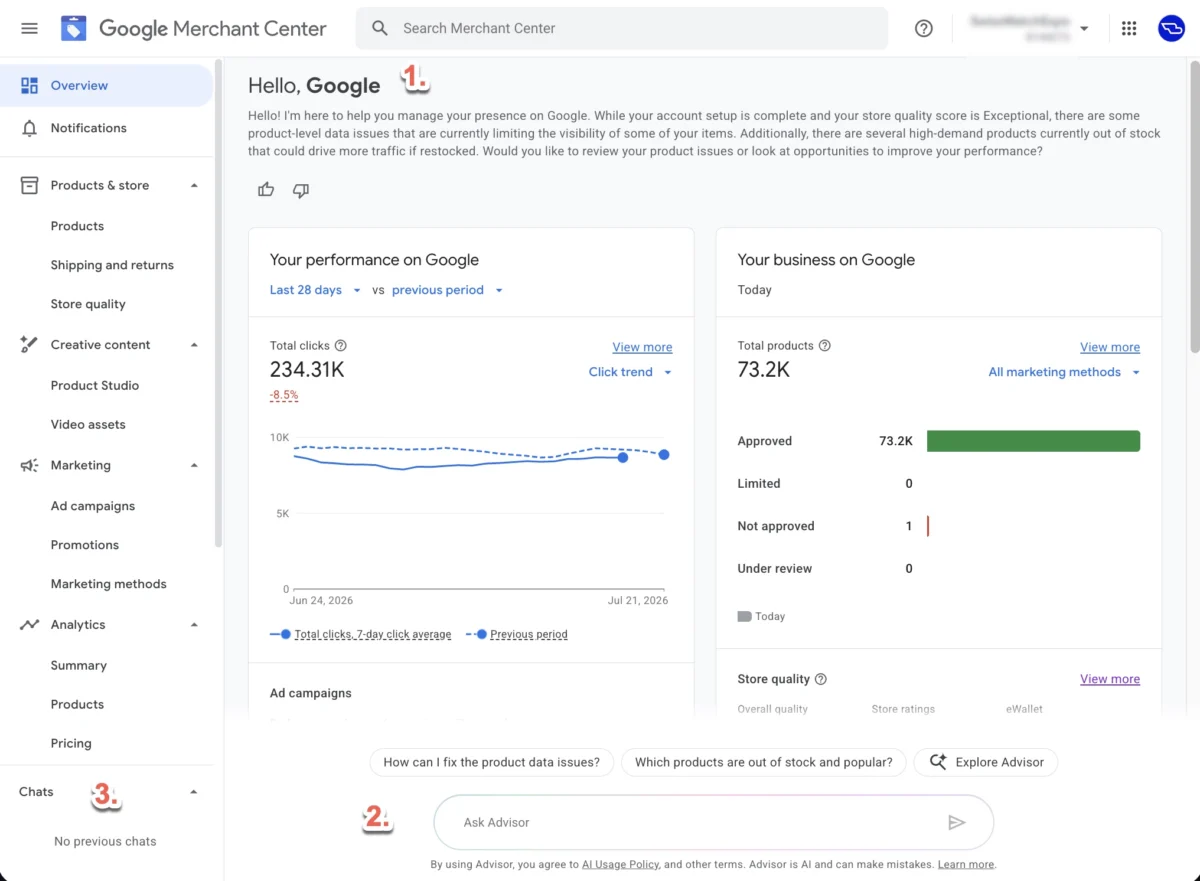
Google continues its aggressive integration of artificial intelligence across its core product offerings, with the Google Merchant Center platform being the latest recipient of a significant influx of AI-powered enhancements. These new features, recently observed and reported by SERP Alerts and digital marketing expert Brodie Clark, include an AI summary for insights, a dynamic search box with suggested queries, and a dedicated section for previous chat interactions, further solidifying Merchant Center’s role as an intelligent hub for online retailers. This latest wave of updates builds upon a series of earlier AI rollouts, including the introduction of "Merchant Advisor" and enhanced "AI performance reports," signaling a clear strategic direction by Google to empower merchants with more sophisticated, automated tools for managing their online product presence and advertising campaigns.
The Evolving Landscape of E-commerce and Google’s AI Ambition
The Google Merchant Center serves as the foundational platform for retailers to upload, manage, and optimize their product data for display across various Google properties, including Google Shopping, Google Search, YouTube, and the Google Display Network. In an increasingly competitive and complex e-commerce environment, where consumer expectations for seamless shopping experiences are at an all-time high, the demands on merchants to manage vast product catalogs, adhere to intricate policy guidelines, and constantly optimize performance have grown exponentially. This evolving landscape necessitates more intelligent, automated solutions, a need that Google is actively addressing through its deep investments in AI.
Google’s broader AI strategy aims to infuse artificial intelligence into virtually every aspect of its ecosystem, from search algorithms and cloud services to consumer applications and business tools. For e-commerce, this translates into making the entire journey, from product discovery to purchase, more efficient and personalized for both shoppers and sellers. By embedding AI directly into the Merchant Center, Google is not merely adding convenience features but fundamentally transforming how businesses interact with their product data and Google’s advertising infrastructure. The objective is clear: to simplify complex tasks, provide actionable intelligence, and ultimately drive greater success for merchants, thereby strengthening Google’s position as a critical enabler of online commerce.
A Chronology of AI Integration in Merchant Center
The recent announcement represents a significant milestone in a series of strategic AI integrations within the Google Merchant Center throughout the current year. This gradual rollout underscores Google’s methodical approach to enhancing the platform.
-
Earlier This Year: Introduction of Merchant Advisor: The initial major AI-driven enhancement came with the launch of "Merchant Advisor." This feature was designed to act as a proactive, intelligent assistant for retailers. Merchant Advisor leverages AI to analyze a merchant’s product data, campaign performance, and account health to provide personalized recommendations. These recommendations can range from identifying critical data quality issues in product feeds that might hinder visibility, suggesting opportunities for optimizing product titles and descriptions, to alerting merchants about potential policy violations before they lead to disapprovals. The goal was to shift from reactive problem-solving to proactive optimization, saving merchants valuable time and preventing costly errors. By offering tailored insights, Merchant Advisor aimed to democratize access to sophisticated optimization strategies, previously requiring significant expertise or third-party tools.
-
Just Weeks Ago: AI Performance Reports: Following the foundational work of Merchant Advisor, Google rolled out advanced "AI Performance Reports." These reports moved beyond basic analytics, utilizing machine learning to uncover deeper trends and patterns in product performance. Merchants gained the ability to see not just what was happening with their products (e.g., sales figures, clicks, impressions) but why it was happening. The AI could identify high-performing products, pinpoint underperforming categories, and suggest specific actions to improve results. For instance, it might highlight that a particular product category is seeing high impressions but low conversion rates, prompting a merchant to review their landing page experience or pricing strategy. These reports provided a more holistic and actionable view of campaign effectiveness, moving beyond raw data to synthesized, intelligent insights.
-
The Latest Enhancements: A New Wave of Intelligence: The most recent additions, as highlighted by Brodie Clark and SERP Alerts, represent a further refinement and expansion of AI’s presence on the Merchant Center dashboard.
-
AI Summary for Insights: This feature directly addresses the challenge of data overload. With the proliferation of performance reports, analytics, and diagnostics, merchants can often feel overwhelmed by the sheer volume of information. The "AI Summary for Insights" is designed to distill complex data points into concise, easily digestible summaries. Instead of sifting through multiple charts and tables, merchants can receive a high-level overview of their most critical performance metrics, key trends, and urgent action items. This summary acts as an intelligent executive brief, allowing merchants to quickly grasp the essence of their account status and focus their attention where it’s most needed. It can synthesize findings from the AI Performance Reports, providing a narrative explanation of the data and its implications.
-
Search Box with Suggested Queries: Enhancing user experience and efficiency, this new search functionality within the Merchant Center dashboard features AI-powered suggested queries. This is a practical application of natural language processing (NLP) and machine learning, predicting what a user might be looking for based on their past behavior, common queries, and the context of the platform. For example, if a merchant frequently checks product diagnostics, the search box might suggest "product disapprovals," "feed errors," or "item status." If they are reviewing performance, suggestions might include "campaign performance," "conversion rates," or "top-selling products." This significantly reduces the time and effort required to navigate the platform, find specific features, or access relevant information, making the Merchant Center more intuitive and user-friendly.
-
Section for Previous Chats: The inclusion of a "Section for Previous Chats" leverages AI to improve the support and troubleshooting experience within Merchant Center. This feature stores a history of interactions a merchant has had with Google’s support or AI-powered assistance features. By maintaining a persistent record of past conversations, merchants can easily refer back to resolutions for previous issues, track the progress of ongoing queries, or pick up a conversation where they left off. This continuity is invaluable for complex troubleshooting, ensuring that merchants don’t have to repeatedly explain their situation. From an AI perspective, this chat history can also feed into future AI models, allowing the system to learn from common problems and their resolutions, further improving the quality of automated suggestions and support.
-
Supporting Data and Market Context: The Imperative for AI in E-commerce
The strategic push for AI in Google Merchant Center is not arbitrary; it’s a direct response to fundamental shifts and exponential growth within the global e-commerce landscape.
According to Statista, global retail e-commerce sales reached approximately $5.8 trillion in 2023 and are projected to grow to nearly $8.1 trillion by 2027. This immense scale brings with it unprecedented data volumes and operational complexities for businesses. Merchants, especially small and medium-sized businesses (SMBs), often struggle to keep pace with algorithmic changes, competitor strategies, and the sheer volume of data generated by their online operations.

AI offers a crucial solution to these challenges. A report by McKinsey & Company highlighted that companies adopting AI in marketing and sales can see a 10-20% increase in revenue. Furthermore, Gartner predicts that by 2025, AI will be a top-five investment priority for 80% of marketing organizations. These statistics underscore the critical role AI plays in enhancing efficiency, personalization, and competitive advantage in the digital marketplace.
For Google, these AI integrations are also about strengthening its advertising ecosystem. Google Shopping and other product-centric ad formats are directly powered by data from Merchant Center. By making it easier for merchants to optimize their product feeds and ad campaigns through AI, Google indirectly drives more effective ad spend on its platforms, ensuring its continued dominance in retail search advertising. Better product data and more optimized campaigns lead to higher click-through rates and conversions, benefiting both the merchant and Google’s advertising revenue.
Fact-Based Analysis of Implications
The continued infusion of AI into Google Merchant Center carries significant implications for various stakeholders:
-
For Merchants:
- Increased Efficiency and Time Savings: Automated insights and intelligent suggestions free up valuable time that merchants would otherwise spend on manual data analysis and troubleshooting. This is particularly beneficial for SMBs with limited resources.
- Improved Performance and ROI: By providing actionable recommendations, AI helps merchants optimize their product listings, resolve issues faster, and refine their advertising strategies, leading to better visibility, higher click-through rates, and ultimately, improved conversion rates and return on investment (ROI).
- Democratization of Advanced Tools: AI features make sophisticated optimization techniques accessible to a wider range of merchants, regardless of their technical expertise or marketing budget. This levels the playing field, allowing smaller businesses to compete more effectively with larger enterprises.
- Proactive Problem Solving: Features like Merchant Advisor and AI summaries help identify potential issues (e.g., product disapprovals, policy violations) before they escalate, minimizing downtime and lost sales opportunities.
- Enhanced User Experience: The intelligent search box and chat history contribute to a more intuitive and less frustrating platform experience, reducing the learning curve for new users and improving productivity for experienced ones.
-
For Google:
- Platform Stickiness: By making Merchant Center an indispensable and intelligent tool, Google increases merchant reliance on its ecosystem, fostering loyalty and reducing churn.
- Data Advantage and AI Refinement: Every interaction with these AI features generates more data, which Google can use to further train and refine its machine learning models, leading to even more accurate and helpful services in the future.
- Reinforced Market Leadership: These innovations underscore Google’s commitment to leading in AI-powered solutions for business, maintaining its competitive edge against other e-commerce platforms and advertising networks.
- Optimized Ad Revenue: More effective product listings and campaigns managed through AI translate directly into more successful ad performance on Google Ads, thereby increasing ad spend and revenue for Google.
-
For the E-commerce Industry:
- Accelerated AI Adoption: Google’s prominent role in e-commerce will likely spur other platforms and solution providers to further integrate AI into their offerings, accelerating the broader adoption of AI across the industry.
- Higher Standards for Merchant Tools: These advancements set a new benchmark for what merchants can expect from their e-commerce management platforms, pushing for continuous innovation across the board.
- Focus on Data Quality: As AI relies heavily on clean and accurate data, these tools will inherently encourage merchants to prioritize the quality and completeness of their product feeds.
Inferred Statements and Industry Reactions
While Google has not released specific official statements on this particular batch of updates beyond general announcements, their consistent messaging around AI integration emphasizes empowering businesses. A hypothetical statement from Google might highlight their commitment to "simplifying the complexities of online retail, enabling merchants of all sizes to thrive by harnessing the power of artificial intelligence." They would likely underscore how these tools "provide actionable insights, streamline operations, and ultimately connect more shoppers with the products they love."
Industry analysts and digital marketing experts would likely echo the sentiment of strategic necessity. An expert might comment, "These continuous AI enhancements are crucial for Google to maintain its dominant position in the retail search ecosystem. By providing tangible, productivity-boosting value directly within the Merchant Center, Google makes it increasingly difficult for businesses to operate effectively without leveraging its platform. It’s a smart move that aligns perfectly with the growing demand for automation and intelligent insights in digital commerce." Merchants themselves, particularly those who have grappled with the intricacies of feed management and performance analysis, are expected to welcome features that promise to reduce manual effort and improve campaign efficacy.
Future Outlook
The trajectory of AI integration into Google Merchant Center suggests an ongoing evolution towards a highly intelligent, largely autonomous platform. Future enhancements could potentially include:
- Predictive Inventory Management: AI could analyze sales trends, seasonality, and supplier lead times to offer predictive insights on inventory levels, helping merchants avoid stockouts or overstocking.
- Automated Policy Compliance: More sophisticated AI could proactively identify and suggest corrections for potential policy violations in real-time, significantly reducing product disapprovals.
- Advanced Competitor Analysis: AI might provide detailed insights into competitor pricing, product availability, and promotional strategies, offering actionable recommendations for competitive positioning.
- Hyper-Personalized Product Recommendations (for shoppers, via merchant data): While Google already does this, AI in Merchant Center could allow merchants more granular control or insights into how their products are being recommended based on shopper behavior.
- Generative AI for Product Content: AI could assist in generating or optimizing product descriptions, titles, and attributes, ensuring they are not only compliant but also highly engaging and SEO-friendly.
As AI capabilities continue to advance, the line between human management and AI automation within platforms like Google Merchant Center will blur further. The focus will increasingly shift from manual data entry and reactive troubleshooting to strategic oversight and leveraging AI for predictive analysis and proactive optimization. However, this also brings into sharper focus the importance of ethical AI development, data privacy, and ensuring transparency in how AI-driven decisions are made, particularly concerning product visibility and merchant performance.
In conclusion, Google’s consistent and comprehensive integration of AI features into the Google Merchant Center is a clear strategic imperative, reflecting the growing demands of the e-commerce landscape and Google’s ambition to remain at the forefront of digital commerce enablement. These enhancements are not just incremental updates; they represent a fundamental shift towards a more intelligent, efficient, and powerful platform designed to empower online retailers in an increasingly AI-driven world.