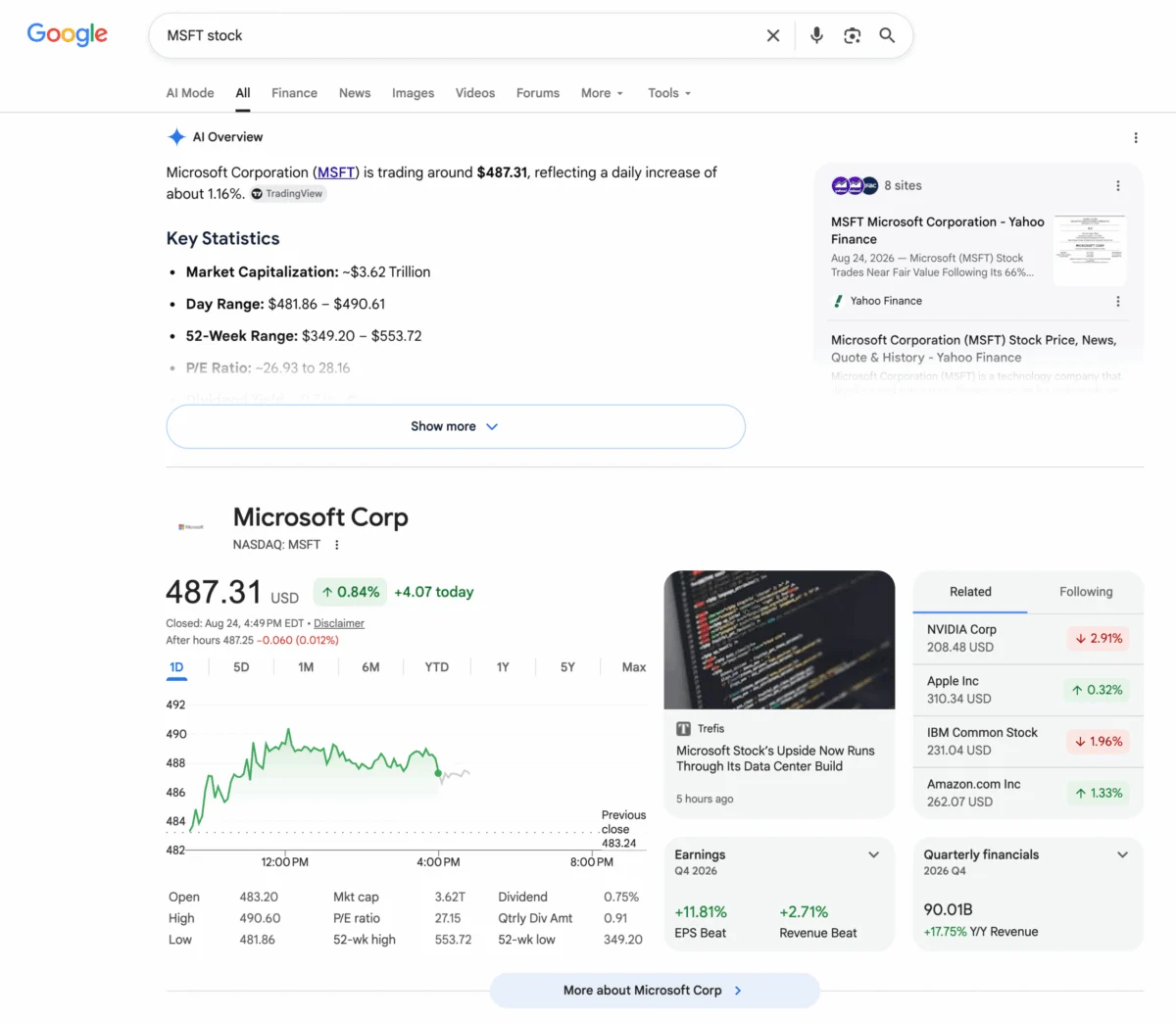
Google has initiated a significant alteration to its search engine results pages (SERPs), now prominently featuring AI Overviews at the top for specific stock price queries, such as [GOOG stock] or [MSFT stock]. This new placement positions the AI-generated summary directly above the traditional stock chart and financial data widget, a move that has drawn considerable attention and initiated discussions within the SEO community and among financial information users regarding its utility and potential impact on information retrieval and user experience. The change represents a further integration of Google’s generative AI capabilities into core search functionalities, extending its influence into highly specific, data-intensive query types that traditionally relied on concise, direct answers.
The Evolution of AI Overviews in Google Search
The introduction of AI Overviews, initially branded as Search Generative Experience (SGE), marked a pivotal moment in Google’s long-term strategy to incorporate generative artificial intelligence directly into its search interface. First unveiled in May 2023 at Google I/O, AI Overviews were designed to provide concise, AI-generated summaries of information directly within the SERP, aiming to answer complex queries more comprehensively without requiring users to navigate to external websites. This initiative built upon years of Google’s development in natural language processing and machine learning, evolving from earlier features like Featured Snippets and Knowledge Panels which also aimed to provide immediate answers.
The underlying rationale for AI Overviews, according to Google, is to enhance the search experience by distilling vast amounts of information from across the web into digestible summaries. For queries that are multifaceted or require synthesis from multiple sources, these overviews promise to save users time and effort. Google has continuously refined the technology, collecting user feedback and iterating on its algorithms to improve accuracy, relevance, and safety, particularly in sensitive domains. The broader rollout of AI Overviews across various query types has been gradual, reflecting Google’s cautious approach to integrating such a powerful, yet occasionally fallible, technology into its primary product. This latest deployment above stock charts indicates a confident, albeit potentially controversial, step into financial data presentation.
Specific Observations and Chronology of Placement Changes
The recent shift in AI Overview placement for stock queries was first brought to wider attention by Len Raleigh, who observed and shared screenshots on X (formerly Twitter) demonstrating the AI Overview appearing above the stock chart for queries like [GOOG stock]. This configuration presents the AI-generated summary as the very first informational block a user encounters, preceding the graphical representation of stock performance, real-time price, and other key financial metrics that have long been the immediate expectation for such searches.
This is not the first instance of AI Overviews appearing for stock-related queries, but it signifies a crucial change in their hierarchical placement. Several months prior, Gagan Ghotra had similarly observed AI Overviews for company stock price queries. However, in Ghotra’s earlier spotting, the AI Overview was situated below the stock chart widget. This earlier placement allowed users to immediately access the core financial data they were seeking, with the AI summary serving as supplementary information, potentially offering broader context or related news.
The chronological distinction is vital:
- Earlier Configuration (observed by Gagan Ghotra, June 2026): Stock Chart Widget -> AI Overview -> Traditional Search Results.
- Current Configuration (observed by Len Raleigh, August 2026): AI Overview -> Stock Chart Widget -> Traditional Search Results.
This change in priority directly impacts the user’s initial interaction with financial search results. Moving the AI Overview to the top suggests Google’s intention to prioritize a generative summary even for highly specific data queries, potentially influencing how users interpret and engage with financial information presented on the SERP. The implications of this repositioning extend beyond mere aesthetics, touching upon user behavior, the perceived reliability of information, and the competitive landscape for financial data providers.
User Experience Implications: Speed Versus Context
The primary concern raised by the SEO community and likely shared by many users is the potential impact on user experience for financial queries. When a user types [GOOG stock] into Google, their intent is overwhelmingly clear: to quickly ascertain the current stock price, its daily movement, and perhaps a simple chart of recent performance. Google has historically excelled at providing this immediate, direct answer through its highly optimized stock chart widget, often pulled from reputable sources like Google Finance or other market data providers.

Placing an AI Overview above this crucial data introduces an additional layer of information that may not always align with the user’s immediate need for speed and precision. While an AI Overview could offer valuable context—such as recent company news, analyst sentiment, or a brief summary of quarterly earnings—its necessity at the very top for a quick price check is debatable. Users seeking a rapid data point might find the AI summary an unnecessary intermediary, potentially delaying their access to the core information they are seeking.
Conversely, for users seeking more than just a number, the AI Overview could theoretically enrich the search experience. It could provide a snapshot of key factors influencing the stock’s performance without requiring multiple clicks. However, the success of this depends entirely on the AI’s ability to consistently generate highly relevant, accurate, and concise summaries that truly add value beyond what is already presented in the stock widget or readily available on financial news sites. If the AI Overview is generic, irrelevant, or worse, inaccurate, it could lead to frustration and a perception of decreased search relevance. This delicate balance between providing immediate data and offering supplementary context is central to the ongoing discussion.
SEO and Publisher Impact
The shift in Google’s SERP layout for financial queries carries significant implications for search engine optimization (SEO) and online publishers specializing in financial news and data. For years, financial websites have vied for top rankings for stock-related terms, driving substantial organic traffic. While the dedicated stock chart widget already served as a "zero-click" answer for many users, the introduction of AI Overviews, especially above the chart, further intensifies the competition for user attention and clicks.
When an AI Overview directly answers a query, or at least attempts to summarize it comprehensively, the likelihood of a user clicking through to external websites may decrease. This "zero-click search" phenomenon, where users find sufficient information directly on the SERP, has been a growing concern across various industries. For financial publishers, this could translate into reduced organic traffic, impacting their advertising revenue and subscription models. Websites that provide in-depth analysis, historical data, and detailed company reports might find it harder to attract users who are content with the AI’s summary.
Furthermore, the sources from which Google’s AI Overviews draw their information are not always explicitly clear or consistently attributed in a way that drives traffic back to the original content. While Google typically includes links to sources within AI Overviews, the prominence of these links and the likelihood of users clicking them after reading a summary are subjects of ongoing debate. Publishers are left to strategize how to differentiate their content and provide unique value that goes beyond what an AI summary can offer, focusing on proprietary data, expert analysis, or interactive tools that cannot be easily replicated by generative AI. This forces financial content creators to innovate their content strategies, emphasizing depth, unique perspectives, and community engagement to maintain their relevance in an AI-driven search landscape.
The Criticality of Accuracy in Financial AI
The domain of financial information demands an exceptionally high degree of accuracy. Misinformation or "hallucinations" by AI in this sector can have severe real-world consequences, influencing investment decisions and potentially leading to significant financial losses. Google’s AI Overviews, while generally impressive, have faced scrutiny for occasional inaccuracies or nonsensical outputs in other query types. The stakes are considerably higher when dealing with stock prices, company performance, and market sentiment.
For example, an AI Overview that incorrectly states a company’s dividend yield, misinterprets recent earnings reports, or inaccurately summarizes future outlooks could inadvertently mislead users. Unlike general knowledge queries where minor inaccuracies might be tolerable, financial data requires absolute precision. The AI’s ability to process real-time market fluctuations, breaking news, and complex regulatory filings and synthesize them accurately into a concise summary is paramount.
Google’s reputation as a trusted information source is intrinsically linked to the reliability of its AI Overviews, especially in sensitive areas like finance. Any widespread or critical errors could erode user trust and potentially invite regulatory oversight. This places immense pressure on Google’s internal quality assurance processes, its data sources, and its feedback mechanisms to ensure that the AI Overviews for financial queries are not only relevant but unimpeachably accurate. The potential for a "bad actor" to manipulate information that an AI then picks up also poses a challenge, requiring robust verification mechanisms.
Google’s Broader AI Strategy and Challenges
This specific change in stock query SERPs is a microcosm of Google’s broader, aggressive strategy to integrate generative AI across its product ecosystem. The company is under immense pressure from competitors, particularly OpenAI with ChatGPT and Microsoft with Copilot, to demonstrate leadership in the AI space. Integrating AI Overviews into core search is Google’s answer to this challenge, aiming to redefine search as a more conversational and summarization-focused experience rather than just a list of links.

However, this strategy is not without its significant challenges:
- Maintaining Search Quality: Ensuring that AI Overviews consistently enhance, rather than detract from, the search experience.
- Addressing Hallucinations: Minimizing instances where the AI generates incorrect, nonsensical, or misleading information.
- Source Attribution and Ecosystem Health: Balancing the provision of direct answers with the need to drive traffic to the publishers and content creators who generate the information the AI summarizes.
- Monetization: Figuring out how to effectively monetize an AI-first search experience without alienating users or advertisers.
- User Adoption: Convincing a vast user base, accustomed to traditional search patterns, to embrace and trust AI-generated summaries.
Google’s continued experimentation with the placement and prominence of AI Overviews, as seen with the stock query example, indicates an ongoing iterative process. The company is likely A/B testing different configurations, collecting data on user engagement, click-through rates, and user satisfaction to fine-tune its approach. The financial sector, with its high-stakes data and clear user intent, serves as a crucial testing ground for the maturity and reliability of Google’s generative AI.
Industry Reactions and Expert Perspectives
Reactions from industry experts, particularly within the SEO and digital marketing communities, have been mixed but largely characterized by cautious observation and concern. Many acknowledge the technological prowess behind AI Overviews but question their practical application in all contexts. For financial queries, the prevailing sentiment leans towards skepticism regarding the utility of an AI summary overshadowing direct data.
"The immediate impulse for a stock query is data, not discourse," remarked one SEO analyst, speaking anonymously due to client sensitivities. "While AI can offer context, placing it above the hard numbers feels like putting the cart before the horse for most financial users. It suggests Google is pushing its AI agenda sometimes at the expense of established user intent."
Financial news outlets and data providers are closely monitoring these developments. There’s a palpable concern about the continued "squeezing" of organic visibility. "Our business model relies on attracting users seeking financial information," commented a representative from a major financial news platform. "If Google provides sufficient answers directly on the SERP, it fundamentally alters our ability to engage with potential readers and subscribers. We have to continually demonstrate unique value beyond what a search engine can summarize."
Some experts suggest that Google might be testing the waters to understand how much "summary" users are willing to consume before diving into specific data. Others believe this is part of a broader strategy to make search more conversational and predictive, where the AI anticipates follow-up questions and provides a richer initial context. Regardless of the underlying intent, the consensus is that this change necessitates a re-evaluation of content strategies for anyone operating in the financial information space.
The Future Landscape of Financial Search
The integration of AI Overviews above stock charts is a harbinger of a future where search engines play an even more active role in synthesizing and presenting information, moving beyond mere indexing and linking. For financial queries, this could evolve into highly personalized AI dashboards that not only show stock prices but also provide tailored news feeds, risk assessments, and investment recommendations, all generated by AI.
However, this future also brings critical questions to the forefront:
- Trust and Verification: How will users verify the accuracy of AI-generated financial insights, especially for complex or time-sensitive decisions?
- Personalization vs. Bias: Will AI Overviews for financial queries become overly personalized, potentially introducing echo chambers or biased information based on user history?
- Regulatory Frameworks: Will governments and financial authorities need to establish new regulations for AI-driven financial information platforms, particularly concerning disclosure and liability?
- Economic Impact: What will be the long-term economic impact on traditional financial news organizations and data providers as search engines increasingly internalize information delivery?
Google’s current experimentation with AI Overviews in financial search is a bold step, reflecting the company’s commitment to an AI-first future. While it promises enhanced convenience and contextual understanding for some, it also raises significant concerns about user experience efficiency, data accuracy, and the sustainable ecosystem of online information. The ongoing dialogue and Google’s subsequent refinements will determine whether this strategic integration proves to be a net positive for users seeking critical financial insights.