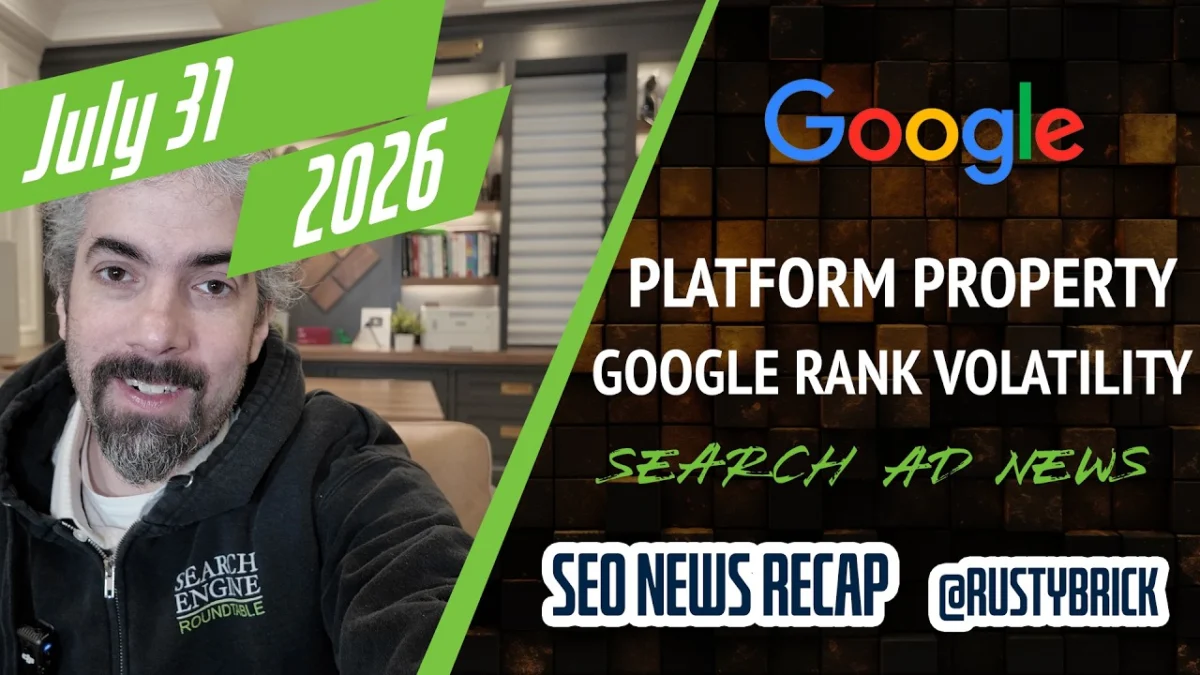
The digital marketing and search engine optimization (SEO) landscape witnessed a dynamic week concluding July 31, 2026, marked by significant updates from industry titans Google and Microsoft, alongside emerging players like ChatGPT. Key developments included continued volatility in Google Search rankings, a major rollout of Google’s platform properties for tracking social media giants, and substantial enhancements across advertising platforms. These changes underscore an accelerated shift towards AI-driven insights, sophisticated targeting, and an ever-evolving battle for user attention and advertiser spend.
Google Search Dominates Headlines with AI and Indexing Shifts
The week began with persistent reports of Google Search volatility, a common occurrence in the SEO world where algorithm updates and indexing shifts can cause significant fluctuations in search engine results pages (SERPs). Webmasters and SEO professionals observed an unsettling period of ranking changes, which eventually showed signs of calming by Wednesday. Such volatility often signals an ongoing Google algorithm update or a series of adjustments designed to refine search quality, combat spam, or enhance user experience. The intermittent nature of these shifts necessitates constant vigilance from those reliant on organic traffic, as ranking changes can directly impact website visibility, traffic, and ultimately, revenue.
Persistent Volatility and New Tracking Capabilities
In a strategic move that reflects the increasing importance of cross-platform digital presence, Google has officially rolled out "platform properties." This new feature enables the tracking and analysis of content performance across major social media platforms, specifically X (formerly Twitter), YouTube, TikTok, and Instagram. For businesses and content creators, this represents a significant advancement in understanding their multi-channel impact. Previously, gathering comprehensive data across these disparate platforms often required fragmented tools and manual aggregation. Google’s integrated approach promises a more holistic view of content reach, engagement, and audience interaction, allowing for more informed content strategies and resource allocation. The integration suggests Google’s recognition of the decentralized nature of content consumption and its commitment to providing comprehensive tools for digital marketers navigating this complex ecosystem. The ability to monitor performance across these platforms directly within Google’s ecosystem could streamline analytics workflows and provide a unified perspective on how content travels and performs beyond traditional web pages.
Navigating Indexing Challenges and Metadata Nuances
Despite these advancements, Google Search continued to grapple with persistent page indexing delays, leading to what many described as "weird static snapshots" in search results. This issue can significantly hinder the visibility of new or updated content, as search engines fail to promptly crawl, index, and reflect the most current version of a webpage. For news outlets, e-commerce sites, and dynamic content platforms, timely indexing is paramount. Delays can result in outdated information being presented to users, missed opportunities for ranking for trending topics, and a generally sluggish response to website updates. The underlying causes for such delays can vary, from server capacity issues on Google’s end to complex site structures or technical SEO misconfigurations.
Adding another layer of complexity, Google has not publicly listed the order of precedence it uses to resolve metadata conflicts. Metadata, such as title tags and meta descriptions, provides crucial context to search engines about a page’s content. When multiple sources of metadata (e.g., HTML, schema markup, Open Graph tags) provide conflicting information, it can create ambiguity for Google, potentially leading to the display of less optimal or irrelevant snippets in search results. Clarity on this precedence would empower webmasters to prioritize and structure their metadata more effectively, ensuring their desired message is conveyed.
Furthermore, Google continues to support the unavailable_after date directive, a useful tool for indicating when content, such as event listings or limited-time offers, should no longer appear in search results. However, reports indicated that Google might not always recognize updates to this date, potentially causing content to remain visible past its intended expiry or, conversely, disappear prematurely if the date is revised. This discrepancy highlights the ongoing challenges in ensuring that search engines accurately interpret and respond to specific directives, particularly when dynamic updates are involved.
The Ascendancy of AI Overviews and Review Integrity
In a move with profound implications for the search experience, Google’s AI Overviews are now appearing on nearly half of all searches. This statistic underscores the rapid integration of generative AI into the core search experience. AI Overviews aim to provide concise, direct answers to user queries by synthesizing information from various sources, potentially reducing the need for users to click through to individual websites. While intended to enhance user convenience, this development has sparked considerable debate within the SEO community. Concerns include potential impacts on organic traffic for publishers, the accuracy and attribution of AI-generated content, and the broader shift in how users discover information. Publishers are actively strategizing how to adapt their content to be effectively summarized by AI and how to maintain visibility in a SERP dominated by these AI-powered snippets.
In the realm of trustworthiness and content quality, Google reiterated its strict prohibition against marking up fake or undisclosed incentivized reviews. This guideline reinforces Google’s commitment to maintaining the integrity of online reviews, which play a crucial role in consumer trust and purchasing decisions. Fake or manipulated reviews can mislead consumers and distort the reputation of businesses. Google’s stance aligns with broader efforts to combat misinformation and ensure that user-generated content genuinely reflects authentic experiences. This policy is particularly relevant in the context of Google’s E-E-A-T (Experience, Expertise, Authoritativeness, Trustworthiness) guidelines, where authentic reviews contribute significantly to a website’s perceived trustworthiness.
Finally, Google made a notable adjustment to its guidelines by removing the explicit requirement to block internal search results from being indexed. Previously, it was often recommended to prevent search engines from crawling and indexing internal site search pages to avoid duplicate content issues and conserve crawl budget. While the requirement has been removed, the recommendation to block such pages often remains, as internal search results can still create low-value, duplicate content that dilutes a site’s overall quality signals and wastes valuable crawl resources. This change may indicate Google’s improved ability to de-duplicate content or a shift in focus towards other quality signals.
Advancements in Google Ads Ecosystem Streamline Campaigns
The advertising landscape also saw a flurry of updates, primarily from Google Ads, aimed at enhancing campaign performance, reporting, and management. These developments signify Google’s ongoing efforts to provide advertisers with more sophisticated tools to navigate an increasingly competitive digital advertising environment.
Enhanced Tracking and Optimization Tools
Google Ads introduced a significant new "lead journey mapping" feature. This tool empowers advertisers to visualize and understand the multi-touchpoint path a potential customer takes from initial interaction to conversion. By mapping the various stages and interactions, marketers can identify crucial touchpoints, pinpoint bottlenecks in the conversion funnel, and optimize their ad spend more effectively across different channels and campaign types. This deeper insight into the customer journey is invaluable for improving lead quality, reducing acquisition costs, and maximizing return on investment (ROI).
Another new addition is the "Budget Panel" within Google Ads. This feature is designed to provide advertisers with a more intuitive and comprehensive overview of their campaign budgets, spending trends, and projected performance. Effective budget management is critical for advertising success, and the Budget Panel aims to offer greater transparency and control, helping advertisers avoid overspending or underspending, and make more informed decisions about allocating their resources.
Strategic Bidding and Reporting Innovations
Google Ads is also rolling out expanded "Target CPA (Cost Per Acquisition)" and "Target ROAS (Return On Ad Spend)" bidding options. These smart bidding strategies leverage Google’s machine learning capabilities to automatically optimize bids in real-time to achieve specific performance goals. Target CPA focuses on acquiring conversions at a desired average cost, while Target ROAS aims to maximize conversion value at a target return. The broader rollout of these options indicates Google’s push towards more automated and goal-oriented campaign management, allowing advertisers to focus more on strategy and less on manual bidding adjustments.
In terms of reporting, Google Ads product reports now include detailed metrics for both "product clicks" and "non-product clicks." This granular reporting is particularly beneficial for e-commerce advertisers running Shopping Ads or Performance Max campaigns. Differentiating between clicks directly on product listings and other clicks (e.g., on headlines or extensions) provides a clearer picture of user engagement with specific product offerings versus broader ad elements. This distinction can inform optimization strategies, helping advertisers refine their product feeds, ad copy, and landing pages to drive more relevant and high-intent clicks.
Furthermore, Google Ads has introduced the capability to exclude audiences based on income for Performance Max (PMax) campaigns. PMax campaigns are Google’s automated, goal-based campaign type that runs across all Google Ads channels. The addition of income-based exclusions provides advertisers with a new layer of targeting precision, allowing them to refine their audience reach and ensure their ads are served to segments most likely to convert, thereby improving campaign efficiency and reducing wasted ad spend. This is particularly useful for luxury brands or budget-friendly products.
To provide greater transparency and clarity, Google Ads shared an updated document on conversion metrics, offering more detailed information on timing and data sources. Accurate conversion tracking is the cornerstone of effective digital advertising, and understanding the nuances of how conversions are attributed and measured is crucial for interpreting campaign performance data correctly. This documentation aims to help advertisers better understand the journey from ad click to conversion, enabling them to optimize their measurement strategies and campaign settings.
Finally, Google Ads Editor version 2.13 was made available. The Editor is an indispensable tool for many advertisers, allowing for bulk editing, offline campaign management, and efficient updates across large accounts. Regular updates to the Editor typically include bug fixes, performance improvements, and support for new Google Ads features, ensuring that advertisers have the necessary tools to manage their campaigns effectively and at scale.
Microsoft Advertising Gains Momentum, ChatGPT Expands Ad Offerings
Google’s primary competitor in the search advertising space, Microsoft Advertising, also unveiled notable updates and reported strong financial performance, signaling its growing influence. Meanwhile, ChatGPT’s Ads Manager continues to evolve, indicating the broader trend of AI platforms integrating advertising capabilities.
Microsoft’s Growing Ad Revenue and Campaign Management
Microsoft Advertising announced that its ad previews hub now supports Performance Max campaigns. Similar to Google’s PMax, Microsoft’s equivalent campaigns are designed for maximum reach and automation. The ability to preview these complex ad formats before launch is critical for advertisers to ensure creative consistency, accurate messaging, and proper rendering across various placements. This feature enhances advertiser control and confidence in deploying highly automated campaigns.
A significant strategic shift for Microsoft Advertising involves moving its "Predictive matching" feature towards "Search Term matching." Predictive matching aimed to anticipate user intent and match ads to queries that were semantically related but not explicitly contained within the keyword list. By shifting to a more direct Search Term matching approach, Microsoft Advertising appears to be offering advertisers greater transparency and control over where their ads appear, potentially reducing instances of irrelevant impressions and clicks. This change might be a response to advertiser feedback seeking more direct control over keyword targeting.
Financially, Microsoft reported robust earnings, with its ad revenue for search and Bing showing a substantial 10% increase. This growth underscores Microsoft’s continued efforts to carve out a larger share of the digital advertising market, leveraging its Bing search engine, Microsoft Edge browser, and other ecosystem assets. The 10% increase, particularly in a competitive landscape dominated by Google, indicates successful strategies in attracting advertisers and users, potentially driven by innovations in ad formats, targeting capabilities, and an expanding user base for its various products. This steady growth positions Microsoft as a strong alternative for advertisers looking to diversify their ad spend.
ChatGPT’s Foray into Advertising Management
In the rapidly evolving AI space, the ChatGPT Ads Manager saw a series of updates, including budget changes, new ad formats, new features, and API changes. These developments highlight OpenAI’s (the creator of ChatGPT) strategic move to integrate advertising directly into its AI platform ecosystem. Budget changes could involve new pricing models or optimization features for ad spend, while new ad formats suggest an expansion of creative possibilities within the ChatGPT interface. New features likely encompass enhanced targeting, analytics, or automation capabilities, making it more attractive for businesses to advertise directly within or through the ChatGPT platform. The API changes are particularly significant, as they open up opportunities for developers and businesses to integrate ChatGPT’s ad capabilities into their own applications and workflows, signaling a future where AI-powered advertising is deeply embedded across various digital touchpoints. This foray into advertising positions ChatGPT not just as a content generation tool but as a potential marketing and monetization platform.
Broader Industry Implications and Future Outlook
The collective updates from Google, Microsoft, and ChatGPT underscore several overarching trends shaping the digital marketing industry. The relentless integration of artificial intelligence across search and advertising platforms is the most prominent. From Google’s AI Overviews dominating SERPs to AI-generated ad descriptions and ChatGPT’s ad manager, AI is rapidly transforming how content is discovered, consumed, and monetized. This shift necessitates that businesses and marketers embrace AI tools, adapt their content strategies for AI summarization, and leverage AI-powered bidding and targeting for optimal campaign performance.
The Shifting Landscape of Digital Marketing
The continued volatility in Google Search, coupled with the rising prominence of AI Overviews, signals a dynamic and somewhat unpredictable future for organic search. Websites can no longer solely rely on traditional SEO tactics but must also consider how their content can be effectively presented in an AI-summarized format. The emphasis on high-quality, trustworthy content becomes even more critical as AI models rely on reputable sources.
The advancements in Google Ads and Microsoft Advertising, particularly in smart bidding, lead journey mapping, and granular reporting, reflect a push towards greater efficiency, automation, and data-driven decision-making. Advertisers are being equipped with tools that offer deeper insights into consumer behavior and more precise control over their ad spend, albeit often through automated systems. The competitive growth of Microsoft Advertising also provides a viable alternative for advertisers seeking to diversify their reach and explore new audiences.
Preparing for an AI-First Search Future
The developments of this week collectively paint a picture of a digital marketing landscape rapidly moving towards an AI-first future. Businesses that proactively adapt to these changes—by optimizing for AI Overviews, leveraging advanced ad targeting and analytics, and maintaining a robust, multi-platform content strategy—will be best positioned for success. The emphasis on user experience, content quality, and ethical practices (such as authentic reviews) remains foundational, even as the technological underpinnings of search and advertising continue to evolve at an unprecedented pace. The coming months will likely see further refinements and innovations as these tech giants continue to integrate AI more deeply into their core offerings, challenging marketers to remain agile and adaptive.