Commerce has consistently evolved, from localized physical marketplaces to expansive, internet-driven e-commerce platforms. Now, a new paradigm, "agentic commerce," is emerging, poised to fundamentally transform how consumers discover, evaluate, and purchase goods and services. This model leverages advanced artificial intelligence (AI) agents to act autonomously on behalf of users, streamlining the buying journey in unprecedented ways. While the concept sparks considerable excitement for its potential to enhance convenience and efficiency, it also raises critical questions about consumer trust, business return on investment, and the broader implications for the digital economy.
The Evolution of Commerce: A Historical Arc Towards Autonomy
For centuries, commerce was a direct interaction, confined by geography and personal networks. The advent of physical stores, followed by malls and department stores, expanded reach but still necessitated physical presence. The late 20th century witnessed a seismic shift with the rise of the internet, giving birth to e-commerce. This digital revolution dissolved geographical barriers, offering consumers boundless choice and competitive pricing at their fingertips. Websites like Amazon, eBay, and countless specialized retailers transformed shopping into a borderless, always-on activity.
The next phase integrated mobile technology, making shopping accessible from anywhere, anytime. Personalized recommendations, digital wallets, and one-click purchasing became standard. However, even with these advancements, the core process remained largely manual: consumers actively searched, compared, and made final purchase decisions. AI’s role was primarily assistive, offering recommendations or powering chatbots for customer service. Agentic commerce represents the leap from assistive AI to autonomous AI, where the system doesn’t just suggest but acts.
Understanding Agentic Commerce: The Digital Proxy in Action

At its core, agentic commerce defines a model where AI agents function as sophisticated digital proxies, making purchase decisions and executing transactions on behalf of consumers. Instead of navigating countless websites, manually sifting through product reviews, comparing prices across tabs, or painstakingly filtering results, users can delegate these complex and time-consuming tasks to intelligent AI agents. These agents operate based on clearly defined user intent, preferences, budgetary constraints, and overarching buying goals, effectively becoming a personalized, proactive shopping assistant.
Alex Moss, a prominent voice in the field, elucidated this concept during the "SEO Unplugged: Agentic Commerce with Alex Moss" podcast, illustrating a practical scenario: "I could literally say into the into a phone to my agent, go and buy me some new shoes with that jacket I bought last week, and that’s it. And it would go away. It would do the research. And of course, you can have a say in an approval in terms of part of the journey." This anecdote perfectly encapsulates the promise: human-defined intent, AI-driven execution, and user oversight.
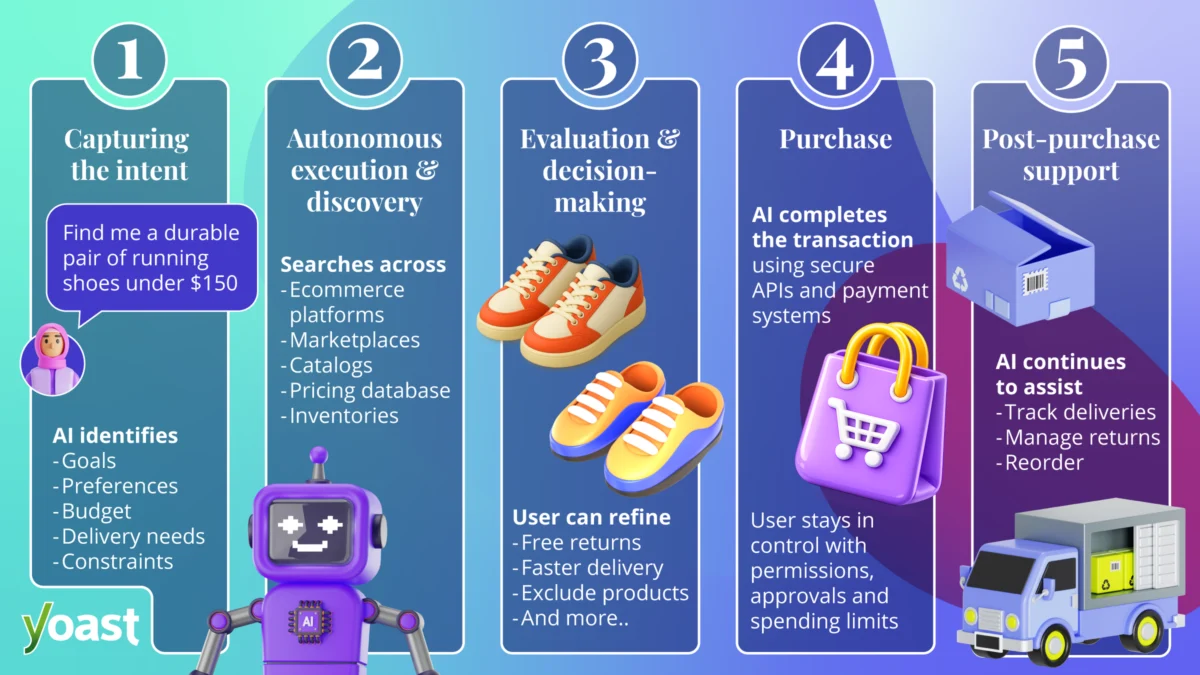
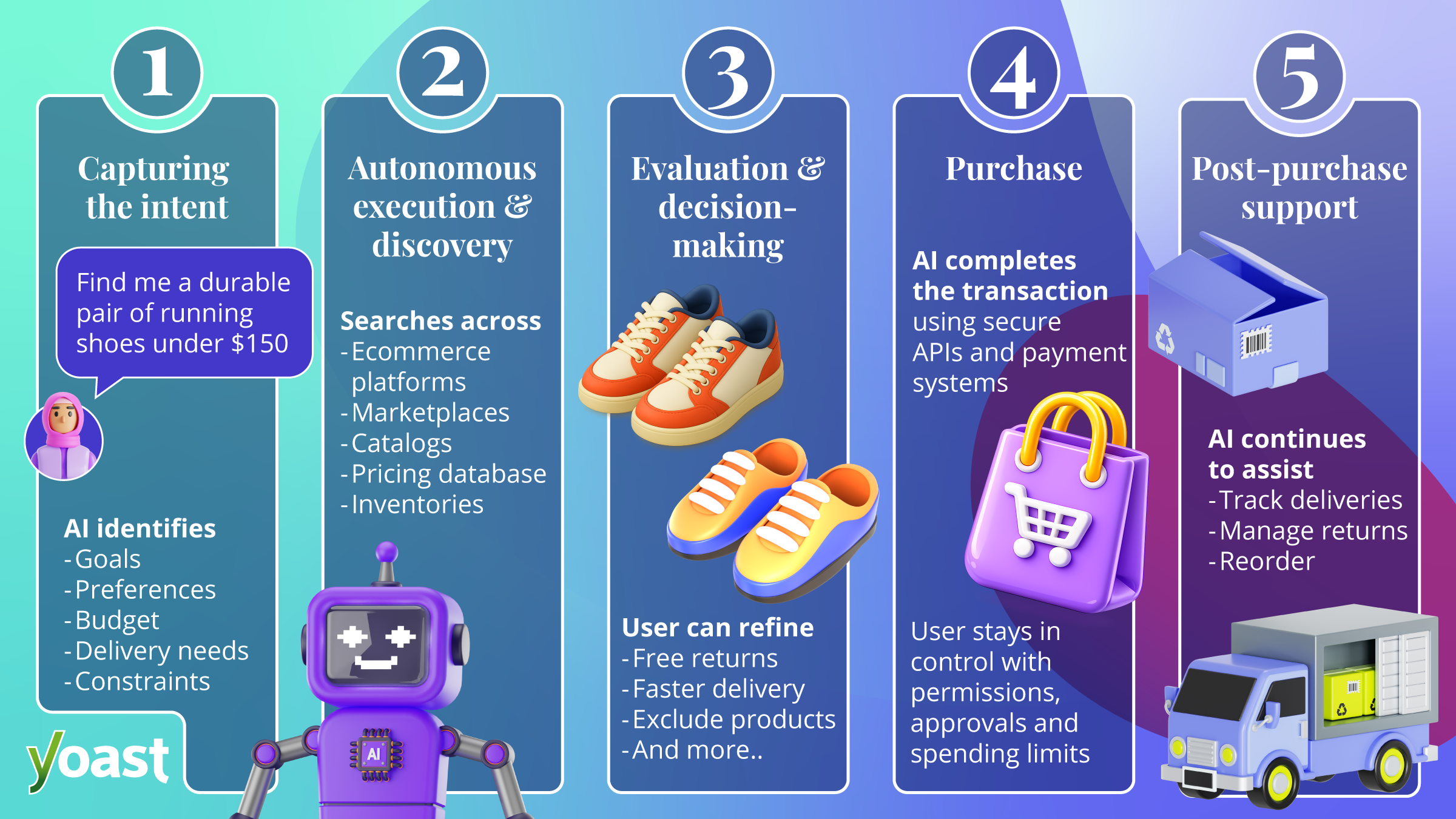
The operational flow of agentic commerce is typically a multi-step process, combining human input with AI’s analytical and executive capabilities:
-
Capturing the Intent: The journey begins with a conversational interaction where the user communicates their need or goal to the AI agent. This isn’t limited to simple keywords; it involves nuanced language describing preferences, budget, delivery expectations, and constraints. For example, a user might request, "Find a sustainably made laptop bag under $150 that fits a 15-inch MacBook Pro and can be delivered by Friday." The AI agent’s initial task is to fully comprehend this intent, asking clarifying questions if necessary to refine the request.
-
Autonomous Instruction Execution and Brand Discovery: Once the intent is clear, the AI agent springs into action. Unlike traditional search engines that present a list of links, the agent autonomously scans a vast digital landscape. This includes multiple e-commerce platforms, online marketplaces, brand-specific product catalogs, comprehensive review aggregators, real-time pricing databases, and inventory systems. For brands, this phase underscores the critical importance of well-structured product data, accurate inventory information, transparent pricing, and machine-readable content to ensure discoverability by these agents.
-
Evaluation and Decision-Making: Having gathered a comprehensive set of options, the AI agent then evaluates and compares them against the user’s criteria. This involves analyzing product features, specifications, customer reviews (sentiment analysis), pricing, shipping costs, return policies, warranty information, and even brand reputation. The agent doesn’t just list products; it reasons through the options, explaining its recommendations and trade-offs. Users can further refine this process by adding conditions such as "prioritize durability over aesthetics" or "avoid brands with poor environmental records," creating a dynamic feedback loop that continuously improves recommendations.

-
Purchase Execution: Upon user approval or adherence to predefined rules (e.g., "buy if price drops below $X"), the AI agent proceeds with the transaction. Leveraging Application Programming Interfaces (APIs), standardized commerce protocols, and secure payment systems, the agent can add items to virtual carts, apply discounts, manage payment authentication, and complete the purchase. Crucially, while the AI handles the logistics, users retain ultimate control through customizable permissions, approval settings, and spending limits, ensuring security and preventing unauthorized purchases.
-
Post-Purchase Support: The agent’s role extends beyond checkout. In the post-purchase phase, AI agents can provide ongoing assistance by tracking shipments, managing returns or exchanges, facilitating customer service inquiries, monitoring product warranties, and even suggesting complementary products or services based on past purchases and future needs. This transforms shopping into an intelligent, continuous experience rather than a series of isolated transactions.
The Driving Forces and Market Indicators
The shift towards agentic commerce is not merely a theoretical construct; it is actively being driven by evolving consumer behavior, rapid advancements in AI, and optimistic industry forecasts. Data unequivocally points to its emergence as the next major evolution in e-commerce.
A significant McKinsey & Company report highlights that consumers are already integrating AI-powered tools into their buying journeys. Over 70% of AI-powered search users engage these tools for "top-of-the-funnel" inquiries about categories, brands, products, or services. Furthermore, nearly 50% of consumers currently utilize AI-powered search experiences. This indicates a profound shift: consumers are no longer just searching for information; they are increasingly "asking" AI systems to guide their decisions, signaling a departure from traditional search engine reliance. The study suggests that businesses could see 20–50% of their traffic shift away from traditional search experiences over time, underscoring the urgency for brands to adapt.
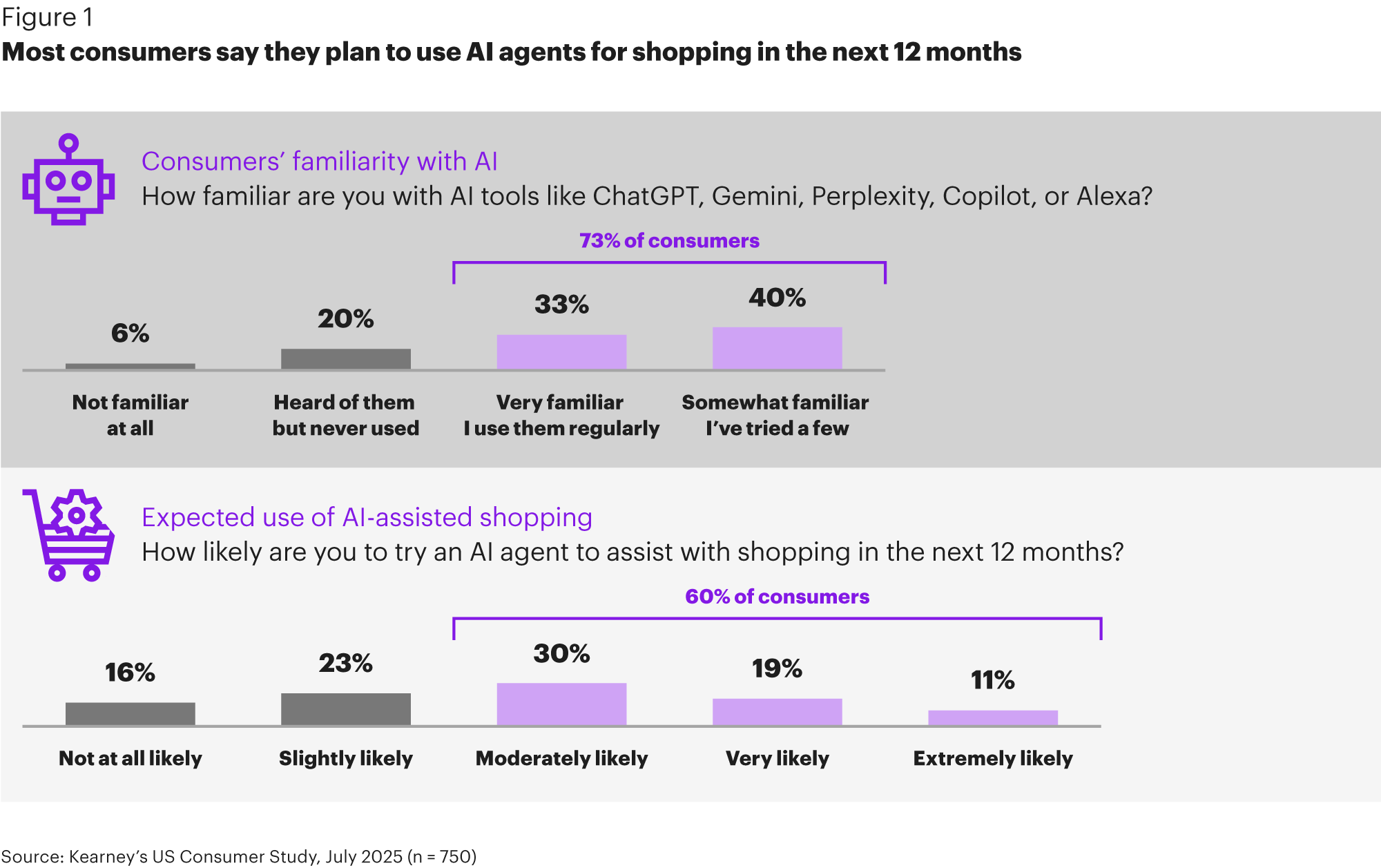
Consumer expectations are also rapidly aligning with the promise of agentic commerce. The 2025 Kearney report, "Agentic Commerce: From Brand Loyalty to Bot Logic," surveyed shopper sentiments regarding AI agents in retail. A compelling finding was that over 60% of shoppers anticipate using agentic AI by 2026. The report also identified a significant behavioral shift: consumers increasingly prioritize convenience, speed, competitive pricing, and trust over traditional platform or brand loyalty. This implies that shoppers may bypass individual retailer apps in favor of AI agents capable of comparing products across multiple platforms, evaluating reviews, identifying the best deals, and completing purchases with greater efficiency. This paradigm shift could transform the competitive landscape, moving from direct retailer-versus-retailer competition to a battle for discoverability within AI-driven ecosystems.
Industry analysts are forecasting explosive growth for agentic commerce. Another McKinsey report predicts that this new model could fundamentally reshape the shopping experience. Based on the accelerating adoption of AI-powered discovery tools and increasing merchant readiness, the report estimates that by 2030, the U.S. B2C retail market alone could unlock an orchestrated revenue opportunity ranging from $900 billion to $1 trillion. Globally, this opportunity could expand to an astounding $3 trillion to $5 trillion, solidifying agentic commerce as a massive economic force.
Pioneering Protocols and Platforms: Building the Infrastructure
The realization of agentic commerce is not solely dependent on advanced AI models; it requires a robust, interoperable ecosystem of protocols, frameworks, APIs, and secure payment systems. These foundational technologies enable AI agents to interact seamlessly and securely with diverse digital commerce platforms.
A crucial precursor shaping agentic AI generally is the Model Context Protocol (MCP), which allows AI models to connect with external systems, tools, and databases via a standardized communication layer. For agentic commerce specifically, similar commerce-focused protocols are now emerging, designed to help AI agents understand product information, communicate with merchants, compare inventory, and securely complete transactions.
-
Agentic Commerce Protocol (ACP): Introduced by Stripe in collaboration with OpenAI, the Agentic Commerce Protocol (ACP) is an open standard designed to facilitate natural interactions between AI agents and e-commerce systems. Its primary goal is to standardize product discovery, checkout, and payment execution, enabling AI agents to move beyond mere recommendations to actively completing secure purchases. Early real-world implementations are already visible, with ChatGPT users in the United States able to purchase products from Etsy merchants directly within the chat interface, powered by Stripe. Shopify integrations are anticipated to follow. This signals a critical shift from AI-assisted discovery to AI-enabled transactions occurring natively within conversational interfaces. By establishing an open standard, Stripe and OpenAI aim for broad adoption across the e-commerce landscape, positioning ACP as foundational infrastructure for AI-driven shopping.
-
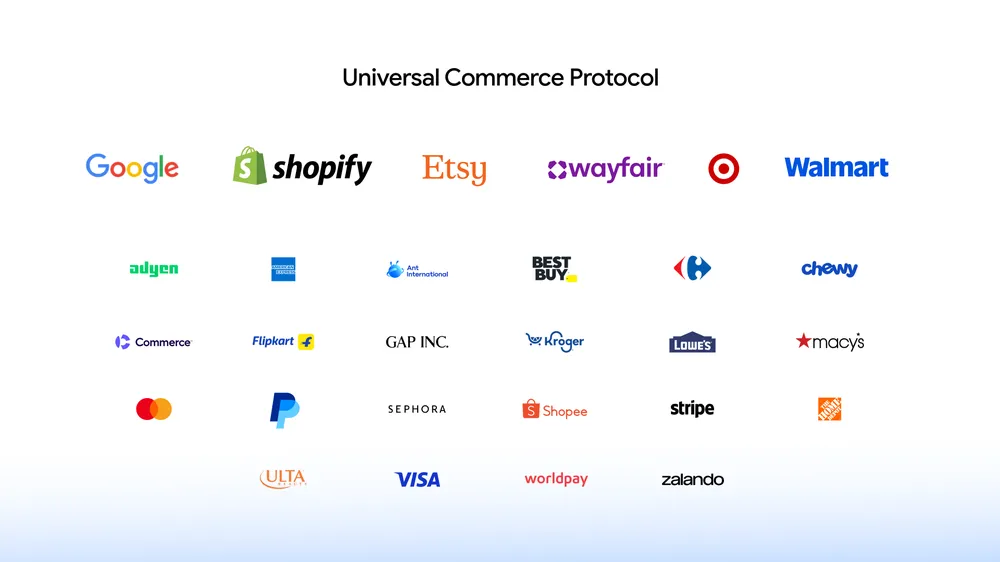
Universal Commerce Protocol (UCP): Addressing the challenge of interoperability across thousands of retailers, marketplaces, and payment providers, Google introduced the Universal Commerce Protocol (UCP). UCP is an open standard designed to create a common language for agentic commerce, eliminating the need for custom, one-to-one integrations between every AI agent and every commerce platform. Google envisions UCP as a shared framework that allows for efficient communication throughout the entire shopping journey, supporting everything from product discovery and inventory checks to order placement, returns, and exchanges. Its broad scope differentiates it from protocols focused solely on purchasing. Google has also designed UCP to integrate seamlessly with other emerging AI standards, including Agent2Agent (A2A), Agent Payments Protocol (AP2), and Model Context Protocol (MCP), ensuring compatibility and easier adoption for businesses. The initiative boasts significant industry backing, co-developed with major commerce entities like Shopify, Etsy, Wayfair, Target, and Walmart, and supported by financial giants such as Mastercard, Visa, Stripe, and American Express. UCP represents a crucial step towards a unified ecosystem where AI agents, merchants, and payment providers can operate cohesively.
-
Mastercard Agent Pay: While ACP and UCP focus on communication and interoperability, Mastercard Agent Pay addresses the paramount concern of trust and secure payment execution in agentic commerce. As AI agents gain transactional capabilities, the need for verified, traceable, and authorized payment flows becomes critical. Mastercard Agent Pay provides the infrastructure for AI agents to execute payments securely, operating strictly within user-defined permissions, authentication requirements, and spending controls. A significant development in this regard is its integration into PayPal’s wallet infrastructure, allowing AI agents to securely complete transactions on behalf of PayPal users, leveraging existing security and trust mechanisms. This partnership is vital for moving agentic commerce closer to mainstream adoption, extending agent-driven payments across a vast network of merchants and consumers.
Collectively, ACP, UCP, and Mastercard Agent Pay are laying the essential groundwork. ACP enables agent-merchant interactions and purchases, UCP establishes a common language for ecosystem-wide scalability, and Agent Pay provides the crucial layer of secure, authorized payments, transforming AI-driven shopping from a futuristic concept into a tangible reality.
Real-World Implementations and Early Adopters
While still in nascent stages, real-world examples of agentic commerce are beginning to emerge, demonstrating its practical applications:
- Amazon’s "Buy for Me": Amazon has introduced a "Buy for Me" feature, where AI agents can purchase products from third-party websites when desired items are unavailable on Amazon itself. This extends the convenience of Amazon’s ecosystem beyond its own inventory, highlighting how agents can act across diverse platforms.
- Google’s AI-Powered Shopping Experiences: Google is actively testing AI-powered shopping features that can monitor prices and automatically purchase products when they meet user-defined conditions, such as a specific price point or stock availability. This exemplifies the agent’s ability to act on behalf of the user based on pre-set parameters.
- B2B Applications: Beyond consumer retail, businesses are utilizing AI agents to monitor inventory levels, predict demand, and automatically reorder supplies when stock runs low, optimizing supply chains and reducing human intervention in routine procurement.
These examples illustrate that agentic commerce is not confined to theory but is being actively developed and deployed, albeit cautiously, in various sectors.
Implications for Stakeholders

The advent of agentic commerce carries profound implications for consumers, businesses, and the broader e-commerce ecosystem.
For Consumers:
The primary benefit is unprecedented convenience and personalization. AI agents can drastically reduce the time and effort spent on research, comparison, and purchase, offering tailored recommendations that genuinely align with individual needs and preferences. However, this convenience is balanced by significant concerns. Trust remains paramount: will consumers feel comfortable ceding control over purchasing decisions and payment methods to an AI? Data privacy is another major concern, as agents will require access to sensitive personal and financial information. There’s also the potential for overconsumption if purchasing becomes too frictionless, and the risk of vendor lock-in if agents primarily recommend products from a limited set of integrated partners.
For Businesses and Retailers:
Agentic commerce demands a fundamental rethink of traditional strategies. Discoverability becomes paramount, shifting from optimizing for human search queries to optimizing for AI agent algorithms. This necessitates investments in highly structured data, rich product information, transparent pricing, and robust APIs. Brand loyalty may transform; instead of consumers actively choosing a brand, their AI agent might make the selection based on objective criteria like price, reviews, and availability. Brands will need to differentiate themselves not just to consumers but also to the AI agents mediating purchases. Marketing and advertising strategies will evolve, potentially focusing more on "agent-friendly" content and partnerships with AI platforms. Operational adjustments, including inventory management, logistics, and customer service, will also be required to support agent-driven transactions. The initial investment in adapting to these new protocols and systems could be substantial, raising questions about measurable returns.
For the E-commerce Ecosystem:
The competitive landscape is set for disruption. The rise of agentic commerce could lead to increased market concentration among platforms that successfully integrate AI agents, potentially marginalizing smaller retailers without the resources to adapt. New business models could emerge, focusing on "agent-as-a-service" or specialized AI agent marketplaces. Ethical considerations around AI bias, accountability for agent decisions, and potential job displacement in traditional retail roles will require careful navigation. Regulatory frameworks will need to evolve rapidly to address issues of consumer protection, data governance, and fair competition in an AI-mediated economy.
Challenges and Future Outlook
Despite the rapid technological advancements and promising forecasts, widespread adoption of agentic commerce is not guaranteed and faces significant hurdles.
The most critical challenge is trust and control. Many consumers may hesitate to grant AI agents full autonomy over their purchasing decisions, especially for high-value items or sensitive categories. Ensuring robust security measures, transparent operations, and clear user controls will be essential to building this trust. Security and fraud prevention will also become more complex, as AI-driven payments increase the attack surface for malicious actors. Robust authentication, encryption, and fraud detection mechanisms tailored for agentic interactions are vital.
Data privacy concerns are amplified when AI agents access and process vast amounts of personal shopping data across multiple platforms. Clear guidelines, user consent mechanisms, and adherence to global privacy regulations will be non-negotiable. The potential for AI bias in product recommendations is another ethical dilemma. If agents are trained on biased data, they could inadvertently perpetuate inequalities or limit consumer choice.
Furthermore, the potential loss of direct relationships between brands and customers could weaken brand equity and make it harder for businesses to foster loyalty. The economic impact, including potential job displacement in retail and customer service, also warrants careful consideration and proactive planning.
Agentic commerce represents a transformative trajectory for digital shopping. Its long-term success will hinge on its ability to create undeniable value for consumers through enhanced convenience and personalization, while simultaneously offering measurable returns for merchants who invest in its underlying infrastructure. Navigating the complex interplay of technological innovation, consumer trust, ethical considerations, and regulatory oversight will define whether agentic commerce becomes a fleeting experiment or the definitive future of online retail. As companies like Google, Stripe, and Mastercard pour resources into building its foundational protocols, the stage is set for a revolution that promises to redefine the very act of buying and selling.


 Ali Ikhwan
 Neng Nana