Google has commenced the rollout of a “Top Stories” carousel within its experimental AI Overview section of search results, a move that confirms a prior announcement made by the tech giant last month. This integration signifies a crucial step in how Google aims to blend generative AI summaries with timely, authoritative news content, particularly for evolving topics. Early observations indicate that this feature is progressively appearing for a subset of users, reflecting a phased deployment strategy.
Understanding Google’s AI Overviews and Search Generative Experience (SGE)
To fully grasp the significance of this development, it is essential to contextualize it within Google’s broader strategy for the future of search. In May 2023, Google unveiled its Search Generative Experience (SGE), an experimental initiative powered by generative artificial intelligence, designed to transform how users interact with search. Initially rolled out to a limited number of users via Search Labs, SGE introduced “AI Overviews” – concise, AI-generated summaries displayed at the top of search results pages, intended to provide direct answers to complex queries without requiring users to navigate multiple websites.
The primary objective of AI Overviews is to synthesize information from various web sources, presenting it in an easily digestible format. This capability aims to streamline the research process, allowing users to quickly grasp key information, compare different viewpoints, and explore topics more deeply through follow-up questions. Google envisions SGE as a conversational search experience, moving beyond keyword-based queries to more natural language interactions. While the initial focus was on summarizing factual information and facilitating research, the integration of real-time news has always been a critical, albeit complex, aspect of its evolution. The challenge for Google has been to integrate dynamic, time-sensitive content like news into a generative AI model that traditionally excels at synthesizing static, established information, all while ensuring accuracy, attribution, and freshness.
The Genesis of News Integration in AI Overviews
The decision to incorporate Top Stories directly into AI Overviews stems from a recognition of user behavior and the inherent limitations of static summaries for certain types of queries. For “developing topics”—events that are unfolding rapidly, such as breaking news, natural disasters, or major political developments—a static AI summary quickly becomes outdated. Users seeking information on such topics require the latest updates, diverse perspectives, and direct access to primary news sources.
Historically, Google has emphasized the importance of timely and authoritative news. Its traditional search results have long featured a “Top Stories” carousel, often prominently displayed, directing users to recent articles from reputable news organizations. This mechanism has been crucial for disseminating critical information and driving traffic to publishers. However, with the advent of AI Overviews, concerns arose within the publishing industry and the SEO community regarding potential traffic diversion. If AI Overviews provided comprehensive answers, would users still click through to original sources? This tension between providing direct answers and supporting the content ecosystem has been a central theme in the evolution of SGE.
Google’s pre-announcement in May 2024 addressed these concerns directly, signaling an intent to bridge the gap between generative AI summaries and the need for up-to-the-minute news. The company stated that for “some searches when you have a question about a developing topic, you’ll start seeing a prominent carousel, which will also highlight your Preferred Sources. This will help make timely articles more visible on a wider range of queries.” This commitment highlighted Google’s strategy to not only integrate news but also potentially personalize it, offering a more tailored experience while ensuring visibility for critical updates. The inclusion of “Preferred Sources” further suggests an effort to empower users with more control over the types of news they consume, aligning with broader trends in personalized information delivery.
Chronology of Development and Rollout
The journey towards integrating timely news into AI Overviews has been incremental, reflecting Google’s cautious approach to evolving its core search product.
- May 2023: Google officially introduces the Search Generative Experience (SGE) in Search Labs, initially as an opt-in experimental feature in the United States, later expanding to other regions and languages. The early iterations of AI Overviews focused on factual summaries and creative brainstorming, with less emphasis on real-time news.
- Late 2023 – Early 2024: Throughout its experimental phase, Google gathers user feedback and iteratively refines SGE. Discussions within the SEO and publishing communities intensify regarding the impact of AI Overviews on website traffic and the need for better integration of current events.
- May 2024: Google makes a formal announcement regarding upcoming enhancements to AI Overviews. A key part of this announcement included the forthcoming integration of a prominent “Top Stories” carousel for developing topics, explicitly mentioning the potential to highlight “Preferred Sources” chosen by the user. This announcement served as a clear signal of Google’s intention to address the need for real-time information within its AI-powered search experience.
- Late May / Early June 2024: The current rollout begins. Digital marketing expert Lily Ray was among the first to publicly observe this new feature, posting about it on X (formerly Twitter). Following her observation, Barry Schwartz of SERoundtable independently replicated the feature in one of his browser sessions, confirming its active deployment to a segment of users. The fact that it appeared in “some” sessions but “not all” underscores Google’s typical phased rollout strategy, often involving A/B testing to monitor performance, user engagement, and potential impact before a wider release.
Observations from the Field: The Top Stories Carousel in Action
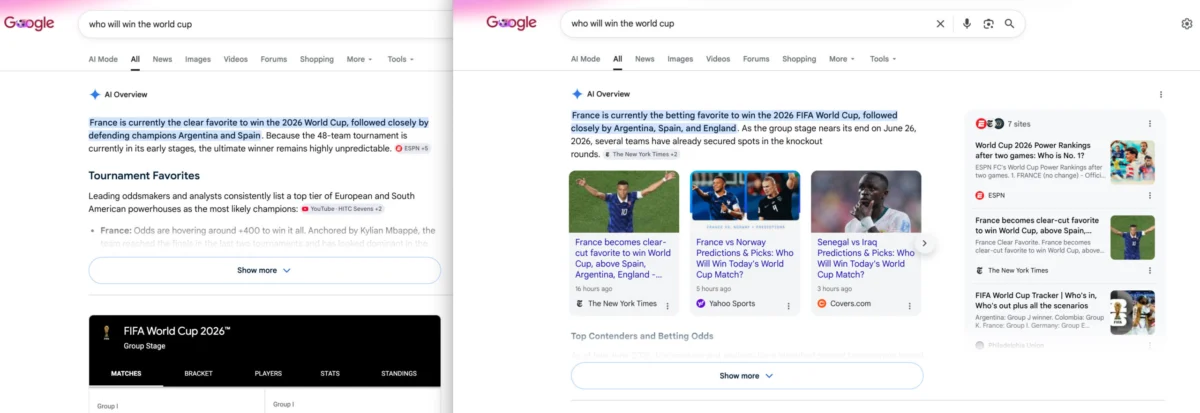
The initial sightings of the Top Stories carousel within AI Overviews provide concrete insights into its implementation. The screenshot shared by Barry Schwartz vividly illustrates the feature: positioned prominently within the AI Overview, a horizontal carousel displays multiple news articles. In the observed instance, sources like The New York Times and Yahoo were featured, indicating that Google is drawing from established news publishers.
Crucially, the observations confirmed that the carousel appears as a distinct, clickable element, offering direct links to the original articles. This design choice is vital for publishers, as it provides a clear pathway for users to navigate to their content, potentially mitigating concerns about AI Overviews entirely circumventing source attribution and traffic generation. The carousel’s appearance suggests that Google’s algorithms are identifying queries related to “developing topics” and dynamically populating the AI Overview with relevant, recent news.
The mention of “Preferred Sources” in Google’s pre-announcement adds another layer of potential personalization. While the initial observed instances did not explicitly show customized “Preferred Sources,” the capability suggests that users might eventually be able to configure their news preferences, leading to a more tailored news experience within the AI Overview. This could empower users to prioritize news from specific outlets they trust, aligning with broader trends in content consumption where individuals seek information from sources that resonate with their values or editorial leanings. The underlying mechanism for determining “preferred” sources, whether through explicit user settings or implicit signals, will be a key area to monitor as the feature matures.
Google’s Stated Intent and Strategic Vision
Google’s stated intent behind this integration is multi-faceted, reflecting a delicate balance between enhancing user experience through AI and sustaining the web’s content ecosystem. The company’s May statement explicitly outlined the goal: “to help make timely articles more visible on a wider range of queries.” This objective directly addresses the challenge of keeping AI-generated summaries current and relevant for rapidly evolving situations. By incorporating a Top Stories carousel, Google acknowledges that for certain types of information, particularly news, direct access to the latest reports from reputable publishers is paramount.
Strategically, this move demonstrates Google’s commitment to maintaining its role as the primary gateway to information, even as the search landscape shifts towards generative AI. Rather than allowing AI Overviews to become a dead-end, the integration of direct links to news articles ensures that Google continues to serve as a vital conduit for traffic to news publishers. It also reinforces Google’s long-standing emphasis on quality and authority. By featuring established news organizations in the carousel, Google implicitly endorses their credibility, which is critical in an era rife with misinformation.
Furthermore, this feature can be seen as an effort to strike a balance between providing immediate answers and promoting deeper engagement. While an AI Overview might offer a quick summary, the Top Stories carousel invites users to explore the nuances, different angles, and ongoing developments of a story by clicking through to original articles. This hybrid approach aims to offer the best of both worlds: the efficiency of AI summarization combined with the depth and timeliness of traditional journalism. It’s a pragmatic response to feedback, both internal and external, about how to evolve search responsibly.
Implications for Users
For the average user, the integration of Top Stories into AI Overviews offers several immediate benefits. Firstly, it streamlines access to breaking news and unfolding events. Instead of sifting through multiple search results or navigating to a separate news tab, users will find the latest headlines directly within the AI-generated summary, saving time and effort. This is particularly valuable for urgent queries where speed of information retrieval is crucial.
Secondly, it enhances the comprehensiveness of the AI Overview itself. For dynamic topics, the AI summary might provide a foundational understanding, while the accompanying carousel ensures that users are also presented with the most current developments. This combination provides a richer, more contextually relevant answer. Thirdly, the potential for “Preferred Sources” offers a degree of personalization, allowing users to prioritize news from outlets they trust or prefer, potentially leading to a more satisfying and less overwhelming news consumption experience. However, users will also need to be aware of the ongoing experimental nature of SGE and understand that not all queries will yield the same results or features, as the rollout is still phased and evolving.
Implications for News Publishers and the Media Landscape
The rollout of Top Stories in AI Overviews carries significant implications for news publishers, representing both opportunities and challenges within a rapidly changing digital ecosystem.
- Enhanced Visibility: The most immediate benefit for publishers is the potential for increased visibility. Being featured prominently within an AI Overview, especially for trending or “developing topics,” places news content in a highly coveted position on the search results page. This could lead to greater brand exposure and recognition for news organizations deemed authoritative by Google’s algorithms.
- Traffic Generation: By providing direct, clickable links to articles, Google is attempting to mitigate concerns about AI Overviews cannibalizing traffic. If users engage with the carousel, it could drive valuable click-throughs to publishers’ websites, potentially compensating for some of the traffic that might otherwise be lost to AI summaries. The success of this will depend heavily on user behavior and how compelling the carousel links are compared to the summary itself.
- Reinforcement of Authority and Credibility: Inclusion in the Top Stories carousel within AI Overviews implicitly validates the authority and trustworthiness of the featured news sources. Google’s algorithms are designed to prioritize high-quality, reputable content, suggesting that publishers consistently producing original, well-researched journalism will be more likely to appear in these prominent positions. This reinforces the importance of journalistic integrity and adherence to E-E-A-T (Experience, Expertise, Authoritativeness, Trustworthiness) principles.
- Monetization Challenges: While visibility and traffic are positive, the impact on advertising revenue remains a complex issue. Even with clicks, if users are spending less time on publisher sites due to quick AI summaries for other queries, overall engagement and ad impressions might still be affected. Publishers will need to continue diversifying their revenue streams and adapting their content strategies to thrive in an AI-driven search environment.
- Algorithmic Reliance: Publishers will become even more reliant on Google’s algorithms to identify “developing topics” and determine which sources are deemed most relevant and authoritative. This necessitates a deep understanding of SEO best practices for news, including rapid indexing, structured data, and strong journalistic signals.
- Competition and Differentiation: The feature could intensify competition among news outlets to be featured. Publishers will need to differentiate their reporting, focus on unique angles, and ensure their content is optimized for discoverability in an AI-driven search.
Implications for SEO and Digital Marketing Professionals
For SEOs and digital marketers, this development introduces new layers of complexity and opportunity. The optimization strategies for news content will need to evolve.
- News SEO Priority: News SEO, already a specialized field, becomes even more critical. Agencies and in-house teams must focus on rapid content publication, technical SEO for swift indexing, and clear semantic markup to help Google understand the timeliness and relevance of articles.
- E-E-A-T for News: The emphasis on authoritative sources means that building and demonstrating E-E-A-T signals for news publishers is paramount. This includes author bios, editorial guidelines, fact-checking processes, and overall site reputation.
- Monitoring and Analysis: SEO professionals will need to closely monitor how traffic from AI Overviews and the Top Stories carousel impacts their clients’ analytics. Understanding click-through rates, user behavior, and the types of queries that trigger this feature will be crucial for refining strategies.
- Content Strategy Adaptation: Content teams will need to align their strategies with Google’s definition of “developing topics.” This might involve a greater focus on breaking news, investigative journalism, and providing unique perspectives on unfolding events.
- Potential for Preferred Sources Optimization: If the “Preferred Sources” feature becomes widely available and configurable by users, it could open new avenues for publishers to encourage users to select them, potentially through in-app prompts or marketing campaigns.
The Broader Future of Search
The integration of Top Stories into AI Overviews is more than just a new feature; it is a significant indicator of the broader trajectory of search. It underscores Google’s commitment to blending the power of generative AI with the foundational principles of traditional search—namely, providing access to diverse, authoritative web content. This hybrid model represents a pragmatic evolution, acknowledging that while AI can summarize, it cannot fully replace the depth, nuance, and real-time reporting of human journalism.
This move also highlights the ongoing tension and collaboration between AI and human-generated content. Google is actively experimenting with how to leverage AI to enhance discovery without undermining the content creators who fuel the web. As SGE continues to evolve, similar integrations for other types of dynamic content, such as live sports scores, stock market updates, or event listings, could follow. The ultimate goal appears to be a search experience that is both intelligently summarized and deeply connected to the live pulse of the internet. The success of this ongoing experiment will shape not only Google’s future but also the future of information discovery for billions worldwide.
In conclusion, Google’s rollout of the Top Stories carousel within AI Overviews marks a pivotal moment in the evolution of search. It represents a strategic effort to address the critical need for timely information within an AI-powered environment, signaling a thoughtful approach to balancing generative summaries with direct access to authoritative news sources. While the full impact on users, publishers, and the digital ecosystem will unfold over time, this development unequivocally demonstrates Google’s ongoing commitment to innovation at the intersection of artificial intelligence and information retrieval.