The digital commerce landscape has shifted from a primary focus on customer acquisition to a sophisticated emphasis on maximizing the value of existing traffic, a discipline known as Conversion Rate Optimization (CRO). As customer acquisition costs (CAC) continue to climb across platforms like Google Ads and Meta, enterprises are increasingly scrutinizing whether the investment in CRO yields a justifiable return on investment (ROI). Data from over 900 companies and an analysis of 52,000 A/B tests suggest that the value of CRO is not a fixed variable but is instead dependent on a complex interplay of existing revenue, traffic volume, and organizational agility.
The Economic Foundation of Conversion Optimization
For many organizations, the initial inquiry into CRO begins with a focus on the potential percentage increase in conversion rates. However, industry analysts argue that this is a flawed starting point. The true economic value of CRO is dictated by the volume of revenue already flowing through a digital ecosystem. A 5% improvement in conversion for a company generating $1 million in annual online sales results in a $50,000 revenue lift. Conversely, for an enterprise generating $30 million, that same 5% improvement translates to $1.5 million.
This disparity highlights why current conversion rates, in isolation, are poor indicators of CRO potential. Strategic decision-makers are now being advised to calculate the "upside" based on net revenue. This involves analyzing the amount of revenue generated by specific segments of the customer journey, multiplied by a realistic improvement factor, and adjusted for the "keep" rate—the actual profit retained after accounting for product costs, shipping, discounts, and direct operational expenses.
In the SaaS and lead-generation sectors, the calculation shifts further down the funnel. The value is determined by the number of additional qualified leads CRO can generate, the conversion rate of those leads into paying customers, and the lifetime value (LTV) of those customers. This shift from surface-level metrics to bottom-line impact is defining the modern approach to digital experimentation.
Statistical Significance and the Traffic Threshold
One of the most significant barriers to effective CRO is the requirement for statistical significance. Traditional A/B testing relies on a sufficient volume of visitors and conversions to ensure that observed differences between variations are not the result of random chance.
According to data provided by experimentation platforms like Optimizely, an experiment with a 15% baseline conversion rate aiming to detect a 10% relative lift at a 95% significance level requires approximately 8,000 visitors per variation. If the baseline conversion rate is lower or the target lift is smaller, the required sample size grows exponentially.
Market experts at Invesp suggest a practical threshold of approximately 500 conversions per month before a company should commit to a heavy A/B testing program. For organizations falling below this threshold, the time required to reach a statistically valid conclusion can span several months, rendering the experiment commercially irrelevant in fast-moving markets.
However, low traffic does not preclude optimization; it merely changes the methodology. In these instances, companies are shifting toward qualitative research, including:
- User Interviews: Direct feedback to identify cognitive friction.
- Usability Studies: Observing real users navigate the site to find functional barriers.
- Session Recordings: Analyzing individual user journeys to spot drop-off points.
- Expert Reviews: Leveraging industry heuristics to fix "low-hanging fruit" without the need for extensive testing.
Identifying the Operational Bottleneck
A critical step in evaluating CRO viability is determining whether the website is the actual bottleneck in the growth engine. Optimization can improve the efficiency of the journey for a visitor who has already arrived, but it cannot manufacture demand for a product that lacks market fit or fix issues stemming from poorly targeted acquisition campaigns.
For e-commerce entities, the focus remains on the "leakage" points in the funnel: the transition from the product page to the cart, and from the cart to the final checkout. The Baymard Institute’s 2024 dataset, which synthesized 50 different studies, found that the average documented e-commerce cart abandonment rate stands at 70.22%. While not all of these carts are recoverable—as many users utilize the cart for price comparison or as a wishlist—usability research suggests that large-scale sites can achieve substantial gains by addressing specific checkout frictions, such as forced account creation or hidden shipping costs.
In the SaaS sector, the bottleneck often exists between the landing page and the demo request or between the initial signup and user activation. Identifying where the "money is leaking" allows organizations to prioritize CRO resources where they will have the most immediate financial impact.
The Shift from Intuition to Evidence-Based Prioritization
A recent analysis of sales conversations within the CRO industry revealed that while 27% of companies seek more revenue, a significant portion faces deeper structural issues. Approximately 23% of organizations struggle with tracking and measurement, finding it difficult to understand the customer journey accurately. Another 18% report difficulty in prioritizing which site changes to implement, and 17% face challenges related to messaging and trust.
The value of a structured CRO program often lies in its ability to replace internal opinions with empirical evidence. In many corporate environments, the "Highest Paid Person’s Opinion" (HiPPO) often dictates design and functional changes. CRO provides a framework where data dictates the roadmap. If a team has dozens of ideas for website improvements but lacks the resources to develop them all, the economic value of CRO is found in its ability to identify the 20% of changes that will drive 80% of the results.
Implementation Capacity and Organizational Readiness
Even the most robust research and successful A/B tests are worthless if the organization lacks the capacity to implement the findings. A common pitfall in the CRO industry is the "implementation gap," where winning variations are identified but never rolled out due to technical debt, legal hurdles, or brand-review delays.
Before investing in a CRO program, analysts suggest evaluating:
- Development Agility: Can the technical team deploy changes within a reasonable timeframe?
- Stakeholder Buy-in: Are executives willing to accept results that contradict their personal preferences?
- Legal and Brand Flexibility: Is there a process for rapid approval of experimental copy and design?
Documented cases in the industry have shown instances where companies rejected statistically significant winning variations because the results did not align with internal design sensibilities. In such environments, the return on CRO investment is effectively neutralized by organizational inertia.
The "Insurance" Value of Negative Results
A common misconception is that a CRO program is only successful if every test results in a "win" or a conversion lift. However, seasoned practitioners argue that negative or inconclusive results provide significant economic value by preventing the rollout of features that would have harmed revenue.
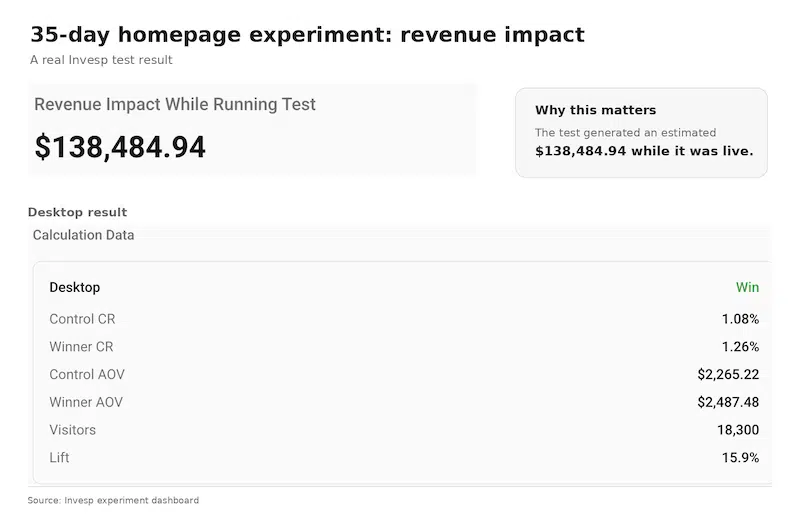
For example, a recent case study involving the implementation of a "wishlist" feature for a retailer showed that while the feature seemed logically sound, the A/B test resulted in a decline in checkout page views and an estimated revenue loss of $83,000 during the testing period. Had the company rolled out the feature without testing, the long-term financial damage could have been catastrophic. In this context, CRO acts as an insurance policy, protecting the existing revenue stream from well-intentioned but misguided "improvements."
Strategic Implications and Future Outlook
As the digital economy matures, the transition from "gut-feeling" marketing to a rigorous, experimental approach appears inevitable for enterprise-level players. The decision to invest in a full-scale CRO program should be treated as a capital allocation exercise.
A strong signal for investment exists when a company has meaningful revenue, sufficient traffic for statistical validity, and clear evidence of funnel drop-offs. Conversely, for startups or companies with unreliable tracking, the immediate focus should be on fixing data measurement and increasing acquisition before attempting to optimize the conversion path.
The ultimate conclusion for many business leaders is that while almost every website can be improved, the fundamental question is whether the specific improvement available on their website is valuable enough to justify the cost of discovery and implementation. As the cost of digital space increases, the ability to convert a higher percentage of visitors into customers remains one of the few sustainable competitive advantages in the modern marketplace.