
 rifanmuazin
If you’re looking for a natural digital marketing companion to your social media, email, and display ads, OTT advertising may be the perfect option. OTT ads, or over-the-top ads, appear when individuals engage with their preferred content on streaming applications, YouTube, and other digital platforms. Beyond reaching a vast viewership, OTT advertising offers sophisticated features, including interactive experiences, designed to capture leads, collect valuable data, and effectively convert viewers into paying customers. This comprehensive guide will explore five compelling OTT advertising examples that skillfully blend traditional marketing principles with the advanced capabilities of modern ad platforms. Following this, we will delve into the intricacies of OTT as an advertising medium, empowering you to launch your own high-impact campaigns.
The Evolving Landscape of Advertising: Embracing OTT
The digital marketing realm is in a constant state of evolution, driven by shifts in consumer behavior and technological advancements. As audiences increasingly migrate from traditional linear television to on-demand streaming services, marketers are presented with a compelling opportunity to meet them where they are. Over-the-Top (OTT) advertising has emerged as a pivotal channel, offering a dynamic and highly targeted approach to reaching consumers. Unlike the broad-stroke approach of traditional television advertising, OTT platforms provide granular control and interactive capabilities, transforming passive viewing into active engagement. This shift is not merely a trend but a fundamental reshaping of the advertising ecosystem, with significant implications for businesses of all sizes.
Five Outstanding OTT Advertising Examples
OTT advertising presents a unique advantage over traditional television advertisements by offering multiple avenues for viewer engagement and conversion. The following examples showcase how businesses are leveraging these powerful features. Crucially, these strategies are accessible to businesses of any scale, enabling local enterprises, such as dentists or car dealerships, to adopt the successful tactics employed by major brands.
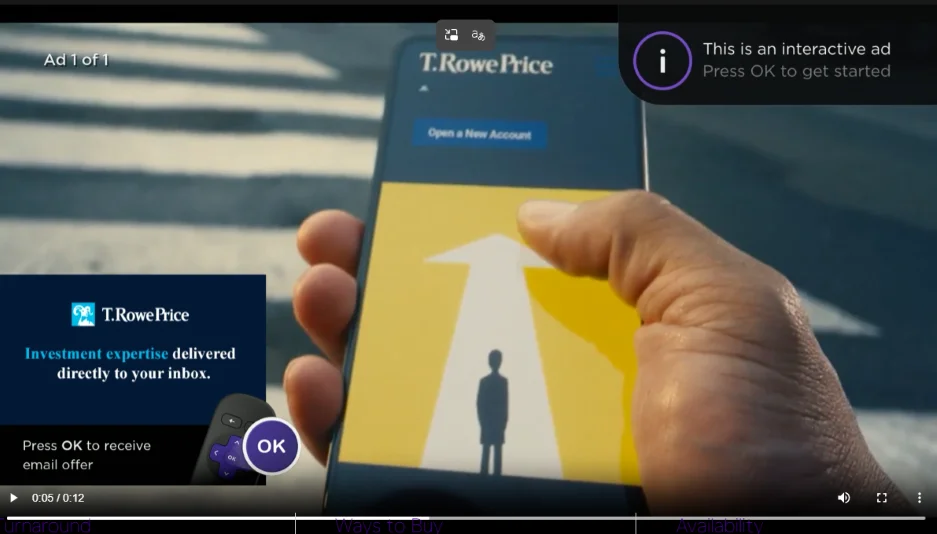
T. Rowe Price: Streamlining Lead Generation with "OK to Email"
Capturing audience attention during their favorite programs has always been a cornerstone of effective advertising. T. Rowe Price, however, has elevated this by utilizing an innovative OTT feature to transform viewers into actionable leads. Through a seamless integration on Roku streaming devices, the brand enabled viewers to receive more information directly to their email inbox by simply pressing the "OK" button on their remote.
Why this OTT advertising example works:
This campaign masterfully reduced friction for the viewer. By eliminating the need to switch devices or interrupt their viewing experience, the ad facilitated an immediate next step in the customer journey. This reduction in barriers is a proven method for enhancing lead generation and improving conversion rates, demonstrating a sophisticated understanding of user experience in the advertising context.
Ring Camera: Driving Conversions with "Add to Cart" Functionality
For marketers accustomed to the television era, the capabilities demonstrated by Ring Camera in their OTT advertising would be revolutionary. Ring successfully created a shoppable ad experience, allowing viewers to add an alarm system directly to their Amazon cart from their viewing device. This integration bridged the gap between content consumption and immediate purchase intent.
Why this OTT advertising example works:
The principle of immediate gratification is a potent emotional driver in consumer marketing. This ad provided viewers with the instant satisfaction of placing a desired product into their virtual shopping cart, placing it mere clicks away from delivery. This approach is particularly effective when paired with limited-time sales promotions or campaigns that aim to create a sense of urgency, capitalizing on impulse and convenience.
Volvo: Engaging Audiences with the "Ad Selector" Feature
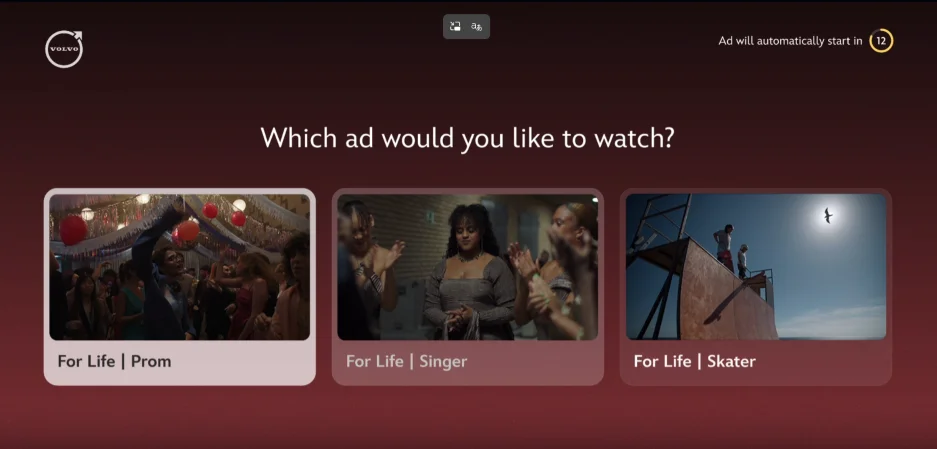
The ability to segment audiences and deliver highly relevant messages to specific demographics is a significant advantage for most businesses. Volvo capitalized on this by developing three distinct video advertisements, each tailored to different market segments. Leveraging the "Ad Selector" feature on the Disney platform, Volvo empowered viewers to choose the advertisement they preferred, thereby increasing relevance and engagement.

Why this OTT advertising example works:
Volvo’s strategy was effective for two primary reasons. Firstly, it significantly enhanced the relevance of the advertising experience for each individual viewer. Secondly, it provided Volvo with a valuable mechanism for gathering first-party data about its audience. For instance, if a substantial portion of viewers selected the "Skater" option, Volvo could then amplify its marketing efforts targeting this specific demographic across social media and display advertising, optimizing resource allocation and message resonance.
Maybelline: Building Brand Awareness with "Binge Ads"
Binge Ads, a specialized type of OTT ad, are offered by various streaming services, enabling brands to sponsor ad-free viewing experiences, typically after a viewer has consumed two or three episodes of a show consecutively. Beauty brand Maybelline strategically employed this format on the Peacock app to promote its Super Stay Coffee Edition lipstick line.
Why this OTT advertising example works:
Building strong brand awareness remains a critical objective for businesses, and offering tangible value to consumers is an effective way to generate positive brand perception. This approach, often the bedrock of successful organic social media and SEO strategies, has now been successfully translated to the OTT advertising space, demonstrating its versatility and impact in building brand recognition and affinity.
NewYork-Presbyterian Hospital: Compelling Storytelling with In-Stream Ads
The art of storytelling is fundamental to impactful advertising, especially in the realm of video content viewed during entertainment or educational programming. The Och Spine Center at NewYork-Presbyterian Hospital effectively utilized a YouTube In-Stream ad to narrate the inspiring recovery journey of a patient who had undergone treatment for a debilitating spinal tumor.
Why this OTT advertising example works:
The ad’s strength lay in its ability to convey a powerful narrative within a concise 30-second timeframe. This brevity was sufficient to capture and hold viewer attention, preventing skips, while still allowing enough space to forge a meaningful connection with the hospital’s target audience. Such customer-centric stories serve as compelling content for in-feed video advertisements, resonating deeply with potential patients.
Understanding the OTT Ecosystem
To effectively harness the power of OTT advertising, a foundational understanding of its components is essential.

What is OTT?
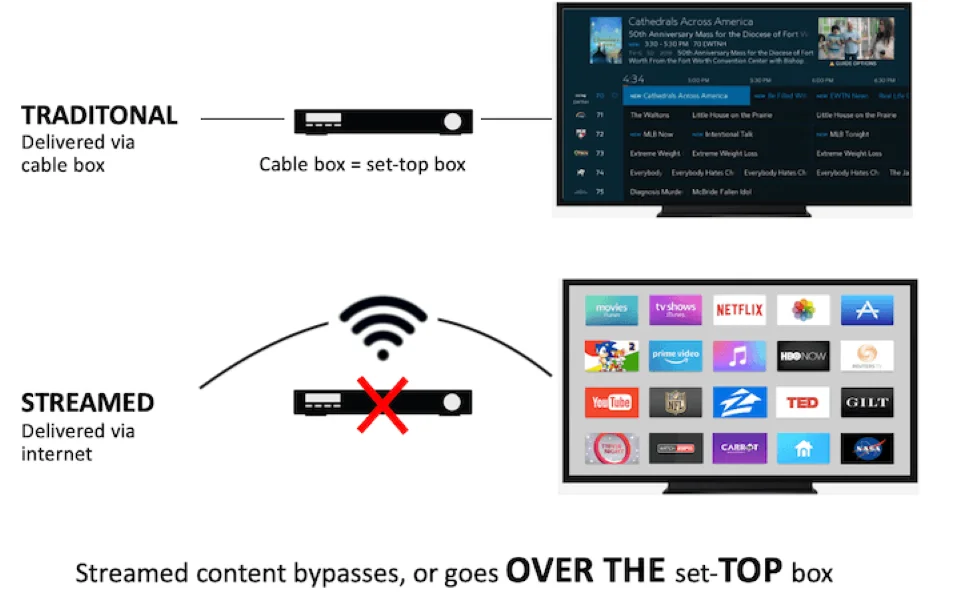
OTT, or "over-the-top," refers to video content delivered directly to viewers via the internet, bypassing traditional cable or satellite infrastructure. The term "over-the-top" originated from the concept of content going "over the top" of the established distribution networks, such as cable set-top boxes. Historically, cable boxes sat atop older, bulky televisions, leading to the term "set-top box." Even as television technology evolved to flat screens and cable boxes were relocated, the term persisted. In contrast, streamed content bypasses these physical boxes entirely, relying solely on an internet connection. This fundamental difference in delivery mechanism is what defines OTT.
What are OTT Devices?
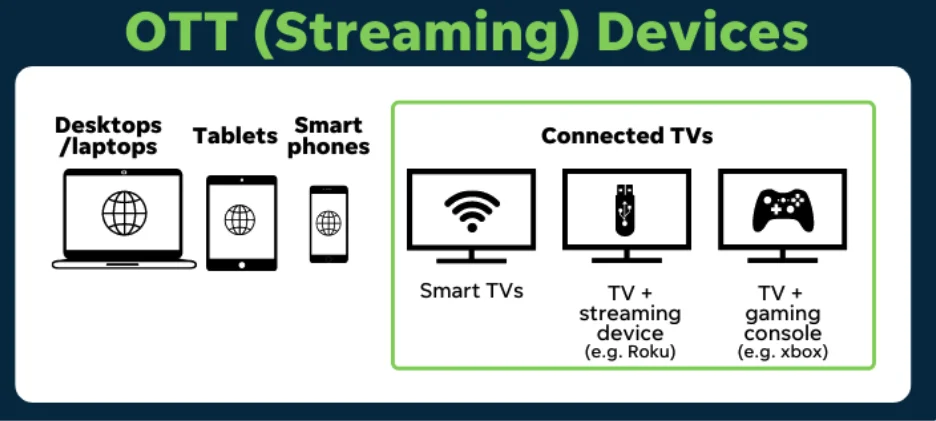
Essentially, any internet-connected device capable of displaying video content can be considered an OTT device. This expansive category includes:
- Smart TVs
- Streaming devices (e.g., Roku, Amazon Fire Stick, Apple TV)
- Gaming consoles (e.g., PlayStation, Xbox)
- Computers (laptops and desktops)
- Tablets
- Smartphones
The proliferation of these devices has significantly contributed to the growth and accessibility of OTT content.

Is OTT the Same as Connected TV (CTV)?
While often used interchangeably, OTT and Connected TV (CTV) are not synonymous. CTV refers specifically to the television set itself that is connected to the internet and capable of streaming content. OTT, on the other hand, encompasses the broader ecosystem of content delivery and the devices through which it is accessed, including but not limited to CTVs. Therefore, a CTV is a device on which OTT content can be viewed.
What are OTT Services?
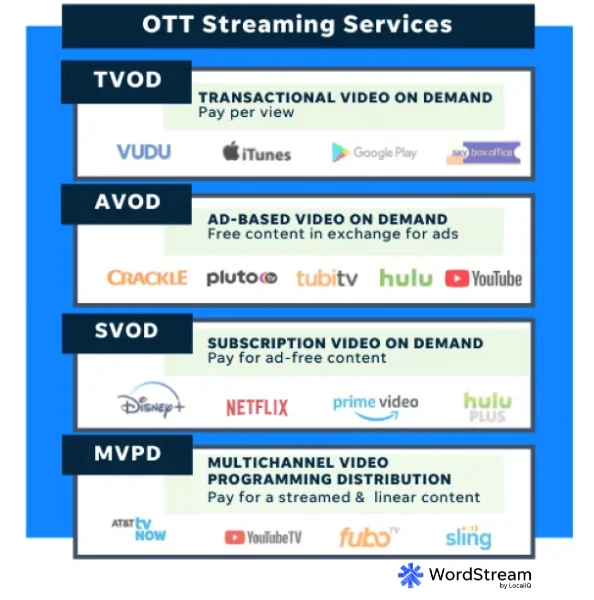
OTT services are the applications and platforms that deliver streamed content over the internet. These services operate under various business models:
- Transactional Video on Demand (TVOD): Users pay to rent or purchase specific content, such as movies or TV show episodes. Examples include Apple TV rentals or Google Play Movies.
- Advertising-Based Video on Demand (AVOD): Content is provided free of charge, with revenue generated through advertisements. YouTube and Pluto TV are prominent examples.
- Subscription Video on Demand (SVOD): Users pay a recurring subscription fee for unlimited access to a library of content. Netflix, Hulu, and Disney+ are leading SVOD services.
- Multichannel Video Programming Distributors (MVPDs): These services offer bundles of live TV channels over the internet, often mimicking traditional cable packages. Examples include YouTube TV and Hulu + Live TV.
In essence, one consumes OTT content (e.g., a popular series) on an OTT device (e.g., a smartphone) through an OTT service (e.g., a streaming app).

The Advantages of OTT Advertising
The appeal of OTT advertising for businesses, particularly local enterprises aiming to boost revenue, is multifaceted.
A Rapidly Growing Audience
The migration from traditional cable to streaming services is undeniable. Cord-cutters now constitute a significant portion of US internet households, with millions more who have never subscribed to cable. This demographic shift is mirrored in the burgeoning OTT streaming market, which is projected for substantial financial growth in the coming years. Advertisers are thus presented with a continually expanding audience pool.
Superior Targeting Capabilities
Traditional cable advertising is largely limited to targeting by Designated Market Area (DMA), a broad geographical classification that often includes areas outside a business’s service region. OTT advertising, conversely, offers granular targeting options:
- Demographics: Targeting based on age, gender, income, education, and other demographic factors.
- Geographics: Precise targeting down to zip codes, allowing local businesses to reach specific neighborhoods or communities.
- Behavioral Data: Targeting based on viewing habits, interests, and online activities, enabling highly relevant ad delivery.
- Household Data: Targeting based on household characteristics and consumption patterns.
This precision ensures that advertising spend is directed towards the most relevant audience segments, maximizing efficiency and impact. Local businesses can specifically target OTT ads to their immediate service areas, mirroring the precision of digital advertising campaigns.
Cookieless Targeting Solutions
In an era where third-party cookies are being phased out, OTT advertising offers a robust alternative for targeting. This is achieved through:
- First-Party Data: Leveraging data collected directly from users through website interactions, app usage, and customer relationships.
- Contextual Targeting: Placing ads within content that aligns with the advertiser’s product or service, ensuring relevance without relying on individual user tracking.
- Platform-Specific Data: Utilizing data provided by streaming platforms and device manufacturers, which often includes aggregated and anonymized user information.
This shift towards privacy-centric targeting methods makes OTT advertising a future-proof solution for marketers.
High Video Ad Completion Rates
A significant advantage of OTT advertising is the inherent inability for viewers to skip ads. Unlike online video platforms where skipping is common, OTT ads are typically unskippable, leading to significantly higher completion rates—often around 95%. This ensures that the intended message is delivered to the viewer. Furthermore, while viewers might physically leave the room, the continuous nature of streaming, especially on mobile devices during commutes or downtime, increases the likelihood of ad exposure.
Pricing Models and Metrics in OTT Advertising
Understanding the financial aspects of OTT advertising is crucial for campaign planning and performance evaluation. Common pricing models and metrics include:
- CPM (Cost Per Mille/Thousand Impressions): The cost an advertiser pays for one thousand views of their advertisement.
- CPCV (Cost Per Completed View): The cost incurred each time an advertisement is watched to completion. This is particularly relevant for OTT due to its unskippable nature.
- CPC (Cost Per Click): The cost an advertiser pays each time a viewer clicks on their ad. This is more common for interactive OTT ads that lead to a website or landing page.
- Viewability: Metrics that measure whether an ad was actually seen by a user, ensuring that impressions are not wasted on non-visible placements.
- Reach and Frequency: Metrics that indicate the number of unique users exposed to an ad (reach) and the average number of times each user saw the ad (frequency).
Best Practices for Effective OTT Video Ads
Drawing insights from successful OTT advertising campaigns reveals several best practices that can enhance the performance of your own initiatives.
Precisely Target Your Personas
A deep understanding of your audience is paramount. When crafting OTT video ad scripts and concepts, consider the language, imagery, and themes that will resonate most effectively with your specific customer personas. This ensures that your message is not only seen but also heard and understood by the intended audience. For instance, if unsure about which audience segment to prioritize, directly soliciting feedback through interactive ad features can provide invaluable direction.
Foster Relatability and Connection
While traditional TV commercials often feel distant and overtly promotional, online video ads, including those on OTT platforms, are expected to be more relatable and personal. Viewers are more receptive to content that feels authentic and speaks directly to their experiences. This human-centric approach fosters a stronger connection between the brand and the consumer.
Harness the Power of Emotion
Emotional marketing is a universally effective strategy, and video is arguably the most potent medium for conveying emotion. Employing evocative imagery, compelling music, and emotionally resonant language can create a memorable and meaningful impact on viewers. Humor, as a powerful emotion, can also be effectively used to make ads more engaging and shareable.
Prioritize Voice-Overs for Message Clarity
Similar to best practices for social media video ads, it’s crucial to ensure that the core message of your OTT ad can be understood even without sound. However, while viewers cannot skip OTT ads, they can disengage or divert their attention. Therefore, a clear and compelling voice-over is essential to convey the advertisement’s message effectively, guaranteeing brand exposure even if the viewer is not actively watching every second.
The Broader Implications of OTT Advertising
The rise of OTT advertising signifies a profound shift in how brands can connect with consumers. It offers the captivating reach of traditional television advertising combined with the precision targeting, detailed analytics, and conversion-driving capabilities of digital marketing. By embracing interactive features, prioritizing compelling storytelling, and deeply understanding their target audiences, businesses can unlock significant ROI from their OTT ad campaigns. As the digital landscape continues to evolve, OTT advertising stands out as a powerful and indispensable tool for modern marketers seeking to engage audiences in an increasingly fragmented media environment. The ability to deliver targeted, engaging, and measurable advertising experiences positions OTT as a cornerstone of future marketing strategies.










