The integration of Artificial Intelligence (AI) into Business-to-Business (B2B) marketing workflows is no longer a speculative future, but a present reality. However, for many organizations, the challenge lies not in identifying potential AI applications, but in strategically evaluating and prioritizing them to ensure maximum impact and return on investment. Tom Swanson, Senior Engagement Manager at Heinz Marketing, proposes a practical 3-part framework designed to bring objectivity to this crucial decision-making process: Leverage, Risk, and Chainability. This framework aims to guide B2B marketing teams in focusing their AI adoption efforts on use cases that offer the greatest potential for efficiency gains and strategic advantage.
Swanson’s approach builds upon previous discussions about identifying AI marketing use cases, emphasizing that once potential applications are identified, a robust evaluation method is paramount. His extensive experience in optimizing marketing orchestration, particularly over the last 18 months focused on AI integration, has led him to develop this structured approach. The core principle is to enable teams to concentrate on a select few AI initiatives and execute them exceptionally well, rather than spreading resources too thinly across numerous, potentially less impactful, projects.
Understanding the Pillars: Leverage, Risk, and Chainability
The framework hinges on a clear, albeit simplified, definition of its three core components:
- Leverage: This metric quantifies how frequently a specific task is repeated within a marketing workflow. Tasks that are highly repetitive and consume significant human resources present a prime opportunity for AI-driven automation, thereby freeing up valuable employee time for more strategic endeavors.
- Risk: This component assesses the potential negative consequences should an AI implementation or its output go awry. The severity of these risks can vary dramatically depending on the task, the industry, and the organization’s specific risk tolerance and strategic objectives.
- Chainability: This refers to the extent to which the output of an AI task can seamlessly serve as the input for another subsequent task within a workflow, ideally without manual intervention. High chainability indicates a potential for creating automated, end-to-end processes that significantly enhance efficiency and reduce bottlenecks.
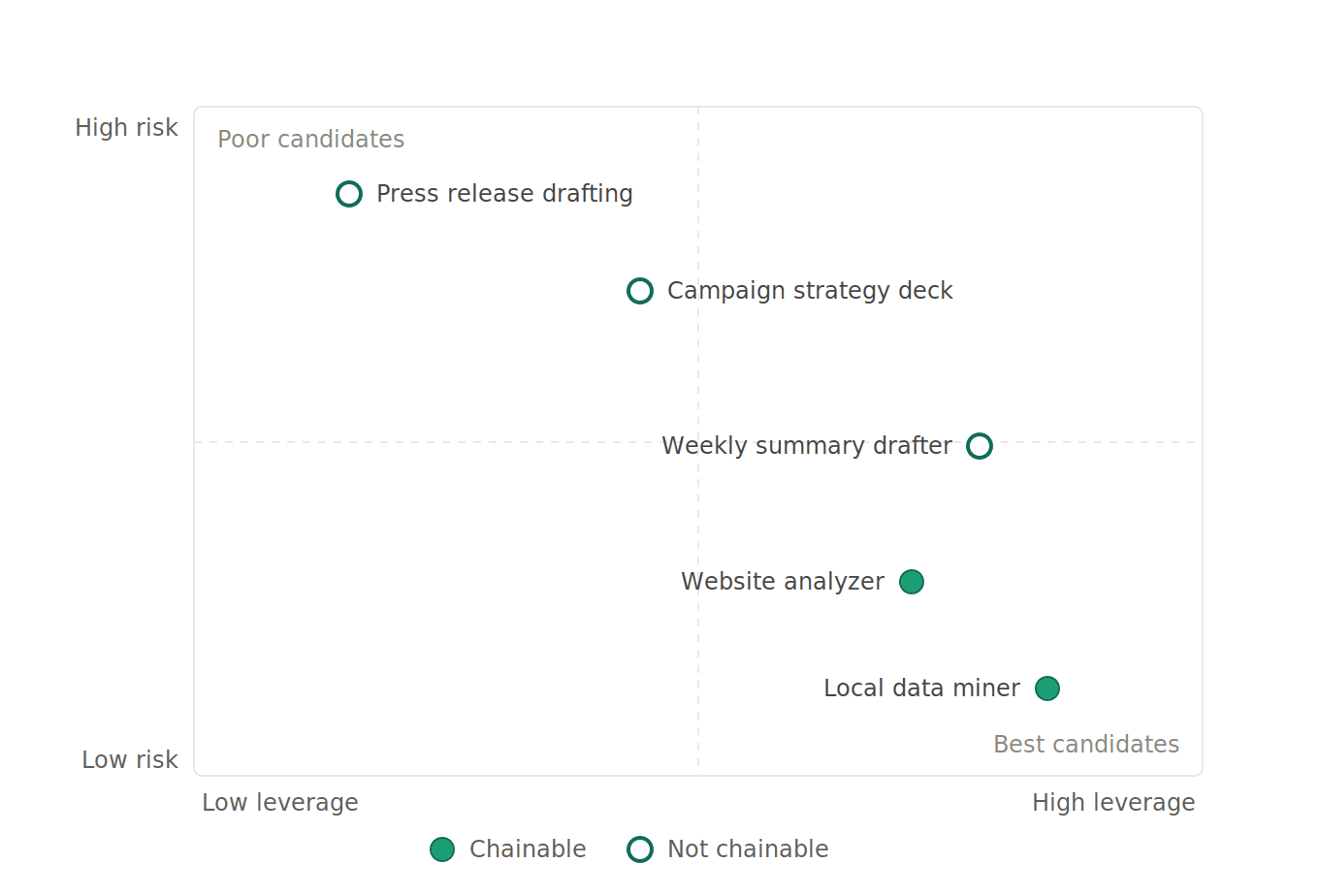
Swanson illustrates the interplay of these factors by suggesting a cartesian plane visualization, where Leverage and Risk can be plotted as axes, with Chainability acting as a critical gating factor or a significant consideration. This visual approach helps in understanding the relative positioning of different AI use cases and identifying those that fall into the most advantageous quadrants.

Deconstructing Leverage: The Power of Repetition
The concept of leverage is fundamental to identifying AI’s most immediate benefits in B2B marketing. Tasks that are performed routinely, often on a daily, weekly, or monthly basis, represent fertile ground for AI automation. Swanson notes that particularly in the early stages of AI adoption, focusing on these rote, repeated tasks is more advisable. This allows teams to gain experience with AI capabilities and understand how machines process information, making it easier to tackle more complex, less frequent tasks later on.
When evaluating leverage, several sub-factors come into play:
- Frequency of Repetition: How often is the task performed?
- Cost of Task Execution: Primarily measured in terms of human time and associated labor costs.
- Workflow Uniformity: Does the process remain largely the same each time the task is executed, or does it vary significantly?
- Output Uniformity: Is the output consistent across different instances of the task, or does it require substantial post-processing or adaptation?
A real-world example provided by Swanson involves a "Local Data Miner" use case for a regional sales team. The situation involved regional representatives needing to identify new local businesses as potential prospects. This task was performed weekly, consuming approximately half a day for each representative. Crucially, the workflow and the expected output structure were uniform each time. This made it an ideal candidate for AI automation because it offered a significant time saving for sales reps, had a regular, predictable trigger, and required minimal ongoing maintenance due to its consistent nature. The risk and chainability factors were also favorable, solidifying its status as a "knockout" AI opportunity.
The economic implications of leverage are substantial. For instance, a recent study by McKinsey Global Institute indicated that organizations can unlock significant productivity gains by automating repetitive tasks, with estimates suggesting that up to 30% of the global workforce’s hours could be automated by 2030. In B2B marketing, where tasks like lead qualification, data entry, and content repurposing are often highly repetitive, the potential for time and cost savings through AI-driven leverage is immense.
Navigating Risk: Mitigating Potential Pitfalls
The assessment of risk is arguably the most nuanced aspect of the framework, as it is highly subjective and context-dependent. What constitutes a high risk for one organization might be a manageable concern for another, influenced by factors such as industry regulations, brand reputation sensitivity, and leadership’s appetite for AI-driven innovation. Swanson categorizes risks into types and then assigns a low, mid, or high rating to define the inherent risk associated with a particular AI task.

Potential risk categories include:
- Financial Risk: The direct monetary cost of an AI error, such as incorrect bidding in advertising campaigns or misallocation of marketing budgets.
- Rework Risk: The time and effort required to correct errors or rectify misinterpretations made by the AI. This is particularly relevant for creative or strategic tasks where "strategic drift" can occur.
- Total Cost of Ownership (TCO) Risk: This encompasses not just the initial implementation costs but also ongoing maintenance, data updates, and potential integration challenges.
- Brand Risk: The potential damage to a company’s reputation resulting from AI-generated content that is inaccurate, insensitive, or off-brand.
- Adoption Risk: The challenge of getting internal teams to trust and effectively utilize AI tools, which may require significant change management and training.
- Accountability Risk: Determining who is responsible when an AI makes a mistake, especially in complex, multi-agent systems.
Swanson provides an example of an "Automated Campaign Strategy with Human Review" use case. While the financial risk was low (primarily token costs), the rework risk was high due to the potential for strategic misdirection. The TCO risk was moderate, necessitating up-to-date documentation. Brand and accountability risks were mitigated by the inclusion of a mandatory human review by leadership, highlighting how organizational structure and oversight can significantly influence risk profiles.
The impact of AI risk in B2B marketing is a growing area of concern. A report by Gartner suggests that by 2025, 70% of organizations will face significant challenges in managing AI ethics and risks, leading to potential reputational damage and regulatory scrutiny. Therefore, a thorough risk assessment is not merely a procedural step but a critical component of responsible AI deployment.
Harnessing Chainability: Building Integrated Workflows
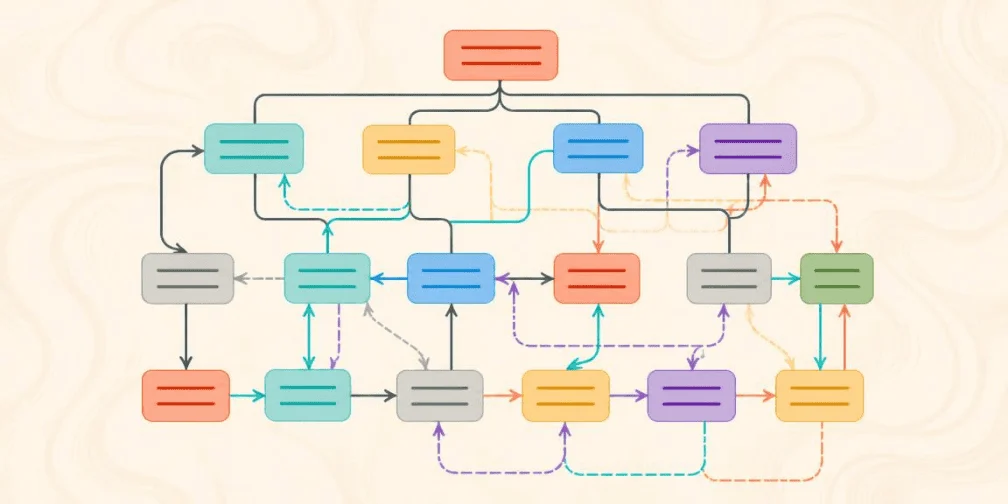
Chainability, for those who appreciate workflow optimization, represents the most exciting dimension of AI integration. It explores how effectively an AI task’s output can flow into the next stage of a process, ideally creating a seamless, automated chain. Swanson emphasizes that this is where the real power of marketing orchestration lies, enabling end-to-end automation that minimizes manual handoffs.
The core question for chainability is: "When do we want human review?" Maximally chained bots operate autonomously, passing data from one to the next. This offers significant advantages:
- Pros of High Chainability:
- Accelerated Time-to-Market: Automated workflows reduce the time from ideation to execution.
- Increased Efficiency: Eliminates manual data transfer and reduces potential for human error in such transfers.
- Scalability: Enables marketing teams to handle a larger volume of tasks and campaigns without a proportional increase in headcount.
- Data Consistency: Ensures that data is processed and passed along in a standardized format.
However, this high degree of automation also comes with inherent challenges:
- Cons of High Chainability:
- Complexity in Error Correction: Identifying the source of an error in a long chain can be difficult and time-consuming.
- Systemic Adjustments: Making broad changes to a deeply integrated workflow can be complex and carry the risk of unintended consequences.
- Reduced Flexibility: Highly automated chains can be less adaptable to unforeseen market shifts or strategic pivots.
- Over-reliance on Automation: May diminish human oversight and critical judgment at crucial decision points.
Swanson shares an example from Heinz Marketing’s internal bot development: a "Website Analyzer Agent." This agent takes a client’s website URL as input, which is often provided by a preceding "Client Info Analyzer" agent. The output of the Website Analyzer—a comprehensive website analysis—is then fed into multiple downstream agents, including a "Content Analyzer," "Messaging Developer," and "Campaign Strategist." While not all agents can trigger immediately (e.g., the Campaign Strategist might require inputs from several other agents), the agent’s ability to produce output that serves as input for multiple subsequent tasks demonstrates strong chainability.
The implications of enhanced chainability in B2B marketing are profound. According to a report by Deloitte, organizations that successfully integrate AI into their core processes can see significant improvements in operational efficiency, with some reporting a 15-20% reduction in process cycle times. For B2B marketing, this translates to faster campaign deployment, more agile responses to market trends, and improved lead nurturing through automated, personalized communication streams.
Strategic Prioritization and the Road Ahead
Ultimately, the prioritization of AI use cases is a strategic decision that rests with each individual organization. Swanson’s framework serves as a guide to introduce objectivity into this process, helping teams identify the most promising areas to begin their AI journey. As organizations become more mature in their AI adoption, the perceived daunting nature of certain risks may diminish with greater understanding and experience. Similarly, the importance of chainability might be tempered by specific organizational structures that inherently require more human intervention at various stages.
The foundational step, as highlighted by Swanson, is a deep understanding of the team’s existing capabilities and workflows. This aligns with the earlier suggestion of conducting a SWOT analysis (Strengths, Weaknesses, Opportunities, Threats) for AI adoption. By starting with this internal assessment, organizations can then develop a clear roadmap for AI implementation.

Marketing, more than many other business functions, possesses a unique opportunity to generate tangible ROI from AI. However, realizing this potential requires a methodical and strategic approach. Swanson concludes with a crucial piece of advice: focus on building one AI initiative or chain at a time. The complexities of AI development, especially when requiring interconnected inputs and outputs, necessitate a phased approach. Building one chain at a time, introducing parallelism modularly, and maintaining a visual representation of workflows are key to successful and sustainable AI integration.
The journey into AI for B2B marketing is not without its complexities, but by applying structured frameworks like the one proposed by Tom Swanson, organizations can navigate this landscape effectively, ensuring that their AI investments translate into meaningful business outcomes and a competitive edge.