


The digital communications landscape, while constantly evolving, reaffirms email’s enduring importance, yet a new comprehensive analysis from Sinch Mailgun highlights a widening chasm between email programs that meticulously invest in measurement, deliverability, and optimization, and those operating on outdated assumptions. Released on April 17, 2026, the Sinch Mailgun 2026 Email Impact Report draws from a robust global survey of over 1,200 email senders and an unprecedented analysis of more than 400 billion real emails transmitted through Sinch Mailgun infrastructure throughout 2025. This landmark report, spanning five critical chapters covering Return on Investment (ROI), industry benchmarks, deliverability, Artificial Intelligence (AI) adoption, and future investment trends, offers a crucial roadmap for email senders navigating the complexities of the latter half of 2026.
The Unmet Potential of Email ROI: A Call for Data-Driven Accountability
Despite the undeniable ubiquity and strategic value of email, a significant disconnect persists in how organizations assess its effectiveness. The report reveals that a staggering 78% of senders categorize email as "very" or "extremely" important to their organization, underscoring its foundational role in marketing and customer engagement strategies. This high level of organizational buy-in, however, stands in stark contrast to the actual practices of performance measurement. Fewer than half of all senders actively measure the ROI of their email programs, with promotional emails at 46% and transactional emails at an even lower 43%. This striking disparity indicates that a substantial majority of teams are operating on conviction and anecdotal evidence rather than robust, quantifiable data.
For those organizations that do prioritize ROI measurement, the financial returns are compelling. Among senders who track promotional email ROI, 60% report a return greater than $10 for every $1 spent, with an impressive 13% achieving returns exceeding $40 for each dollar invested. Similarly, 62% of senders measuring transactional email ROI confirm hitting the $10:1 threshold, and 13% also report returns above $40:1. The report, however, offers a critical nuance: exceptionally high ROI figures, particularly above $40:1, might not always signify peak efficiency. Instead, they could paradoxically signal an underinvestment in the email channel, suggesting that more resources could be deployed to further scale successful programs without diminishing returns.
The primary impediment to increasing email investment, cited by 43% of senders, is budget constraints. Yet, the report posits that this "budget barrier" is often a symptom of a deeper issue: the inability to make a compelling, data-backed case for increased funding. Without concrete ROI data, securing additional resources becomes an uphill battle. To bridge this gap, Sinch Mailgun recommends an actionable intermediate step: beginning with revenue per campaign tracking. While not a perfect attribution model, it provides a tangible starting point for demonstrating value and building a foundation for more sophisticated ROI analysis over time. This strategic approach allows organizations to move beyond qualitative assertions and towards a data-centric narrative that justifies sustained or increased investment in email.
Beyond Surface Metrics: Unpacking Real-World Email Benchmarks
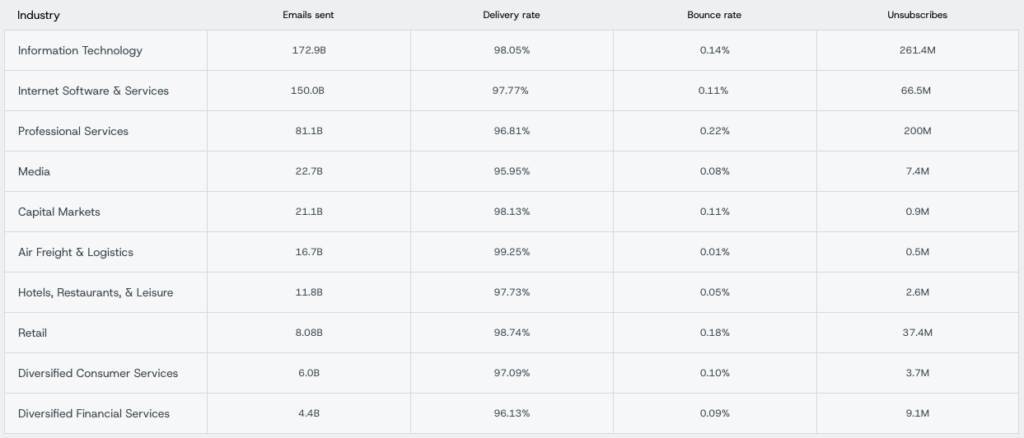
Traditional email benchmark data often relies on self-reported estimates and surveys, which can introduce biases and inaccuracies. Chapter 2 of the Sinch Mailgun report takes a revolutionary approach, leveraging real sending data from its infrastructure across the top 10 industries by volume in 2025 to provide an unprecedented, empirical view of email performance. This analysis of hundreds of billions of emails offers a more authentic perspective on industry standards.

The performance metrics vary significantly across sectors. The Air Freight & Logistics industry leads with an exceptional 99.25% delivery rate and a minimal 0.01% bounce rate. This superior performance is largely attributable to the nature of their email traffic, which consists predominantly of highly anticipated transactional sends like shipping confirmations and tracking updates. Recipients actively expect and desire these messages, contributing to high engagement and low rejection rates. Conversely, the Media industry sits at the lower end of the top 10, with a 95.95% delivery rate. This can be explained by the high volume of promotional content and broader audience targeting inherent in media operations, which naturally exert downward pressure on deliverability metrics.
However, the report makes a crucial distinction: delivery rate alone can be a misleading indicator of success. An email technically "delivered" to a spam folder still counts towards the delivery rate, despite failing to reach the intended recipient’s primary inbox. The report strongly advocates for senders to pair delivery rate tracking with robust inbox placement testing. This proactive measure provides a true understanding of where emails are actually landing, enabling marketers to optimize content, sender reputation, and authentication protocols to ensure maximum inbox penetration.
Further emphasizing the need for contextual analysis, the report scrutinizes unsubscribe rates. While the Information Technology sector recorded the highest raw number of unsubscribes at 261 million, this figure must be weighed against its massive sending volume of 172.9 billion emails, resulting in a relatively low unsubscribe rate of approximately 0.15%. In contrast, the Retail industry generated 37.4 million unsubscribes from a much smaller volume of 8.08 billion sends, indicating a significantly higher unsubscribe rate per email. This comparison underscores the report’s assertion that raw unsubscribe volume without the context of send volume is largely meaningless, and that rates provide a far more accurate gauge of audience engagement and list health.
Deliverability’s Paradox: Progress in Infrastructure, Stagnation in Understanding
Deliverability, the ability of an email to successfully reach a recipient’s inbox, remains a paramount concern for email senders, with 89% affirming its importance to their organization. Encouragingly, the report indicates tangible progress, with 43% of senders reporting an improvement in their inbox placement over the preceding 12 months. This positive trend is largely attributed to significant advancements in email infrastructure, particularly the widespread adoption of DMARC (Domain-based Message Authentication, Reporting, and Conformance).
DMARC, a crucial email authentication protocol, has seen substantial growth, driven by stringent requirements from major email service providers (ESPs) such as Gmail, Yahoo, and Microsoft. The report highlights a critical milestone: for the first time in Sinch Mailgun’s research, DMARC enforcement policies (quarantine or reject) are outpacing passive monitoring, with over half of DMARC adopters now implementing stricter policies. The growth trajectory is clear: DMARC adoption rose from 43% in 2023 to 54% in 2024, reaching 61% in 2025. This increasing enforcement signifies a maturing landscape where email authentication is no longer optional but a prerequisite for reliable delivery, helping to combat phishing and spoofing and protecting sender reputation.
Despite these infrastructure improvements, a concerning knowledge gap persists among senders. A significant 36% claim to monitor their "email deliverability rate," a metric that, as the report clarifies, does not technically exist in a way that accurately reflects inbox placement. The delivery rate, as noted earlier, only measures acceptance by the server, not necessarily placement in the primary inbox. Crucially, only 25% of senders actively conduct inbox placement tests to ascertain where their emails truly land. Furthermore, a remarkable 27% of DMARC users are unaware of the specific policy (none, quarantine, or reject) they have in place. This disparity between the availability of advanced tools and the lack of fundamental understanding among users presents a significant challenge. The report underscores that while the technology and protocols for improving deliverability are evolving rapidly, the literacy and proactive engagement required to leverage them effectively are lagging, potentially leaving many organizations vulnerable to deliverability issues and lost opportunities.
The AI Divide: Unlocking Value Beyond Basic Content Generation
Artificial Intelligence (AI) has emerged as a transformative force across industries, and email marketing is no exception. The Sinch Mailgun report reveals a widespread interest in AI integration, with 79% of senders either currently utilizing or planning to adopt AI in their email programs. However, the actual regular use of AI sits at a more modest 27%, indicating that a significant portion of adopters are still in the experimental phase, rather than systematically embedding AI into their daily workflows.
The most common application of AI is for copy generation, cited by 41% of users, followed by content personalization (36%), dynamic content creation (29%), send time optimization (27%), and data analysis (27%). This pattern illuminates a key insight: AI delivers its most profound value when deeply integrated into decision-making processes, rather than being confined to mere content production. Teams that leverage AI for sophisticated tasks such as personalization, optimizing send times, and A/B testing report compounding returns, experiencing iterative improvements across their email campaigns. Conversely, teams that restrict AI usage to more superficial tasks, like drafting subject lines or basic content, observe limited impact on overall program performance.
The report provides compelling evidence of AI’s burgeoning influence, highlighting a notable 17-point performance gap. Specifically, 54% of senders who have implemented AI reported moderate or significant improvements in their email programs year-over-year, compared to only 37% of senders who are not utilizing AI. While this correlation does not definitively prove causation, the consistency of the direction strongly suggests that AI is indeed beginning to differentiate email programs by performance tier. This implies that early and strategic AI adopters are gaining a competitive edge, leaving non-adopters at a disadvantage. It’s also worth noting that 23% of AI users reported that the technology had not helped them at all. The report attributes this not to a failure of the AI tools themselves, but rather to the insufficient depth of their integration and the lack of a strategic approach to leveraging AI’s capabilities. This further reinforces the idea that superficial adoption yields minimal returns, while deep integration unlocks substantial value.
Strategic Investment for 2026: AI and Engagement at the Forefront
Looking ahead to 2026, the strategic priorities for email senders are clear and converged. "Taking advantage of AI" and "increasing email engagement" are tied as the top priorities, each cited by 40% of senders. This dual focus underscores a recognition that leveraging advanced technology and fostering deeper audience connections are inextricably linked to future success in email marketing.
In terms of financial commitment, the investment landscape for email programs in 2026 reflects a cautious yet optimistic outlook. A substantial 31% of organizations plan to increase their email investment, signaling confidence in the channel’s potential. The largest segment, 48%, intends to maintain their current spending levels, indicating a stable and foundational role for email within their marketing budgets. Only a small minority, 7%, anticipate decreasing their email investment, further solidifying email’s position as a vital and enduring marketing channel.
The overarching conclusion of Sinch Mailgun’s 2026 Email Impact Report is unequivocal: email continues to be an exceptionally effective marketing tool. The vast dataset and survey findings consistently support this across ROI metrics, industry benchmarks, and deliverability trends. However, the report issues a clear call to action: the email programs poised to achieve superior performance and pull ahead of the competition are those that commit to simultaneous, integrated investment in three core areas. Firstly, measurement, which entails moving beyond assumptions to prove ROI with verifiable data. Secondly, deliverability, focusing on consistently reaching the inbox through robust authentication protocols (like DMARC), meticulous list hygiene, and proactive monitoring. And thirdly, optimization, which involves strategically leveraging AI and continuous testing to enhance performance at scale. Crucially, the report emphasizes that none of these essential areas necessitate a massive initial budget. Instead, they are incremental investments that, when pursued consistently, offer compounding returns over time, ensuring long-term success and competitive advantage in the dynamic world of digital communication.








