rifanmuazin
The digital communications landscape continues to evolve at a rapid pace, yet email remains an indispensable cornerstone for businesses worldwide. However, a significant chasm is rapidly forming between organizations that proactively invest in robust measurement, deliverability, and optimization strategies for their email programs and those that continue to operate based on outdated assumptions. This critical observation forms the bedrock of Sinch Mailgun’s comprehensive 2026 Email Impact Report, released on April 17, 2026. The report, drawing from an extensive global survey of over 1,200 email senders and an in-depth analysis of more than 400 billion real emails processed through Sinch Mailgun’s infrastructure in 2025, offers an unparalleled view into the state of email marketing. Spanning five crucial chapters covering Return on Investment (ROI), industry benchmarks, deliverability trends, AI adoption, and future investment trajectories, the findings provide vital insights for email senders navigating the complexities of the second half of 2026 and beyond.
The Enduring Relevance of Email and the ROI Paradox
Despite the proliferation of new communication channels and marketing technologies, email’s fundamental importance to organizational strategy remains undisputed. The Sinch Mailgun report reveals that a staggering 78% of senders classify email as "very" or "extremely" important to their organization. This high level of perceived value underscores email’s unique position as a direct, cost-effective, and highly scalable communication channel, capable of fostering customer relationships, driving conversions, and facilitating critical transactional exchanges. From welcome sequences and promotional campaigns to essential service notifications and password resets, email serves as the backbone of digital interaction for countless businesses.
However, this strong organizational belief often fails to translate into rigorous, evidence-based program management. A significant disconnect exists between acknowledging email’s importance and actively measuring its financial impact. Fewer than half of senders—specifically 46% for promotional emails and 43% for transactional emails—actively measure the ROI of their email programs. This data suggests that a substantial majority of teams are operating on conviction rather than concrete financial evidence, potentially hindering their ability to secure increased budget and resources.
For those who do measure ROI, the returns are often compelling, reinforcing email’s power. The report highlights that 60% of senders measuring ROI for promotional emails report a return greater than $10 for every $1 spent. This impressive figure demonstrates email’s efficiency as a marketing channel. Furthermore, a smaller but significant 13% of senders measuring email marketing ROI claim returns exceeding $40 for every dollar invested. Similarly, 62% of senders tracking transactional email ROI report surpassing the $10:1 threshold, with 13% also achieving returns above $40:1. The report, however, offers a nuanced interpretation of these exceptionally high returns, suggesting that such figures might occasionally signal underinvestment in the channel rather than peak efficiency. In scenarios where a program delivers outsized returns with minimal spend, it often indicates untapped potential for further, strategic investment that could yield even greater overall revenue.
The primary obstacle to increasing email investment, cited by 43% of senders, is budget constraints. This perpetuates a challenging cycle: without robust data demonstrating ROI, it becomes difficult to justify additional budget, yet acquiring such data often requires initial investment in measurement tools and expertise. The report wisely recommends an intermediate step for organizations struggling with full ROI tracking: beginning with revenue per campaign. While attribution models may not be perfect from the outset, consistently tracking revenue generated by individual campaigns provides actionable insights and builds a foundation for more sophisticated ROI analysis, thereby strengthening the case for increased investment. Industry analysts suggest that this gap in ROI measurement is a significant impediment to securing further investment, emphasizing the need for marketers to adopt more robust analytical frameworks.
Unveiling Real-World Benchmarks: Insights from 400 Billion Emails
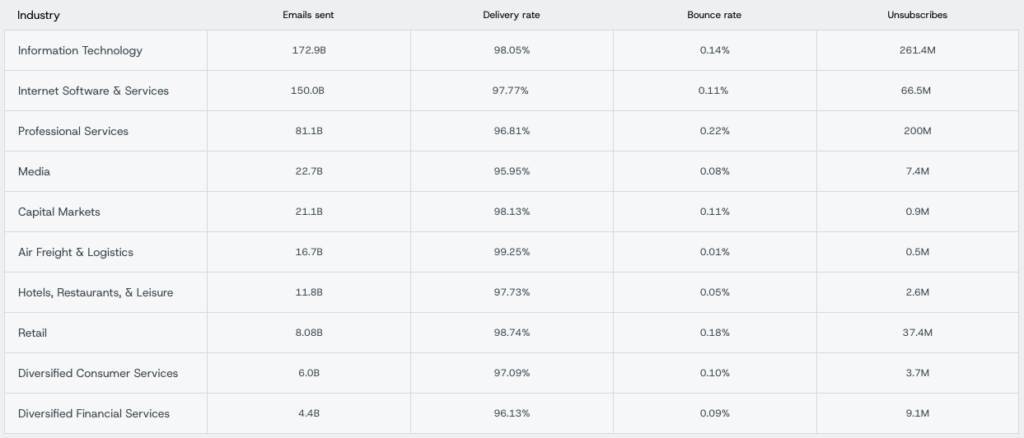
One of the most groundbreaking aspects of the 2026 Email Impact Report is its unique approach to industry benchmarks. Unlike many studies that rely on self-reported estimates from surveys, Chapter 2 of the Sinch Mailgun report leverages real sending data from its infrastructure, analyzing over 400 billion emails sent across the top 10 industries by volume in 2025. This methodology provides an unprecedented, data-driven perspective on actual email performance metrics, offering a more accurate yardstick for businesses to measure their own programs.

The benchmarks reveal a diverse performance landscape. The Air Freight & Logistics sector leads with an exceptional 99.25% delivery rate and a minuscule 0.01% bounce rate. This stellar performance is largely attributable to the nature of their email traffic, which consists predominantly of highly anticipated transactional sends like shipping confirmations and tracking updates. Recipients in this sector actively expect and welcome these communications, leading to high engagement and minimal rejection. In contrast, the Media industry records the lowest delivery rate among the top 10 at 95.95%. This can be explained by the inherent characteristics of media email programs, which often involve high volumes of promotional content sent to broader, less precisely targeted audiences, naturally leading to downward pressure on delivery metrics.
However, the report makes a crucial distinction: delivery rate alone can be a misleading metric. An email technically "delivered" to a spam folder still counts as delivered by most Email Service Providers (ESPs). To gain a true understanding of audience reach, the report strongly advocates for senders to pair delivery rate tracking with consistent inbox placement testing. This dual approach provides a far more accurate picture of where emails are actually landing—whether in the primary inbox, promotions tab, or spam folder—rather than merely confirming their acceptance by the recipient server. Without inbox placement data, marketers risk overestimating the effectiveness of their campaigns and missing critical issues that impact reach.
The analysis of unsubscribe rates further underscores the importance of contextual data. Information Technology, for example, logged the highest raw number of unsubscribes at 261 million. However, when viewed against its colossal send volume of 172.9 billion emails, this translates to a relatively low unsubscribe rate of approximately 0.15%. Conversely, the Retail sector generated 37.4 million unsubscribes from a much smaller base of 8.08 billion sends, resulting in a significantly higher unsubscribe rate per email. This comparison unequivocally demonstrates that raw unsubscribe volume, without the vital context of send volume, is meaningless for performance evaluation. Marketers must analyze these metrics proportionally to accurately assess list health and audience engagement. These real-world benchmarks serve as a powerful tool for businesses to identify strengths, pinpoint weaknesses, and strategically allocate resources to improve their email program performance.
The Deliverability Imperative: Progress in Infrastructure, Stagnation in Understanding
Deliverability—the ability of an email to successfully reach the recipient’s inbox—is universally acknowledged as critical, with 89% of senders citing its importance to their organization. The good news is that 43% of senders reported an improvement in their inbox placement over the past 12 months, indicating tangible progress in email infrastructure and practices. A significant driver of this improvement has been the widespread adoption of DMARC (Domain-based Message Authentication, Reporting & Conformance), a crucial email authentication protocol.
DMARC adoption has seen remarkable growth, largely propelled by stricter sender requirements from major mailbox providers like Gmail, Yahoo, and Microsoft, implemented to combat spam and phishing. For the first time in Sinch Mailgun’s research, the report notes that DMARC enforcement is outpacing passive monitoring, with over half of DMARC adopters now utilizing quarantine or reject policies. This shift is significant: while a "monitoring" policy merely reports on authentication failures, "quarantine" directs suspicious emails to the spam folder, and "reject" blocks them outright. This move towards more assertive policies signals a maturing understanding and application of email security standards across the industry.
Despite these infrastructure advancements, a concerning knowledge gap persists. The report highlights that 36% of senders claim to monitor their "email deliverability rate," a metric that, as defined, does not truly exist. This often conflates the "delivery rate" (emails accepted by the server, including those filtered to spam) with true "inbox placement" (emails actually reaching the intended inbox). Only 25% of senders proactively run inbox placement tests to ascertain where their emails are truly landing. Furthermore, 27% of DMARC users are unaware of the specific policy they have implemented (monitor, quarantine, or reject). This disparity between tool improvement and user literacy is a critical challenge. The tools and protocols are becoming more sophisticated, but the understanding and strategic application of these tools by many senders are lagging. A spokesperson for Sinch Mailgun emphasized, "The technical advancements in email security are profound, but their full potential can only be realized when senders possess the literacy to understand and leverage them effectively. Education and continuous learning in deliverability best practices are paramount." This lack of understanding can lead to misdiagnosed problems, ineffective solutions, and ultimately, a reduced return on email investment.
AI’s Transformative Potential: Wide Adoption, Uneven Impact
The integration of Artificial Intelligence (AI) into email programs is rapidly gaining traction, reflecting its broader impact across the digital marketing spectrum. The report reveals that 79% of senders currently use or plan to use AI in their email programs. However, the depth and effectiveness of this adoption vary considerably. Regular, systematic use of AI currently stands at just 27%, indicating that a substantial portion of adopters are still in the experimental phase rather than fully embedding AI into their routine workflows.
The most common application of AI is for copy generation, cited by 41% of senders, followed by content personalization (36%), dynamic content creation (29%), send time optimization (27%), and data analysis (27%). This pattern illuminates a key insight: AI delivers the most substantial value when it is deeply integrated into decision-making processes, rather than being confined solely to content production. Teams that leverage AI for sophisticated tasks such as personalization, optimizing send times, and A/B testing report compounding returns. In contrast, teams that limit AI’s role to drafting basic subject lines or introductory copy experience a more constrained impact.
The tangible benefits of strategic AI integration are evident in performance metrics. A notable 54% of senders who have implemented AI report that their email programs improved moderately or significantly year over year. This stands in stark contrast to just 37% of senders who are not using AI and observed similar improvements in the same period. This 17-point gap serves as a clear signal that AI is beginning to stratify email programs into distinct performance tiers. While this correlation does not definitively prove causation, the consistent direction of the trend strongly suggests that AI, when applied thoughtfully, acts as a significant amplifier for email marketing effectiveness. For the 23% of AI users who claim it has not helped them at all, the report concludes that the issue is not with the AI tool itself, but rather with the superficiality or lack of strategic depth in its integration.
Investment Trends and the Future Trajectory of Email
Looking ahead to 2026, the priorities for email senders are clear: "Taking advantage of AI" and "increasing email engagement" are tied as the top strategic objectives, each cited by 40% of senders. This dual focus underscores a collective understanding that future email success will hinge on both technological innovation and a deeper connection with the audience.
Regarding financial commitments, the report indicates a generally stable to upward trend in email investment. Approximately 31% of organizations plan to increase their email investment, reflecting confidence in the channel’s potential. A substantial 48% intend to maintain their current spending levels, acknowledging email’s continued value. Only a small minority, 7%, anticipate decreasing their email investment, suggesting that most businesses recognize email as a critical, non-negotiable component of their digital strategy.
The overarching conclusion of Sinch Mailgun’s report is unequivocal: email not only works, but its efficacy is demonstrably supported across ROI figures, real-world benchmarks, and improving deliverability trends. However, the future success of email programs will be increasingly dictated by a strategic commitment to three interconnected areas:
- Measurement: Proving ROI with verifiable data, moving beyond assumptions to data-driven decision-making.
- Deliverability: Consistently ensuring emails reach the inbox through rigorous authentication (like DMARC), meticulous list hygiene, and continuous monitoring.
- Optimization: Leveraging advanced tools, particularly AI, and systematic testing to continuously enhance performance at scale, from content personalization to send time.
Crucially, none of these areas necessitate a massive initial budget. The report emphasizes that even modest, consistent investments in these three pillars will yield compounding returns over time. The "widening gap" identified in the report is not merely a statistical observation but a profound indication of a bifurcating industry. On one side are the proactive, data-driven innovators who will capitalize on email’s enduring power, securing competitive advantages. On the other are those who cling to outdated practices, risking diminishing returns and falling behind in an increasingly sophisticated digital landscape. The 2026 Email Impact Report serves as a comprehensive roadmap for navigating this evolving environment, urging all email senders to embrace a future where strategy, data, and technology converge to unlock email’s full, transformative potential.