Evan Lee Salim

The retail landscape of the 2025 holiday season marked a significant turning point in how digital influence translates into consumer action. As online spending reached a record-breaking $11.8 billion on Black Friday alone—an increase from $10.8 billion in 2024—the role of the "creator economy" has moved from a secondary marketing channel to a primary driver of commerce. However, a comprehensive analysis of over 508,000 social media posts by U.S.-based creators reveals a surprising shift in consumer psychology: the depth of a discount is no longer the most reliable predictor of engagement. Instead, the nature of the offer and the timing of the outreach have become the critical variables for success.
The 2025 Black Friday Landscape: A Quantitative Overview
According to data compiled from Instagram, TikTok, and YouTube between November 1 and December 2, 2025, the volume of creator-led Black Friday content has reached unprecedented levels. Shopify merchants reported a staggering $14.6 billion in sales over the Black Friday through Cyber Monday (BFCM) weekend, much of which was funneled through social referrals.
The study analyzed posts from creators with a minimum of 1,000 followers, focusing on "engagement per view"—a metric calculated by dividing likes, comments, and shares by total views. This provides a more accurate reflection of audience interest than raw reach. The findings suggest that while 32% of Instagram posts focused heavily on percentage-based discounts, these were frequently outperformed by alternative value propositions, most notably the "free gift with purchase" (GWP).
The Supremacy of the Free Gift Over Deep Discounts
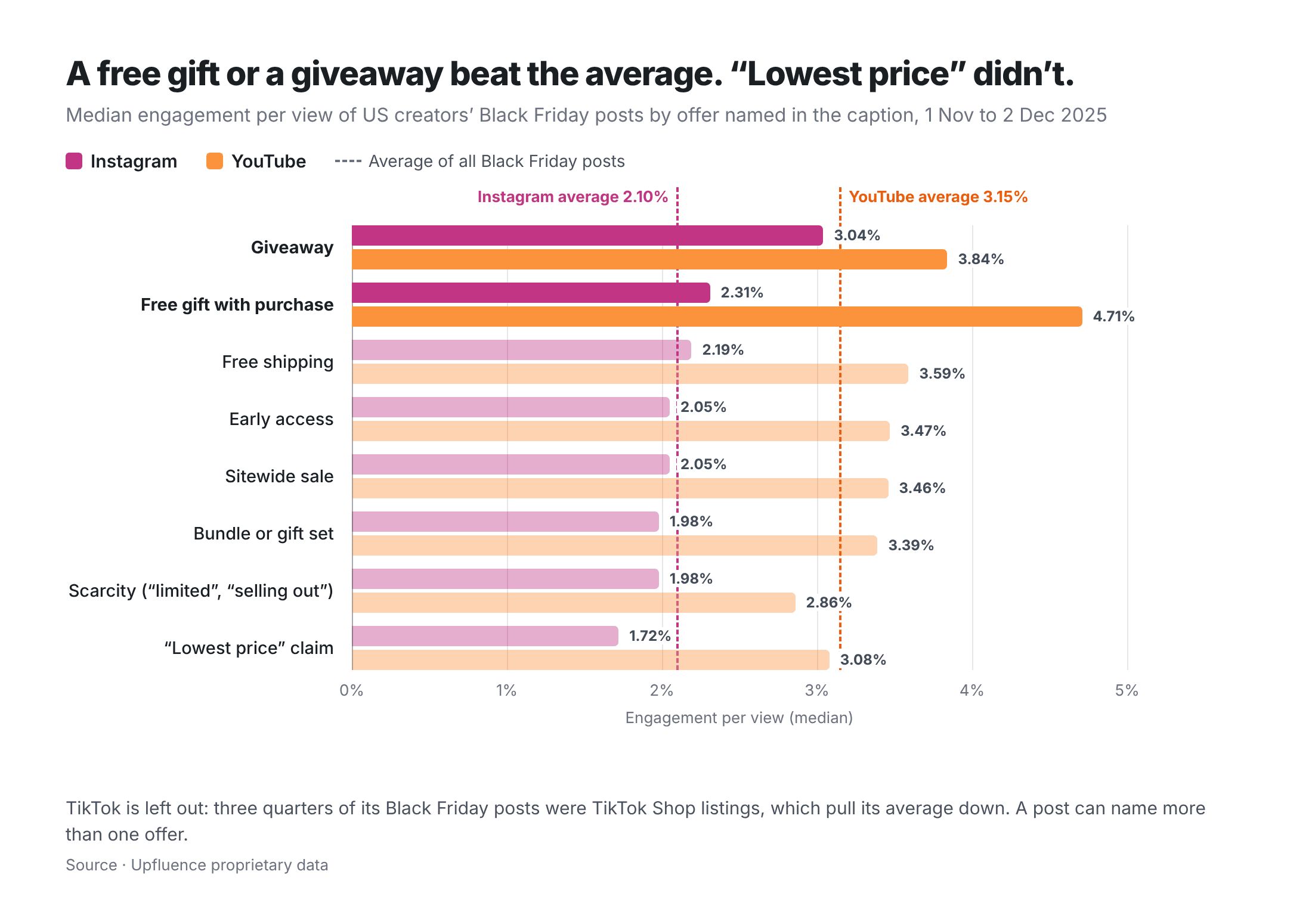
In a saturated market where every brand offers a percentage off, the psychological "nudge" of a tangible free gift has proven significantly more effective than price slashing. On YouTube, Black Friday posts featuring a free gift earned a 4.71% engagement rate per view, compared to a platform average of 3.15%. This represents a nearly 50% increase in audience interaction.

This trend held true across all major platforms. On Instagram, free-gift content saw 2.31% engagement against a 2.10% average. On TikTok, excluding the specific ecosystem of TikTok Shop, the rate reached 4.50%, well above the 3.75% benchmark. Despite this clear efficacy, the "free gift" strategy remains underutilized; only 2,600 Instagram posts mentioned a gift, compared to over 61,000 posts that relied on traditional percentage discounts. This gap presents a strategic "blue ocean" for brands looking to differentiate themselves in future cycles.
The Paradox of Discount Depth: The 50% "Dead Zone"
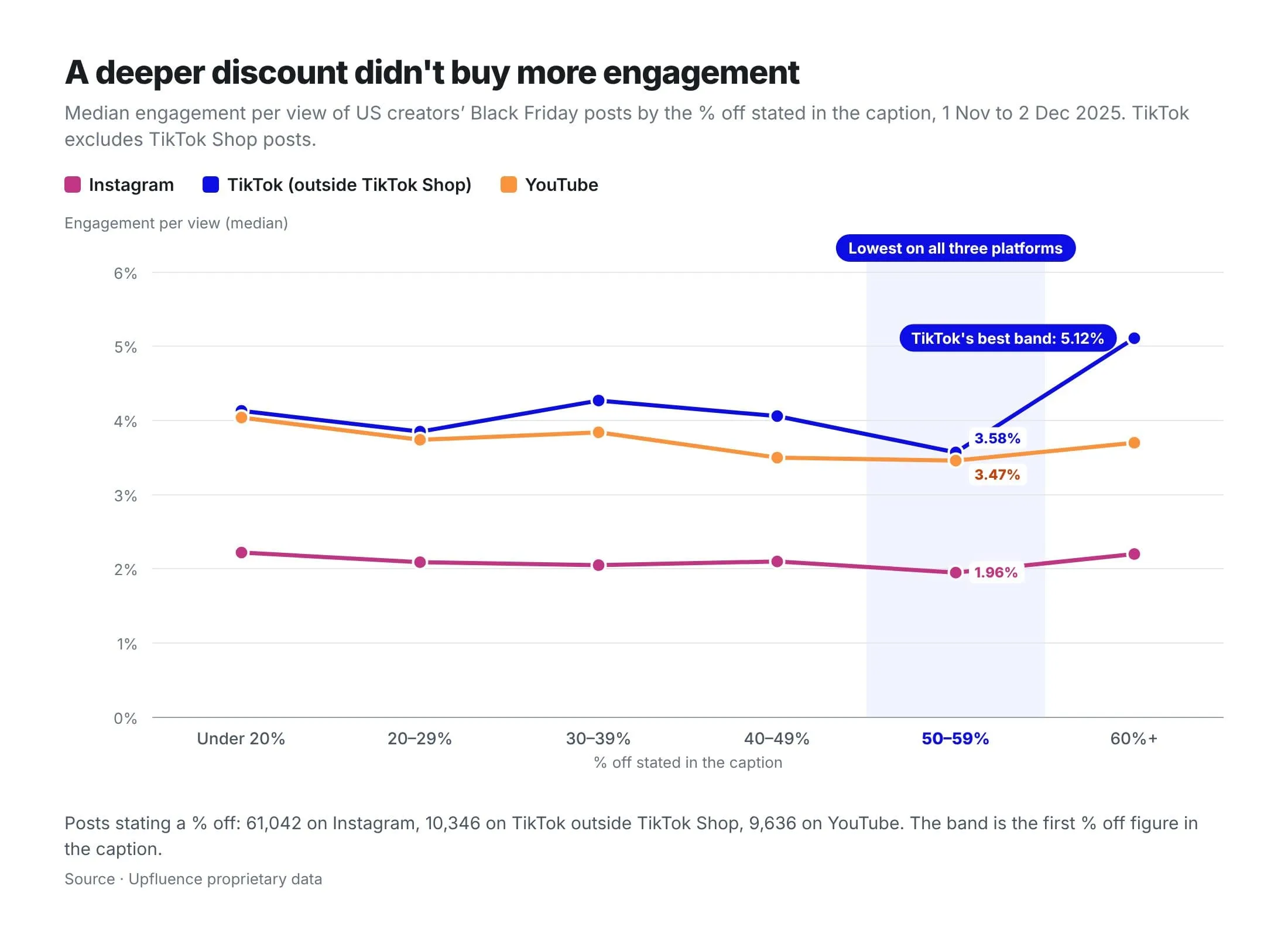
One of the most counterintuitive findings of the 2025 data is that deeper discounts do not inherently yield higher engagement. In fact, posts offering discounts between 50% and 59% were the weakest performers across Instagram, TikTok, and YouTube.
On Instagram, engagement rates remained remarkably flat regardless of the discount size, hovering between 1.96% and 2.23%. On TikTok, the 50-59% bracket dipped to 3.58% engagement, while posts offering less than 20% off actually performed better, averaging 4.14%.
Market analysts suggest this may be due to "discount inflation" or consumer skepticism. When a brand offers a 50% discount, consumers may perceive the product as having a lower intrinsic value or suspect that the original price was artificially inflated. Conversely, a smaller, exclusive discount of 15% or 20% from a premium brand—often paired with a creator-specific code—can feel more authentic and urgent to a loyal follower base.
Chronology of a Campaign: The October Shift
The timeline for Black Friday has effectively moved forward by a full month. The 2025 data indicates that the "shopping conversation" no longer begins in late November. Approximately 58% of all U.S. creator posts regarding Black Friday were published before the actual Black Friday week even began.
On Instagram, mentions of Black Friday began to double as early as October 20. By November 3, the volume of content was ten times higher than it had been in early October. This suggests that the modern consumer uses the weeks leading up to the sale for research and "wish-listing," rather than impulsive discovery on the day of the event. Brands that wait until the week of Thanksgiving to launch their creator campaigns are likely entering the fray after their target audience has already allocated their holiday budget.
Platform Dynamics: Matching Category to Content
The 2025 season highlighted the necessity of platform-specific strategies, as different product categories resonated differently depending on the medium:
- Instagram and the Fashion Dominance: Fashion content outperformed all other categories on Instagram, yielding a 2.68% engagement rate—28% higher than the platform average for Black Friday content. The visual, aspirational nature of Instagram Reels makes it the ideal environment for "try-on hauls" and outfit inspiration.
- YouTube and the Research-Heavy Purchase: While fashion thrived on Instagram, technical products found their home on YouTube. Tech-related Black Friday posts accounted for 16% of all YouTube content in this category, earning 3.43% engagement. High-ticket items like laptops, cameras, and home appliances require the long-form, detailed review format that YouTube provides.
- TikTok and the Impulse Economy: Beauty and fitness content remained staples on TikTok, though the platform is increasingly bifurcated between organic creator content and TikTok Shop listings. Organic posts (outside of the Shop) maintained a higher engagement median (3.75%), suggesting that users still value the creator’s authentic voice over a direct, integrated sales pitch.
The Decline of Traditional Urgency Tactics
The data also signals a fatigue regarding traditional high-pressure sales tactics. Captions utilizing phrases like "lowest price ever," "selling fast," or "limited stock" consistently underperformed the general average.
On Instagram, posts claiming "lowest price" saw only 1.72% engagement, compared to the 2.10% baseline. On TikTok, the gap was even wider, with urgency-focused posts trailing the average by nearly 1.4 percentage points. This indicates that modern social media users, particularly Gen Z and Millennials, are becoming desensitized to manufactured scarcity. They respond more favorably to "value-add" content—such as tutorials, styling tips, or exclusive "behind-the-scenes" access—than to aggressive price claims.
Strategic Implications: From Content to Conversion
The final phase of a successful 2025 campaign involved the transition from organic engagement to paid amplification. A key takeaway for marketing teams is the high ROI of turning top-performing creator videos (User-Generated Content or UGC) into paid social ads.
Surveys indicate that 66% of app users skip traditional in-app video ads when given the option. However, creator-led content, which mirrors the organic aesthetic of the user’s feed, experiences much lower skip rates. By securing usage rights in initial contracts, brands were able to identify the "winners" in early November and put significant ad spend behind them during the peak shopping window of November 24 to December 1.
Economic Context and the Future of Social Commerce
The success of the 2025 Black Friday season occurred against a backdrop of fluctuating consumer confidence and continued interest in social commerce. The "Creator Economy" is no longer a niche segment of the advertising world; it is a fundamental pillar of the retail ecosystem.
As we look toward 2026, the implications of this data are clear. Brands must move away from the "race to the bottom" on pricing. Instead, the focus should shift toward:
- Value Differentiation: Utilizing free gifts and exclusive bundles.
- Strategic Timing: Initiating the creator dialogue in mid-October to capture the research phase.
- Platform Alignment: Allocating tech budgets to YouTube and fashion budgets to Instagram.
- Authenticity Over Urgency: Prioritizing genuine creator endorsements over hyperbolic price claims.
The record $11.8 billion spent online in 2025 proves that the appetite for Black Friday remains robust, but the methods for capturing that spend have evolved. The most successful brands of the next season will be those that treat creators not as mere megaphones for discounts, but as strategic partners in a months-long value-building narrative.


 Muslim