The landscape of digital marketing is undergoing a significant transformation with the advent of artificial intelligence, particularly in critical areas like lead generation and customer engagement. A prominent example of this evolution is AWeber’s new AI Signup Form Builder, which, as of its projected launch in June 2026, marks a decisive departure from the traditional, often cumbersome, reliance on pre-designed templates. This innovation promises to streamline the creation of signup forms, offering businesses a more efficient, personalized, and brand-aligned approach to capturing valuable subscriber information.
The Evolution of Digital Forms: From Basic HTML to AI-Driven Personalization
For decades, the creation of web forms has been a fundamental yet frequently frustrating aspect of online presence. In the early days of the internet, forms were meticulously coded using HTML and CSS, requiring technical expertise and considerable time. The rise of content management systems and dedicated form builders introduced templates, which were initially hailed as a time-saving solution. These templates offered pre-configured layouts, field sets, and basic styling options, allowing users with limited coding knowledge to deploy forms more easily.
However, the convenience of templates came with inherent limitations. While they provided a starting point, their "one-size-fits-all" design often meant they were a poor fit for specific business needs and brand identities. Marketers would spend hours sifting through galleries, selecting the "closest match," only to then embark on a lengthy customization process. This typically involved adjusting fields, rewriting generic headlines like "Subscribe to our newsletter," swapping colors to match brand guidelines, and painstakingly rearranging layouts. The process effectively became one of working backward, adapting a general solution to a specific problem, rather than building from the ground up with the user’s unique requirements in mind.
Industry data consistently highlights the challenges associated with generic forms. Studies have shown that conversion rates for signup forms can vary wildly, with highly personalized and contextually relevant forms outperforming generic ones by significant margins. For instance, research from various marketing analytics firms indicates that personalized calls to action can convert up to 202% better than standard CTAs. While this data isn’t exclusively about forms, it underscores the broader principle that relevance and customization are paramount in driving user engagement. Generic forms, by their very nature, struggle to achieve this level of relevance, often leading to suboptimal performance, higher bounce rates, and ultimately, missed opportunities for lead capture.
The Inadequacies of Template-Based Form Creation

The core issue with signup form templates stems from their universal design philosophy. Built to appeal to the broadest possible audience, they inherently lack the specificity required for effective, high-converting forms. This generalization manifests in several critical areas:
- Generic Messaging: Templates often ship with bland, uninspired headlines such as "Subscribe to our newsletter." This is a stark mismatch when a business is offering a highly specific value proposition, like a "free five-day email course on dog training" or an exclusive industry report. Such generic phrasing fails to immediately communicate the unique benefit to the potential subscriber, leading to disinterest and abandonment.
- Irrelevant Field Sets: Default templates typically include a fixed number of fields, which may not align with the data a business genuinely needs. A minimal brand might only require an email address, yet a template could force the inclusion of first name, last name, and company, creating unnecessary friction. Conversely, a complex offer might require more specific information than a template provides, necessitating manual additions and reconfigurations.
- Suboptimal Layouts and Design: Templates often feature layouts optimized for nobody in particular. A brand known for its minimalist aesthetic might be presented with a busy, two-column layout, requiring significant design adjustments. This not only consumes valuable time but also compromises brand consistency and user experience.
- Cognitive Anchoring: Perhaps a more subtle but equally damaging problem is the psychological effect of templates. Starting with a pre-existing structure can "anchor" a designer’s thinking, limiting creative freedom and encouraging adaptation rather than innovation. Instead of conceiving a form that perfectly serves their audience and offer from scratch, users find themselves constrained by someone else’s design decisions, leading to compromises that dilute the form’s effectiveness.
The cumulative effect of these shortcomings means that the "shortcut" promised by templates often becomes a detour. The gap between a generic template and a truly effective, branded form requires substantial effort in copywriting, design refinement, and field logic implementation. By the time a template is sufficiently customized, the time investment can easily exceed that of building a form from the ground up with a clear, specific vision.
A New Paradigm: AWeber’s AI Signup Form Builder
AWeber’s AI Signup Form Builder ushers in a new era by fundamentally altering this workflow. Instead of starting with a gallery of pre-made options, the process begins with the user’s specific needs and objectives. This AI-driven approach leverages advanced algorithms to generate highly customized forms, addressing the limitations of templates head-on.
The builder offers three primary methods for form creation, each designed to maximize efficiency and personalization:
-
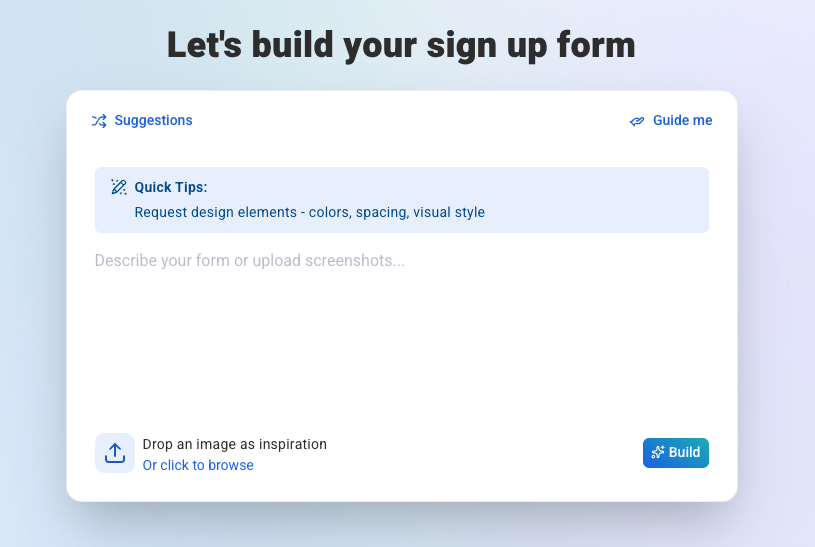
Describe It: This intuitive feature allows users to articulate their requirements in plain language. For instance, a user might type, "A simple one-field form for a free guide on meal planning for busy parents." The AI then interprets this natural language input and generates a form tailored to the description. This includes a relevant, engaging headline, an appropriate number of fields (in this case, likely just an email field), and copy that directly aligns with the offer. This method dramatically reduces the time spent on initial setup and ensures that the form’s core message is immediately on-brand and compelling.
-
Upload a Screenshot: Recognizing that inspiration often comes from existing designs, AWeber’s AI builder incorporates a unique screenshot upload feature. If a marketer encounters a form online that captures their attention – perhaps due to its layout, call to action, or field structure – they can simply upload a screenshot of it. The AI analyzes the design cues, structure, and aesthetic elements from the image. It then uses this visual information as inspiration to produce a new form, customized to the user’s brand and content, rather than merely copying the original. This allows businesses to draw creative insights without the laborious manual rebuilding process, offering a "creative shortcut without the brand mismatch." This feature is particularly powerful for maintaining brand consistency while adopting successful design elements observed elsewhere.
-
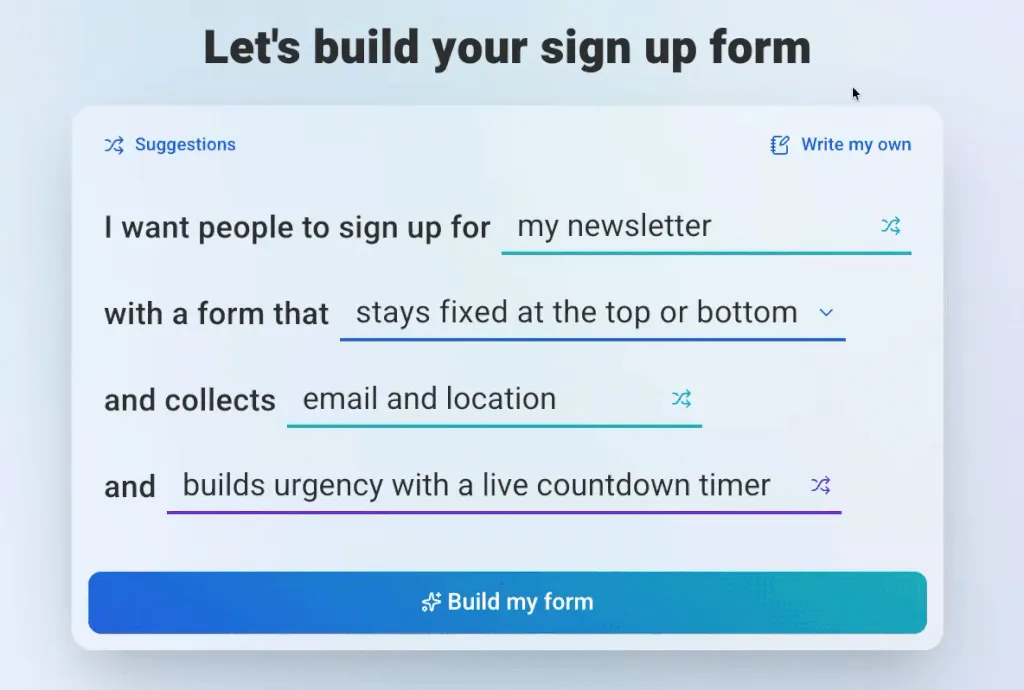
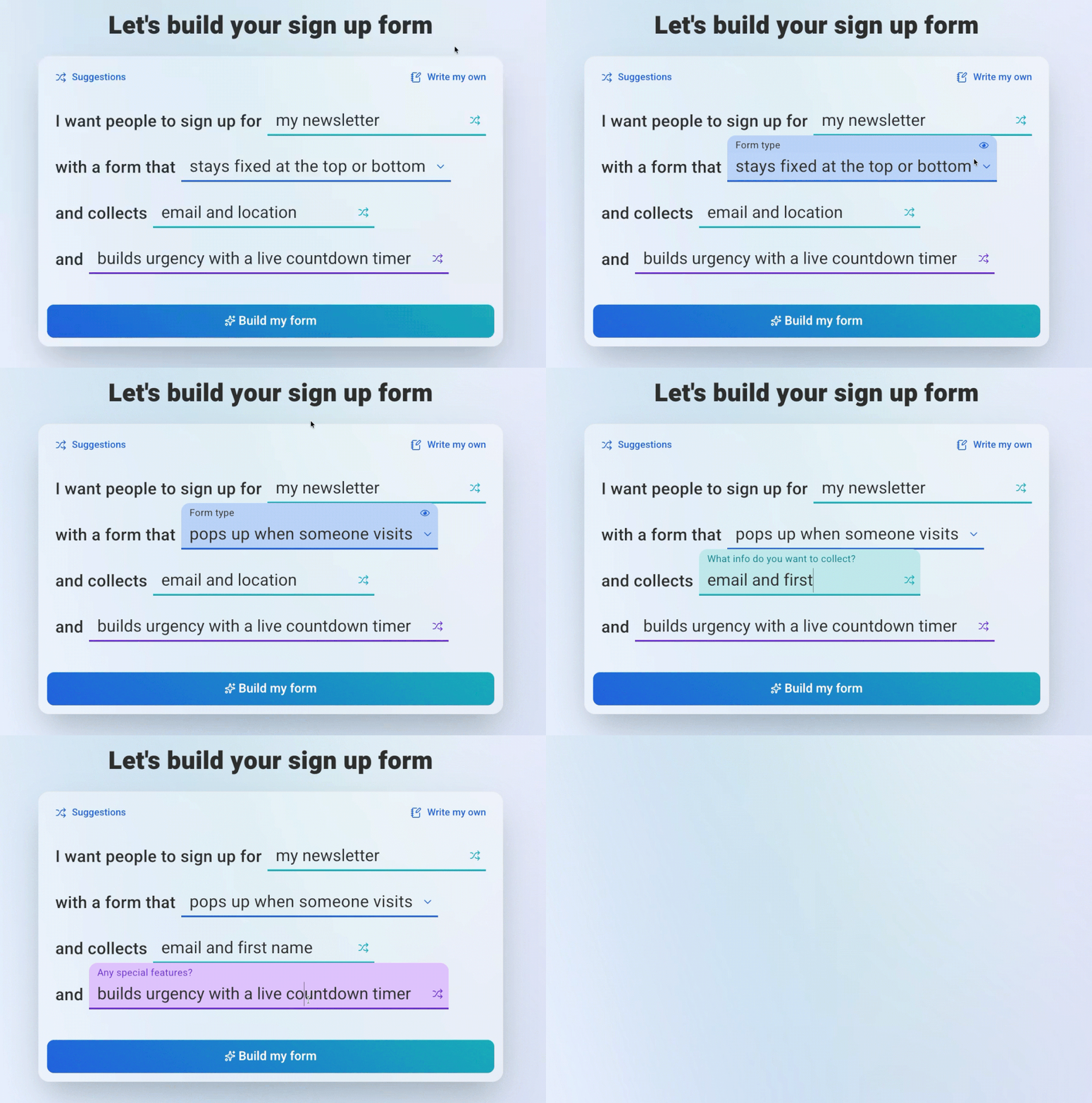
Use Guided Prompts: For users who prefer a more structured approach, the AI builder provides a series of guided prompts. By answering a few targeted questions about their audience, the specific offer, and their overarching goals, the AI system assembles a form dynamically. These specific inputs directly translate into specific outputs, ensuring that every element of the form – from the headline to the fields and button text – is purpose-built based on the user’s responses. This method combines the ease of a wizard-style interface with the power of AI to generate highly relevant forms.
A critical aspect of this AI-driven process is the ability to refine forms through natural language conversation post-initial generation. Users can instruct the AI to "shorten the headline," "add a checkbox for terms and conditions," or "change the button text to ‘Get My Free Guide Now’." The form updates in real-time without the user ever having to navigate complex settings panels or field editors. This conversational interface mirrors human interaction, making form design more accessible and significantly faster.
Unmatched Speed and Quality: A Comparative Advantage
The distinction between an AI-generated form and one built using a traditional drag-and-drop template builder is profound, particularly in terms of speed and quality. With a template gallery, businesses are limited to a fixed set of options. If the perfect form for their brand and offer doesn’t exist within that gallery, they are forced to compromise, either by settling for a suboptimal design or investing significant time in customization.
The AI builder, conversely, operates without a fixed set of options. Each form is generated dynamically from the user’s inputs, ensuring that every element is precisely aligned with the business’s unique requirements. This means the headline precisely matches the offer, the field count is appropriate for the ask, and the copy authentically reflects the brand’s voice, rather than sounding like generic marketing speak. For example, a fitness coach requires vastly different copy and a distinct aesthetic compared to a B2B SaaS tool. A template gallery would typically offer both the same generic starting point, whereas the AI builder initiates the process from the specific description provided by the user. This level of granular customization at the outset is what truly differentiates AI-powered builders.
AWeber highlights this advantage by showcasing examples, such as Alycia, who used Stu McLaren’s brand as inspiration to rapidly create a custom form with the AI Signup Form Builder. Such real-world applications underscore the builder’s ability to facilitate efficient, high-quality form creation that truly resonates with target audiences.
Broader Implications for Digital Marketing and Business Efficiency
The introduction of AI-powered form builders like AWeber’s has significant implications for the broader digital marketing landscape:
- Democratization of Sophisticated Marketing: Small businesses and individual entrepreneurs, often lacking dedicated design or copywriting teams, stand to benefit immensely. These tools level the playing field, enabling them to create professional, high-converting forms that were previously only achievable with significant resources or expertise. This democratization allows them to compete more effectively with larger organizations.
- Enhanced Marketing Efficiency: The dramatic reduction in time spent on form creation frees up marketers to focus on higher-level strategic tasks, such as content creation, campaign optimization, and audience analysis. This shift from tactical, repetitive tasks to strategic initiatives can lead to more impactful marketing outcomes.
- Improved Conversion Rates and Lead Quality: By ensuring forms are highly personalized, relevant, and on-brand from the outset, businesses can expect to see improvements in conversion rates. Furthermore, precisely tailored forms can gather more targeted information, leading to higher-quality leads that are more likely to convert into paying customers.
- Evolution of Marketing Tools: This innovation signals a broader trend in the marketing technology (MarTech) sector, where AI is increasingly being integrated to automate and personalize various aspects of campaigns. Other form builders and marketing platforms will likely follow suit, intensifying competition and driving further innovation in AI-assisted tools.
- Focus on Strategic Thinking: As AI handles the minutiae of form design and copywriting, marketers can shift their focus towards understanding their audience deeper, crafting compelling offers, and analyzing performance data to refine their overall strategy. The AI becomes a powerful assistant, executing creative briefs with precision and speed.
When Templates Still Hold Value: Inspiration, Not Imitation
While AI builders are rendering generic templates largely obsolete for direct application, templates are not entirely useless. Their true value now lies in their capacity for inspiration. If a particular form’s layout, call to action (CTA), or field structure catches a marketer’s eye, it serves as a valuable source of creative insight. The goal is not to copy it but to understand what made it effective and apply those principles to a new, custom design.
This is precisely where the screenshot feature of the AI Signup Form Builder becomes invaluable. By grabbing a screenshot of an inspiring form and uploading it, combined with a description of their own business, users can leverage the AI to extract structural cues and design elements. The builder then applies these insights to generate a form that is unique, on-brand, and functionally superior, embodying the inspiration without falling into the trap of imitation. It offers a genuine creative shortcut that respects brand individuality.
Building the Future of Lead Generation
The transition from generic templates to AI-generated, bespoke signup forms represents a significant leap forward in digital marketing. AWeber’s AI Signup Form Builder exemplifies this shift, providing businesses with a powerful tool to create effective, personalized lead capture mechanisms with unprecedented speed and ease. By simply opening AWeber, selecting the AI Signup Form Builder, and providing a single sentence describing their offer, users can generate a customized form in minutes.
This innovation eliminates the need for template browsing, layout compromises, and extensive copy overwrites. The result is a form that is ready to deploy when the business is, poised to collect subscribers who will immediately receive their welcome email, initiating a personalized customer journey from the very first interaction. Businesses looking to optimize their lead generation efforts and embrace the future of marketing technology are encouraged to explore AWeber’s offering, with a free 14-day trial providing an opportunity to experience the transformative potential of AI-generated signup forms firsthand. This marks not just an incremental improvement, but a fundamental rethinking of how businesses connect with their audience online.

 Laily UPN
 Basiran