


The discipline of Conversion Rate Optimization (CRO) and product experimentation is undergoing a fundamental shift as enterprise organizations transition from tactical A/B testing to integrated, platform-driven experimentation ecosystems. As digital landscapes become more complex and AI-driven workflows become the norm, the challenge for modern leadership is no longer just about running more tests, but about building systems that can scale across thousands of products and teams without compromising data integrity or decision quality. Apurva Sandbhor, Manager of Platform and Product Experimentation at The Home Depot, provides a blueprint for this evolution, highlighting how one of the world’s largest retailers navigates the intersection of human judgment, automated infrastructure, and strategic risk management.
The Paradigm Shift From Headcount to Platform Architecture
In the early stages of digital growth, many organizations treat experimentation as a centralized service where a small team of specialists handles every request. However, as an organization the size of The Home Depot scales, this model inevitably leads to operational bottlenecks. Sandbhor argues that scaling a team without scaling the underlying platform architecture simply compounds friction. When organizations attempt to solve scaling issues by merely increasing headcount, they often encounter siloed execution, metric discrepancies, and a surge in operational noise that hampers velocity.
To counter this, Sandbhor advocates for a "platform-first" strategy. This approach shifts the focus from manual test execution to the creation of structural and cultural frameworks that allow decentralized teams to experiment autonomously. The goal is to move away from a reactive support mindset—where the experimentation team is a "help desk"—toward an enablement model where the platform acts as a force multiplier for the entire enterprise.

The Dual-Lane Framework for Work Distribution
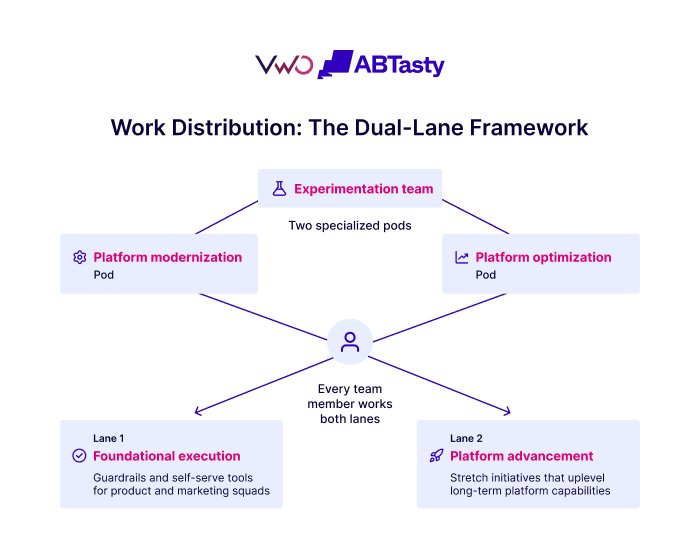
Central to this scaling strategy is the "Dual-Lane" framework, which decouples day-to-day enablement from core innovation. This framework ensures that a centralized experimentation team does not become bogged down by transactional requests.
- The Enablement Lane: This lane focuses on democratizing experimentation. It involves providing product squads with the tools, documentation, and automated guardrails they need to run their own tests. By standardizing the process, the central team empowers others to move at their own pace while maintaining quality standards.
- The Innovation Lane: By offloading the execution of standard tests to the product squads, the core experimentation team can focus on high-impact innovation. This includes re-architecting the platform, exploring server-side capabilities, and integrating AI to enhance predictive modeling and hypothesis generation.
This distribution of labor prevents the "centralized ceiling" effect, where the speed of the entire company is limited by the bandwidth of a single department.
Redefining Success Beyond Win Rates and Volume
A critical component of a mature experimentation program is the move away from "vanity metrics." Traditionally, programs have been judged on the number of tests launched or the "win rate" (the percentage of tests that yield a statistically significant positive result). Sandbhor contends that these metrics are not only insufficient but can be actively counterproductive.
When executive leadership mandates high win rates, it inadvertently incentivizes teams to test low-risk, incremental changes—such as button colors or minor copy tweaks—because they are "safe." This culture starves the organization of true innovation, which often requires testing bold, high-risk ideas that may fail but provide immense learning value.

Anchoring on Learning Value and Decision Integrity
The Home Depot’s approach involves re-anchoring organizational goals around "Learning Value" and "Decision Integrity." This means valuing a "losing" test just as much as a "winning" one, provided the data gathered is high-integrity and informs future strategy.
Sandbhor emphasizes that a healthy program distinguishes between:
- Winning Tests: Validated ideas that move the needle on core KPIs.
- Losing Tests: Ideas that, while unsuccessful, prevent the company from investing millions in a flawed feature.
- Inconclusive Tests: Results that suggest a need for deeper segmentation or a refined hypothesis rather than a simple "yes" or "no."
By framing "losses" as "strategic risk avoidance," experimentation leaders can demonstrate to executives how the program acts as an insurance policy against costly strategic missteps.
The Technical Infrastructure of Velocity
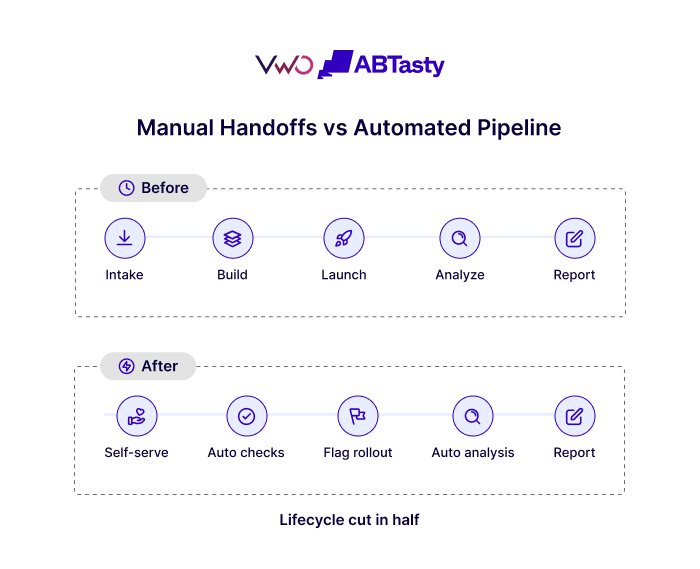
Achieving high velocity in an enterprise environment requires more than just a cultural shift; it requires an automated technical infrastructure. Sandbhor notes that true velocity is achieved by embedding statistical guardrails directly into the platform’s ingestion pipeline. This reduces the time spent on manual data cleaning and prevents the "garbage in, garbage out" problem that plagues many testing programs.
Automated Statistical Guardrails
The Home Depot utilizes proprietary statistical engines to automate several critical checks:
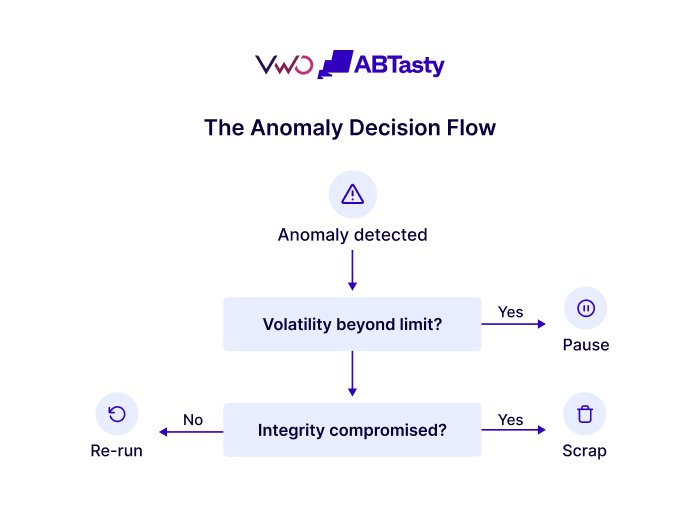
- Sample Ratio Mismatch (SRM) Detection: Automatically flagging tests where the traffic distribution between variations is uneven, which usually indicates a technical bug in the bucketing logic.
- Traffic Anomaly Monitoring: Real-time alerts that trigger if a specific variation is causing a spike in errors or a drop in system performance.
- Automated Power Analysis: Ensuring that a test has a sufficient sample size to produce meaningful results before it is even launched.
Decoupling Deployment from Activation
A major technical hurdle in modern experimentation is the lag between code deployment and test activation. Sandbhor advocates for a modernized architecture that supports both client-side and server-side experimentation. By using server-side testing, teams can experiment with core backend logic—such as search algorithms or pricing engines—without the "flicker" effect or performance hits often associated with client-side JavaScript overrides.
Furthermore, decoupling deployment (pushing the code to the server) from activation (turning the test on for specific users) allows for "dark launches" and gradual rollouts. This minimizes risk, as a feature can be tested on 1% of the audience and monitored for system health before being scaled to the general population.
Case Study: Algorithmic Recommendations and Decision Paralysis
The importance of deep data analysis over surface-level results was highlighted in a high-visibility checkout optimization project at The Home Depot. The team launched an algorithmic recommendation engine designed to cross-sell accessories during the final stages of the checkout process. Initial data showed an unexpected drop in overall cart conversion rates—a result that might lead a less mature team to abandon the project entirely.
However, Sandbhor’s team conducted a segment deep-dive. They discovered that while the recommendations were highly relevant, the multi-choice layout was overwhelming users at a high-intent moment. This "decision paralysis" was causing users to hesitate or abandon the cart.
The team pivoted their hypothesis: instead of offering multiple individual choices, they tested a single "bundle" option that allowed users to add all relevant accessories with one click. This follow-up test eliminated the cognitive friction, resulting in a net revenue lift. This case study serves as a reminder that "losing" data is often the roadmap to a more significant "win" if analyzed with behavioral nuances in mind.
The Role of AI and the Future of Experimentation Leadership
As AI begins to commoditize the execution layer of experimentation—automating data pulls, building test variants, and performing basic analyses—the role of the human leader is evolving. Sandbhor believes that while AI can optimize the path, humans must still choose the mountain.
Human judgment remains irreplaceable in three specific areas:
- Ethical and Strategic Boundaries: Determining what should be tested and ensuring that experiments align with long-term brand values and customer trust.
- Psychological Synthesis: Translating complex user behaviors into novel hypotheses that AI, which relies on historical data, might not be able to generate.
- Stakeholder Alignment: Building the narrative that keeps cross-functional teams and executives bought into the experimentation mission.
Conclusion: Experimentation as a Long-Term Capability
The insights from Apurva Sandbhor’s tenure at The Home Depot suggest that the most successful experimentation programs are those that treat the discipline not as a series of isolated projects, but as a permanent, automated infrastructure. By focusing on platform architecture, moving away from vanity metrics, and embracing the "strategic risk avoidance" value of testing, enterprise organizations can scale their innovation without losing sight of data integrity.
In an era where digital competition is fiercer than ever, the ability to uncover business truths quickly while protecting the enterprise from strategic errors is the ultimate competitive advantage. As Sandbhor concludes, volume is merely an input; the true output of a world-class experimentation program is decision integrity. Through the combination of robust technical guardrails and sophisticated human leadership, organizations can ensure that every experiment—regardless of its outcome—contributes to a more resilient and data-driven future.







