A groundbreaking analysis by Brainlabs, examining 1.35 million keywords across nine key UK search categories, reveals a dramatic and unambiguous shift in user search behavior, directly influenced by the rise of AI-powered search features. The findings indicate a structural decline in the dominance of "head terms" – short, high-volume search queries – in seven out of nine categories studied. Concurrently, "longtail" queries, which are longer and more specific, are experiencing significant growth. Crucially, Google’s AI Overviews are disproportionately appearing on these burgeoning longtail searches, creating a narrowing window of opportunity for brands reliant on organic search visibility.
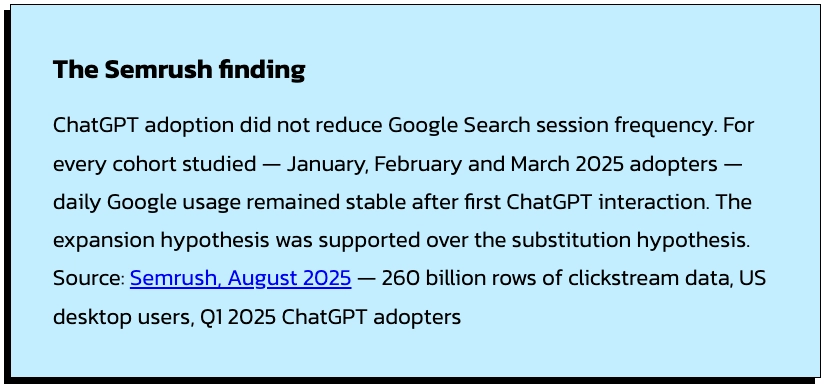
This comprehensive study builds upon earlier research, notably a significant August 2025 report by Semrush. The Semrush study, analyzing 260 billion rows of clickstream data, explored user search habits post-initial ChatGPT interaction. Its conclusion suggested that AI, rather than replacing Google, was augmenting its use, with ChatGPT adopters showing no statistically significant decrease in daily Google sessions; in fact, overall search activity saw a marginal uptick.

While the Semrush findings offered a degree of reassurance by confirming Google’s continued relevance, the Brainlabs analysis delves deeper, questioning not if users are searching on Google, but what they are searching for and what Google is presenting in response. This nuanced perspective is critical for brands navigating the evolving landscape of organic and paid search strategies over the next two years. Google itself has publicly acknowledged an increase in average query length, a trend predating AI Overviews but significantly accelerated by them. Brands are witnessing this firsthand: head term traffic is softening, longtail queries are expanding, and AI Overviews are surfacing in contexts beyond purely informational searches.
Motivated by these observations, Brainlabs undertook its own in-depth analysis, hypothesizing two core shifts:
- AI Adoption Reshaping Query Composition: The study posited that while overall Google usage might remain stable, the nature of search queries is transforming. AI tools, by encouraging more natural, conversational language, are training users to ask longer, more specific questions. This would logically lead to a decline in high-volume head terms and a corresponding rise in longtail and potentially branded queries.
- AI Overviews Expanding Beyond Informational Queries: The prevailing wisdom suggested AI Overviews (AIOs) were primarily deployed for informational searches (how-to, what-is, research), thereby protecting commercial SERPs and ad revenue. Brainlabs hypothesized that AIOs were already appearing across a broader spectrum, including mid-funnel commercial queries, posing a more significant click-suppression risk than widely anticipated.
The Brainlabs study, employing Ahrefs data to analyze search volume trends at the keyword level, offers a complementary perspective to Semrush’s session-frequency approach. It directly addresses what users are searching for and what they are seeing on the Search Engine Results Page (SERP), providing actionable insights for strategic planning.

AI Overview Coverage Varies Significantly by Sector
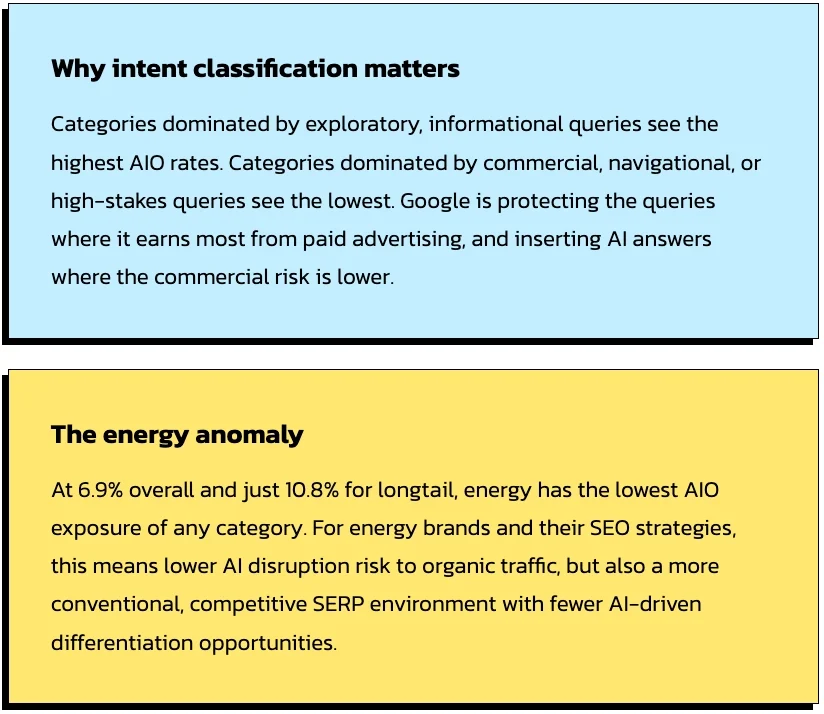
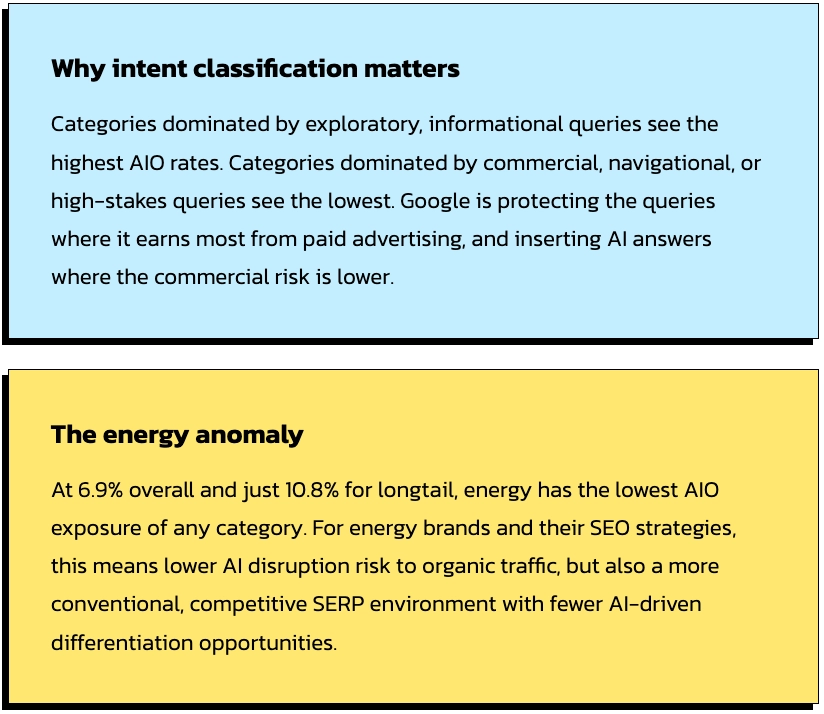
Google’s deployment of AI Overviews is not uniform, exhibiting distinct variations across different industry sectors. This divergence appears to be a deliberate strategy based on intent classification rather than algorithmic inconsistency.
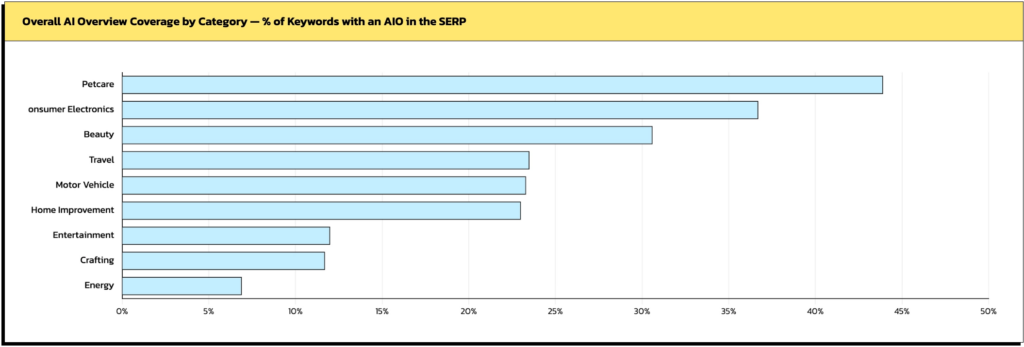
The Petcare sector leads in AIO coverage, with rates reaching up to 43.9%. This is attributed to the category’s saturation with informational queries such as "What can dogs eat?" or "Is chocolate toxic to cats?". Google’s confidence in its AI’s ability to accurately answer these types of questions makes Petcare a prime candidate for an AI-first content approach.
Conversely, the Energy sector registers the lowest AIO coverage, around 6.9%. This is because most energy-related queries are navigational ("British Gas contact number") or highly commercially specific ("cheapest electricity provider"). Google appears to be exercising caution in generating AI answers for queries where inaccuracies could lead to significant financial repercussions for users.
Sectors like Consumer Electronics (36.7% AIO coverage) and Beauty (30.6% AIO coverage) fall into the middle-to-upper range, driven by strong user behavior around research and comparison. Travel (23.5%) and Motor Vehicles (23.3%) show similar AIO deployment rates, suggesting a shared dynamic where commercial intent suppresses AIO visibility. Entertainment (12.0%) and Crafting (11.7%) also exhibit low AIO rates, a finding that warrants further investigation, particularly given their informational nature.
Longtail Queries are Prime Real Estate for AI Overviews
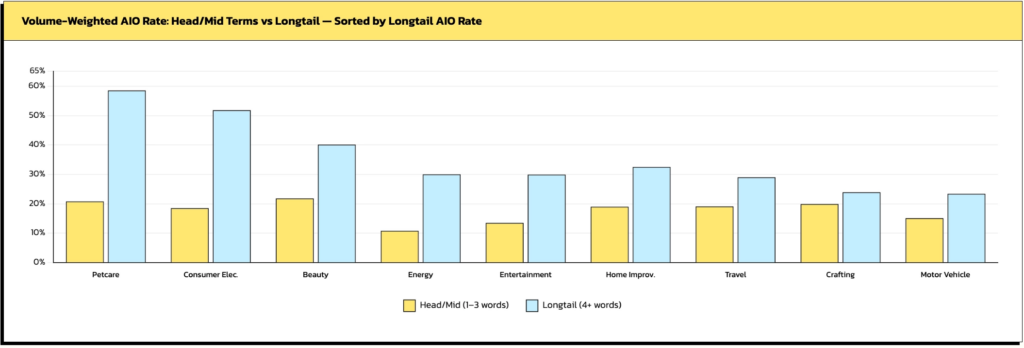
A consistent and striking finding across all nine categories is that longtail queries are attracting AI Overviews at a significantly higher rate than head and mid-length terms. Volume-weighted AIO rates for queries of four or more words consistently outpace those for one to three-word queries, with the gap being particularly dramatic in several categories.
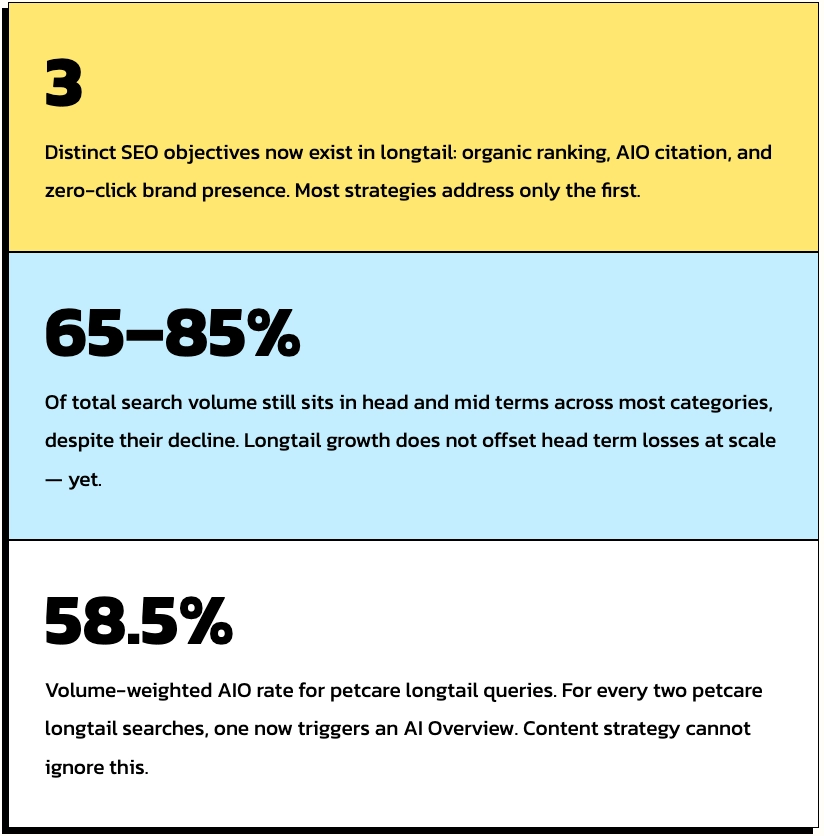
In Petcare, for instance, the AIO rate for longtail queries reaches 58.5%, nearly three times the rate for head terms (20.8%). Similarly, Consumer Electronics shows a pronounced difference, with longtail queries seeing a 51.8% AIO rate compared to 18.5% for head terms. This pattern underscores Google’s perception of longtail queries as ideal territory for AI-generated answers that provide substantial user value, while head terms are approached with more caution, often deferring to traditional ranked results.
The Motor Vehicles category presents a notable exception. The disparity between head and longtail AIO rates is minimal (15.1% vs. 23.4%), suggesting that the car-buying journey, regardless of query length, is treated by Google as a high-commercial-intent process where AI-generated shortcuts are less favored due to the consequential nature of the decisions involved.
For brands operating in sectors like Petcare and Consumer Electronics, this trend signifies a paradigm shift. Longtail optimization is no longer solely a strategy for capturing niche traffic; being cited within an AI Overview for high-intent longtail queries has emerged as a distinct and crucial visibility objective, complementing traditional ranking efforts.
Head Terms Face Structural Decline in Most Sectors
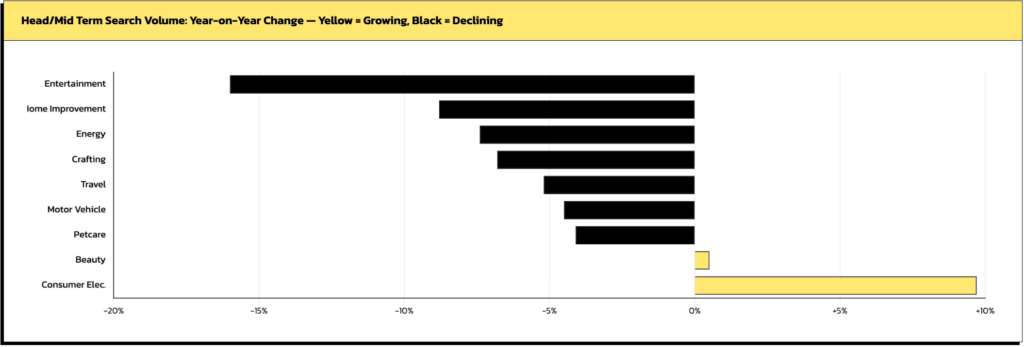
The year-on-year trend analysis for head and mid-length terms (one to three words) reveals a consistent pattern of structural decline across seven of the nine studied categories. The Entertainment sector leads this decline with a significant -16% year-on-year drop. This is particularly noteworthy as entertainment queries are often readily substitutable by AI tools. For instance, questions like "What should I watch tonight?" can be effectively answered by AI chatbots or streaming platform recommendation engines, potentially leading these queries to migrate away from Google altogether.
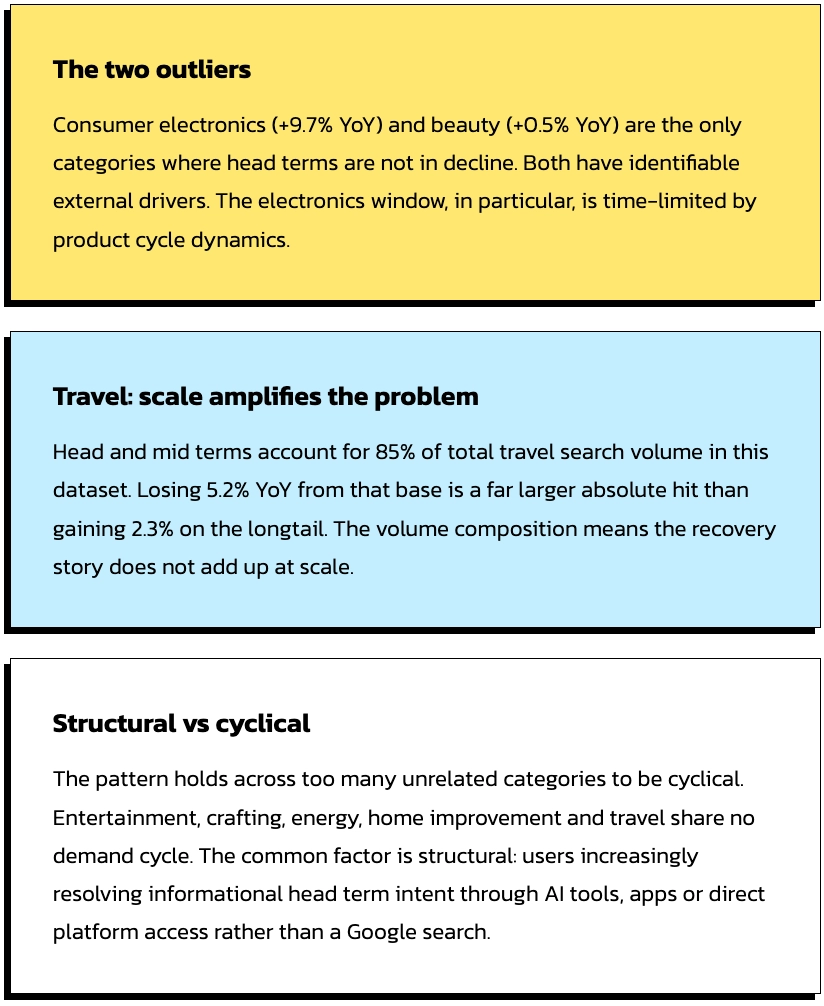
Other categories experiencing meaningful declines include Home Improvement (-8.8%), Energy (-7.4%), and Crafting (-6.8%). The Travel sector, despite its substantial volume base, shows a concerning absolute decline of -5.2%, representing millions of lost impressions annually, with 69.6% of individual keywords already in decline.
The exceptions to this downward trend are Consumer Electronics (+9.7%) and Beauty (+0.5%). Consumer Electronics is experiencing a surge driven by the AI device supercycle, with new product launches and comparison queries fueling head term volume. The Beauty sector’s growth is attributed to the ongoing influence of social media discovery and trend-led search terms. However, even these gains may be transient, with forecasts for Consumer Electronics already indicating a deceleration.
Longtail Growth Partially Offsets Head Term Decline, But Not Universally
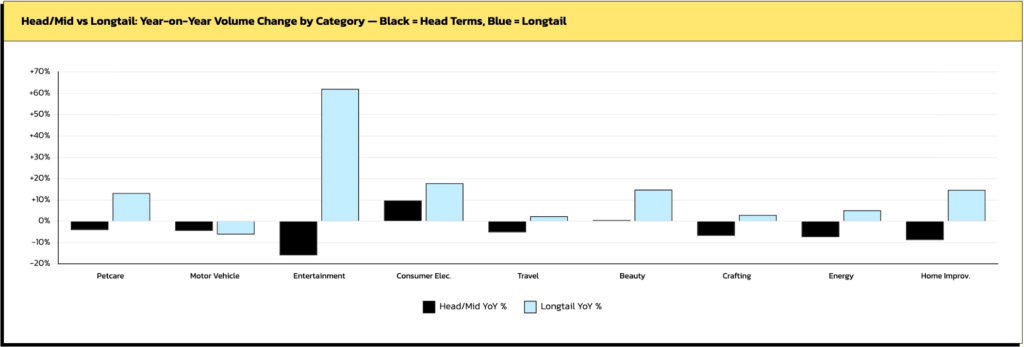
When comparing year-on-year trends for head and longtail queries side-by-side, the scale of divergence becomes apparent. In most categories, a significant gap exists, with only Beauty and Consumer Electronics showing positive growth across both tiers. The Motor Vehicles category stands out as the sole sector where both head and longtail volumes are declining, suggesting a potential migration of search activity away from Google towards more specialized automotive platforms.
The Entertainment sector exhibits the most dramatic divergence, with head terms falling by 16% while longtail experiences a remarkable 62.1% surge. This substantial longtail growth reflects a fundamental shift in how entertainment-related queries are formulated, moving from generic terms like "Netflix shows" to highly specific inquiries such as "What should I watch on Netflix if I liked Severance?" Google’s AI is increasingly answering these detailed questions.
Home Improvement (+14.7% longtail, -8.8% head) and Petcare (+13.2% longtail, -4.1% head) display a similar, albeit less pronounced, dynamic. While head term declines are evident, longtail growth provides a partial offset in total volume, and the higher AIO exposure on longtail queries alters the visibility calculus.
The Motor Vehicles category, as previously noted, deviates from this pattern. The decline in both head and longtail search volumes suggests that users are increasingly turning to manufacturer apps, dealer configurators, and dedicated automotive search tools, indicating a structurally challenged landscape for traditional search visibility.
Detailed Category Performance
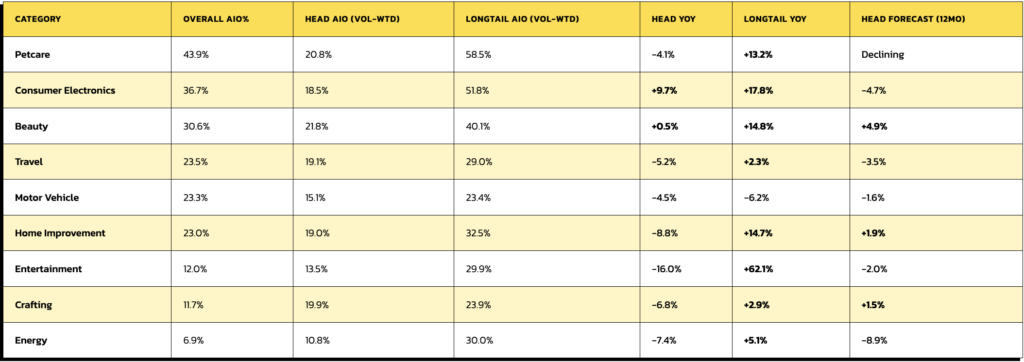
The Brainlabs analysis provides a comprehensive breakdown of all nine categories:
- Petcare: Head term decline (-4.1%) is partially compensated by strong longtail growth (+13.2%). High AIO presence on longtail queries (58.5%).
- Motor Vehicles: Both head (-15.1%) and longtail (-23.4%) volumes are declining, with minimal AIO differentiation.
- Entertainment: Sharpest head term decline (-16%), met by substantial longtail growth (+62.1%). High AIO presence on longtail queries (50.7%).
- Consumer Electronics: Positive growth across both head (+9.7%) and longtail (+27.9%) terms. High AIO presence on longtail queries (51.8%).
- Travel: Significant absolute head term decline (-5.2%), with modest longtail growth (+14.7%). Moderate AIO presence on longtail queries (39.7%).
- Beauty: Modest head term growth (+0.5%) alongside strong longtail growth (+24.1%). Moderate AIO presence on longtail queries (46.8%).
- Crafting: Decline in head terms (-6.8%), with moderate longtail growth (+14.1%). Moderate AIO presence on longtail queries (32.6%).
- Energy: Decline in head terms (-7.4%), with modest longtail growth (+7.6%). Low AIO presence overall.
- Home Improvement: Significant head term decline (-8.8%), met by strong longtail growth (+14.7%). Moderate AIO presence on longtail queries (45.7%).
Methodology and Data Insights
The Brainlabs analysis is based on 1.35 million Ahrefs keyword exports across the nine UK consumer categories, captured in May 2026. Historical search volume data spans May 2024 to April 2026, with forecast data projected from May 2026 to May 2027. AI Overview presence was identified via SERP Features within Ahrefs data. Volume-weighted AIO rates were calculated by weighting each keyword’s AIO flag against its monthly search volume, providing a more representative measure of user exposure than a simple keyword count. Head/mid terms were defined as 1-3 words, and longtail as 4+ words. Year-on-year trends were derived by comparing average monthly search volumes between two 12-month periods.
A critical aspect of the methodology is the use of volume-weighting. For example, in Petcare, a keyword like "dog food" (500,000 monthly searches) with an AIO is weighted far more heavily than a longtail keyword like "labrador puppy grain-free wet food pouches" (50 monthly searches) with an AIO. This approach ensures that the analysis reflects the actual search volume experienced by users, rather than being skewed by the sheer number of niche keywords.
The Evolving Objectives of Search Visibility
The significant shift towards longtail queries, coupled with the pervasive presence of AI Overviews, necessitates a re-evaluation of traditional search optimization strategies. Ranking in position one for a longtail query no longer guarantees traffic if an AI Overview effectively resolves user intent without a click.
This reality introduces three primary objectives for brands:

- Optimizing for AI Overview Citation: Brands must now actively work to be cited as a source within AI Overviews. This requires creating authoritative, well-structured content that presents clear, verifiable claims. The focus shifts from broad, generalized "comprehensive guides" to highly specific, factually precise content that directly answers the precise question being asked. Trust, in this context, is built on demonstrated expertise and accuracy.
- Ensuring Brand Presence in Zero-Click Scenarios: In categories with high AIO saturation, achieving brand visibility even without a click-through is crucial. When an AI Overview cites a brand, it builds credibility and awareness. Measuring this exposure requires new frameworks beyond traditional organic traffic reporting.
- Strategic Content Investment: The growing demand for longtail queries, particularly in categories like Consumer Electronics and Beauty, justifies increased content investment. However, this window may be temporary, as evidenced by the decelerating forecast for Consumer Electronics.
The decline in head term volume, despite longtail growth, has significant implications. In most sectors, head and mid-length terms still constitute 65-85% of total search volume. A 5-17% decline in this substantial volume base represents a larger absolute loss than a percentage gain on a smaller longtail base, except in specific categories like Entertainment. The longtail AIO rate is not a future concern; it is a present reality demanding immediate strategic adaptation.
Implications for Google’s Ad Revenue Model
Google’s advertising business is heavily reliant on high-volume head term auctions, where advertisers often pay significantly higher Cost-Per-Click (CPC) rates. A decline in head term volume, as observed in several major categories, directly impacts auction depth and consequently, Google’s revenue per search. The steepest risks are concentrated in Entertainment (-16% YoY), Energy (-7.4%), Home Improvement (-8.8%), and Crafting (-6.8%).
While longtail growth offers a partial offset through increased ad impressions, the revenue per click is generally lower, and inventory is more fragmented. To fully compensate for head term revenue decline, Google would require substantially higher longtail volume growth, which current data suggests is not consistently occurring across all sectors.
A more significant long-term threat for Google lies in users bypassing the SERP entirely by turning to AI tools for informational queries. In categories like Entertainment and Crafting, where conversational AI offers a credible substitute for Google searches, this "silent attrition" of queries could erode Google’s core search volume.
For paid search advertisers, the immediate implication of declining head term volume in certain categories could be a temporary increase in CPCs due to constrained supply. The long-term dynamics will depend on whether advertisers follow the volume migration to longtail searches or maintain head term budgets for brand visibility.
Conclusion: Adapting to a Transformed Search Landscape
The Brainlabs analysis paints a clear picture: the search landscape is undergoing a profound transformation driven by AI. Head terms are losing their grip, longtail queries are ascendant, and AI Overviews are increasingly shaping the user experience. Brands that continue to rely solely on traditional SEO tactics risk becoming increasingly invisible. A strategic shift towards optimizing for AI citation, understanding zero-click brand presence, and investing in longtail content is not just recommended, but essential for sustained organic visibility and competitive advantage in the evolving digital ecosystem. The window to adapt is narrowing, and proactive strategic planning is paramount.