In the dynamic landscape of digital marketing, the success of any email campaign, no matter how meticulously crafted with sharp copy and snappy design, hinges fundamentally on its ability to reach the intended recipient’s inbox. This critical, often overlooked aspect is governed by email infrastructure, the intricate behind-the-scenes plumbing that dictates whether messages land effectively or are relegated to the digital abyss of a spam folder. Establishing this infrastructure correctly is not a glamorous task, but it is unequivocally the difference between a campaign that yields tangible results and one that fails to launch.
At its core, email infrastructure refers to the comprehensive technical system responsible for sending, routing, and delivering electronic mail. This encompasses a multitude of components: the designated sending domain, the sophisticated servers that manage delivery, the essential security protocols verifying sender legitimacy, and the analytical tools employed for continuous oversight. Without a robust foundation in these areas, even the most elegantly designed email stands little chance of achieving its objective. The increasing sophistication of spam filters, coupled with a surge in cyber threats and stricter regulatory frameworks, has elevated email infrastructure from a “best practice” to an absolute necessity for any organization relying on email for communication, marketing, or transactional purposes.
The Evolution of Email Security and Deliverability Challenges
The journey of email infrastructure has been marked by continuous evolution, driven primarily by the need to combat spam and enhance security. In the early days of the internet, email delivery was relatively straightforward. However, as email became ubiquitous, it also became a primary vector for unsolicited commercial email (spam), phishing attempts, and malware distribution. This led to a gradual tightening of controls by Internet Service Providers (ISPs) and Mailbox Providers (MBPs) like Gmail, Yahoo, and Microsoft.
Initially, these providers relied heavily on IP reputation – judging incoming mail based on the sending server’s history. While still relevant, this approach proved insufficient against sophisticated spammers who frequently rotated IPs. The late 1990s and early 2000s saw the introduction of rudimentary content filtering, analyzing keywords and patterns within email bodies. However, this often led to legitimate emails being caught in spam traps.
The mid-2000s marked a significant shift with the emergence of standardized email authentication protocols. Sender Policy Framework (SPF) was introduced around 2003-2004, followed by DomainKeys Identified Mail (DKIM) in 2007. These protocols aimed to verify that an email originated from an authorized sender, moving beyond mere IP reputation to domain-level authentication. Despite their introduction, widespread adoption was slow, and their implementation remained largely voluntary for many years.
Fast forward to the 2010s, and the rise of email as a cornerstone of e-commerce and digital marketing further highlighted the need for robust deliverability. The concept of “sender reputation” became paramount, encompassing not just technical authentication but also user engagement (opens, clicks), complaint rates, and bounce rates. Deliverability became a complex interplay of technical configuration and sender behavior.
The most recent and impactful development came in late 2023, with major mailbox providers like Google and Yahoo announcing stringent new requirements for bulk senders, taking effect in February 2024. These mandates effectively transformed email authentication from an optional best practice into a mandatory prerequisite for successful inbox delivery. Senders who fail to comply risk having their emails outright blocked or routed directly to spam folders, regardless of content quality or sender intent. This chronological progression underscores a clear trend: the technical aspects of email sending are no longer peripheral but central to digital communication strategy.
Key Pillars of a Robust Email Infrastructure
Building a resilient email infrastructure involves several critical steps, each contributing to a sender’s reputation and deliverability.

1. Strategic Email Service Provider (ESP) Selection
The Email Service Provider (ESP) serves as the technological engine powering an entire email program. The decision of which ESP to partner with can have profound, long-term implications, making it a potentially costly mistake if not approached with due diligence. Before committing to a platform or considering a switch, organizations must pose the right questions to ascertain whether a given ESP can sustainably support their program’s evolving needs.
Key considerations include the ESP’s deliverability track record and reputation, often indicated by its IP pool health and adherence to industry best practices. Does the ESP actively manage its shared IP addresses to prevent blocklisting? What tools does it provide for senders to monitor their own reputation? Scalability is another vital factor; can the platform handle projected email volumes as the business grows, without compromising performance or deliverability? Integration capabilities with existing CRM systems, marketing automation platforms, and analytics tools are crucial for streamlining operations and ensuring data consistency.
Furthermore, the level of customer support and access to deliverability experts can be invaluable, especially for navigating complex technical issues or recovering from reputation setbacks. Compliance with global data privacy regulations such as GDPR (General Data Protection Regulation) and CCPA (California Consumer Privacy Act) is non-negotiable, requiring the ESP to demonstrate robust data handling and consent management features. Finally, understanding the ESP’s pricing model, which can vary based on subscriber count, email volume, or feature sets, is essential for budget planning. Choosing an ESP solely based on cost without evaluating these critical aspects can lead to significant long-term expenses in lost revenue and damaged reputation.
2. Implementing a Dedicated Sending Domain
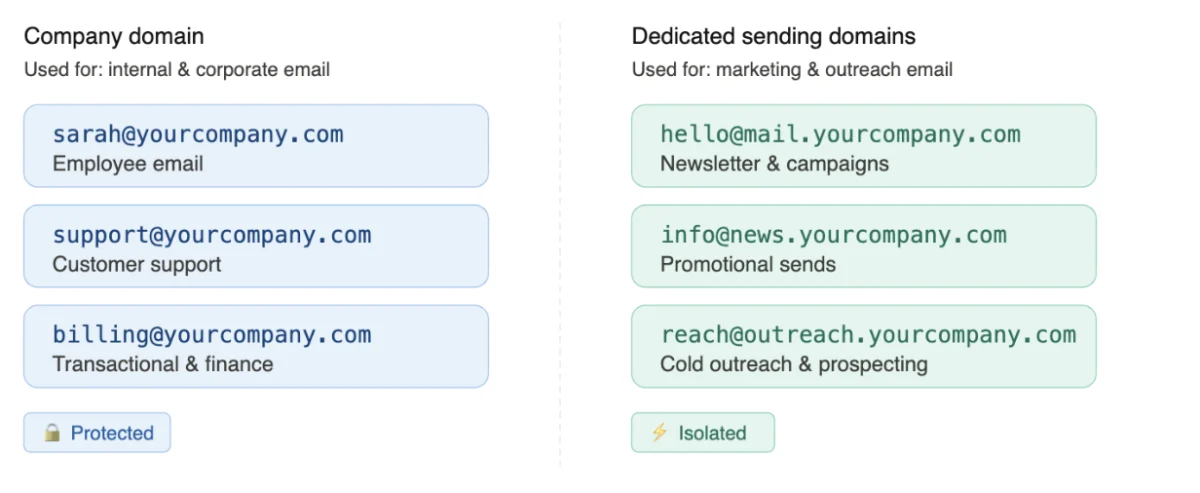
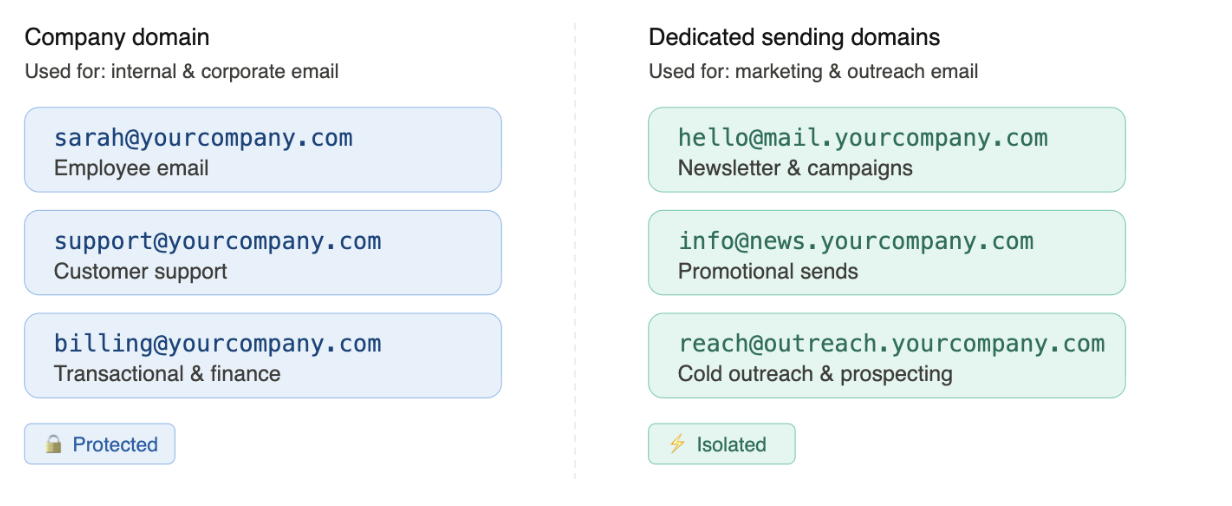
A foundational principle for maintaining email deliverability and protecting brand integrity is to avoid sending marketing emails from a company’s primary corporate domain. In the unfortunate event of a negative incident, such as a surge in spam complaints or an unexpected blocklisting, the repercussions could severely impact the domain that underpins the entire business’s operational communications.
Instead, the recommended strategy involves establishing a dedicated domain or subdomain exclusively for outreach efforts. For instance, if the main corporate domain is yourcompany.com, which remains strictly for core business email correspondence, a separate entity such as marketing.yourcompany.com or even an entirely distinct domain like yourcompany-news.com should be configured for marketing sends. This strategic separation serves multiple purposes. It acts as a protective shield, keeping the corporate email domain pristine and insulated from potential reputation damage associated with marketing activities. Concurrently, it provides a controlled environment to meticulously build and nurture a sender reputation from the ground up, specifically for marketing communications. This isolation ensures that any issues arising from marketing campaigns do not inadvertently compromise critical business operations, thereby safeguarding essential communications and brand trust.
(Image Placeholder: Illustrating separate domains for corporate vs. marketing)
3. Configuring Mandatory Authentication Protocols
Email authentication has transitioned from a mere “best practice” to an absolute requirement in the contemporary digital landscape. Major mailbox providers, including Gmail, Yahoo, and Microsoft, have unequivocally mandated robust authentication for all bulk senders, a policy whose enforcement is only intensifying. Neglecting this crucial step no longer merely results in underperforming campaigns; it almost certainly guarantees that emails will be blocked outright or heavily filtered into spam folders.
Three primary authentication protocols form the bedrock of legitimate email sending:
-
Sender Policy Framework (SPF): SPF allows a domain owner to publish a list of authorized servers that are permitted to send email on behalf of their domain. When an email server receives an incoming message, it checks the SPF record of the sender’s domain to verify if the sending IP address is on the approved list. If the IP is not authorized, the receiving server can flag the email as suspicious, potentially quarantining or rejecting it. This helps prevent spammers from forging the sender’s address.
-
DomainKeys Identified Mail (DKIM): DKIM adds a digital signature to outgoing emails, cryptographically linking the email to the sending domain. This signature is generated using a private key by the sending server and verified by the receiving server using a public key published in the sender’s DNS records. DKIM ensures the email’s content has not been tampered with in transit and confirms the sender’s identity, adding another layer of trust and integrity.
-
Domain-based Message Authentication, Reporting, and Conformance (DMARC): DMARC builds upon SPF and DKIM by providing a policy framework for domain owners to specify how receiving servers should handle emails that fail SPF or DKIM authentication. DMARC policies can instruct receiving servers to “none” (monitor without action), “quarantine” (send to spam), or “reject” (block outright) unauthenticated messages. Crucially, DMARC also provides reporting capabilities, sending aggregate data back to the domain owner about email authentication failures, offering invaluable insights into potential spoofing attempts or misconfigurations. The recent Google and Yahoo mandates specifically require DMARC implementation for bulk senders.
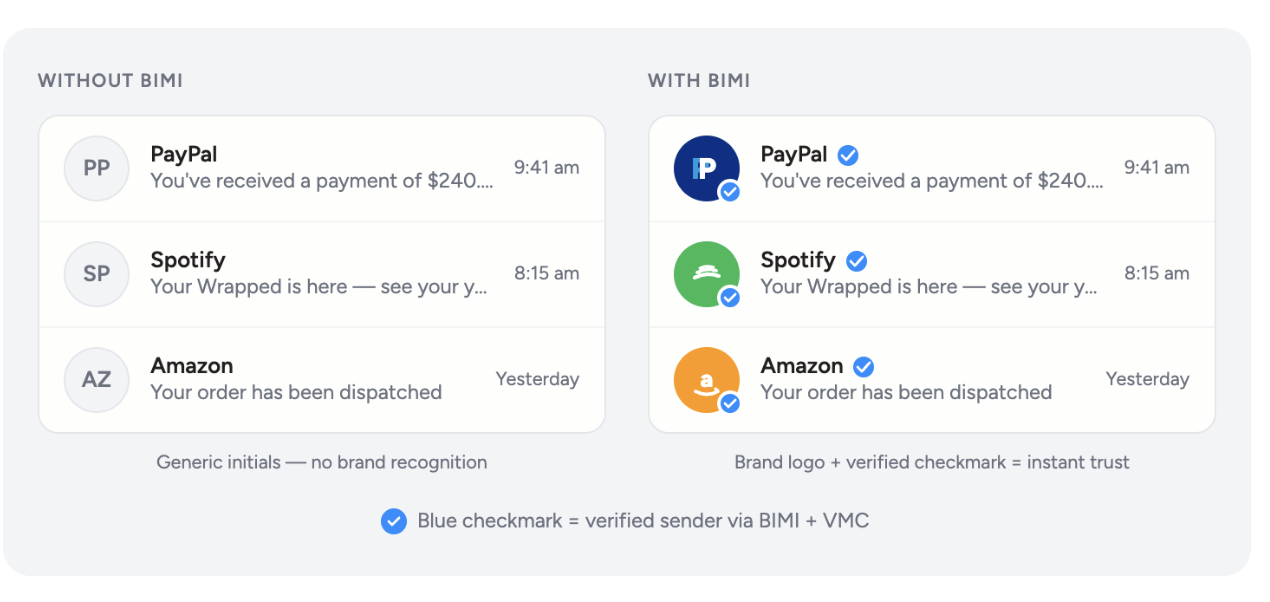
Implementing these protocols typically falls under the purview of an organization’s IT team or domain administrator, requiring specific DNS record configurations. Beyond these core three, Brand Indicators for Message Identification (BIMI) is an emerging standard that allows organizations to display their verified brand logo next to authenticated email messages in supporting inboxes. While not directly a deliverability protocol, BIMI enhances brand recognition, trust, and engagement, further rewarding senders who have meticulously set up their SPF, DKIM, and DMARC. According to a 2023 report by Valimail, DMARC adoption by Fortune 500 companies reached 93%, highlighting its widespread recognition as a critical security measure. The average global DMARC adoption rate has also seen significant growth, demonstrating an industry-wide commitment to securing email communications.
(Image Placeholder: Illustrating SPF, DKIM, DMARC flow)
4. Patient Domain Warming
A newly established sending domain possesses zero historical reputation with mailbox providers. Consequently, launching a large-scale email campaign immediately after setup is one of the quickest routes to being flagged as spam. Mailbox providers are inherently suspicious of new domains that suddenly send high volumes of email, as this behavior often mimics that of spammers. Instead, a methodical and patient approach to “domain warming” is essential to gradually build a positive sender reputation.
A robust warming strategy typically involves starting with a modest volume of emails, perhaps around 500–1,000 per day, during the initial days. These initial sends should be directed exclusively to the most engaged contacts within a mailing list—individuals who have recently interacted with previous communications (e.g., opened, clicked). This strategy ensures that initial engagement metrics are high and complaint rates are low, sending positive signals to mailbox providers. Every few days, the sending volume can be incrementally increased, roughly doubling it, provided that critical metrics such as bounce rates and spam complaints remain at acceptably low levels (ideally below 0.1% for complaints). If these metrics show an undesirable spike, it is imperative to reduce volume or even pause sending to address the underlying issues before attempting to increase volume again.
This meticulous process is not a quick fix; it typically spans several weeks, not days. While the patience required can be challenging, the sender reputation cultivated through a careful warmup period forms the indispensable foundation upon which all future email marketing success depends. Neglecting this phase can lead to prolonged deliverability issues, significantly hampering campaign effectiveness and potentially requiring extensive remedial work to repair a damaged reputation.
5. Proactive Deliverability Monitoring
A common misconception among senders is that an email reported as “delivered” by an ESP has successfully reached the recipient’s inbox. This is often not the case. According to Validity’s 2026 Email Deliverability Benchmark report, a significant portion—1 in 7 legitimate, permission-based marketing emails—never actually reaches the inbox, instead landing in spam folders or being blocked entirely. This stark reality underscores why active and continuous deliverability monitoring is not merely advisable but absolutely essential.
Effective monitoring involves tracking several key metrics:
- Inbox Placement Rate: The percentage of emails that successfully land in the primary inbox, rather than spam or promotions folders.
- Spam Complaint Rate: This is a critical metric. Senders should strive to keep their spam complaint rate below 0.3%, with an ideal target of 0.1% or less. High complaint rates are a strong indicator of poor sender reputation and can lead to blocklisting.
- Bounce Rate: Distinguishing between “hard bounces” (permanent delivery failures due to invalid email addresses) and “soft bounces” (temporary issues like a full inbox). Hard bounces indicate a need for list hygiene, while persistent soft bounces can signal broader deliverability problems.
- Blocklisting Status: Regularly checking if sending IPs or domains have been listed on major industry blocklists.
- Engagement Metrics: Beyond technical delivery, open rates, click-through rates, and conversion rates provide insights into how recipients are interacting with emails, which indirectly influences sender reputation.
To gain comprehensive visibility into how major inbox providers perceive their sending reputation, organizations should leverage free feedback loops and postmaster tools. These include Google Postmaster Tools, Microsoft SNDS (Smart Network Data Services), and Yahoo Sender Hub. These platforms offer invaluable data on sender reputation, IP and domain health, spam complaint rates, and deliverability issues as seen directly by the mailbox providers. This data goes beyond merely confirming if emails were “accepted at mailbox providers’ gateways” and provides actual insights into inbox placement. Regular analysis of these tools allows senders to proactively identify and address potential problems before they escalate into widespread deliverability crises.
Broader Impact and Implications
The investment in robust email infrastructure extends far beyond mere technical compliance; it carries significant implications across business, security, and competitive landscapes.
Business Impact: Poor deliverability directly translates to lost revenue. If marketing emails, promotional offers, or transactional notifications fail to reach the inbox, sales opportunities are missed, customer engagement plummets, and customer churn can increase. The return on investment (ROI) of email marketing, consistently one of the highest among digital channels, is entirely dependent on inbox placement. A strong infrastructure ensures that marketing spend translates into measurable results. Conversely, neglecting infrastructure can lead to substantial financial losses, both in terms of direct campaign underperformance and the long-term cost of rebuilding a tarnished brand reputation.
Security Implications: Strong email authentication protocols like SPF, DKIM, and DMARC are crucial defenses against phishing, spoofing, and other forms of email-borne cybercrime. By verifying the authenticity of the sender, these protocols make it significantly harder for malicious actors to impersonate legitimate organizations, thereby protecting both the company’s brand and its customers from fraudulent activities. The widespread adoption of these standards contributes to a safer email ecosystem for everyone.
Competitive Advantage: In an increasingly crowded digital marketplace, organizations that proactively invest in and maintain superior email infrastructure gain a distinct competitive advantage. Their messages are more likely to reach the inbox, fostering stronger customer relationships, driving higher engagement, and ultimately outperforming competitors who lag in their deliverability efforts. This enables more effective communication strategies and a more reliable connection with their audience.
Future Trends: The landscape of email deliverability is continuously evolving. Artificial intelligence (AI) is playing an increasingly significant role in spam filtering, with algorithms becoming more sophisticated at detecting nuanced patterns of malicious or unwanted email. Furthermore, privacy concerns continue to shape email policies, with a greater emphasis on consent management and data protection. Senders who embrace these changes and maintain agile infrastructure will be better positioned to adapt to future mandates and technological advancements.
Conclusion: A Non-Negotiable Investment
While establishing and maintaining solid email infrastructure may not be the most captivating aspect of digital marketing, it is unequivocally the foundational element that underpins the success of all other efforts. The current trend indicates that authentication requirements will only become stricter, and inbox algorithms will continue to grow smarter. Consequently, the performance gap between senders who prioritize investment in their infrastructure and those who do not is widening at an accelerated pace.
Organizations must begin with a technically sound foundation, meticulously warm up their sending domains, and consistently monitor their deliverability metrics with unwavering vigilance. By adhering to these principles, businesses will position themselves advantageously to consistently reach their target audiences, safeguard their brand reputation, and maximize the efficacy of their email communications in an increasingly complex digital environment. For those navigating the technical intricacies, specialized professional services are available to audit existing setups, configure essential authentication protocols, and ensure sustained deliverability, transforming potential hurdles into pathways for robust digital communication.


 Ammar Sabilarrohman
 Asro
Asro