The landscape of digital marketing is undergoing a profound transformation with the rise of artificial intelligence (AI) in search. For the initial phase of this evolution, the primary question for marketers was straightforward: "Does our brand appear in AI-generated answers?" This led to the widespread adoption of metrics like mentions and citations, which offered a basic measure of brand presence. However, as AI search matures, these foundational metrics are proving insufficient to capture the true impact and longevity of a brand’s visibility. The industry is now grappling with a more complex challenge: demonstrating that this visibility is not only consistent and valuable but also sustainable. In response, a new framework of Key Performance Indicators (KPIs) is emerging, aiming to move beyond simply proving presence to understanding what that presence signifies and whether it endures.
The early days of AI search reporting were characterized by a focus on quantifiable presence. Mentions tracked the frequency of a brand’s appearance in AI responses, while citations indicated how often these responses linked back to brand-associated sources. These metrics served as crucial initial indicators, allowing businesses to confirm their inclusion in the nascent AI search ecosystem. Yet, as marketers delved deeper, they discovered the limitations of mere presence. A brand might be mentioned numerous times but never be the AI’s primary recommendation. It could appear consistently but be described in ways that contradicted established brand positioning. Furthermore, the ephemeral nature of online content meant that a citation earned one week might vanish the next. Critically, even strong visibility scores could be misleading if the prompts being tracked bore little resemblance to the actual queries real customers were posing.
This measurement challenge marks the current frontier of AI search. While 2025 was largely defined by the effort to establish brand presence, 2026 is rapidly becoming the year to validate the meaning and resilience of that visibility. To address this evolving need, a series of proposed KPIs have been developed and tested. These are not yet industry standards but represent a framework designed to extract deeper insights from existing data. By borrowing methodologies from fields such as statistics, bibliometrics, brand tracking, and survey research, these KPIs aim to shift the conversation from "Are we present?" to a more strategic set of questions: "Where are we strong?", "Are we being chosen?", "How are we being understood?", "Does our visibility last?", and "Are we measuring the right demand?"
Consensus Position: Gauging the Consistency of AI Platform Endorsement
A fundamental limitation of simple mention scores is their inability to reveal the distribution of a brand’s presence across different AI platforms. While a brand might appear frequently in total, this aggregate data can obscure significant variations in how consistently it is recognized. The Consensus Position KPI directly addresses this by treating each AI platform as an independent arbiter of information. For any given prompt, this metric quantifies how many of the tracked AI platforms include the brand in their responses.
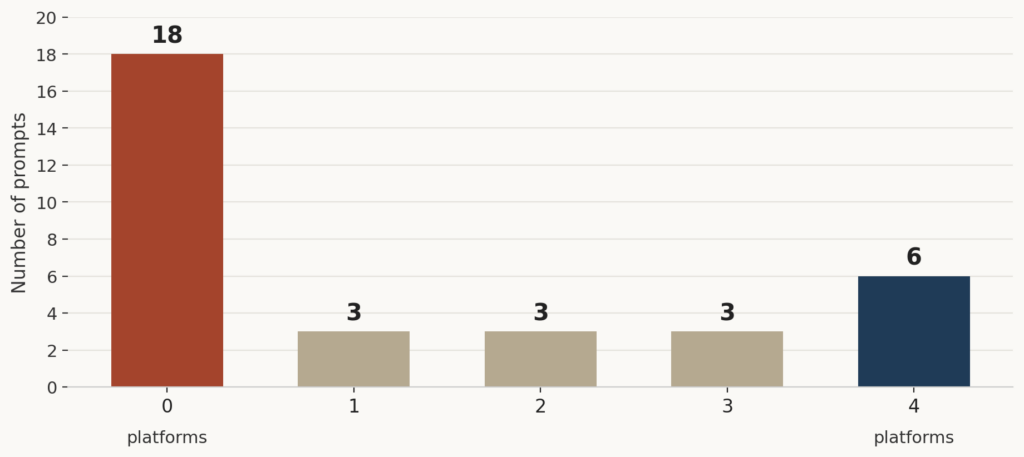
For example, if a marketer is monitoring four distinct AI platforms, a prompt could result in the brand appearing on zero, one, two, three, or all four platforms. Instead of averaging these outcomes into a single, potentially misleading figure, Consensus Position reveals the actual distribution. In a recent analysis involving an anonymized B2B brand, tracking 33 prompts across four AI platforms over 13 weeks, the data illustrated this point starkly. A simple average might suggest a modest presence of approximately 1.3 platforms per prompt. However, the distribution told a far more nuanced story: 18 prompts showed zero brand presence, six achieved consensus across all four platforms, and nine landed in the intermediate range, appearing on one to three platforms.
This granular view is crucial for strategic decision-making. Prompts where the brand is invisible across all tracked platforms highlight areas where new content creation or authority-building initiatives may be necessary. Those with full consensus represent strong positions that require reinforcement and defense. The prompts with partial presence are often the most actionable, offering a clear path for improvement by closing the remaining gap to achieve broader platform agreement. Ultimately, Consensus Position moves beyond a raw visibility score to reveal the breadth and agreement of a brand’s presence, preventing valuable distinctions from being lost in aggregation.
Share of Recommendations: Differentiating Presence from Endorsement
Once a brand’s presence is established, the critical next step is to understand how AI platforms are utilizing that presence. There’s a significant qualitative difference between an AI mentioning a brand as one option among many and explicitly recommending it as the preferred solution. Most existing mention metrics fail to make this distinction, treating both scenarios identically.
Consider a scenario where a user asks an AI for the "best project management software." The AI might list eight vendors, but then highlight one as the most suitable for the user’s specific needs. In this instance, all eight vendors receive a mention, but only one earns a recommendation. The Share of Recommendations KPI is designed to isolate this crucial distinction.
In the aforementioned B2B brand analysis, 42 brand mentions were recorded across 33 prompts. However, only four of these instances met the criteria for a recommendation – where the brand was presented as the definitive answer, the primary choice, or an explicit suggestion. This resulted in a Share of Recommendations of 12.1%. More revealingly, a recommendation rate among mentions of 9.5% was calculated. This second figure offers insight into how frequently a brand’s presence translates into active endorsement by the AI.
A brand appearing in 80% of answers but recommended in only 5% faces a different strategic challenge than one appearing in 20% of answers and recommended 15% of the time. The former struggles with persuasion despite broad visibility, while the latter may be compelling when it appears but lacks sufficient overall coverage. Mention counts alone can obscure these critical differences. Therefore, Share of Recommendations emerges as one of the most valuable signals in AI search, akin to a conversion metric, pinpointing the moment an AI transitions from merely informing a user about market options to actively guiding their selection. Establishing a clear, consistent definition of what constitutes a "recommendation" is vital, especially when AI models employ nuanced language. The key is consistency in application to ensure that changes in the metric reflect shifts in AI behavior, not just classification adjustments.
Citation Half-Life: Measuring the Durability of AI Visibility
While being cited by an AI is valuable, the longevity of that citation significantly impacts its true worth. A citation that disappears within a week offers a vastly different return on investment than one that persists for months. Citation Half-Life introduces a temporal dimension to measurement, tracking the lifespan of cited URLs.
For each URL cited by an AI platform, this metric records its first appearance and subsequent appearances across repeated prompt executions. The resulting "half-life" indicates the typical duration for which a cited URL remains in active AI responses. In the test case, the median half-life for URLs cited more than once was 28 days. However, a more striking finding was that 76% of all cited URLs appeared for only a single week before disappearing entirely.
This revelation fundamentally alters the perception of AI visibility. Content that consistently earns long-lived citations can become a compounding asset, with the initial effort to earn the citation yielding ongoing visibility benefits. Conversely, content whose citations are fleeting creates a treadmill effect, requiring continuous effort to re-establish visibility. This principle also extends to third-party sources. If citations from one review site consistently endure while those from another aggregator vanish quickly, the former may hold significantly more long-term value, even if their immediate citation counts are similar.
Citation Half-Life directly addresses a critical gap in current AI visibility dashboards: identifying where investments are generating durable presence and where efforts are yielding only temporary results. While the 28-day median in the study applied only to URLs cited multiple times, and the overall median would approach zero, the significance lies in demonstrating that durability can be measured and compared over time. The 13-week study window, while short, was sufficient to prove the concept, laying the groundwork for establishing industry benchmarks in the future.
Share of Narrative: Understanding What AI Platforms Say About Your Brand
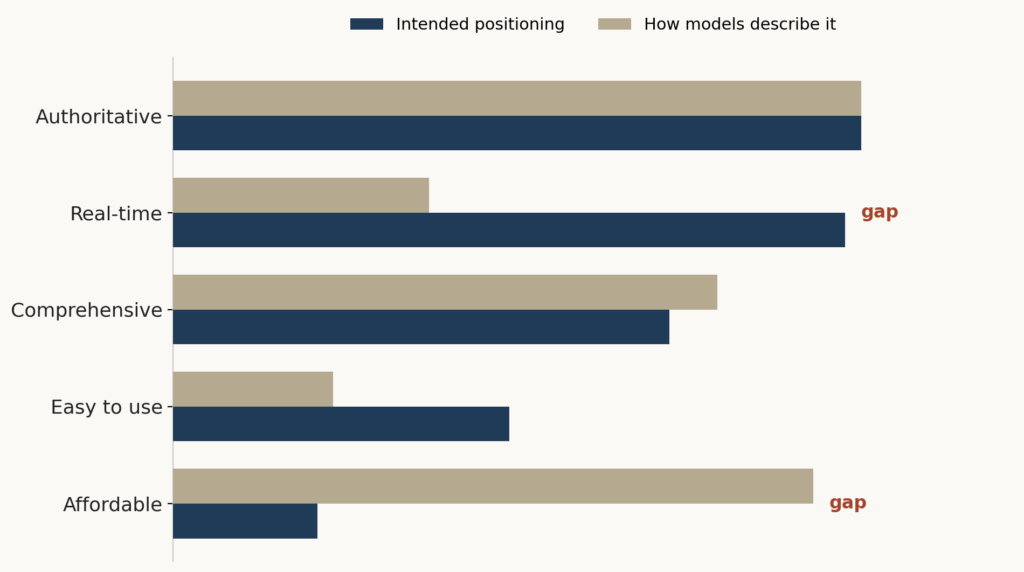
A brand can excel in mentions, recommendations, and citations and still face significant challenges if the narrative surrounding it is misaligned with its strategic positioning. Share of Narrative moves beyond mere presence to assess how AI platforms characterize a brand, analyzing the attributes, use cases, and descriptive language associated with it. The goal is to measure the congruence between the AI’s portrayal and the brand’s desired positioning.
This metric is particularly important because narrative problems often manifest subtly, rather than through overt negative sentiment. Imagine a software company that has invested heavily in positioning itself as a leader in real-time data processing. If AI platforms consistently describe it as "comprehensive, though slower to update," a conventional visibility dashboard might appear healthy. However, from a brand perspective, this indicates that the AI has internalized a detrimental characteristic.
Given the interpretive nature of this metric, a robust methodology is essential. A recommended approach involves three steps:
- Attribute Identification: Define a set of key attributes, use cases, or descriptive terms that align with the brand’s strategic positioning. These should be derived from internal messaging frameworks.
- AI Response Analysis: Systematically analyze AI-generated content related to the brand, identifying instances where these defined attributes are mentioned or implied. This can involve natural language processing (NLP) tools or manual coding.
- Narrative Alignment Scoring: Quantify the frequency and prominence of the desired attributes in AI descriptions compared to any conflicting or absent narratives.
The critical takeaway from Share of Narrative is identifying critical attributes that consistently fail to appear in AI responses, suggesting that supporting evidence may not be reaching the sources AI platforms rely on. Conversely, a sudden shift in narrative on one platform, while stable on others, can point to the influence of a specific source, page, or discussion. This metric is best viewed as a trend indicator rather than a fixed benchmark, as changes in attribute lists or classification methods can alter results. The valuable signal lies in observing whether the gap between the brand’s intended perception and the AI’s portrayal is widening or narrowing over time.
Prompt Space Coverage: Ensuring Measurement Aligns with Real-World Demand
All the preceding metrics are predicated on a crucial assumption: that the prompts being tracked accurately represent the demand landscape the marketer aims to address. This assumption warrants rigorous scrutiny. Unlike traditional keyword research in a more observable search environment, the behavior of prompt-based AI interactions is far less defined. Users can articulate the same need in myriad ways, incorporating context, specific entities, multiple requirements, or engaging in conversational follow-ups.
Consequently, the denominator of any AI visibility score – the list of tracked prompts – is inherently a selection. Prompt Space Coverage directly challenges this selection by assessing the overlap between the chosen prompt list and the actual queries users are posing in the real world.
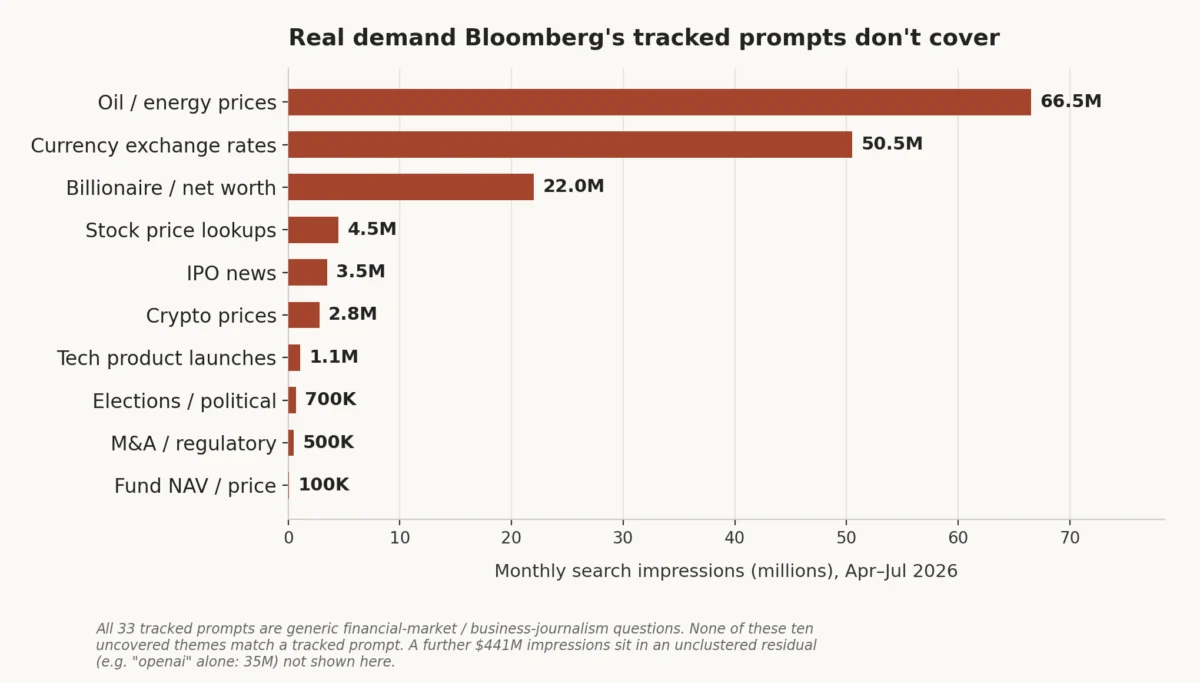
In the research underpinning this framework, the 33 tracked prompts for the B2B brand were predominantly generic, evergreen questions related to financial markets and business journalism. A comparison with Search Console data from April to July 2026 revealed a significant disparity. Approximately 690 million impressions across around 15,000 queries fell within themes not represented by the tracked prompts. These unaddressed areas included substantial demand around oil and energy prices (66.5 million impressions), currency exchange rates (50.5 million impressions), and billionaire net-worth rankings (22 million impressions), alongside considerable interest in stock prices, IPO news, cryptocurrency, tech launches, elections, and mergers and acquisitions.
While the AI visibility program might have performed adequately against the limited set of tracked prompts, the issue was that these prompts captured only a fraction of the overall demand. Prompt Space Coverage serves as an essential "honesty check" for all other AI visibility metrics. A claim of "38% Share of Mentions" gains critical context when it’s understood that the underlying prompts represent only 61% of identified demand themes. The more accurate statement becomes "38% Share of Mentions at 61% prompt coverage."
This metric is not intended to achieve perfect precision, as the reference set of real-world queries is itself a sample. Its primary function is to expose significant blind spots. The uncovered areas are often more valuable than the percentage itself, providing marketing teams with an immediate list of questions they are neither tracking nor, potentially, answering through their AI visibility strategies.
An Additional Signal: Source Concentration
Beyond the core KPIs, Source Concentration offers valuable contextual insight. This metric examines the degree to which a brand’s AI visibility relies on a limited number of cited domains. High dependency on just a few websites can render visibility more fragile than a similar level of exposure spread across numerous independent sources.
Drawing inspiration from the Herfindahl-Hirschman Index used in market concentration analysis, this application to AI search can reveal whether citation visibility is broadly distributed or disproportionately concentrated. In the tested account, a median Source Concentration score of 407 (on a 0-10,000 scale) suggested a relatively diverse sourcing landscape.
It is important to note that Source Concentration is not necessarily a metric to be optimized downwards in all cases. Some industries inherently possess a smaller pool of authoritative sources. However, understanding the concentration of a brand’s visibility is crucial for risk assessment. Changes to a single influential page, the locking of a content thread, or the implementation of a crawler block on a dominant domain could create disproportionate risk for brands with highly concentrated citation sources.
The Future of AI Visibility: A Multifaceted Approach, Not a Single Score
The temptation with five new metrics might be to aggregate them into a singular "master AI Visibility Score." However, this approach risks obscuring the nuanced insights each KPI provides. Each metric is designed to answer a distinct strategic question: Consensus Position illuminates where visibility is established or fragmented; Share of Recommendations clarifies whether visibility translates into advocacy; Citation Half-Life assesses the persistence of visibility; Share of Narrative reveals what a brand is being known for; and Prompt Space Coverage ensures the measurement framework is aligned with actual demand.
Compressing these distinct questions into a single number simplifies dashboards but can make underlying problems harder to identify and address. The example of Consensus Position highlights this: an average of 1.3 platforms per prompt might seem unremarkable. However, this average masks three entirely different scenarios – complete invisibility, full consensus, and partial presence – each requiring a unique strategic response. The average obscures the very distinctions that make the data actionable.
Furthermore, the field of AI search measurement is still in its nascent stages. None of these metrics have been definitively validated against long-term revenue performance, and some, particularly Share of Narrative, remain inherently interpretive. The objective is not to overstate the maturity of AI search measurement but to build upon established methodologies and test their efficacy in providing marketers with superior signals compared to basic mention and citation counts.
The evolution of AI visibility measurement is essential for marketers to navigate the complexities of this new digital frontier. Knowing that a brand appears in an AI answer is a starting point. Understanding how consistently it appears, whether it is recommended, what the AI says about it, how long that visibility endures, and whether the measurement framework is tracking the right demand provides the foundation for a robust and adaptable AI search strategy. Mentions and citations proved that brands could show up. The next critical task is to prove that this presence holds enduring value and strategic significance.