


While the digital marketplace continues to expand, the technical complexity of enterprise-level e-commerce platforms often creates a significant barrier to effective conversion rate optimization. Most standard A/B testing frameworks operate under the assumption of a linear, lightweight architecture. However, Magento—rebranded as Adobe Commerce following its landmark $1.68 billion acquisition by Adobe in 2018—operates on a sophisticated, multi-layered infrastructure that requires a specialized approach to experimentation. For enterprise store owners, the stakes are high: inconsistent test delivery can lead to corrupted data, skewed analytics, and a degraded user experience that directly impacts the bottom line.
The Evolution of the Magento Architecture
To understand the challenges of A/B testing on this platform, one must look at the chronology of its development. Originally launched in 2008, Magento quickly became the gold standard for flexibility in e-commerce. By the time it was integrated into the Adobe Experience Cloud, it had evolved into a robust system capable of handling thousands of transactions per minute across multiple global storefronts. This robustness is achieved through a combination of full-page caching (FPC), Varnish integration, and a complex session-handling logic.
While these features ensure high performance and scalability, they introduce a "blind spot" for traditional client-side testing tools. Because the platform is designed to serve pre-rendered HTML to maximize speed, it often bypasses the visitor-level logic required to assign different versions of a page to different users.
The Technical Complexity of Enterprise Caching
The primary differentiator for Magento Enterprise is its reliance on the Varnish layer. Varnish acts as a reverse proxy cache, sitting in front of the web server to intercept requests. In a standard environment, Varnish serves identical HTML to every visitor to maintain sub-second load times.
From an A/B testing perspective, this creates a fundamental conflict. If a testing tool attempts to bucket a user into "Variant A" while Varnish is serving a cached "Variant B," the result is either a "flicker" effect—where the original content flashes before the variant appears—or a total failure of the experiment. Consequently, reliable testing on Adobe Commerce necessitates a configuration where the cache is "aware" of the testing cookies. Without this synchronization, data integrity is compromised, as a single visitor might see different versions of the same page across a single session.
Strategic Priority Areas for Magento Optimization
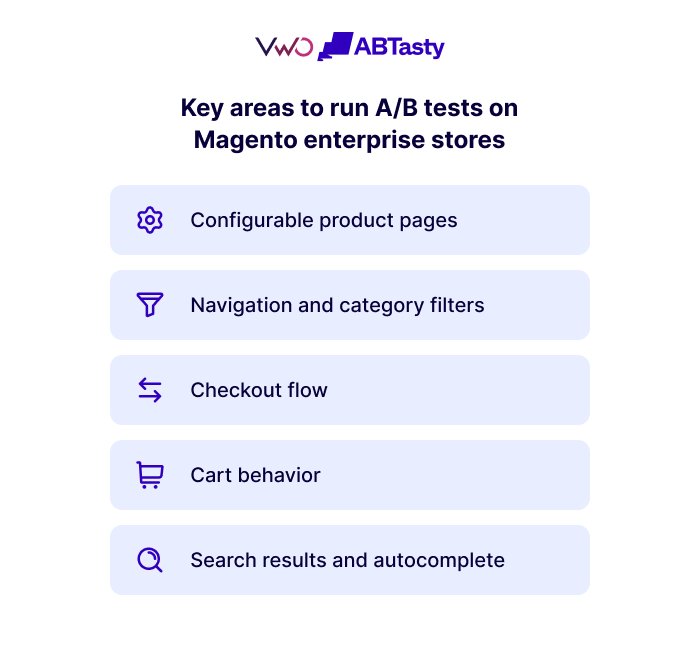
Given the template-driven nature of Adobe Commerce, enterprise brands can achieve the highest return on investment by focusing their experimentation on high-traffic, high-impact areas.
1. Configurable Product Pages
Magento’s native ability to handle configurable products—items with multiple attributes like size, color, or material—offers a fertile ground for testing. Optimization teams often experiment with how these attributes are displayed (e.g., dropdowns vs. visual swatches) and how stock status or "low inventory" alerts are communicated. Data suggests that refining the visual hierarchy of these pages can improve "Add to Cart" rates by as much as 15% for high-inventory retailers.

2. Layered Navigation and Category Filters
For stores with massive catalogs, the efficiency of product discovery is paramount. Layered navigation is often the most overlooked element in CRO programs. Testing the order of filters, the default state of expansion (collapsed vs. expanded), and the mobile-specific filter UI can significantly reduce bounce rates on category pages.
3. The Multi-Step Checkout Flow
The Adobe Commerce checkout is a highly structured process involving address validation, shipping selection, and payment processing. Unlike more restrictive platforms, Magento allows for deep customization of these steps. Testing the removal of non-essential fields or the inclusion of trust signals at the payment stage is critical, especially considering the global e-commerce cart abandonment rate hovers at approximately 70.22%.
4. Intelligent Search and Autocomplete
With the rise of "search-first" shopping behavior, the search bar has become a critical conversion point. Enterprise teams often test the default sort order of search results and the effectiveness of autocomplete suggestions. Promoting high-margin products within the search dropdown is a common tactic that requires rigorous A/B testing to validate.
Best Practices for Technical Implementation
To ensure that experiments yield reliable, data-backed results, optimization teams must adhere to a strict set of technical protocols.
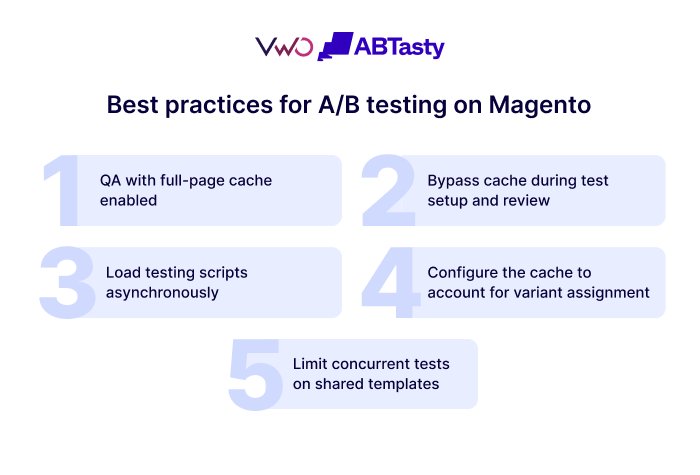
- Asynchronous Script Loading with Pre-hiding: To maintain site speed, testing scripts should load asynchronously. However, to eliminate the "flicker" effect, a pre-hiding snippet must be placed at the very top of the
<head>tag. This temporarily suppresses the page content until the variant is ready to render, ensuring a seamless user experience. - Persistent First-Party Cookies: Given the increasing restrictions on third-party cookies, it is essential that the testing tool utilizes first-party cookies for visitor bucketing. Furthermore, the Magento FPC and Varnish configuration must be updated to "Vary" the cache based on these specific cookies.
- Environment Mirroring: Quality Assurance (QA) should never be conducted on a "naked" staging site. The staging environment must mirror the production site’s caching and Varnish configuration. A test that appears functional without a cache may break entirely once deployed to a cached production environment.
- Bypassing Cache for Review: During the setup phase, developers often use IP-based bypasses or specific developer-mode cookies to view live changes without affecting the global cache. This allows for real-time adjustments without risking the integrity of the data being collected from actual visitors.
Organizational Alignment and Resource Allocation
Successful experimentation on an enterprise scale is as much about people as it is about technology. Garret Cunningham, Director of Global Optimization at Columbus Global, emphasizes that testing velocity is tied to dedicated resources. Organizations that rely on "shared" design and development teams—those who also handle general maintenance—often find their testing programs stalled.
Furthermore, Ilan Hurwitz, a leading voice in enterprise e-commerce, notes that the biggest challenge for large-scale businesses is securing alignment across departments. A marketing-led A/B test that inadvertently breaks a B2B pricing rule on a shared template can create significant friction. Therefore, a centralized "Center of Excellence" for experimentation is often recommended for Magento stores operating multiple brands or international storefronts.

Comparative Analysis of Enterprise Testing Tools
Several platforms have emerged as leaders in the Magento ecosystem, each catering to different organizational needs:
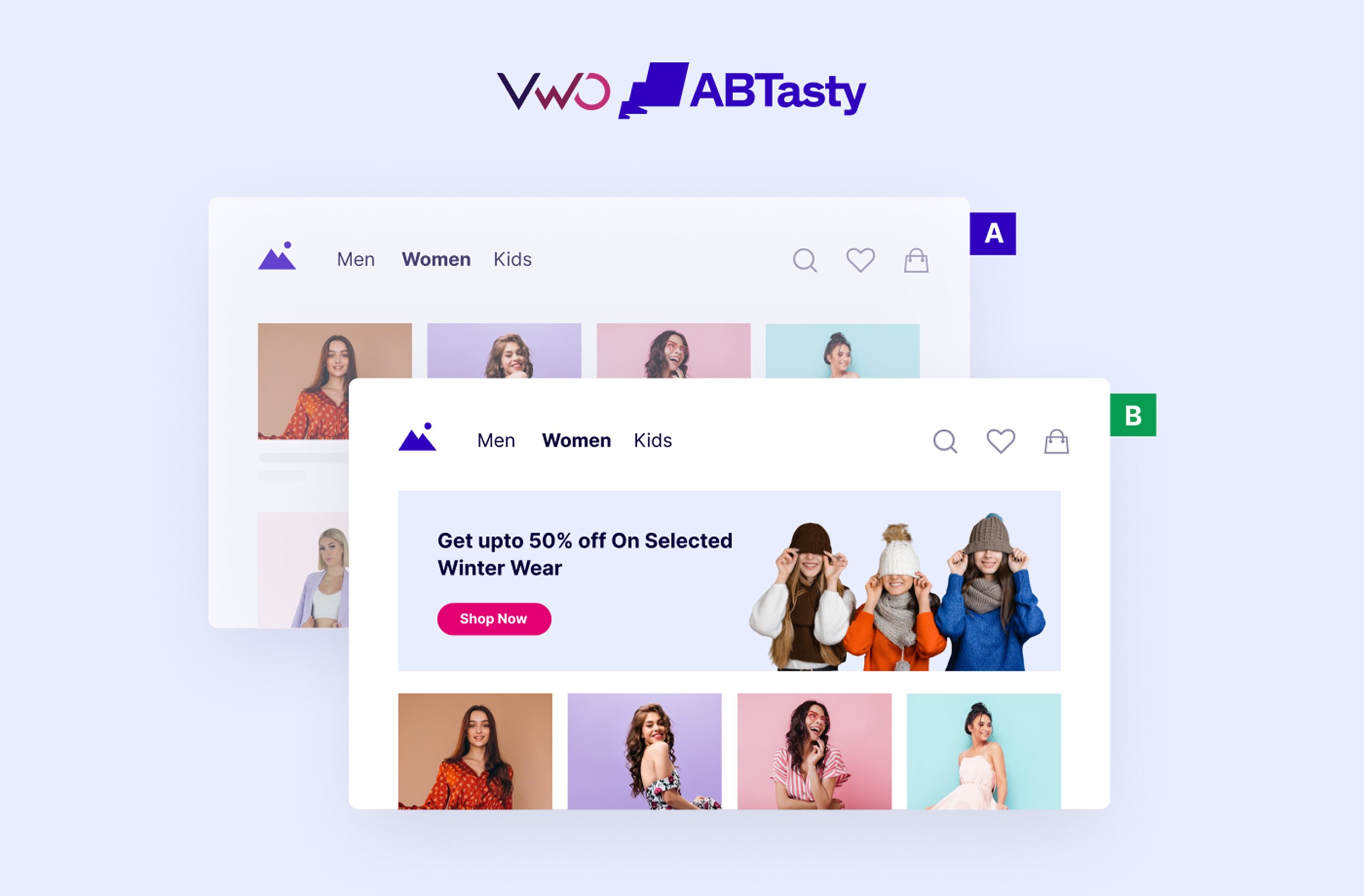
- VWO AB Tasty: Known for its deep integration capabilities, it allows for both client-side and server-side testing. Its "SmartCode" can be scoped to specific store views, making it ideal for multi-storefront architectures.
- Kameleoon: This platform is frequently selected by high-traffic stores that require advanced personalization. It is designed to handle variant assignment early in the request cycle, which mitigates some of the challenges posed by heavy caching.
- Optimizely: A long-standing player in the enterprise space, Optimizely offers a suite that combines A/B testing with content management. It is often the choice for teams that want to integrate experimentation directly into their broader digital experience stack.
Broader Impact and Industry Implications
The move toward more rigorous A/B testing on Magento Enterprise reflects a broader shift in the e-commerce industry. As customer acquisition costs (CAC) continue to rise across social and search channels, brands are shifting their focus toward maximizing the value of existing traffic.

In the B2B sector, where Magento holds a significant market share, experimentation is being used to optimize complex buying flows, such as quote requests and requisition lists. For these businesses, a 1% increase in conversion doesn’t just mean more orders; it can mean millions of dollars in recurring contract value.
Ultimately, the complexity of Adobe Commerce should not be seen as a deterrent to experimentation, but rather as a competitive advantage. Brands that invest the time to correctly configure their testing infrastructure—balancing the needs of the Varnish layer with the requirements of the testing tool—will gain insights that their less-sophisticated competitors cannot reach.

Analysis of Future Trends
Looking ahead, the integration of Artificial Intelligence (AI) into the Magento testing workflow is set to redefine "agentic optimization." Tools like VWO’s Wandz are beginning to offer automated hypothesis generation based on user behavior data. As these AI agents become more adept at navigating the specific architectural quirks of Magento, the barrier to entry for complex tests will lower, allowing teams to focus on high-level strategy rather than technical troubleshooting.
In conclusion, A/B testing on Magento Enterprise is a specialized discipline. It requires a deep understanding of server-side caching, a disciplined approach to QA, and a strategic focus on high-leverage site elements. By treating the platform’s complexity with the respect it deserves, enterprise brands can transform their online stores into high-performance engines of growth, backed by the certainty of statistical significance.







