rifanmuazin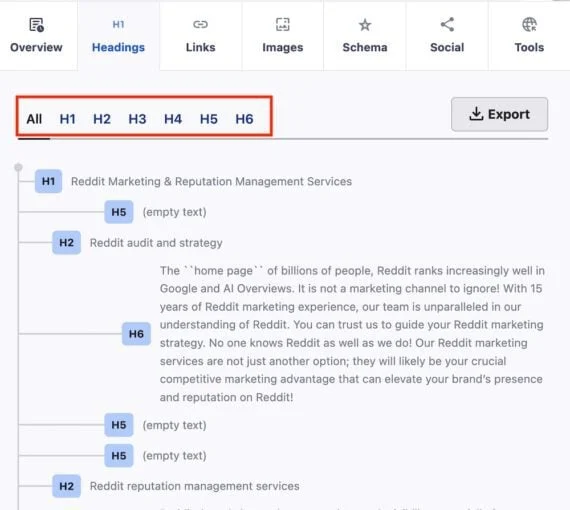
The quest to optimize content visibility within the rapidly evolving realm of generative artificial intelligence (AI) models remains a complex and largely uncharted territory. Unlike the established, data-driven methodologies of traditional search engine optimization (SEO), there is no universally recognized, step-by-step process for ensuring content is discoverable and prioritized by platforms such as OpenAI’s ChatGPT, Google’s Gemini, Anthropic’s Claude, and others. This inherent ambiguity necessitates a continuous cycle of testing and experimentation to decipher the underlying priorities and ranking factors, however opaque they may be, of these influential AI systems.
To navigate this dynamic environment, a multi-faceted approach is crucial, employing a diversity of tools to glean insights from various perspectives. This article will delve into three key Chrome extensions that have emerged as valuable assets for content creators and digital marketers aiming to enhance their visibility within generative AI models. While these tools offer helpful recommendations, it is imperative to understand that they are not definitive guides. The absence of explicit ranking signals, akin to those found in traditional search engines, means that their suggestions should be viewed as hypotheses or "ideas" to be further explored and validated.
Understanding the Generative AI Optimization Challenge
The fundamental challenge in optimizing for generative AI lies in its nascent stage of development and deployment. Generative AI models are trained on vast datasets, and their algorithms for retrieving and presenting information are proprietary and constantly being refined. Unlike search engines that provide clear metrics like keyword rankings, backlinks, and page authority, generative AI platforms do not publicly disclose their internal weighting mechanisms. This lack of transparency forces practitioners to infer best practices through observation and the application of heuristic tools.
The implications of this opacity are significant. Businesses and individuals investing in content creation for the digital sphere are grappling with how to ensure their expertise, products, or services are surfaced when users query these powerful AI systems. The potential for generative AI to become a primary gateway to information and solutions means that visibility within these models could soon rival or even surpass traditional search engine rankings in importance. Therefore, proactive exploration and adaptation are not merely beneficial but essential for future digital relevance.
Chrome Extensions for Enhanced Generative AI Visibility
The following three Chrome extensions offer distinct functionalities that can aid in the process of understanding and improving content performance within generative AI contexts.

GEO Auditor: A Comprehensive AI Optimization Scorecard
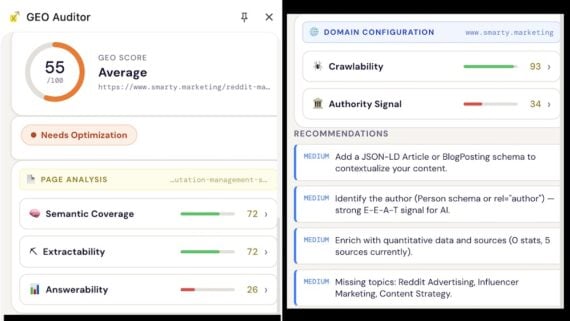
GEO Auditor is a Chrome extension designed to evaluate the AI optimization of any given webpage. It operates by assessing three primary, albeit unspecified, signals that are believed to influence how AI models perceive and rank content. While the exact nature of these signals is not detailed by the extension, their impact is presented through a scoring mechanism, offering a quantitative measure of a page’s AI-friendliness.
Beyond its core scoring, GEO Auditor extends its analysis to critical aspects of web presence that indirectly impact AI discoverability. It scrutinizes crawlability by examining a domain’s robots.txt file and meta robot tags, ensuring that search engine crawlers, and by extension, AI indexing processes, are not inadvertently blocked from accessing the content. Furthermore, the extension assesses domain authority, a metric traditionally associated with search engine rankings, by analyzing backlinks and citations. It’s important to note that GEO Auditor does not publicly cite its sources for these authority calculations, which means users should approach this data with a degree of caution.
Upon analyzing a page, GEO Auditor provides actionable recommendations for optimization. For instance, when applied to content on the Smarty Marketing site, the tool suggested specific improvements, highlighting areas where the page might be falling short in its AI optimization. These recommendations often translate into concrete tasks, such as refining content structure, enhancing keyword relevance, or improving the clarity and specificity of information presented. The visual representation of the scorecard, as shown in the accompanying image, provides a clear overview of a page’s strengths and weaknesses in the context of AI indexing.
The underlying principle here is that AI models, much like search engines, benefit from well-structured, authoritative, and accessible content. By providing a score and specific suggestions, GEO Auditor aims to translate the abstract concept of AI optimization into tangible steps that webmasters can implement. The emphasis on crawlability and domain authority, even if inferred, aligns with established digital marketing best practices that are likely to hold relevance in the AI-driven information ecosystem.
AI SEO Extension by RadarKit: Gauging "AI Friendliness"
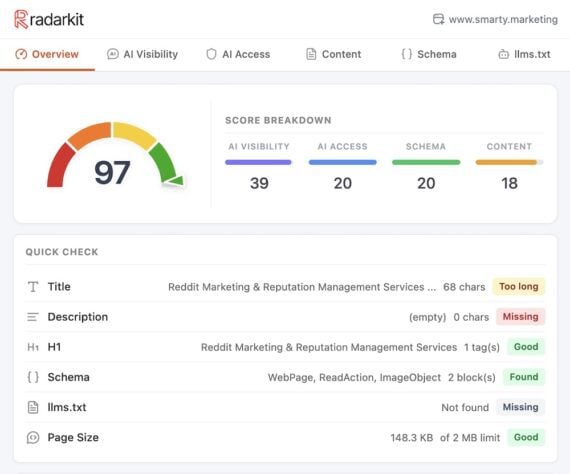
The AI SEO Extension, developed by RadarKit, offers another perspective on content evaluation for generative AI. This extension assigns a score to each page, quantifying its "AI friendliness." Similar to GEO Auditor, the specific factors contributing to this score are not exhaustively detailed, but the extension provides a useful benchmark for assessing how well a page is likely to be understood and utilized by AI systems.
The AI SEO Extension delves into several facets of content that are presumed to be important for AI comprehension and retrieval. These often include:
- Content Quality and Relevance: Evaluating the depth, accuracy, and topical relevance of the content to potential user queries.
- Structured Data Markup: Assessing the presence and correctness of structured data (e.g., Schema.org markup), which helps AI models understand the context and relationships within the content.
- Readability and Clarity: Analyzing the language used, sentence structure, and overall ease with which the content can be processed by algorithms.
- Technical SEO Elements: While not exclusively AI-focused, fundamental technical SEO aspects like page load speed and mobile-friendliness contribute to a positive user experience, which AI models may indirectly favor.
The extension’s scoring system provides a snapshot of a page’s current standing in terms of AI readiness. The visual representation of the score, as depicted in the screenshot, allows users to quickly identify areas of strength and opportunities for improvement. This tool is particularly valuable for content creators who want to ensure their material is not only informative for human readers but also easily digestible and correctly interpreted by AI.
The concept of "AI friendliness" encapsulates the idea that content needs to be not just present but also structured and semantically rich enough for AI to effectively extract value. This aligns with the broader trend of AI systems moving beyond simple keyword matching to understanding nuanced meaning and intent. By highlighting these aspects, RadarKit’s extension encourages a more holistic approach to content creation that considers both human and artificial intelligence consumption.
All in One SEO Analyzer: Leveraging Traditional SEO for AI Insights
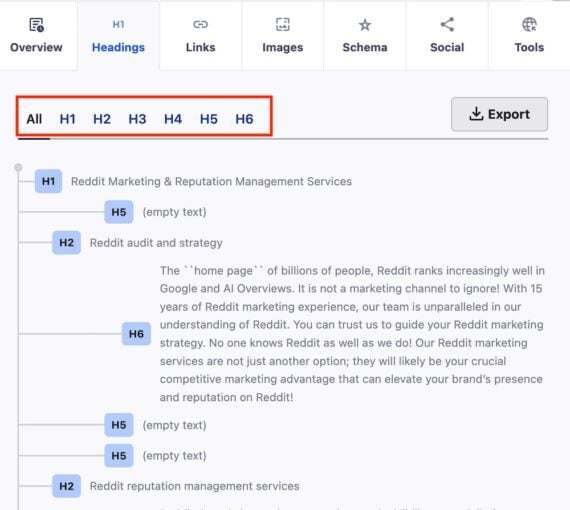
While the All in One SEO Analyzer by AIOSEO is primarily focused on optimizing content for traditional search engines, its detailed analysis of HTML headings (H1-H6) provides valuable, albeit indirect, insights for generative AI visibility. The rationale is that the structured hierarchy established by headings is a fundamental organizational principle that both human readers and AI algorithms rely on to understand the flow and key topics of a document.
Generative AI models often synthesize information from multiple sources, and the way content is segmented and labeled with headings can significantly influence how specific pieces of information are extracted and cited. Well-defined H1, H2, and H3 tags, for instance, clearly demarcate main topics, sub-topics, and supporting details, making it easier for AI to pinpoint relevant sections for answering queries or generating summaries. The extension’s ability to audit these headings thoroughly means users can ensure their content is logically structured and that important concepts are clearly signposted.
Furthermore, the underlying principles of good SEO, such as clarity, relevance, and authority, are likely to have a positive correlation with AI visibility. Content that is well-optimized for search engines often exhibits characteristics that are also beneficial for AI models:
- Keyword Integration: Natural and strategic inclusion of relevant keywords within headings and body text can help AI models identify the core subject matter.
- Content Depth and Comprehensiveness: Detailed and authoritative content, which tends to rank well in search engines, is also more likely to be a valuable resource for AI.
- Readability: Content that is easy for humans to read and understand is often also easier for AI to process.
The All in One SEO Analyzer’s focus on these foundational elements makes it a complementary tool in the generative AI optimization toolkit. By ensuring content is robust from a traditional SEO perspective, creators can lay a strong groundwork that is likely to benefit their visibility in AI models as well. The direct analysis of HTML headings is particularly relevant, as these structural elements are crucial for information retrieval and synthesis by AI.
The Future of Generative AI Visibility: An Ongoing Evolution
The tools and methodologies for optimizing visibility in generative AI are still in their infancy. As AI models become more sophisticated and their integration into daily life deepens, the need for clear, actionable optimization strategies will only intensify. The current landscape, characterized by experimentation and reliance on inferential data, highlights the dynamic nature of this field.
The implications of this evolving space are far-reaching. Content creators, businesses, and organizations that can effectively adapt to the demands of generative AI visibility will gain a significant advantage in reaching their target audiences. This may involve a reevaluation of content creation processes, a greater emphasis on structured data, and a continuous effort to understand how AI models process and prioritize information.
Supporting Data and Trends:
The growth of generative AI adoption provides a compelling backdrop to this discussion. As of early 2024, various reports indicate a rapid increase in the usage of AI chatbots for information retrieval and content generation. For example, surveys suggest that a significant percentage of internet users have experimented with AI tools for tasks ranging from research to creative writing. This widespread adoption underscores the growing importance of ensuring content is discoverable within these systems.
Furthermore, the rise of AI-powered search experiences, such as Google’s AI Overviews and Microsoft’s Copilot, signals a fundamental shift in how users will interact with online information. These features aim to provide direct answers and synthesized information, making the underlying content sources and their discoverability within AI models paramount. The ability of AI to cite sources is also a developing area, with early indications suggesting that well-structured and authoritative content is more likely to be referenced.
Broader Impact and Implications:
The challenge of generative AI visibility has broader implications for the digital ecosystem. It necessitates a deeper understanding of how information is consumed and synthesized in the age of artificial intelligence. For businesses, failing to adapt could mean being overlooked by a growing segment of potential customers and users. For individuals and publishers, it means a potential shift in how content is created and promoted to maintain relevance.
The reliance on tools like GEO Auditor, AI SEO Extension, and All in One SEO Analyzer reflects a pragmatic approach to an uncertain future. By leveraging these extensions, practitioners can gain valuable, albeit interpreted, insights into how their content might be perceived by AI systems. This proactive stance is crucial for staying ahead of the curve and ensuring that valuable information remains accessible in an increasingly AI-driven world. The journey to mastering generative AI visibility is ongoing, and continuous learning and adaptation will be key to success.


 Raul Delapena Setiawan
 Ammar Sabilarrohman