rifanmuazin
The burgeoning integration of artificial intelligence into consumer search and chat functionalities presents a tantalizing prospect for e-commerce businesses: a potential influx of highly motivated, ready-to-buy customers. However, as emerging data begins to paint a picture of this new frontier, early evidence suggests a complex and nuanced reality, where the promise of elevated engagement and conversion rates is tempered by significant variations and the potential for misinterpretation.
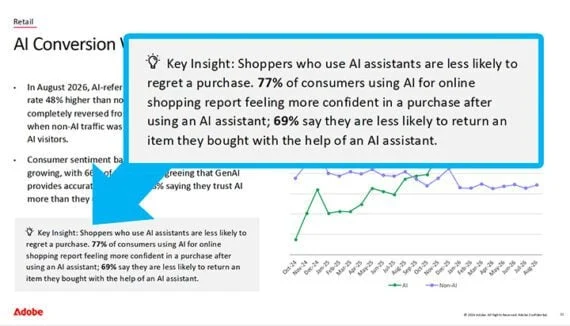
Recent analyses from prominent industry players and academic institutions offer a glimpse into this dynamic shift. The April 2026 Adobe Digital Insights "Quarterly AI Traffic Report" initially highlighted a compelling narrative, indicating that consumers originating from AI search and chat interfaces were demonstrating superior performance metrics. According to Adobe’s findings, AI-referred visitors in March were a remarkable 42% more likely to complete a purchase and generated 37% more revenue per visit compared to those arriving from traditional online channels. This suggested that AI platforms were not merely a source of traffic, but a potent engine for customer acquisition, driving deeper engagement and a higher propensity to convert. The report, drawing on extensive digital data, positioned AI as a premium channel for businesses seeking to capture high-intent shoppers.
This optimistic outlook was echoed by other industry giants. Google, a dominant force in online search, has also reported that clicks originating from its AI Overviews are demonstrating a greater likelihood of conversion than those derived from conventional organic search listings. Similarly, Similarweb’s "State of E-commerce 2025" report posited that "AI search has become a high-intent growth channel." Their analysis indicated that traffic directed to e-commerce sites from OpenAI’s ChatGPT exhibited a conversion rate of approximately 11.4%, significantly outperforming the 5.3% conversion rate observed from organic search. These initial reports collectively painted a picture of AI as a transformative force, poised to redefine the e-commerce customer journey by directing more decisive buyers to online storefronts.
However, a more granular and extensive academic study, published in October 2025, introduced a note of caution and highlighted the nascent stage of AI’s impact on e-commerce traffic. Titled "ChatGPT Referrals to E-Commerce Websites," a study conducted by German university professors Maximilian Kaiser and Christian Schulze of the University of Bamberg, presented a contrasting perspective. Their research, which analyzed 12 months of first-party data from August 2024 to July 2025 across 973 e-commerce websites and $20 billion in order revenue, found that ChatGPT accounted for a relatively modest share of e-commerce traffic, less than 0.2%. This figure starkly contrasts with the substantial traffic volumes generated by established channels like email, advertising, and organic search.
The professors’ comprehensive analysis, which included nearly 50,000 transactions attributed to ChatGPT referrals and 164 million from traditional channels, also revealed significant variations in conversion rates. While ChatGPT-referred traffic converted at roughly twice the rate of paid social media, it underperformed most other established channels. Specifically, organic search demonstrated about a 13% higher conversion rate than AI referrals. Furthermore, affiliate marketing (86% more likely to convert) and paid search (45% more likely to convert) significantly outperformed AI-driven traffic in terms of conversion efficacy. These findings underscore the argument that while AI may be an emerging channel, its current impact on overall e-commerce traffic volume and conversion consistency is still being established and is far from uniform.
Moreover, the Kaiser and Schulze study also delved into user engagement patterns, observing that AI visitors were less likely to exhibit a high bounce rate compared to users from other channels. While this aligns with Adobe’s findings of deeper engagement, it also suggested a potentially different browsing behavior, possibly involving fewer pages visited and less time spent on site. This could indicate a more targeted, task-oriented approach by AI-referred users, a characteristic that warrants further investigation into how AI influences product discovery and purchase decision-making.
The divergence between these prominent reports raises a critical question: which analysis holds the greater truth? The answer likely lies in the inherent complexities and the evolving nature of the AI traffic landscape. It is plausible that both sets of findings are, in fact, correct, reflecting the distinct datasets and methodologies employed. Adobe’s analysis, likely leveraging a broad spectrum of digital signals and potentially focusing on specific high-performing segments, might be capturing the upper echelon of AI-driven performance. In contrast, Kaiser and Schulze’s study, with its extensive dataset spanning numerous e-commerce sites and a longer timeframe, offers a more comprehensive, albeit potentially more conservative, view of the average AI traffic performance.
Several factors could contribute to these discrepancies, making the interpretation of AI traffic data a challenging endeavor. The type of AI platform generating the traffic is a significant variable. Traffic from a sophisticated AI shopping assistant designed for product recommendation might yield different results than traffic from a general-purpose AI chatbot that offers broad information. The sophistication and user intent behind the AI query itself play a crucial role. A user actively seeking a specific product through an AI interface is likely to have a higher purchase intent than someone engaging in exploratory AI-driven research.
Furthermore, the performance of AI traffic is heavily influenced by the characteristics of the e-commerce business itself. Factors such as the size of the online store, the breadth and depth of its product catalog, and the established brand recognition of the merchant can all skew the data. For small and midsize e-commerce companies, the implication is not to chase sheer volume of AI traffic, but to strategically understand how AI is reshaping product discovery and to proactively adapt their digital presence accordingly. This might involve optimizing product descriptions for AI understanding, ensuring clear and concise product information, and developing content that AI can readily interpret and surface.
The timeline of data collection also becomes a critical consideration. As AI technologies rapidly advance and user adoption patterns shift, data from earlier periods may not accurately reflect current trends. For instance, a study conducted in late 2025 might capture a different market dynamic than one from mid-2026, especially as AI integration becomes more widespread and sophisticated. The specific methodologies used to attribute traffic to AI sources can also introduce variations. Different tracking mechanisms and attribution models might lead to differing conclusions about the volume and performance of AI-referred traffic.
Despite the unevenness and potential for misinterpretation, the overarching consensus is that AI is rapidly becoming an indispensable element of the e-commerce ecosystem. While the channel is undeniably early, its influence on how shoppers discover products is already profound, arguably representing the most significant shift in product discovery since the advent of the internet itself. Businesses that fail to acknowledge and adapt to this evolving landscape risk being left behind.
The implications for e-commerce merchants are clear and immediate. The focus should shift from solely chasing volume to a more strategic approach centered on understanding and optimizing for AI visibility. This involves closely monitoring AI-driven traffic sources, analyzing their performance metrics, and iterating quickly on strategies to enhance presence and engagement within AI-powered discovery journeys. As AI continues to mature and integrate more seamlessly into consumer behavior, businesses that embrace this transformation proactively will be far better positioned to thrive in what appears to be a once-in-a-generation shift in the retail paradigm. The challenge lies in navigating the current ambiguity with agility, leveraging emerging data, and preparing for a future where AI plays an even more central role in connecting consumers with products.