rifanmuazin
The landscape of customer experience management has undergone a fundamental shift over the last decade, moving away from the traditional pursuit of "customer delight" toward a more pragmatic focus on reducing friction. At the heart of this transition is the Customer Effort Score (CES), a metric designed to quantify the ease with which a customer can interact with a brand, resolve a problem, or complete a transaction. Unlike traditional satisfaction metrics that measure sentiment, CES focuses on the tactical efficiency of the user journey. Recent data indicates that customers rarely voice complaints when an experience requires excessive effort; instead, they quietly transition to competitors. This phenomenon, often referred to as "silent churn," has established CES as a leading indicator of long-term loyalty and operational health.
The concept of the Customer Effort Score was first introduced to the mainstream business community in 2010 through a seminal study by the Corporate Executive Board (CEB), a research firm later acquired by Gartner. Published in the Harvard Business Review under the title "Stop Trying to Delight Your Customers," the research challenged the prevailing wisdom that brands needed to exceed expectations to build loyalty. The study found that while "delighting" customers had a marginal impact on loyalty, "disappointing" them—primarily through high-effort interactions—had a massive negative impact. The core takeaway was that loyalty is driven more by how well a company delivers on its basic promises than by how many "wow" moments it creates.
The Strategic Importance of Measuring Effort
In a digital economy defined by instant gratification, every additional click, form field, or ambiguous instruction acts as a point of friction. Over time, this friction erodes the psychological bond between the consumer and the brand. Business analysts argue that Customer Effort Score is a more accurate predictor of future purchasing behavior than either the Net Promoter Score (NPS) or Customer Satisfaction (CSAT) scores. According to Gartner research, 96% of customers who experience high-effort interactions become disloyal, compared to only 9% of those who have low-effort experiences.
The importance of CES can be categorized into four primary strategic pillars. First, it serves as a primary driver of customer loyalty and retention. When customers can easily track an order or find pricing details without assistance, they perceive the brand as reliable. Second, CES acts as an early warning system for churn. High effort scores often signal systemic failures in a product or service before they manifest in declining sales figures. Third, it provides essential context that satisfaction scores often miss. A customer might be "satisfied" with a support agent’s politeness but "frustrated" by the five-step process required to reach that agent. Finally, CES directly correlates with operational efficiency. By identifying and streamlining high-effort interactions, businesses can reduce the volume of repeat support requests and lower the cost-to-serve.
The Chronology of CX Metric Evolution
To understand the current relevance of CES, one must look at the timeline of customer experience measurement. In the 1980s and 1990s, CSAT was the dominant metric, focusing on post-purchase sentiment. By 2003, the introduction of the Net Promoter Score by Fred Reichheld shifted the focus toward long-term brand advocacy and the "likelihood to recommend."
The 2010 introduction of CES marked the third wave of CX metrics, prioritizing the "frictionless" experience. As e-commerce and SaaS models became dominant in the mid-2010s, the need for transactional, real-time feedback became paramount. Today, in the 2020s, CES has evolved into a sophisticated tool integrated with AI and predictive analytics, allowing companies to anticipate friction points before the customer even encounters them. This progression reflects a broader market reality: as technology makes life easier, consumer patience for corporate inefficiency continues to dwindle.

Methodologies for Measuring Customer Effort
Measuring the Customer Effort Score is a standardized but nuanced process. The most effective surveys rely on a single, core question: "How easy was it to resolve your issue today?" or "To what extent do you agree that the company made it easy for me to handle my issue?"
Businesses typically employ one of three primary scales to capture this data:
- The 1–7 Likert Scale: This is the industry standard, ranging from "Very Difficult" to "Very Easy." It provides enough granularity to track subtle improvements in the user experience.
- The 1–5 Scale: Often used in mobile environments or quick-response scenarios where simplicity is key.
- The Emoticon Scale: Utilizing visual cues (sad face to happy face) to capture quick, visceral reactions, though this method lacks the depth required for complex analytical modeling.
The calculation of the CES is straightforward: the sum of all customer effort ratings divided by the total number of responses. For example, if a company receives 200 responses with a total point value of 840 on a 7-point scale, the resulting CES is 4.2. While there is no universal "perfect" score, industry benchmarks suggest that anything above a 5.0 on a 7-point scale is indicative of a healthy, low-effort environment.
Optimized Deployment: When to Trigger Surveys
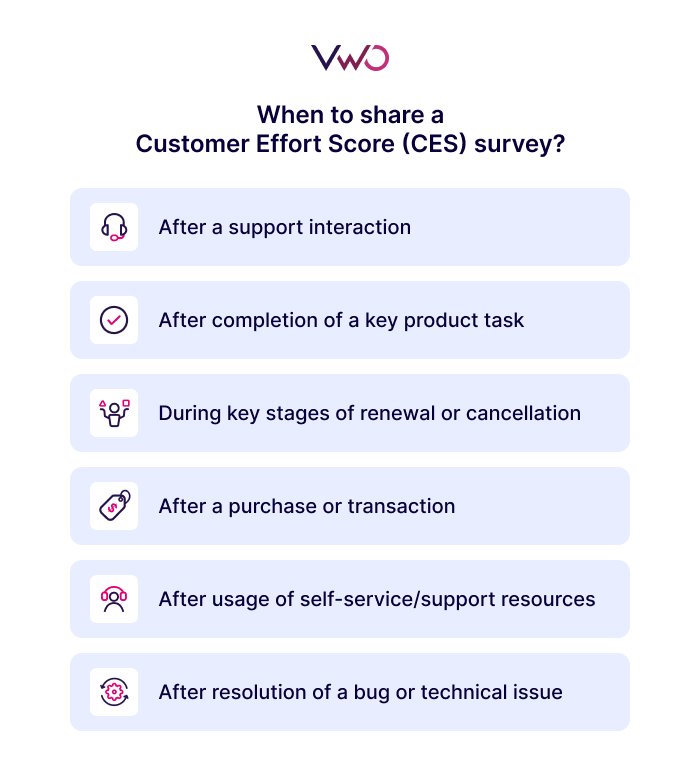
The utility of a CES survey depends heavily on its timing. Because it is a transactional metric, it must be deployed immediately following a specific interaction. Industry experts identify six critical touchpoints for CES deployment:
Post-Support Interactions: This remains the most common use case. Whether through live chat, email, or phone support, measuring the ease of resolution allows organizations to evaluate the efficiency of their support protocols and the training of their staff.
Product Task Completion: For SaaS and digital platforms, surveys should be triggered after a user completes a significant task, such as setting up a new integration, inviting a team member, or exporting a data report.
Post-Transaction: In e-commerce, the checkout process is a high-risk friction zone. Deploying a survey on the "Thank You" page helps identify technical glitches or confusing UI elements that could lead to future cart abandonment.

Self-Service Resources: When a customer visits a help center or interacts with a chatbot, businesses must know if the resource actually helped. High effort scores in self-service indicate that the documentation is either unclear or difficult to find.
Subscription Management: Renewals, cancellations, and plan changes are often emotionally charged. If a customer finds it difficult to cancel a service, the resulting high-effort experience ensures they will never return and may lead to negative public reviews.
Technical Issue Resolution: Following a bug fix or a system update, CES helps product teams verify if the solution implemented was intuitive or if it created new hurdles for the end-user.
Expert Insights and Industry Reactions
Leading voices in the conversion rate optimization (CRO) and user experience (UX) space emphasize the psychological impact of effort. Jon MacDonald, a prominent voice in digital experience, notes that every element on a website sends a signal regarding brand trustworthiness. He suggests that confusion is the primary driver of visitor exit, and identifying these moments across the digital journey is the central challenge of modern business.
Similarly, April Hung, a specialist in user feedback, advocates for the use of on-site surveys to capture sentiment in real-time. According to Hung, the ability to capture feedback at the exact moment of friction is far more valuable than retrospective surveys, which are often clouded by memory bias. This "in-the-moment" data collection is what allows companies to move from reactive troubleshooting to proactive experience design.
Strategies for Reducing Customer Effort
Improving a Customer Effort Score requires a cross-functional approach involving product design, customer support, and marketing. The first step is mapping critical journeys to identify "pain points" using heatmaps and session recordings. By visualizing where users hover, click repeatedly (rage-clicking), or stall, teams can identify the physical manifestations of high effort.
Streamlining website flows is another critical strategy. This involves reducing the number of form fields, clarifying navigation menus, and ensuring that the "next best action" is always obvious. Furthermore, strengthening self-service options is a high-leverage activity. A searchable, well-organized knowledge base can deflect a significant percentage of support tickets, naturally lowering the overall effort required for a customer to find answers.
Finally, organizations must focus on making support interactions effortless. This includes implementing "omnichannel" capabilities where a customer can move from a chat to a phone call without having to repeat their information. Eliminating the need for customers to re-explain their problems is one of the single most effective ways to boost a CES.
Broader Impact and Future Implications
The implications of the Customer Effort Score extend beyond simple customer satisfaction. From a financial perspective, low-effort companies enjoy higher customer lifetime value (CLV) and lower churn rates. Operationally, reducing effort minimizes the strain on human support teams, allowing them to focus on complex issues rather than repetitive, simple queries.
As artificial intelligence continues to integrate into the customer journey, the measurement of effort will become even more precise. Predictive CES, which uses machine learning to assign an effort score to a customer’s journey based on their behavior—even if they don’t fill out a survey—is the next frontier. This will allow brands to intervene in real-time, offering assistance the moment a user appears to be struggling.
In conclusion, the Customer Effort Score is no longer just an optional metric for the "customer-obsessed"; it is a vital business KPI. In an era where "ease of use" is a primary competitive advantage, businesses that fail to measure and minimize customer effort risk obsolescence. By focusing on the mechanics of the interaction rather than the fluff of "delight," organizations can build a foundation of loyalty that is both resilient and measurable.


 Asro
Asro
 Dwi Wanna