rifanmuazin
The advent of artificial intelligence has fundamentally reshaped the landscape of online search and, consequently, the strategies brands must employ to achieve visibility, trust, and credibility. Traditional search engine optimization (SEO), once the cornerstone of digital marketing, is proving increasingly insufficient in an era where AI-powered platforms like ChatGPT, Google Gemini, and Perplexity are becoming primary conduits for information and recommendations. Brands that fail to appear in these AI-generated answers face a significant existential challenge, transcending mere traffic loss to encompass a broader erosion of their market presence and customer trust.
The Paradigm Shift in Search: From Links to Curated Answers
For decades, SEO revolved around optimizing content to rank high on search engine results pages (SERPs), primarily by securing top positions for relevant keywords. Success was measured by click-through rates and organic traffic driven by lists of links. However, the rise of large language models (LLMs) and their integration into search experiences has introduced a new paradigm. Users are no longer just looking for links; they are asking complex, conversational questions and expecting direct, curated answers that synthesize information from multiple sources.
Google’s own Search Generative Experience (SGE), for instance, exemplifies this shift, blending traditional links with AI-generated summaries and responses directly within the SERP. This evolution means that even a brand ranking #1 organically on Google may remain invisible if its content isn’t effectively parsed and presented by AI systems in response to user queries. Data from various industry reports indicates a growing preference among users for AI-summarized answers, with some studies projecting that AI-generated content could fulfill a significant portion of search queries in the coming years, potentially reducing direct clicks to traditional websites. This behavioral change underscores the urgency for brands to adapt their visibility strategies.
The AI Visibility Blind Spot: A Growing Threat to Brands
The current generation of SEO tools, while adept at tracking keyword rankings, backlinks, and website traffic, largely possess a critical blind spot: they do not monitor how a brand appears within AI-generated responses. This oversight creates a perilous situation where competitors might be consistently recommended by AI platforms, gaining a substantial advantage in brand recognition and customer acquisition, without the affected brand even realizing the extent of its diminished presence.
This "AI visibility gap" poses several risks:
- Lost Opportunity: Brands miss out on being recommended to a rapidly growing audience that relies on AI for initial product or service discovery.
- Reputational Harm: Negative sentiment or inaccurate information about a brand, amplified by AI systems, can quickly damage reputation without immediate detection or recourse through traditional monitoring.
- Competitive Disadvantage: Competitors actively optimizing for AI visibility can dominate recommendations, establishing themselves as the default choice in AI-driven search environments.
The imperative for brands is clear: traditional SEO is no longer a complete strategy. It must be augmented by a dedicated focus on AI visibility, encompassing how LLMs understand, synthesize, and present information about a brand.
Controlling the Narrative in an AI-Driven World
AI platforms construct a brand’s narrative by piecing together information from an extensive array of online sources—including reviews, news articles, social media discussions, and the brand’s own content. If these diverse sources convey inconsistent or contradictory messages, the AI’s generated responses will inevitably reflect that fragmentation. Therefore, a unified, consistent brand message across all digital touchpoints is paramount.
To effectively control a brand’s narrative within AI ecosystems, organizations must:
- Ensure Message Consistency: Repeat core brand messages—whether it’s "affordable luxury," "sustainable innovation," or "unparalleled customer service"—across website content, press releases, social media, and external interviews. This consistent reinforcement helps AI systems build a cohesive understanding of the brand’s identity and value proposition.
- Proactive Misinformation Management: Swiftly address and correct misinformation or inaccurate reviews by publishing clarifications and official statements online. This proactive approach prevents AI from inadvertently amplifying outdated or incorrect details.
- Leverage Structured Data: Employ schema markup to highlight the brand’s most important attributes, awards, unique selling points, and factual information. Structured data provides AI platforms with a clear, machine-readable framework, enabling them to reference accurate and comprehensive brand details.
- Authoritative Content Creation: Focus on producing unique, in-depth, and expert-driven content that LLMs can identify as authoritative. This includes original research, whitepapers, comprehensive guides, and expert opinions that are frequently cited by other reputable sources.
By meticulously shaping the online narrative, brands can influence AI systems to project their desired image, ensuring that recommendations and summaries are accurate, positive, and aligned with strategic objectives.
Yoast AI Brand Insights: A New Tool for the AI Era
Recognizing this critical shift, Yoast, a prominent name in SEO tools, has introduced "Yoast AI Brand Insights." This innovative tool is designed to bridge the AI visibility gap, offering brands a clear, actionable view of their presence, sentiment, and credibility across major AI platforms like ChatGPT, Perplexity, and Google Gemini. It moves beyond traditional ranking metrics to provide insights directly relevant to how AI understands and presents a brand.
Yoast AI Brand Insights is built to help brands:
- Monitor AI Visibility: Track how often and in what context a brand is mentioned in AI-generated answers for specific queries.
- Analyze Brand Sentiment: Gauge the positive, negative, or neutral sentiment associated with a brand in AI responses, identifying areas for reputational management.
- Benchmark Against Competitors: Compare AI visibility and sentiment against key competitors to identify strategic advantages and weaknesses.
- Identify Actionable Insights: Turn complex AI data into practical recommendations for content optimization, public relations, and overall brand strategy.
- Control Brand Narrative: Understand how AI is piecing together a brand’s story and proactively influence it through consistent messaging and structured data.
The tool’s core value lies in transforming the opaque "AI black box" into transparent, actionable insights, enabling brands to measure and strategically improve their standing in the AI-driven search ecosystem.
Understanding the AI Visibility Metrics
To effectively utilize Yoast AI Brand Insights, understanding its key metrics is crucial:
-
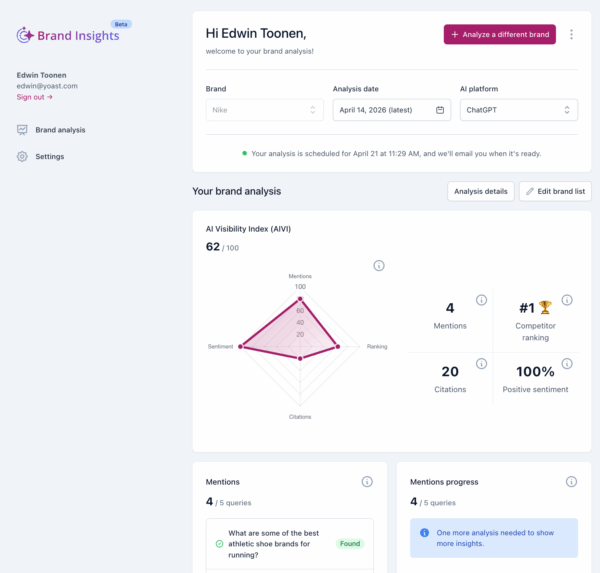
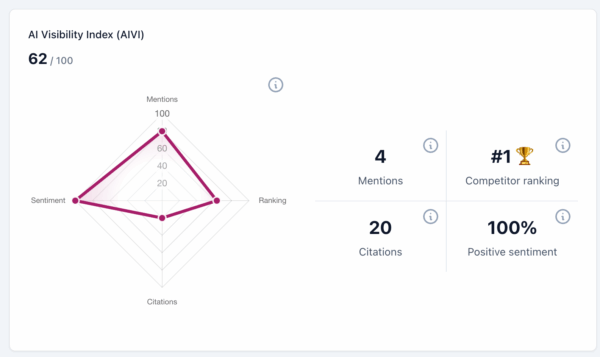
AI Visibility Index (AIVI): This proprietary score, ranging from 0 to 100, quantifies a brand’s overall visibility across AI platforms for tracked terms. AIVI is a composite metric, reflecting a brand’s performance across several critical dimensions:
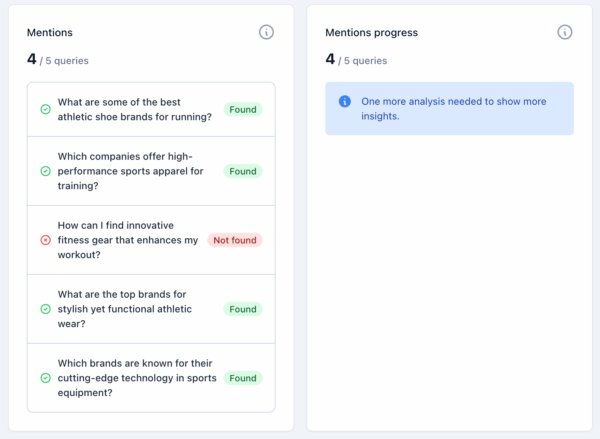
- Mentions: The frequency with which a brand appears in AI responses.
- Sentiment: The emotional tone (positive/negative) associated with the brand in these mentions.
- Citations: The number of authoritative sources explicitly referenced by AI platforms that also mention the brand.
- Relevance: How pertinent the brand is to the queries being answered by AI.
A higher AIVI score indicates stronger AI visibility. A low score signals the need to focus on increasing mentions, cultivating positive sentiment, and enhancing the authority of content.
-
Mentions: This metric tracks the specific queries for which a brand is included in AI responses. For example, if a user asks, "What is the best project management software for remote teams?" and a brand like "Asana" is part of the AI’s answer, that constitutes a mention. More mentions generally lead to greater visibility and increased brand exposure. To improve mentions, brands must create comprehensive, authoritative content that directly answers high-intent, conversational questions relevant to their offerings, optimizing for long-tail and natural language queries.
-
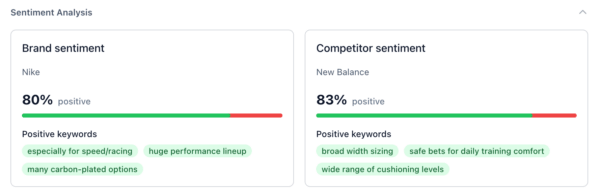
Sentiment: This measures the percentage of positive versus negative language associated with a brand in AI-generated answers. AI describing a brand as "innovative" or "reliable" contributes to positive sentiment, while terms like "overpriced" or "poor customer service" indicate negative sentiment. Positive sentiment builds trust and attracts customers, whereas negative sentiment can deter them. Proactive management of online reviews, public responses to complaints, and consistent amplification of positive testimonials are essential strategies to improve sentiment. Monitoring sentiment trends allows brands to detect and address issues early.
-
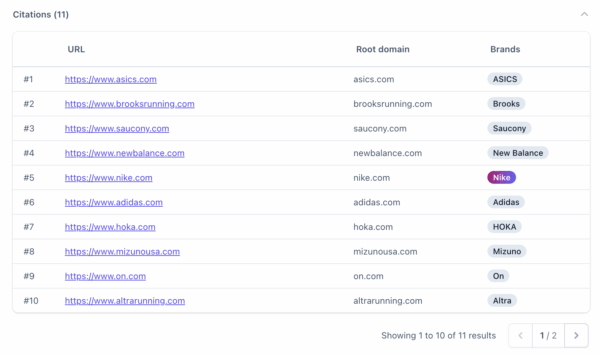
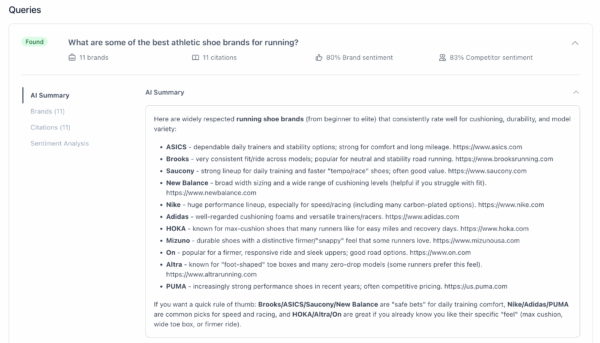
Citations: This refers to the explicit sources that AI platforms reference when generating an answer. While a brand might be mentioned within a cited source (e.g., American Express in a New York Times article), the direct citation is attributed to the publisher (The New York Times). However, appearing consistently in highly reputable and relevant cited sources significantly increases the likelihood of a brand being included in AI responses over time. AI platforms use citations to validate the accuracy and credibility of their answers. Brands should aim to be featured in industry publications, news sites, and authoritative blogs that are frequently cited by AI, essentially becoming part of the trusted information ecosystem. This requires producing high-quality content that others want to link to and strategically seeking opportunities for expert contributions and mentions in relevant publications.
Strategic Imperatives for Influencing LLMs
To effectively influence LLMs and secure prominent, positive mentions, brands must adopt a multi-faceted approach:
-
Publish Authoritative and Unique Content:
- Original Research: Invest in proprietary studies, surveys, and industry reports with unique data. LLMs prioritize sources that offer novel insights. For example, a "2024 Global E-commerce Trends Report" positions a brand as a thought leader.
- Expert Opinions: Feature content from recognized experts within the organization, complete with author bios and credentials, reinforcing expertise, experience, authoritativeness, and trustworthiness (E-E-A-T).
- Structured Information: Employ the inverted pyramid structure for content, starting with conclusions and key findings, followed by supporting details. This facilitates AI’s ability to extract and summarize critical information.
- Fact-Rich Content: Integrate statistics, data points, and quotes from credible sources. Instead of generic claims, provide evidence (e.g., "Our CRM increased client retention by 25% in Q3 2023, according to internal analytics").
-
Earn Mentions on Relevant, High-Authority Sites:
- Strategic PR and Outreach: Pitch compelling stories to journalists and industry-specific blogs. Aim for inclusion in "best of" lists, expert roundups, and feature articles relevant to your niche.
- Customer Reviews: Actively encourage customers to leave reviews on influential platforms like G2, Capterra, Trustpilot, and Google Reviews. These platforms are heavily crawled by AI and directly influence brand perception. Engaging with both positive and negative reviews demonstrates transparency.
- Guest Contributions: Seek opportunities to publish guest posts on reputable industry blogs or news sites, ensuring a strong author bio that highlights your brand.
- Podcast and Webinar Participation: Appearing as a guest expert on industry podcasts or webinars can generate valuable mentions and establish authority.
-
Optimize for Conversational Queries:
- Question-Focused Content: Structure content to directly answer common questions users might ask AI (e.g., "Is [Your Brand] suitable for startups?"). Place clear, concise answers early in the content.
- Long-Tail Keyword Targeting: Move beyond broad keywords to optimize for specific, multi-word phrases that reflect natural language queries (e.g., "most affordable cloud storage for small businesses in Europe").
- FAQ Pages and Schema Markup: Create dedicated FAQ sections or pages on your website and implement FAQ schema markup. This helps AI platforms easily identify and extract direct answers.
-
Build a Robust Citation Profile:
- Linkable Assets: Develop valuable resources such as comprehensive guides, templates, tools, or datasets that other websites and publications will naturally want to reference and link to.
- Proactive Link Building: Engage in ethical outreach to relevant websites, informing them of your valuable content and suggesting it as a useful resource for their audience.
- Media Coverage: Secure mentions in press releases, industry reports, and news coverage, which often serve as authoritative sources for AI.
-
Ensure AI Crawler Accessibility and Technical SEO:
- Technical Foundation: Maintain a technically sound website with fast loading speeds, mobile responsiveness, clean URLs, and well-optimized meta tags and descriptions.
- Schema Markup Implementation: Beyond basic brand information, use schema markup for products, services, reviews, and how-to guides to provide AI crawlers with structured context.
llms.txtFile: Utilize the proposedllms.txtstandard (which Yoast SEO supports) to guide AI crawlers to the most important and authoritative content on your site, or to restrict access to certain pages if necessary.- Robots.txt Audit: Regularly check your
robots.txtfile to ensure it isn’t inadvertently blocking AI crawlers from accessing valuable content.
-
Actively Participate in Online Communities:
- Engage on Q&A Platforms: Provide valuable, non-promotional answers to questions on platforms like Quora and Reddit, naturally mentioning your brand where relevant and helpful.
- Forum and Group Participation: Join industry-specific forums, Slack channels, Discord servers, and LinkedIn groups. Share insights, contribute to discussions, and link to your authoritative content when appropriate.
- Social Media Thought Leadership: Post informative content and engage in discussions on platforms like LinkedIn and X (formerly Twitter), positioning your brand as a knowledgeable voice in its field.
The Future of Brand Visibility is AI-Driven
The shift towards AI-powered search is not a fleeting trend but a fundamental transformation in how consumers discover and interact with brands. Brands that adapt early to this new reality will gain a significant competitive advantage, building trust and securing customer loyalty in an increasingly AI-centric world. Conversely, those that cling solely to outdated SEO methodologies risk becoming invisible to a vast and growing segment of the online audience.
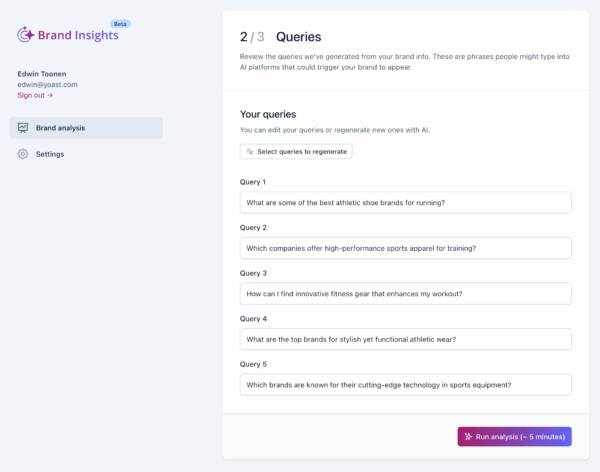
Yoast AI Brand Insights offers a crucial toolkit for this new era, providing the metrics and actionable intelligence necessary to:
- Accurately measure AI visibility.
- Understand and influence AI-driven brand perception.
- Strategically benchmark against competitors.
- Optimize content and online presence for LLM comprehension.
The future of brand success hinges on proactive engagement with AI. The time for brands to take control of their AI visibility is not tomorrow, but today. By embracing these strategies and leveraging specialized tools, organizations can ensure their brand is not just seen, but recommended and trusted by the AI systems shaping consumer decisions.

 Jia Lissa
 Siti Muinah