rifanmuazin
The affiliate marketing industry was sent into a state of flux during the week of January 12, 2026, as two of the most prominent affiliate networks in the United States took decisive action against PayPal Honey. The browser extension and shopping tool, which was acquired by PayPal for $4 billion in 2020, has been removed or suspended from both Rakuten Advertising and Impact.com. These actions follow a series of high-profile investigations that alleged the platform engaged in attribution manipulation and violated industry-standard "stand-down" protocols. The timing of the removals coincided with Affiliate Summit West, the industry’s largest annual conference, making the disciplinary actions a central point of discussion among thousands of marketing professionals, merchants, and publishers.
The controversy surrounding PayPal Honey reached a breaking point following a detailed video report by the investigative creator MegaLag and a subsequent technical investigation by Ben Edelman, a well-known researcher and expert on online advertising fraud. The investigations provided evidence suggesting that Honey’s browser extension was failing to adhere to "stand-down" rules—agreements designed to ensure that extensions do not overwrite the cookies of other affiliates who have already introduced a customer to a brand. By allegedly circumventing these rules, Honey was able to claim commissions for sales that were actually driven by other content creators, influencers, or publishers, a practice known in the industry as attribution manipulation or "commission jumping."
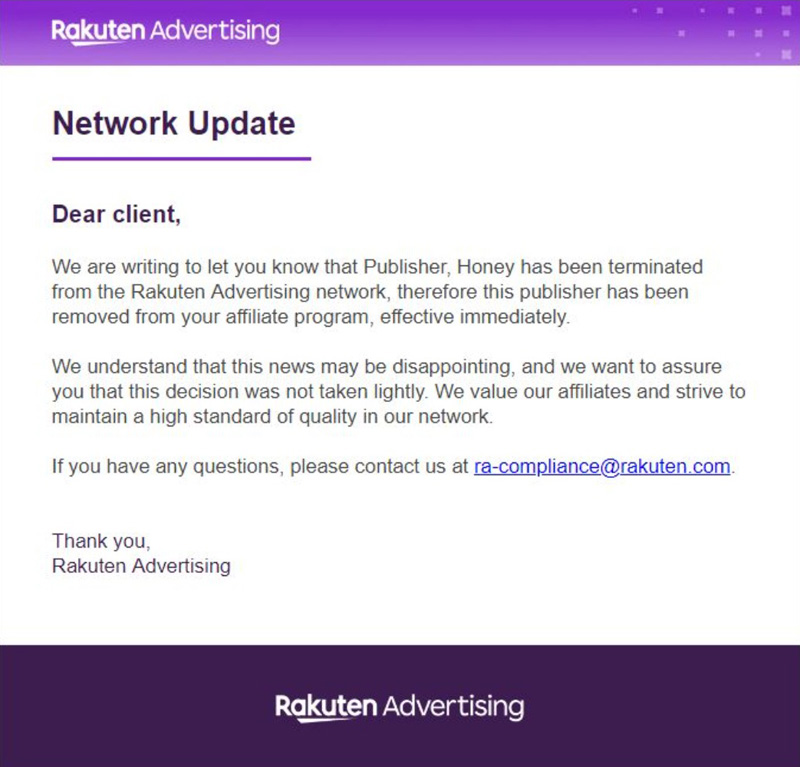
On Monday, January 12, Rakuten Advertising officially announced that Honey had been "terminated from the network." In a statement issued to its partners, Rakuten framed the decision as a necessary measure to "maintain a high standard of quality" and protect the integrity of its ecosystem. The termination was immediate and comprehensive, signaling a zero-tolerance approach to the alleged policy violations. Just days later, on Friday, January 16, Impact.com followed suit. The platform informed its users that Honey was found to be "out of compliance" with platform policies and had been removed from the "Discovery Marketplace." While Impact.com’s action was characterized as a suspension rather than a permanent termination, the platform’s CEO explicitly cited "attribution manipulation" as the cause, stating that such behavior undermines the fundamental trust required for a healthy partnership economy.

To understand the gravity of these events, it is necessary to examine the technical mechanics of affiliate attribution. Most modern affiliate programs operate on a "last-touch-wins" model. Under this system, the affiliate whose link was clicked last before a purchase is completed receives the full commission for that sale. Browser extensions like Honey are meant to offer value by finding coupons or providing cashback, but they are also governed by "stand-down" rules. These rules dictate that if a user has already clicked an affiliate link from another source—such as a product review blog or a social media influencer—the extension must remain dormant and not fire its own tracking link. This ensures the original affiliate, who did the work of "top-of-funnel" discovery, is fairly compensated. The investigations alleged that Honey used concealed methods to bypass these checks, effectively "stealing" the last-click attribution from other hard-working publishers.
The fallout from these suspensions serves as a stark reminder of the "one bad apple" theory in digital marketing. When a major player like Honey is perceived to be gaming the system, it does not just affect the merchants’ bottom lines; it creates a toxic environment for all other affiliates. Savvy content producers and high-value influencers often audit the affiliate programs they join. If they see that a brand allows "cookie-dropping" extensions to operate without oversight, they are likely to abandon that program. They recognize that their efforts to drive traffic will likely be unrewarded if an extension can overwrite their tracking at the final moment of checkout. Consequently, a merchant’s reliance on a single high-volume but non-compliant affiliate can lead to the exodus of hundreds of honest, high-quality partners.
For affiliate managers and brand owners, the PayPal Honey case provides several critical lessons in program governance. The first is that while affiliate networks provide the infrastructure for partnerships, they cannot be the sole source of policing. Networks often have conflicting interests, as they earn fees from the volume generated by large affiliates. Historically, networks have been known to "look the other way" when major earners violate minor policies. The recent actions by Rakuten and Impact.com are notable because they represent a departure from that trend, likely spurred by the undeniable public evidence presented by Edelman and MegaLag. Brands must therefore perform their own due diligence, clearly defining prohibited behaviors in their Terms and Conditions (Ts & Cs) and using third-party monitoring tools to ensure compliance.
Furthermore, the Honey situation highlights the need for a deep technical understanding of the "Downloadable Software Publisher" (DSP) category. Not all browser extensions are predatory. Many provide legitimate value and adhere strictly to stand-down rules. However, without a granular understanding of how these tools interact with a browser’s clickstream, affiliate managers cannot distinguish between a value-added partner and a parasitic one. The Affiliate & Partner Marketing Association (APMA) recently conducted an independent audit of thirty brands across ten networks, revealing the complexity of attribution rules. Their findings suggested that "soft clicks" and "stand-down" violations are often difficult to detect without sophisticated auditing, yet they have a massive impact on where marketing dollars actually end up.
The most significant long-term implication of the Honey suspension is the urgent need for affiliate base diversification. Many brands have allowed their affiliate programs to become top-heavy, with a small handful of coupon and cashback sites driving upwards of 80% of total referred revenue. When one of those "mega-affiliates" is removed for non-compliance, the brand’s revenue can plummet overnight. To build a resilient program, managers are now being encouraged to explore a wider array of affiliate types. A truly robust program should include a mix of the following 28 affiliate categories:
- Affinity groups and professional organizations
- Card-linked offers that integrate with banking apps
- Charities and fundraising platforms
- Niche content producers and bloggers
- Complementary brands in non-competing sectors
- Co-registration affiliates
- Legitimate coupon and deal aggregators
- Connected TV (CTV) and streaming partners
- Consultants and B2B service providers
- Datafeed-driven comparison websites
- Domainers and parked page traffic
- Educational platforms and course creators
- Opt-in email marketers
- Existing customers and brand advocates (refer-a-friend)
- Loyalty and rewards platforms (both public and closed-user groups)
- Mass media and news publishers
- Mobile-first and in-app affiliates
- Online communities, subreddits, and forums
- Managed paid search affiliates (with strict trademark bidding rules)
- Pay-per-call publishers
- Podcasters and audio content creators
- Post-checkout upsell solutions
- Independent ranking and review sites
- Cart abandonment and retargeting solutions
- Social media influencers across various platforms
- Sub-affiliate networks (with transparent reporting)
- Software and browser extensions (compliant with stand-down rules)
- Video marketers and YouTube creators
By spreading risk across these various channels, a brand ensures that the loss of any single partner—no matter how large—does not result in a catastrophic failure of the channel. Moreover, this diversification often leads to higher-quality customer acquisition, as content-based affiliates typically reach users earlier in the buying journey than coupon extensions, which often only engage the user once they have already decided to buy.
As the industry moves forward into 2026, the PayPal Honey incident is likely to be viewed as a turning point for transparency. The "partnership economy" relies on the idea that all parties—merchants, networks, and publishers—are acting in good faith. When that trust is broken by attribution manipulation, the entire model is threatened. The decisive actions taken by Rakuten Advertising and Impact.com suggest that the industry is entering an era of increased accountability. For PayPal Honey, the path back to these marketplaces will likely require significant technical overhauls and a transparent audit of their tracking practices. For the rest of the industry, the message is clear: the era of "growth at any cost" is being replaced by a focus on sustainable, compliant, and diversified partnerships. Merchants who prioritize these values will be better positioned to weather the storms of affiliate non-compliance and build long-term brand equity in an increasingly scrutinized digital landscape.