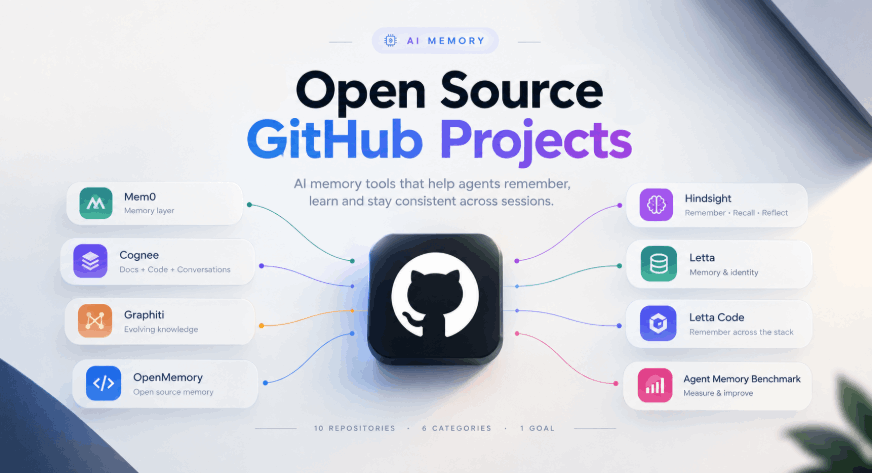
The current landscape of Artificial Intelligence is defined by a paradoxical limitation: while modern Large Language Models (LLMs) can process massive context windows—some exceeding two million tokens—they remain fundamentally stateless, suffering from total amnesia once a session concludes. This "memory gap" represents the primary hurdle in transitioning from simple chatbots to truly autonomous agents capable of long-term planning, personalized assistance, and professional reliability. In response to this challenge, a new ecosystem of open-source projects has emerged on GitHub, focusing on building a "cognitive layer" for AI. These projects move beyond simple message history, utilizing vector databases, knowledge graphs, and temporal logic to give agents the ability to remember, reflect, and evolve.
The necessity for these systems is underscored by the economic and technical inefficiencies of the current paradigm. Re-inserting thousands of tokens of context into every new prompt is not only computationally expensive but also prone to the "lost in the middle" phenomenon, where LLMs struggle to retrieve specific facts buried in large datasets. By externalizing memory into specialized architectures, developers can create agents that maintain a "persistent state," allowing them to pick up a task exactly where they left off, regardless of when the last interaction occurred.
The Evolution of AI Memory: From Chat History to Cognitive Architectures
To understand the significance of current GitHub projects, it is essential to trace the chronology of AI memory. In the early stages of generative AI (2022–2023), memory was synonymous with "chat history"—a simple list of previous exchanges appended to the current prompt. As tasks became more complex, developers turned to Retrieval-Augmented Generation (RAG), which allowed agents to query external databases. However, standard RAG is often "cold"; it retrieves information based on semantic similarity but lacks an understanding of the user’s evolving preferences or the chronological order of events.
The projects currently gaining traction represent the third generation of memory: Agentic Memory. These systems do not just store data; they organize it, prune it, and reflect upon it. According to industry analysts, the market for autonomous agents is expected to grow at a CAGR of over 30% through 2030, with "persistence" cited as the most requested feature for enterprise-grade deployments.
1. Mem0: The Layer for Personalized Intelligence
Mem0 has positioned itself as the "memory layer" for AI applications, designed specifically to handle the nuances of user-specific preferences and historical interactions. Unlike traditional databases that store raw text, Mem0 focuses on extracting and storing useful facts and relationships. For instance, if a user mentions a preference for Python over Java in one session, Mem0 ensures that this preference is retrieved in all future sessions without the developer needing to manually manage the state.

The project’s importance lies in its ability to provide continuity across different platforms and sessions. By decoupling memory from the specific LLM being used, Mem0 allows for a portable user profile that can follow an individual across various AI-driven tools. This "General-Purpose" approach is critical for developers looking to add sophisticated personalization to existing applications without re-engineering their entire backend.
2. MemGPT: Managing LLM Memory Like an Operating System
While not originally in the provided list, MemGPT (Memory-GPT) is a cornerstone of the open-source memory movement. It treats the LLM’s context window like RAM and external storage like a hard drive. MemGPT provides a system for "virtual context management," allowing agents to autonomously move information between their "working memory" and "long-term storage." This mimics the way an operating system manages memory, enabling agents to handle tasks that technically exceed their token limits by paging information in and out as needed.
3. Hindsight: Bridging the Gap with Reflection and Recurrence
Hindsight introduces a critical psychological component to AI: reflection. While most memory systems focus on simple recall, Hindsight is designed to let agents "think back" on their past experiences to inform future decision-making. This project focuses on long-term retention by creating a feedback loop where the agent evaluates the success or failure of previous actions.

In a professional setting, an agent equipped with Hindsight could remember that a specific approach to a coding problem failed three months ago and suggest an alternative today. This move from "retrieval" to "reflection" is a significant step toward achieving metacognition in AI systems, allowing them to learn from their own history rather than just providing static responses.
4. Cognee: Semantic Interconnectivity via Knowledge Graphs
Cognee addresses the limitations of vector-only search by implementing a graph-based knowledge memory. Traditional vector databases find information based on "meaning," but they often miss the "connections" between disparate pieces of data. Cognee transforms documents, codebases, and conversations into a structured graph where entities and concepts are linked.
By combining vector search with graph relationships, Cognee allows agents to perform complex reasoning. If an agent is asked about a project’s progress, Cognee can navigate the graph to find the lead developer, the associated GitHub repositories, and the last three status updates, even if those pieces of information were never mentioned in the same document. This structured context is vital for enterprise agents managing complex, interconnected data silos.

5. Graphiti: The Dimension of Time in Knowledge
One of the most difficult challenges in AI memory is "temporal decay"—the fact that information changes over time. A user’s favorite programming language might change, or a company’s CEO might be replaced. Graphiti solves this by building time-aware knowledge graphs.
Instead of treating facts as static records, Graphiti models the evolution of information. It allows agents to distinguish between "what was true then" and "what is true now." This temporal awareness is indispensable for personal assistants and research agents that must track the progression of events or the shifting nature of human relationships and preferences.
6. Zep: Low-Latency Long-Term Memory for AI Assistants
Zep is an open-source platform designed to provide fast, scalable long-term memory for AI assistant apps. It focuses on the "enrichment" of memory—automatically summarizing conversations, extracting entities, and ensuring that the most relevant information is always available at the top of the context window. Zep’s architecture is optimized for production environments where latency is a primary concern, providing a bridge between raw data storage and real-time agent responsiveness.

7. memU: Proactive Knowledge Organization
The memU project treats stored experience as a continuously organized knowledge layer. Rather than acting as a passive repository that waits for a query, memU is designed for "proactive" memory. It attempts to surface relevant knowledge when it becomes useful for a new task, even if the user doesn’t explicitly ask for it. This simulates the human experience of "having an idea" or "remembering a relevant fact" in the middle of a conversation, making the AI feel more like a collaborator than a simple search engine.
8. OpenViking: Ensuring Persistent Agent State
For agents tasked with multi-day or multi-week projects, maintaining a "state" is difficult. OpenViking focuses on making agent context persistent and retrievable across interactions. It is particularly useful for organizing context so an agent can "resume" a complex workflow. By ensuring that the internal state of the agent—including its current sub-goals and pending tasks—is saved, OpenViking prevents the "cold start" problem that plagues most autonomous systems.
9. OpenMemory: Portability Across Agent Harnesses
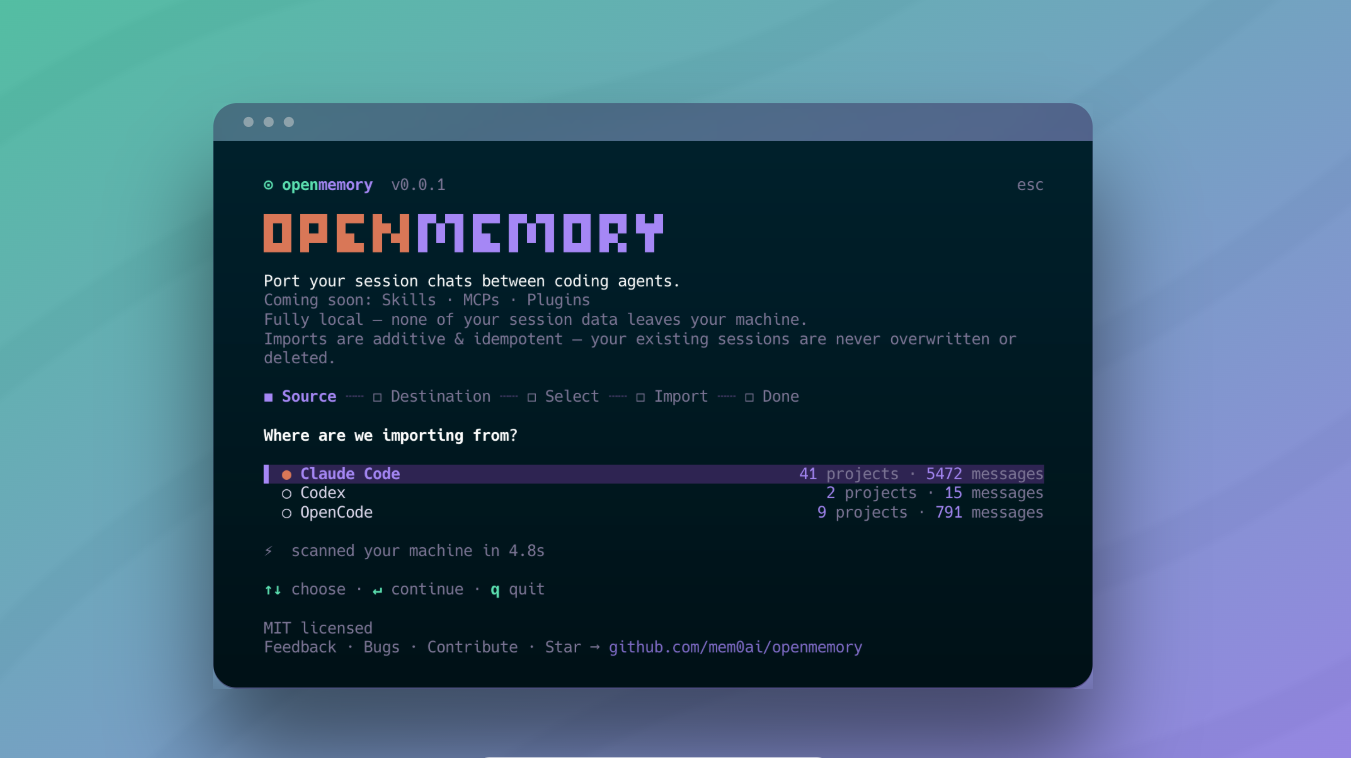
As the AI field evolves, developers often find themselves switching between different tools like Claude Code, Codex, or OpenCode. OpenMemory addresses the "silo" problem by making coding-session context portable. It allows for the import and export of session data, ensuring that the "memory" of a coding project isn’t locked into a single proprietary tool. This focus on interoperability is a significant move toward an open ecosystem where users own their interaction history.
10. HippoRAG: Bio-Inspired Associative Memory
HippoRAG is a research-centric project that draws inspiration from the human hippocampus to improve how LLMs handle associative memory. While standard RAG is good at finding "the most similar" document, HippoRAG is designed to find "related" information that might not be semantically similar but is contextually linked. This mimicry of human neurological processes allows for a more natural form of information retrieval, helping agents connect dots that traditional systems might overlook.
Technical Implications and Data Trends
The shift toward these memory systems is backed by compelling data regarding LLM performance. Research into "In-Context Learning" (ICL) suggests that while LLMs are powerful, their performance degrades as context windows become cluttered with irrelevant information. A study by Stanford researchers found that "needle-in-a-haystack" retrieval accuracy can drop by up to 20% when the relevant information is placed in the middle of a large context block.
Memory systems like Cognee and MemGPT mitigate this by ensuring that only the "right" context is injected into the prompt. Furthermore, the cost implications are significant. For a high-volume enterprise application, re-processing 100,000 tokens of history in every turn of a 50-turn conversation can cost hundreds of dollars per user. Efficient memory systems can reduce this cost by 90% or more by utilizing local indexing and selective retrieval.

The Broader Impact: From Stateless Models to Digital Twins
The development of robust AI memory systems has implications that extend far beyond technical efficiency. We are witnessing the birth of the "Digital Twin" or "Personal AI." When an agent can remember every interaction, preference, and piece of feedback over years, it ceases to be a tool and becomes an extension of the user’s cognitive process.
However, this transition brings significant challenges regarding privacy and data sovereignty. If an agent "remembers everything," the security of that memory becomes paramount. Projects like Mem0 and OpenMemory are increasingly focusing on encryption and local-first storage options to ensure that the "digital brain" of the user remains under their control.
Conclusion: The Future of Stateful AI
The distinction between context and memory is the frontier of AI development. Context is what an agent knows for the next five minutes; memory is what it knows for the next five years. The ten projects highlighted here—ranging from graph-based architectures like Cognee to temporal systems like Graphiti—are the building blocks of this future.
As these open-source frameworks mature, we can expect a shift in how AI is integrated into daily life. We will move away from the "disposable conversation" model toward a "continuous relationship" model. In this new era, the value of an AI system will not just be measured by the size of its parameters or the speed of its tokens, but by the depth and accuracy of what it remembers. These GitHub projects are not just code repositories; they are the blueprints for the first generation of AI that truly never forgets.