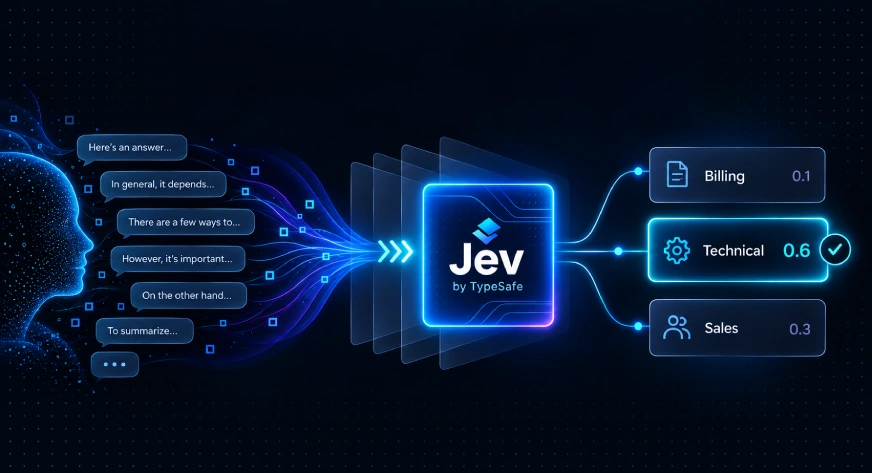
The landscape of artificial intelligence underwent a significant shift on September 15, 2026, as TypeSafe AI emerged from two years of stealth operations to announce the launch of Jev, a new category of AI model designed specifically for software integration rather than human conversation. Backed by $40 million in seed funding and led by former OpenAI researcher Diogo Almeida, the company is positioning Jev as the missing link in enterprise automation—a model that prioritizes deterministic judgment and speed over the creative, token-by-token generation characteristic of traditional Large Language Models (LLMs) like ChatGPT and Claude.
The emergence of Jev follows a period of mounting frustration within the developer community regarding the latency and unpredictability of conversational AI when used as a component of backend software. While models have achieved superhuman performance in dialogue, the sequential nature of text generation remains a bottleneck for high-volume, real-time decision-making. Almeida, who played a pivotal role in the research foundations of ChatGPT, founded TypeSafe AI to address this specific architectural limitation. The result is Jev, a model that does not "write" in the traditional sense but instead analyzes inputs to return fixed, predefined judgments with mathematically calibrated confidence scores.
The Architectural Departure: Judgment over Generation
To understand the impact of Jev, one must first examine the fundamental mechanics of the current AI status quo. Standard LLMs operate on an autoregressive principle, predicting the next token in a sequence based on all preceding tokens. This chain-link process is inherently slow and prone to "hallucinations," as the model is forced to maintain a linguistic narrative. Jev abandons this paradigm entirely. It is engineered to process an entire "state"—a block of data, a customer ticket, or a snippet of code—in a single pass.
By eliminating sequential token generation, Jev can process multiple questions about a single input in parallel. In traditional systems, asking an AI to determine a customer’s intent, sentiment, and urgency would require either three separate calls or a single long response that the model generates piece by piece. Jev performs these evaluations simultaneously. According to TypeSafe AI’s internal documentation, asking the model thirteen questions instead of one results in negligible increases in latency. This "System One" approach—a reference to fast, intuitive thinking—allows the model to function more like a high-speed logic gate than a conversational partner.
The pricing model reflects this architectural shift. TypeSafe AI has set the cost of input at $0.042 per million tokens, while making output entirely free. This is possible because Jev does not generate new text; it merely selects from predefined choices or provides numerical scores, significantly reducing the compute overhead typically associated with generative output.
Development History and the Stealth Period
The road to Jev’s launch began in late 2024, shortly after Almeida’s departure from OpenAI. During the two-year stealth period, the TypeSafe team focused on a training methodology known as Reinforcement Learning from Correct Distributions (RLCD). This method stands in contrast to Reinforcement Learning from Human Feedback (RLHF), which has been criticized for encouraging models to sound confident even when they are incorrect.
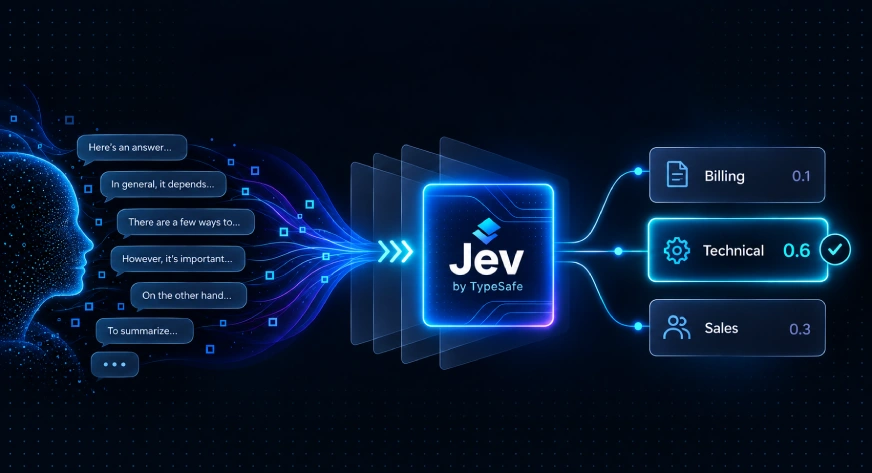
RLCD was designed to produce "honest probabilities." The goal was to create a model that is "well-calibrated"—meaning that if Jev assigns a 0.8 confidence score to a decision, that decision is statistically likely to be correct 80% of the time. For developers building autonomous agents, this calibration is more valuable than raw intelligence; it allows code to automatically execute high-confidence decisions while flagging low-confidence ones for human review.
Empirical Performance and Real-World Applications
Since its mid-September release, Jev has seen rapid adoption among early-access developers, with several high-profile use cases trending across technical forums. These examples highlight the model’s ability to handle massive datasets at a fraction of the cost and time required by traditional LLMs.
In one notable instance, a developer identified as Roman utilized Jev to process 700 high-intent sales leads. The task involved analyzing personalized outreach messages to predict performance and detect mismatches between the lead’s profile and the message content. Jev completed the entire batch in 40 seconds at a total cost of $0.09. A similar task performed by a generative model would likely have cost several dollars and taken minutes to complete due to the time required to output text for each lead.
Another researcher, Devaiah Shrithan, applied Jev to a massive academic dataset, processing the abstracts of every AI-related paper uploaded to arXiv between 1993 and 2026. This involved 464,720 papers and required Jev to answer five specific questions for each, ranging from whether the paper claimed a new "state-of-the-art" result to whether the language used was overly "hyped." The resulting analysis, derived from 2.3 million individual judgments, was produced in a timeframe that would have been prohibitive using standard API-based LLMs.
A third application demonstrated Jev’s potential in DevOps and site reliability engineering. A builder named Tarasshyn directed Jev toward 3 million session-replay events to identify UI friction and errors. Within 40 seconds, and for a cost of $2.17, Jev reviewed over 3,200 sessions, identifying specific instances of "rage clicks" and JavaScript errors. Most significantly, the model’s judgments were used to automatically open 213 draft pull requests to fix the identified bugs, demonstrating a level of reliability that allows for autonomous software maintenance.
Critical Analysis: Type Safety vs. Correctness
Despite the enthusiastic reception, Jev has faced scrutiny from some corners of the AI research community. Critics argue that the model is essentially a "well-packaged classifier," a technology that has existed for decades. TypeSafe AI’s response centers on the distinction between simple classification and large-scale semantic understanding. While traditional classifiers require extensive training on specific datasets, Jev utilizes the broad world-knowledge of a transformer-based model while outputting results in a constrained, type-safe format.
TypeSafe AI is also remarkably transparent about the model’s limitations. The official documentation lists nine specific failure modes. Jev is known to struggle with complex arithmetic and precise date calculations—tasks the company suggests should remain within the realm of traditional code. Additionally, the model’s performance can degrade when presented with excessively large or noisy inputs, requiring developers to pre-filter data for optimal results.
Furthermore, the company emphasizes the difference between "type safety" and "correctness." Because Jev is constrained by a developer-defined schema, it is physically incapable of returning a malformed or "unparseable" response—a common headache when using LLMs to generate JSON. However, being "type-safe" does not mean the model is always right. It can still choose the wrong option from a list of predefined choices. The "no hallucinations" claim made by TypeSafe refers specifically to the structural integrity of the output, not the factual accuracy of the judgment.
Market Context and Future Implications
The launch of Jev comes at a time when the "AI Agent" craze is reaching a fever pitch. Companies are increasingly looking for ways to move beyond chatbots and toward autonomous systems that can take actions. For an AI agent to be effective, it needs to make thousands of small, reliable decisions every hour. The high latency and "chattiness" of current LLMs have been the primary barriers to this goal.
By offering a model that is 10 to 12 times faster and significantly cheaper than the industry standard, TypeSafe AI is positioning itself as the foundational infrastructure for the next generation of autonomous software. If the company’s claims hold true under wider public testing, Jev could force a shift in how major players like OpenAI and Anthropic design their enterprise APIs.
The broader implications for the labor market and software development are also profound. If a model can triage millions of events and open pull requests for $2.00, the role of junior QA engineers and entry-level data analysts may undergo a radical transformation. The focus will likely shift from performing these analyses to designing the "criteria" and "instructions" that Jev uses to make its judgments.
Conclusion and Outlook
As TypeSafe AI moves toward a wider release, the tech industry is watching closely to see if Jev’s performance in the field matches the impressive benchmarks provided by the company. While the initial data is compelling, the figures regarding accuracy and cost remain internal evaluations that have yet to be fully validated by independent third-party audits.
However, the excitement surrounding Jev on platforms like X suggests that TypeSafe has tapped into a deep-seated need within the developer community. By moving away from the "human-mimicry" of chatbots and toward a "machine-integrated" logic engine, Jev represents a pragmatic evolution of transformer technology. The coming months will determine if this specialized approach becomes the new standard for software automation or remains a niche tool for high-scale data processing. For now, the successful $40 million seed round and the pedigree of its founding team suggest that TypeSafe AI is a formidable new entrant in an already crowded field, offering a vision of the future where AI is seen not as a person to talk to, but as a reliable component of the global software stack.