In the rapidly evolving landscape of software engineering and digital product management, the traditional "big bang" release—where new features are deployed to an entire user base simultaneously—has become an antiquated and high-risk strategy. Modern development teams have instead pivoted toward a more nuanced methodology known as full-stack experimentation. At the heart of this shift are three distinct yet interconnected concepts: feature flags, feature rollouts, and feature testing. While these terms are frequently used interchangeably in industry discourse, they serve different strategic purposes within the product lifecycle. Understanding the technical distinctions and operational applications of each is essential for organizations aiming to reduce deployment risk, optimize user experience, and drive data-backed business growth.
The Evolution of Full-Stack Experimentation
Full-stack experimentation represents a departure from traditional client-side A/B testing. While client-side testing typically involves modifying the Document Object Model (DOM) in a user’s browser to change visual elements like button colors or header text, full-stack testing operates deeper within the technology stack. It touches backend systems, search algorithms, pricing engines, and infrastructure configurations. By integrating experimentation logic directly into the server-side code or mobile application binary, organizations can eliminate the "flicker effect"—a common issue in client-side testing where the original content is visible for a split second before the variation loads.
The infrastructure required to support this level of sophistication relies on Software Development Kits (SDKs). Leading platforms, such as Convert Experiences, provide SDKs across various programming environments including JavaScript/TypeScript, PHP, Python, Ruby, iOS, and Android. These SDKs ensure that the bucketing logic—the process of determining which user sees which version of a feature—remains consistent regardless of the device or platform the user is utilizing. This cross-platform consistency is the bedrock upon which feature flags, rollouts, and tests are built.
Feature Flags: The Fundamental On-Off Switch
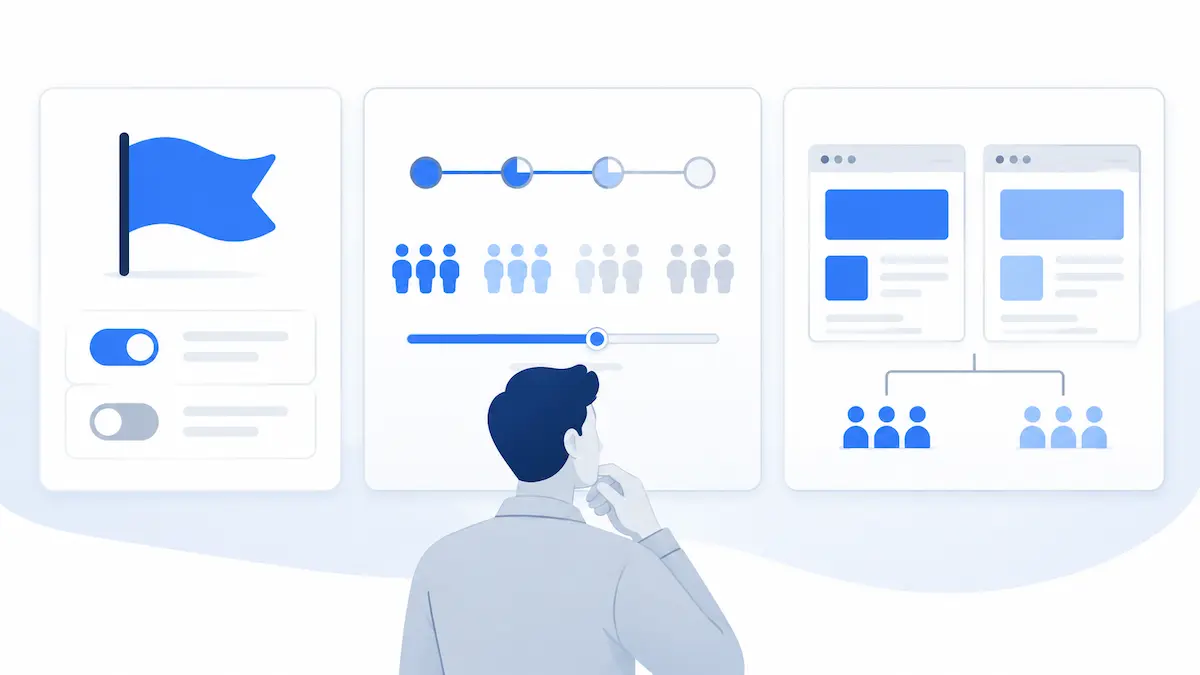
A feature flag, also known as a feature toggle, is a software development pattern that allows teams to enable or disable functionality at runtime without deploying new code. In its simplest form, it is a conditional statement (an "if/else" block) that checks a remote configuration to decide which code path to execute. This decoupling of "code deployment" from "feature release" is a transformative capability for DevOps teams.
The primary utility of a feature flag is risk management. For instance, a "kill switch" can be implemented for a new third-party payment integration. If the integration begins to fail or causes latency issues in the production environment, engineers can flip the flag to the "off" position via a dashboard, instantly reverting to the legacy system without needing an emergency code rollback.
Beyond emergency fixes, feature flags are used for "permission gating." This allows a company to keep a feature hidden from the general public while making it visible only to internal employees or "power users" on a specific subscription plan. Because these flags can remain in the codebase for months or even years, they require rigorous management to avoid "technical debt" or "flag sprawl," where stale logic paths clutter the system and increase complexity.
Feature Rollouts: The Strategic Dimmer Switch
While a feature flag is a binary switch, a feature rollout is more akin to a dimmer switch. A rollout is a deployment strategy used once a team has already decided to launch a feature but wishes to mitigate the "blast radius" of potential bugs or performance regressions. Instead of 100% exposure, the feature is initially released to a small subset of the population—perhaps 5% or 10%.

The chronology of a typical rollout involves several phases:
- Internal Testing: The feature is enabled for the development and QA teams via a feature flag.
- Canary Release: The feature is rolled out to a tiny percentage of live traffic (the "canaries in the coal mine"). Engineers monitor system health metrics, such as CPU usage, memory leaks, and error logs.
- Incremental Expansion: If the system remains stable, the exposure is increased to 25%, then 50%.
- Full Launch: Once the feature is proven stable at scale, it is moved to 100% of the user base.
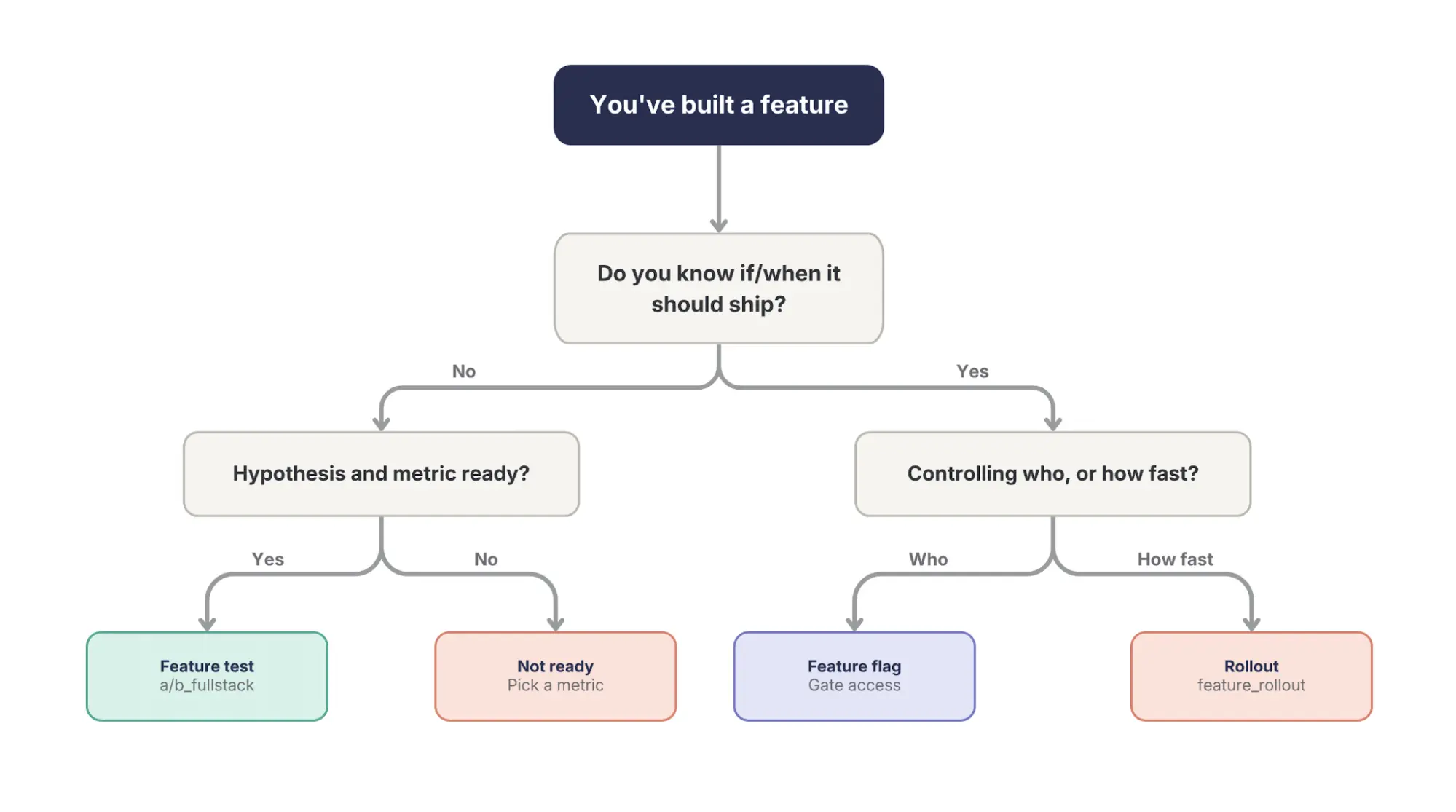
In the context of Convert Experiences, a rollout is defined as an experience with a single variation and no control group. The objective is not to measure if the feature is "better" than the old version, but rather to ensure that the feature is "safe" and does not break the existing ecosystem.
Feature Testing: The Measuring Scale of Innovation
Feature testing, or full-stack A/B testing, is the most rigorous of the three methods. It is used when a product team is uncertain whether a new feature will actually improve user behavior or business outcomes. Unlike a rollout, a feature test requires a hypothesis, a control group, and statistical significance.
For example, a travel booking site might want to test a new search algorithm that prioritizes "eco-friendly" hotels. Before committing to this change, they run a feature test. Half the users (the control group) continue to see the standard algorithm, while the other half (the treatment group) see the eco-friendly results. The team then measures specific metrics, such as conversion rate, average order value, or task completion time.
The distinction between feature testing and quality assurance (QA) feature testing is vital. In a QA context, "feature testing" refers to verifying that a button works when clicked. In an experimentation context, it refers to verifying that the button—once proven to work—actually drives the desired business value.
Technical Comparison and Operational Framework
To effectively implement these strategies, organizations must understand how they differ across several key factors:
| Factor | Feature Flags | Rollouts | Feature Testing |
|---|---|---|---|
| Primary Goal | Operational control and safety | Controlled exposure and scaling | Validating impact and performance |
| Control Group | No | No | Yes |
| Traffic Allocation | Targeted by attributes (e.g., ID, region) | Percentage-based ramp (e.g., 10% to 100%) | Fixed split between variations (e.g., 50/50) |
| Success Metric | System uptime / No errors | Guardrail metrics (latency, error rates) | Statistical significance of a KPI |
| Primary Operator | Engineering / DevOps | Product Management / Engineering | Product / Growth / Data Science |
| Typical Duration | Short-term (release) or Permanent (ops) | Hours to Days | Weeks (until statistical significance) |
Supporting Data and Industry Implications
The adoption of these full-stack techniques has a measurable impact on software delivery performance. According to the 2023 State of DevOps Report (DORA), "Elite" performers—those who utilize advanced deployment strategies like feature flags and automated rollouts—have a change failure rate that is five times lower than "Low" performers. Furthermore, these organizations can recover from incidents in less than one hour, compared to several days for teams using traditional deployment methods.
From a business perspective, the implications are equally significant. A study on digital experimentation suggests that only about 10% to 30% of new ideas actually yield positive results. Without feature testing, companies risk spending months of engineering resources on features that may actually hurt their conversion rates. By utilizing feature flags to wrap new code, and feature testing to validate it, companies can "fail fast" and pivot their resources toward initiatives that are proven to work.

Implementation Challenges: Managing the Lifecycle
Despite the benefits, implementing these systems is not without challenges. One of the most significant risks is "flag debt." When a feature test is concluded or a rollout reaches 100%, the conditional logic and the "old" code path should ideally be removed from the codebase. Failure to do so leads to a "spaghetti code" scenario where it becomes difficult for developers to understand the current state of the application.
Moreover, the human element of these processes cannot be ignored. A successful full-stack strategy requires tight alignment between engineering, product, and data teams. Engineers must ensure the flags are performant and don’t introduce latency; product managers must define the metrics of success; and data scientists must ensure the bucketing is truly random and the results are statistically valid.
Conclusion: A Unified Strategy for Digital Growth
Feature flags, rollouts, and feature testing are not competing methodologies but rather complementary tools in a unified toolkit. A sophisticated product team will often use all three in a single feature lifecycle:
- A Feature Flag is used to hide the code while it is being built in the production environment (Continuous Integration).
- A Feature Test is then conducted to see if the feature improves the user experience.
- If the test is successful, a Rollout is used to gradually scale the feature to the entire population to ensure infrastructure stability.
As digital products become increasingly complex and user expectations for seamless, high-performance experiences continue to rise, the ability to experiment at the "full-stack" level is becoming a prerequisite for success. Platforms like Convert Experiences, with their robust SDK support and unified data models, provide the necessary infrastructure to manage this complexity. By mastering the switch (flags), the dimmer (rollouts), and the scale (testing), modern organizations can transform their software development process into a high-speed engine for innovation and growth.