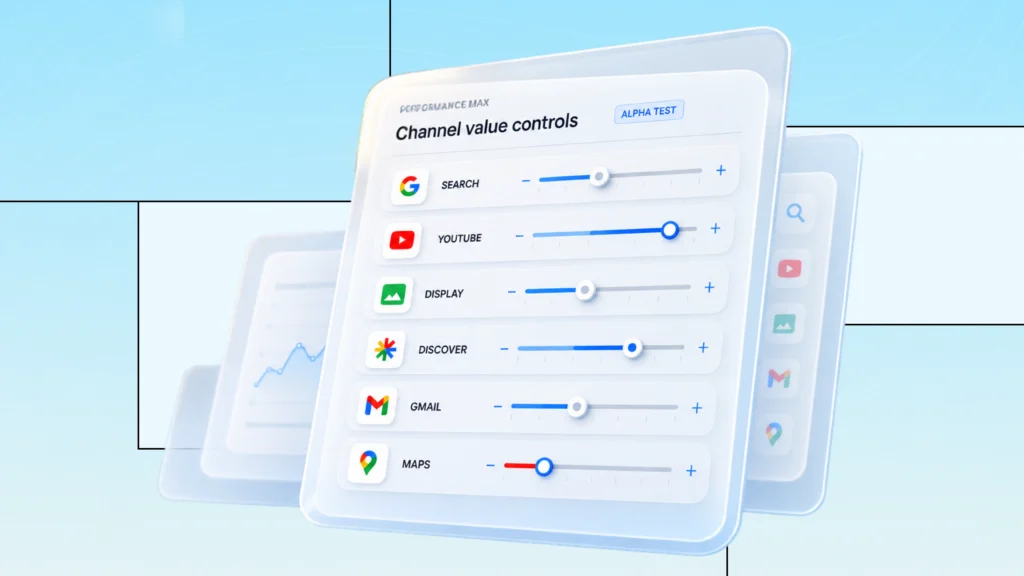
Google is reportedly in the early stages of alpha testing new channel-level controls within its Performance Max (PMax) campaign management system, a development that could significantly alter how advertisers direct and value the diverse array of Google advertising platforms integrated into the automated solution. While Google has not officially confirmed these tests, early observations suggest that these controls might empower advertisers to influence the perceived importance of individual channels such as Search, YouTube, Display, Discover, Gmail, and Maps, potentially by adjusting their relative value rather than through direct budget allocation. This move, if widely implemented, could represent a substantial evolution in advertisers’ ability to guide Google’s AI-driven advertising engine, but it also underscores the critical importance of robust data measurement and strategic insight.
The initial identification of this emerging functionality was shared on LinkedIn by search marketing advisor Heidi Sturrock, indicating that the details are still fluid and subject to change as the testing progresses. The mechanism appears to operate analogously to conversion value rules, a feature that allows advertisers to adjust the value of conversions based on specific attributes. In this PMax context, it suggests advertisers could assign a higher or lower relative weight to certain channels based on their perceived contribution to business objectives, moving beyond the current opacity of how PMax allocates spend and prioritizes placements across its vast inventory.
This potential shift in control comes at a time when the efficacy of automated advertising platforms like Performance Max is increasingly tied to the quality and completeness of the data signals provided by advertisers. As Google’s AI systems become more sophisticated, their performance is intrinsically linked to the accuracy of conversion tracking, the implementation of Consent Mode for privacy-compliant data collection, the use of enhanced conversions for improved accuracy, and the effective utilization of first-party data. The success of these new channel-level controls will therefore hinge on advertisers’ ability to feed Google’s algorithms with precise, actionable insights about their customer journeys and the real-world value generated by each touchpoint.
The Crucial Nexus of Data Quality and Advanced Controls
The introduction of channel-level controls, should it materialize, will amplify the existing imperative for advertisers to establish and maintain impeccable measurement practices. The effectiveness of any attempt to guide Performance Max’s channel prioritization will be directly proportional to the quality of data signals fed into the system. Accurate conversion tracking, which forms the bedrock of performance evaluation, becomes even more critical. Furthermore, the strategic deployment of Google’s Consent Mode is essential for ensuring that advertising efforts are aligned with evolving privacy regulations while still enabling data collection for optimization. Enhanced conversions, which provide a more robust view of conversions by leveraging hashed first-party data, will further refine the accuracy of performance attribution. For businesses with physical locations, sophisticated store visit measurement is indispensable for understanding the impact of online advertising on offline sales.
Beyond technical tracking, a nuanced understanding of the customer journey is paramount. Historically, attribution models have often favored the last-click channel, potentially undervaluing the role of earlier touchpoints. Channels like Display, which may rarely receive direct credit for a final conversion, can play a significant role in brand awareness and consideration, subtly influencing eventual customer actions. If advertisers gain the ability to influence how Performance Max values these channels, these decisions must be informed by a holistic view of customer behavior, rather than solely by easily digestible, albeit potentially incomplete, attributed CPA figures.
For advertisers who have invested in sophisticated measurement frameworks, these potential channel-level controls could be a game-changer. The ability to identify specific customer journeys and interactions that consistently lead to higher lifetime value customers would provide a powerful basis for instructing Performance Max to prioritize those pathways and the channels that facilitate them. This represents a move from simply optimizing for immediate conversions to optimizing for long-term customer profitability, a more sophisticated objective that aligns with broader business goals.
Strategic Applications of Channel-Level Value Adjustments
The widespread rollout of channel-level value controls could prove particularly impactful for businesses where different Google channels serve distinct and crucial roles in the path to conversion. Consider a local restaurant chain. Visibility on Google Maps, driving direct foot traffic and phone calls, might hold significantly more commercial value than it would for a global e-commerce fashion retailer. For the restaurant, a higher perceived value for Maps within Performance Max could lead to more strategic ad placements and a greater emphasis on local search optimization.
Similarly, a travel company might observe a pattern where potential customers discover destinations through YouTube video content, are re-engaged through Display ads while browsing other sites, and ultimately make a booking after searching for specific flight or hotel deals on Google Search. The direct CPA reported for YouTube or Display might not capture the full value they contribute in nurturing that lead through the funnel. Channel-level controls would allow such a company to reflect this understanding of customer behavior directly into the campaign, assigning a greater weight to the channels that initiate and nurture interest, even if they don’t close the sale.
A particularly relevant use case emerges for advertisers running Performance Max campaigns concurrently with dedicated standalone Search campaigns. Since the introduction of PMax, advertisers have expressed concerns about potential cannibalization of spend between the two. Google has incrementally introduced measures to mitigate this, such as brand exclusions and negative keywords. However, if a robust standalone Search campaign is already effectively capturing high-intent search demand, advertisers might opt to reduce the relative value assigned to the Search channel within their PMax campaigns. This would serve as an additional layer of control, allowing for a more refined management of the interplay between these campaign types and potentially freeing up PMax to explore and optimize across other Google inventory where it might add greater incremental value.
More broadly, these controls offer advertisers an additional dimension for experimentation within Performance Max. While much of the optimization focus for PMax has traditionally been on bidding strategies, creative assets, and foundational measurement, the ability to influence channel-specific value introduces a new lever for testing and refining campaign performance based on a business’s unique customer journey.
However, this also brings the quality of creative assets into sharper focus. If an advertiser decides to elevate the perceived value of the YouTube channel, they must ensure they have compelling video creative capable of performing effectively on that platform. The same principle applies to Display and Discover; strong channel signals are most potent when supported by appropriate and high-quality creative assets designed for those environments.
The Potential Pitfalls of Over-Control
The introduction of increased control mechanisms into a platform fundamentally built on automation carries inherent risks. Performance Max is designed to leverage a vast network of signals across Google’s ecosystem to make complex optimization decisions at a scale that is virtually impossible for manual management. If advertisers begin adjusting channel values based on incomplete or misinterpreted performance data, they risk inadvertently steering the AI away from potentially valuable, albeit less visible, activities.
For instance, an advertiser might observe a high CPA for Display advertising and consequently reduce its assigned value. If, unbeknownst to them, Display is consistently introducing new customers who later convert through Search, this decision, based on partial journey data, could diminish the overall effectiveness of the campaign. The advertiser gains more control, but the data underpinning that control leads to a less optimal outcome.
Therefore, these channel-level controls should be viewed as a means of injecting valuable business context into Performance Max, not as a substitute for understanding its automated processes. Any decision to alter how Google values a specific channel must be driven by a clear rationale and supported by substantial, objective evidence that accounts for the entirety of the customer journey.
The Imperative for Rigorous Experimentation
Should Google broaden the availability of these channel-level controls, their successful implementation will depend heavily on the provision of robust experimentation capabilities. This will enable advertisers to empirically validate whether these adjustments actually lead to improved performance.
An advertiser might possess a strong hypothesis that Google Maps holds exceptional value for their business, or conversely, that the Search channel within PMax should have a diminished role due to strong performance in standalone Search campaigns. The critical next step is to rigorously test whether acting on these hypotheses yields superior results.
A well-structured A/B testing framework would empower advertisers to compare Performance Max campaigns with and without these channel value adjustments. This would allow for a precise measurement of the impact on incremental performance, overall efficiency, and profitability. Such testing is crucial for distinguishing between assumptions that sound plausible and strategic changes that demonstrably enhance campaign outcomes.
The prospect of channel-level controls within Performance Max is met with cautious optimism. For advertisers navigating complex customer journeys, these controls could indeed offer a vital mechanism for integrating nuanced business understanding into Google’s sophisticated automation. However, the addition of another control lever inherently raises the bar for its judicious use. The ultimate value derived from these controls will be contingent upon an advertiser’s deep comprehension of each channel’s role, their confidence in measuring that contribution, and their commitment to testing hypotheses before implementing them as permanent adjustments.
Ultimately, this development serves as a potent reminder of a fundamental principle in modern digital advertising: the power of artificial intelligence is inextricably linked to the quality of the data, the strategic acumen, and the sound judgment of the human operators who direct it.