


In the high-stakes landscape of modern business, the synchronization between sales and marketing departments has transitioned from a competitive advantage to a fundamental requirement for survival. According to a comprehensive 2026 study conducted by Unbounce, which surveyed more than 500 small-to-medium business (SMB) go-to-market (GTM) professionals, the disparity between the perceived value of alignment and its actual implementation remains a critical bottleneck for revenue growth. While 87% of teams anticipate that improved sales and marketing alignment would significantly lift organizational performance, only 56% of those surveyed describe their current operations as highly aligned.
The friction between these two core functions rarely presents as a singular, identifiable strategic failure. Instead, it manifests through a series of operational inefficiencies: "qualified" leads generated by marketing that sales teams treat with skepticism, marketing campaigns that remain unknown to the sales representatives responsible for closing deals, and a pipeline that appears robust on paper but fails to translate into closed revenue. As organizations navigate the complexities of the 2026 fiscal year, the data suggests that the "alignment gap" is not merely a communication issue but a structural flaw in the underlying operating models of many GTM teams.
The Disconnect Between Leadership and Execution
One of the most striking findings of the Unbounce report is the significant perception gap existing between executive leadership and front-line employees. The data reveals that 69% of executives report strong sales and marketing alignment within their organizations, whereas only 47% of non-executive staff agree with that assessment. This 22-point discrepancy highlights a structural information lag where leadership views alignment through the lens of high-level strategy decks and scheduled meetings, while those in the field experience the daily reality of broken processes.
This perception gap is further complicated by functional biases. Approximately 62% of sales professionals feel their teams are highly aligned, compared to only 53% of marketing professionals. Experts suggest this stems from the differing ways the two departments measure success. Marketing teams often feel the brunt of data inconsistencies and lack of feedback on lead quality, while sales teams may perceive alignment simply as the consistent delivery of any lead volume, regardless of the strategic nuances behind the acquisition.

The report identifies several barriers that executives tend to underreport compared to their staff. These include data inconsistencies (cited by 28% of staff vs. 22% of execs), limited communication (33% vs. 28%), and the presence of leadership silos (19% vs. 14%). This suggests that while leadership may be mandating alignment, they are often disconnected from the technical and procedural hurdles that prevent it from becoming a reality.
The Operational Cost of Misalignment
Misalignment is frequently dismissed as a "culture problem" or a lack of chemistry between department heads, but the financial and operational costs are tangible and compounding. The Unbounce report indicates that the primary consequence of poor GTM alignment is employee frustration, cited by 29% of respondents. However, the downstream effects on the bottom line are equally severe.
The first symptoms of misalignment typically appear as operational drag. Delayed lead follow-up is a primary concern, with 32% of marketers flagging it as a major issue compared to 22% of sales professionals. When sales teams do not trust the leads provided by marketing, they hesitate to engage, leading to missed opportunities and a higher cost per acquisition. Furthermore, 29% of marketers cite a lack of clarity regarding target customers as a direct consequence of misalignment, a sentiment shared by only 16% of sales staff. This suggests that marketing is often operating in a vacuum, building campaigns for personas that the sales team does not actually encounter in the field.
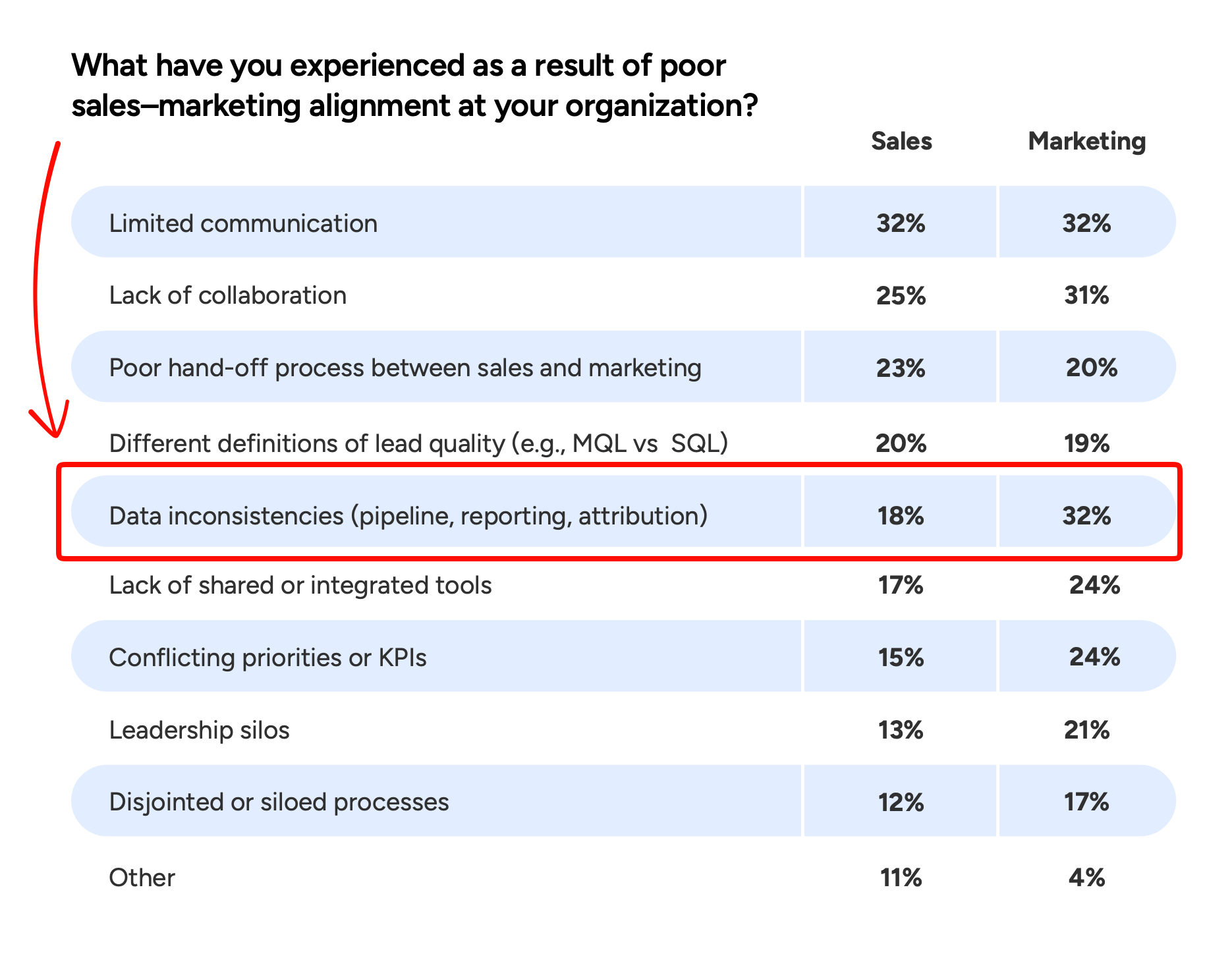
These gaps eventually compound into pipeline problems. When marketing and sales cannot agree on the definition of a "qualified" lead—specifically the transition from a Marketing Qualified Lead (MQL) to a Sales Qualified Lead (SQL)—the entire revenue engine stalls. Approximately 20% of sales and 19% of marketing professionals cite these differing definitions as a primary blocker. Without a unified feedback loop, marketing continues to spend budget on low-intent leads, while sales spends time manually filtering through them, resulting in a protracted sales cycle and declining win rates.
The Technology Paradox: Tool Bloat vs. Adoption
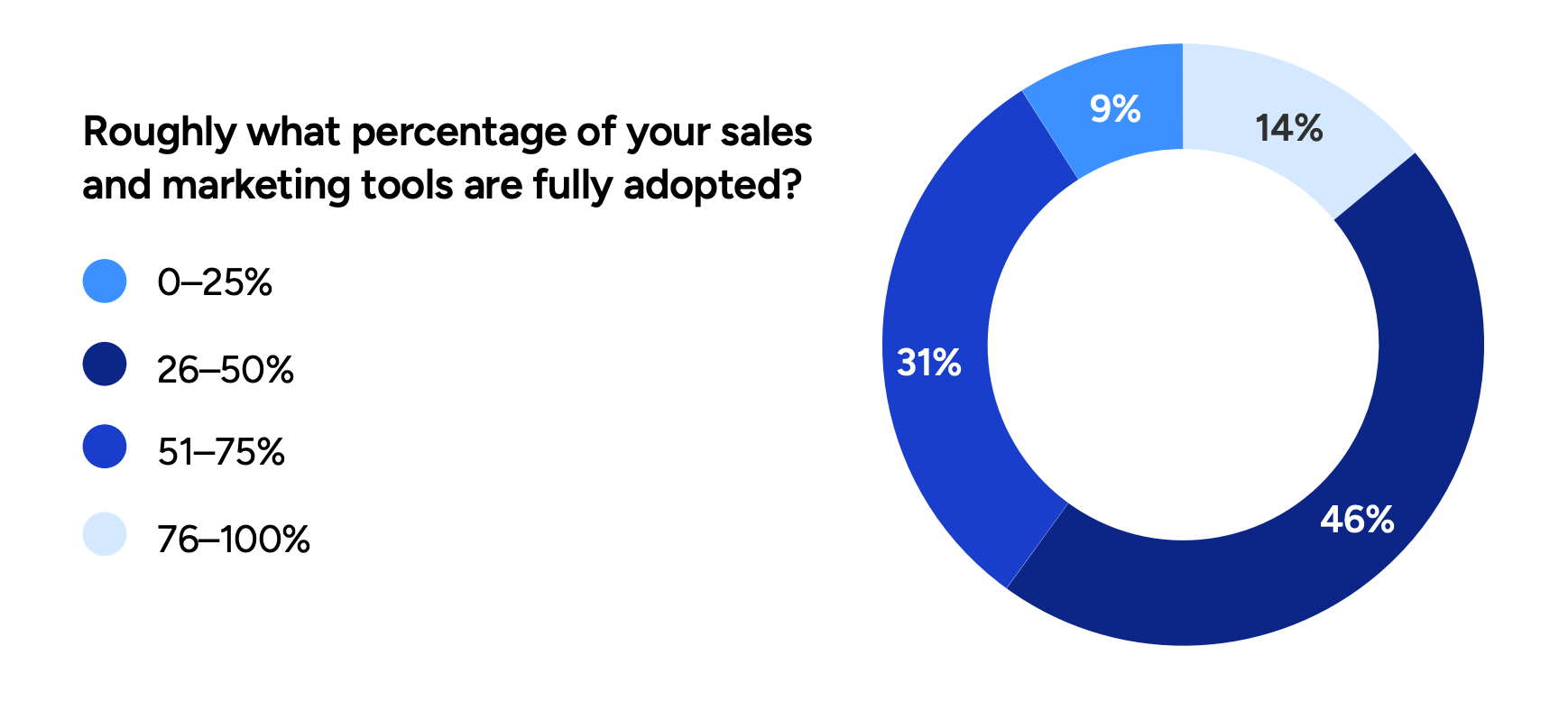
In an effort to bridge the alignment gap, many organizations have historically turned to software solutions. However, the 2026 data suggests that "buying your way into alignment" has created a secondary problem: tool bloat. 56% of GTM professionals report that their organizations suffer from an overabundance of tools, with 60% of respondents admitting they use less than half of the software currently available in their tech stack.

The adoption rates tell a cautionary tale of operational inefficiency:
- 14% of teams utilize only 0% to 25% of their software stack.
- 46% of teams utilize between 26% and 50% of their stack.
This fragmented tech stack often leads to siloed data. While 40% of GTM teams claim to have "excellent" cross-functional data sharing, 68% of the same group report encountering regular data inconsistencies. Marketing teams are particularly affected, with 32% citing data inconsistencies as a barrier to performance, compared to 18% of sales teams.
The report suggests a "leaner is better" approach. Teams that have significantly consolidated their tech stacks are twice as likely to rate their lead quality as "excellent" (55% vs. 20%). By focusing on a smaller number of highly integrated tools—specifically CRMs, marketing automation platforms, and data integration layers—organizations can ensure that both departments are working from a single source of truth.
Characteristics of High-Performing Aligned Teams
The 56% of organizations that successfully describe themselves as "highly aligned" share several common operational traits that distinguish them from their peers. These teams have moved beyond the "meeting cadence" layer—where alignment is defined by how often people talk—to the "operating model" layer, where alignment is defined by how work is actually done.
1. Unified Data and Measurement
Highly aligned teams are 3.5 times more likely to have strong cross-functional data sharing (59% vs. 16%). In these organizations, marketing data feeds both functions from a shared repository. Decisions are made based on shared Key Performance Indicators (KPIs) such as Customer Acquisition Cost (CAC) and conversion rates, rather than team-specific metrics like lead volume or call quotas.
2. Messaging Consistency
A major friction point in the buyer’s journey occurs when a marketing campaign promises one outcome, but the sales discovery call delivers another. Aligned teams report significantly fewer messaging inconsistencies (17% vs. 28%). This is achieved by involving sales in the creation of buyer personas and allowing marketing access to sales call recordings to ensure the "voice of the customer" is reflected in top-of-funnel content.
3. Rigorous Handoff Protocols
Rather than relying on informal handoffs, high-performing teams utilize Service Level Agreements (SLAs). These agreements define exactly what information must be present for a lead to be passed to sales, the timeframe in which sales must follow up, and the feedback loop required if a lead is rejected. 36% of GTM professionals identify lead qualification and handoff processes as the single most impactful lever for improving alignment.
Strategic Recommendations for 2026 and Beyond
As B2B and SMB environments become increasingly competitive, the Unbounce report outlines three critical actions for organizations seeking to fix their alignment issues.
First, teams must define shared buyer personas and lead quality standards. This should not be a marketing-only exercise. Sales input is required to ensure that the people marketing targets are the same people sales can actually close. When personas are a joint artifact, the debate over lead quality is settled before the first dollar of ad spend is deployed.
Second, organizations must unify their reporting systems. The report identifies CRM systems, marketing automation platforms, and data integration tools as the three most essential pieces of technology for alignment. Investment should be prioritized toward tools that both functions use daily, rather than niche platforms that serve only one department.
Third, leadership must align incentives. As long as marketing is compensated based on lead quantity and sales on revenue, their goals will remain fundamentally at odds. Shared incentives—where marketing is partially rewarded for closed-won revenue and sales is rewarded for adhering to follow-up SLAs—create a structural motivation for the two teams to support one another.
Conclusion: The Path Forward
The findings from the 2026 Unbounce report serve as a wake-up call for GTM professionals. While the desire for sales and marketing alignment is nearly universal, the execution remains elusive for nearly half of the industry. The cost of this failure is not just organizational friction, but stalled growth and wasted resources.
True alignment is not achieved through more meetings or more software; it is achieved through the hard work of operationalizing the relationship between the two departments. By focusing on shared data, leaner tech stacks, and unified definitions of success, SMBs can turn their GTM teams into a single, cohesive engine for revenue generation. As the report concludes, the teams that will win in the coming years are those that stop treating sales and marketing as two separate relay runners and start treating them as a single, synchronized unit.







