Google has dramatically accelerated the integration of its AI Overviews into the People Also Ask (PAA) sections of its search results, with recent data indicating that nearly all PAA queries are now being answered by generative artificial intelligence. This represents a monumental shift from just 14 months ago when only approximately 12% of these results were powered by AI. The rapid ascent underscores Google’s commitment to transforming its core search experience, moving further into direct answer generation rather than solely presenting links.
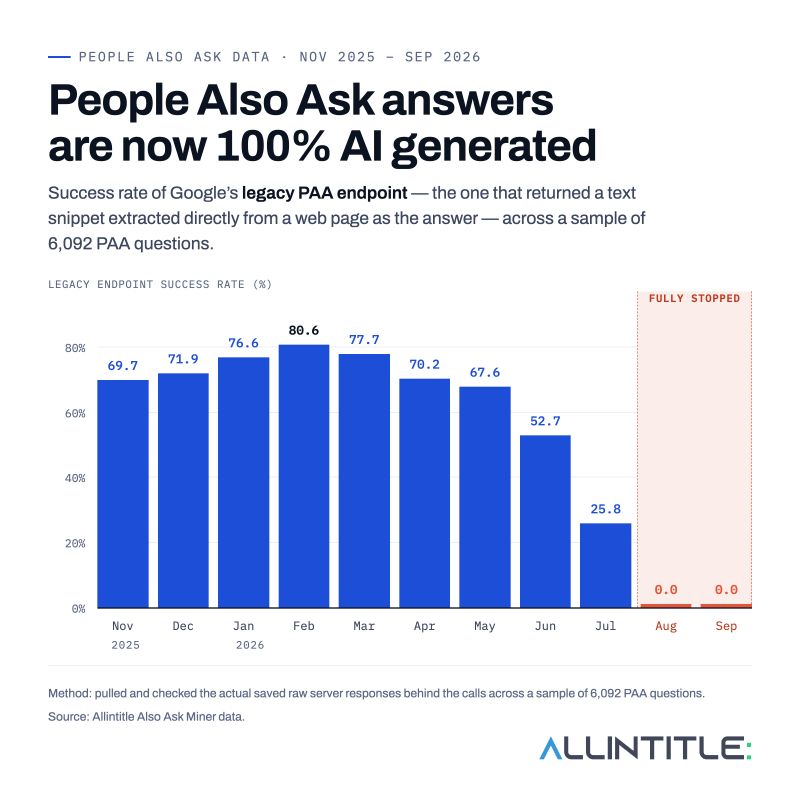
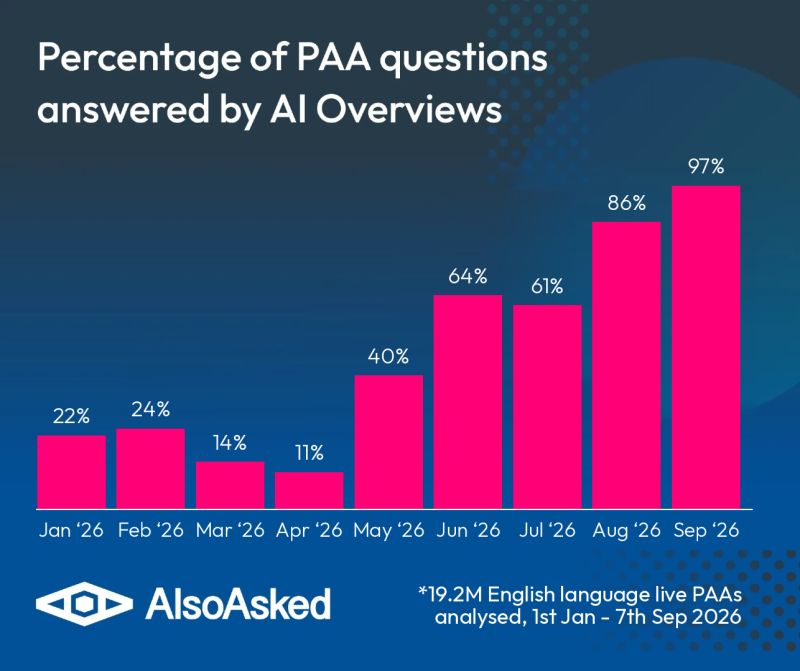
The transformation was initially brought to light by observations from Saeed Khosravi of Allintitle, who shared on LinkedIn that data from their "Also Ask Miner" tool projected that by August 2026, Google People Also Ask answers would be 100% AI-generated. This significant claim prompted further investigation, leading to corroborating data from Mark Williams-Cook of AlsoAsked, a platform specializing in PAA data. Williams-Cook, analyzing a vast dataset of nearly 20 million English-language queries from 2026, confirmed the near-complete takeover, reporting that 97% of PAA answers in the first week of September were AI Overviews, a substantial jump from 86% in August. He further added that it "seems highly likely we are on track for 100% shortly."
The Evolution of People Also Ask and the Rise of AI Overviews
The People Also Ask (PAA) feature has been a staple of Google’s Search Engine Results Pages (SERPs) for several years, designed to anticipate and address related questions users might have after their initial query. Typically appearing as an accordion-style box, PAA sections expand to reveal a brief answer, often sourced from a relevant webpage, along with a link to that page. For content creators and SEO professionals, PAA has long represented a valuable opportunity for increased visibility and traffic, as it allows websites to capture queries beyond the primary search term. Optimizing for PAA has involved creating comprehensive content that directly answers common questions related to a topic.
The introduction of AI Overviews marks a significant evolution in how these answers are presented and generated. AI Overviews, which evolved from Google’s experimental Search Generative Experience (SGE), leverage large language models (LLMs) like Gemini to synthesize information from multiple sources and present a concise, direct answer at the top of the SERP. While they still often include links to the underlying sources, the primary interaction shifts from clicking a link to consuming the generated summary. This strategic pivot aims to provide users with quicker, more comprehensive answers directly within the search interface, particularly for complex or nuanced queries that might otherwise require visiting multiple websites.

A Rapid Chronology of AI Integration
The journey from minimal AI presence to near-ubiquitous integration in PAA has been swift and deliberate on Google’s part.
- Early 2025: Initial observations indicated that approximately 12% of PAA results were being answered by what was then known as SGE. This period represented the early beta phase, where Google was testing the capabilities and user reception of generative AI within its search environment. The integration was cautious, often appearing for specific types of queries or user groups enrolled in the experimental program.
- Throughout 2025-2026: Google systematically expanded the reach and capabilities of SGE. This involved refining the underlying AI models, improving accuracy, reducing instances of "hallucination," and enhancing the ability to cite sources effectively. The transition from SGE to the more broadly available "AI Overviews" signaled a move from experimental feature to a core component of the search experience.
- August 2026: This month marked a critical inflection point. Data from Allintitle’s "Also Ask Miner" showed an exponential increase in AI-generated PAA answers, leading to the projection of 100% AI generation by the end of the month. This rapid acceleration suggests a concerted effort by Google to push this feature into general availability across a wider range of queries and user demographics.
- First Week of September 2026: Mark Williams-Cook’s analysis of AlsoAsked data further solidified these findings, reporting a 97% AI-generated rate for PAA answers. This near-complete integration within a matter of weeks highlights the speed and scale of Google’s deployment. The consistency between different datasets, despite minor percentage variations likely due to sampling methods or real-time data capture, reinforces the undeniable trend.
The charts provided by both Allintitle and AlsoAsked visually depict this dramatic upward trajectory, showing a steep curve in the percentage of AI-powered PAA results, particularly in recent months. This data illustrates a clear strategic decision by Google to prioritize direct, AI-synthesized answers in these user-centric question sections.
Detailed Data and Expert Observations
The findings from both Allintitle and AlsoAsked provide a robust statistical foundation for understanding this transformation.
Allintitle’s "Also Ask Miner" Data:
Saeed Khosravi’s initial post on LinkedIn, citing data from Allintitle’s proprietary "Also Ask Miner," served as a bellwether. While the precise methodology of the "Also Ask Miner" wasn’t fully detailed in the original report, it likely involves large-scale automated scraping and analysis of Google SERPs over time, specifically tracking the presence and nature of PAA answers. The projection of "100% AI Generated" by August 2026 is a strong indicator of a complete saturation within their observed dataset, signifying that for the queries they track, the traditional, link-based PAA answer has been entirely supplanted by AI Overviews. This projection speaks to the efficiency and scale of Google’s rollout.
AlsoAsked’s Comprehensive Dataset Analysis:
Mark Williams-Cook of AlsoAsked, a platform known for its extensive PAA data, offered crucial corroboration and granular detail. His analysis drew from a massive sample of 19.2 million English language queries conducted in 2026. This extensive dataset lends significant weight to his findings. The reported 97% AI-generated rate for the first week of September, up from 86% in August, showcases not just a high level of integration but also the rate of acceleration. This "dramatic monthly increase" suggests that the remaining 3% gap to 100% is likely a matter of days or weeks, rather than months. The slight difference between Allintitle’s 100% projection and AlsoAsked’s 97% actual figure for early September could be attributed to various factors, including slightly different sampling methodologies, the exact timeframes of data collection, or the specific queries included in each dataset. Regardless, both studies point to the same undeniable conclusion: AI Overviews now dominate PAA.
Google’s Broader AI Strategy and Context
The near-complete integration of AI Overviews into PAA sections is not an isolated event but a critical component of Google’s overarching strategy to infuse generative AI into every facet of its products, especially its flagship search engine. This strategy stems from several key motivations:
- Enhanced User Experience: Google aims to provide more immediate, comprehensive, and contextually relevant answers, especially for complex or multi-faceted queries. By synthesizing information, AI Overviews can save users time and effort, reducing the need to click through multiple links to find an answer.
- Competitive Landscape: The rise of powerful AI chatbots like ChatGPT and specialized AI-powered search engines (e.g., Perplexity AI) has intensified the pressure on Google to innovate. Integrating generative AI directly into its search results helps Google maintain its leadership position and demonstrate its advanced AI capabilities.
- Future of Information Retrieval: Google envisions a future where search is more conversational and intelligent, capable of understanding nuanced queries and providing tailored insights. AI Overviews are a significant step towards this vision, transforming search from a directory of links into a dynamic, interactive knowledge engine.
- Monetization Potential (Long-term): While the immediate monetization strategy for AI Overviews is still evolving, the ability to deliver highly relevant, direct answers could open new avenues for advertising and premium features in the long run.
The clear labeling of AI Overview responses within the PAA sections, as shown in Google Search screenshots, reflects Google’s commitment to transparency regarding the source of these AI-generated answers. This is crucial for building user trust and differentiating AI-generated content from traditional organic results.
Implications for Search Engine Optimization (SEO) and Content Creators
The near-universal presence of AI Overviews in People Also Ask sections carries profound implications for the SEO industry, content creators, and publishers.
- Reduced Click-Through Rates (CTRs) for Traditional Organic Results: If users are getting direct answers within the PAA section, they may be less inclined to click through to the originating website. This could lead to a decrease in organic traffic for pages that traditionally ranked well for PAA-eligible queries. Content creators will need to reassess their traffic projections and focus on alternative avenues for user engagement.
- Shift in Content Strategy: The emphasis for content creation may shift from simply answering questions to providing unique insights, in-depth analysis, and authoritative perspectives that go beyond what an AI Overview can summarize. Content that serves as a primary source, offers novel research, or presents highly specialized expertise might retain more value. The goal will be not just to be found by users, but to be cited by Google’s AI.
- Importance of E-E-A-T (Experience, Expertise, Authoritativeness, Trustworthiness): With AI synthesizing information, the credibility of the source becomes paramount. Google’s algorithms are expected to prioritize content from highly authoritative and trustworthy sources to feed its AI Overviews. This reinforces the importance of building a strong brand, demonstrating clear expertise, and ensuring content accuracy.
- Optimization for AI Consumption: Content creators may need to consider how their content can be best understood and summarized by AI models. This could involve clear headings, concise answers to specific questions, well-structured data, and potentially leveraging schema markup more effectively to highlight key information. The goal is to make content "AI-friendly."
- Focus on Long-Tail and Niche Queries: While broad, common questions are likely to be heavily impacted by AI Overviews, highly specific, long-tail, or niche queries that require deeper investigation might still drive users to traditional web pages. Content strategies could pivot to target these less-summarizable queries.
- Monitoring and Analytics Adaptation: SEO professionals will need to adapt their monitoring and analytics strategies. Tracking impressions and clicks for PAA sections will become more complex, and understanding user behavior after engaging with an AI Overview will be critical. New metrics may emerge to measure the impact of AI in SERPs.
- Monetization Challenges for Publishers: For publishers relying on ad revenue driven by page views, the reduction in click-throughs from PAA could pose significant financial challenges. This fuels ongoing industry discussions about fair compensation for content used by AI models for training and answer generation.
Broader Industry Reactions and Future Outlook
The rapid expansion of AI Overviews in PAA sections has been met with a mix of anticipation and apprehension across the digital marketing and publishing industries. While Google champions the move as an enhancement to user experience, many content creators express concerns about potential reductions in organic traffic and the devaluation of their intellectual property.
Publishers and content creators have been vocal about the need for Google to ensure proper attribution and fair compensation when their content is used to train AI models or generate AI Overviews. The debate around AI’s impact on the open web, creator revenue, and the sustainability of high-quality content production is likely to intensify as AI Overviews become more pervasive across other SERP features.
Looking ahead, it is highly probable that Google will continue to integrate AI Overviews into more search features beyond PAA. We may see AI summaries appearing more frequently for featured snippets, local search results, or even as part of general organic listings. The eventual goal for Google appears to be a search experience where AI serves as an intelligent intermediary, directly answering user queries while still providing pathways to deeper exploration through traditional links.
The future of search is undeniably intertwined with artificial intelligence. The near 100% adoption of AI Overviews in People Also Ask sections is a powerful indicator of this irreversible trend, signaling a fundamental shift in how users find information and how content creators must adapt to remain visible and valuable in an AI-first search ecosystem. This ongoing evolution will necessitate continuous adaptation from all stakeholders involved in the creation and dissemination of online information.