The global commerce landscape is on the cusp of another profound transformation, moving beyond the internet-driven e-commerce era into what industry experts are terming "agentic commerce." This emerging paradigm leverages advanced artificial intelligence (AI) agents to autonomously manage the entire shopping journey on behalf of consumers, from product discovery and comparison to purchase completion and post-transaction support. While the concept sparks considerable excitement for its promise of unprecedented convenience, it also raises critical questions regarding consumer trust, business return on investment, and the fundamental nature of the buyer-seller relationship.
The Evolution of Commerce: A Historical Context
Commerce has continually evolved, adapting to technological advancements and shifting consumer behaviors. For centuries, localized physical stores dominated, fostering community ties and direct interaction. The late 20th century ushered in the age of borderless, internet-driven e-commerce, dismantling geographical barriers and offering unparalleled product variety and competitive pricing. This shift empowered consumers with vast information, but also introduced new challenges like decision fatigue from endless browsing, the need to compare dozens of products across myriad websites, and the time-consuming process of manual research.
Now, AI, particularly generative AI, is poised to instigate the next major shift. Agentic commerce seeks to address the complexities of the modern digital marketplace by delegating the heavy lifting of shopping to intelligent software. These AI agents are designed to understand user intent, evaluate options based on predefined rules and preferences, compare prices, and ultimately act on the consumer’s behalf, making what once sounded like science fiction an increasingly tangible reality.
Defining Agentic Commerce: A Digital Shopping Proxy

At its core, agentic commerce defines a model where AI agents function as sophisticated digital shopping proxies. Instead of direct manual interaction with online stores, consumers articulate their needs, preferences, and constraints to an AI agent. This agent then takes over, navigating the vast digital marketplace to fulfill the request. As Alex Moss elucidated in the SEO Unplugged podcast, one could simply instruct an agent, "Go and buy me some new shoes with that jacket I bought last week," and the agent would independently research, compare, and present options, potentially even completing the purchase with user approval.
This model is characterized by the AI agent’s ability to act as a decision-maker and executor within specified parameters. Unlike traditional AI assistants that primarily provide information or recommendations, agentic AI can independently perform tasks across the entire shopping journey. The human user defines the intent or goal, maintaining ultimate control over final decisions, while the AI agent orchestrates the complex execution process behind the scenes.
The Mechanics of Agentic Commerce: A Step-by-Step Breakdown
The operation of agentic commerce involves a sophisticated interplay of human instruction and AI autonomy:
-
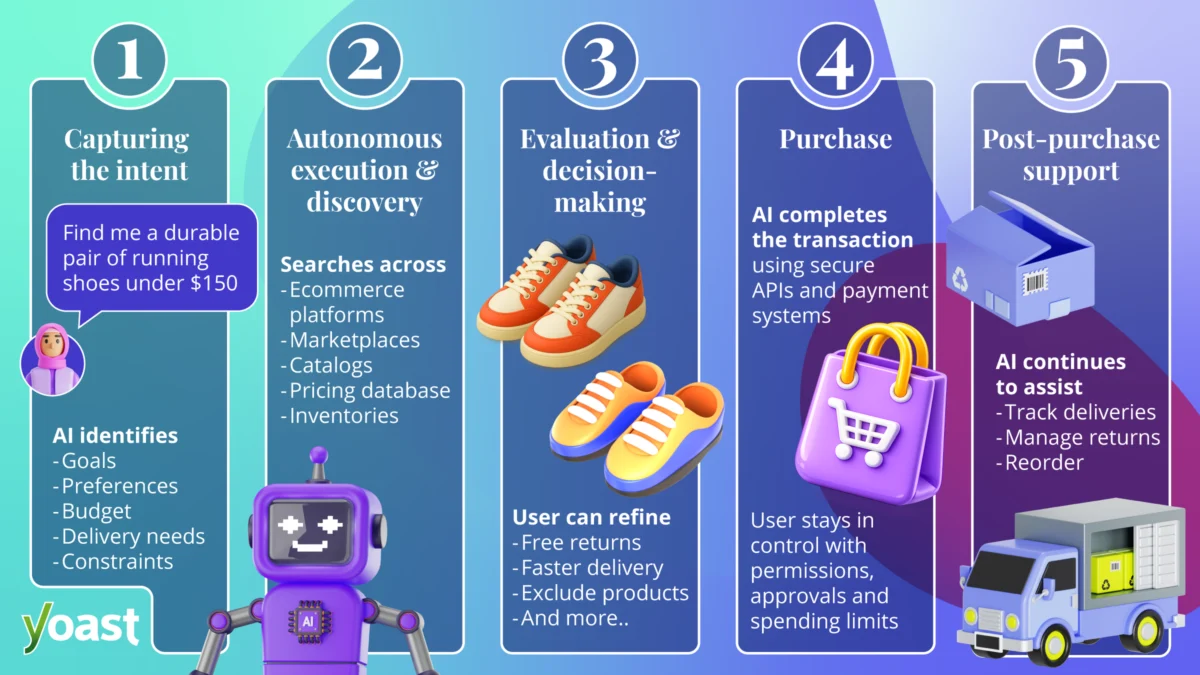
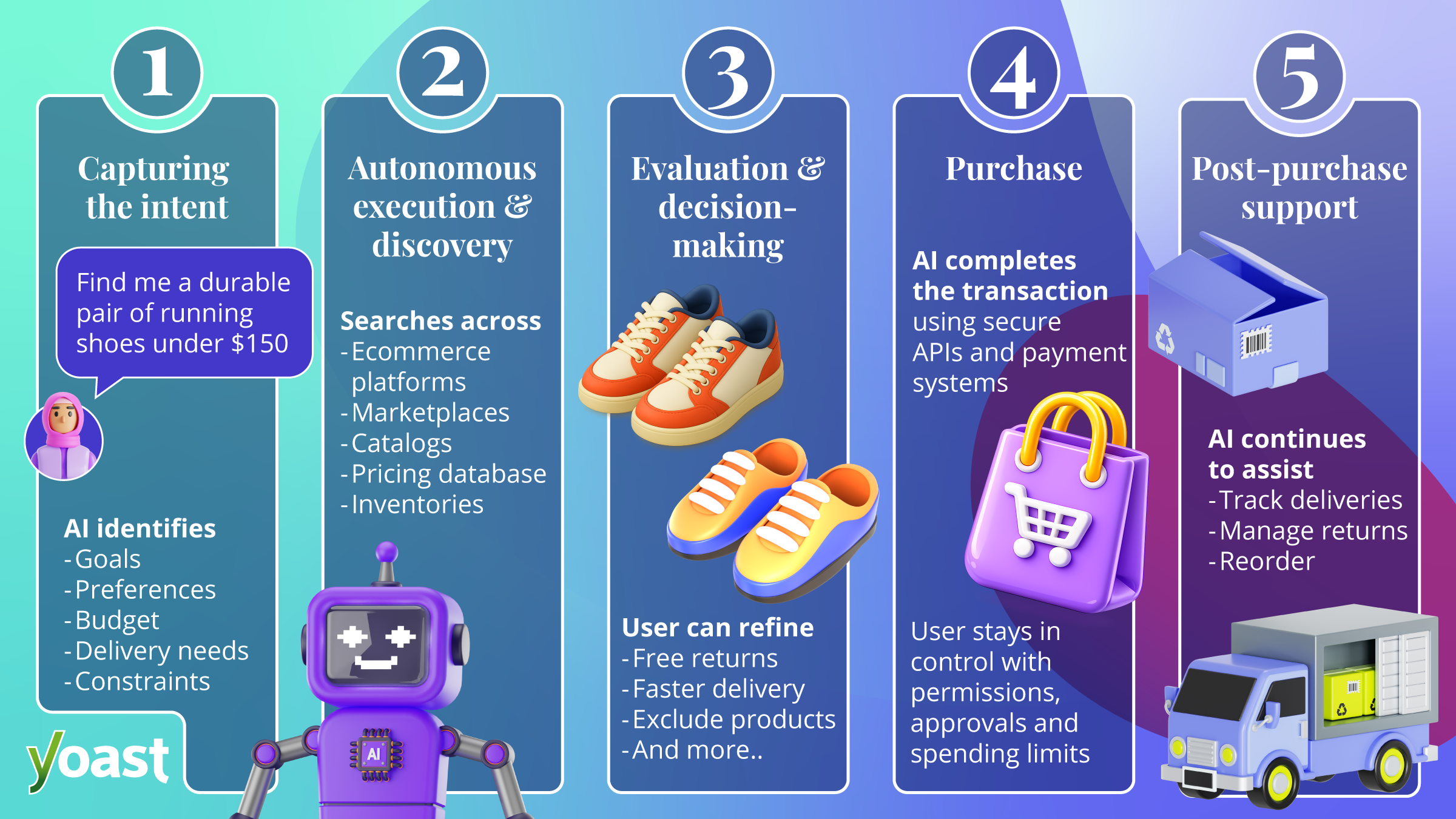
Capturing Intent: The process commences with the user expressing a need in natural language, moving beyond simple keywords to conversational queries. For example, a shopper might ask, "Find me a sustainable, waterproof hiking jacket under $200 that can be delivered by next Tuesday." The AI agent then engages in a dialogue, asking follow-up questions to clarify budget, style, ethical considerations, and delivery expectations, refining the intent until it is crystal clear.
-
Autonomous Instruction Execution and Brand Discovery: Once the intent is fully understood, the AI agent autonomously executes the task. This involves scanning not just one website, but an expansive network of e-commerce platforms, marketplaces, product catalogs, review aggregators, pricing databases, and inventory systems simultaneously. This stage fundamentally alters traditional product discovery. Instead of presenting an overwhelming list of products, the agent intelligently filters and narrows down the most relevant options. Brands with meticulously structured product data, accurate inventory information, transparent pricing, and machine-readable content are inherently more discoverable and favored by these AI agents.

-
Evaluation and Decision-Making: Having gathered potential options, the AI agent proceeds to evaluate products and compare trade-offs. It analyzes a multitude of factors, including product features, customer reviews and ratings, pricing, shipping costs and speed, warranty information, return policies, and the brand’s reputation for sustainability or ethical practices. The agent doesn’t merely list products; it reasons through the options, explaining why certain choices align better with the user’s requirements. Users can further refine this process by adding conditions like, "Only show products with a 4-star rating or higher" or "Prioritize brands known for their ethical sourcing," creating a continuous feedback loop that enhances recommendation accuracy.
-
Purchase Execution: Upon user approval or predefined rule activation, the AI agent proceeds with the transaction. Leveraging APIs, commerce protocols, and secure payment systems, the agent can add items to carts, apply eligible discounts, authenticate payments, and complete purchases. The transaction might be immediate, or the agent could be programmed to wait for specific conditions, such as a price drop or improved stock availability, before finalizing the order. User control is maintained through permissions, approval settings, and spending limits, ensuring security and accountability.
-
Post-Purchase Support: The agent’s role extends beyond the point of sale. Post-purchase, AI agents can assist with tracking shipments, initiating returns or exchanges, resolving customer service inquiries, managing subscriptions, and even providing proactive reminders for product maintenance or reordering. This transforms shopping from a discrete transaction into an ongoing, intelligent, and personalized experience.
The Impetus for Change: Data and Consumer Behavior
The shift towards agentic commerce is not merely a theoretical construct but a response to evolving consumer behavior and robust market indicators. Multiple reports highlight the growing reliance on AI in the buying journey:
-
Existing AI Adoption: A McKinsey & Company report indicates that over 70% of AI-powered search users engage in top-of-the-funnel inquiries about categories, brands, or services. Furthermore, nearly 50% of consumers are already utilizing AI-powered search experiences. This suggests a significant behavioral shift: consumers are increasingly asking AI systems to guide their decisions, rather than merely using them for information retrieval. The report projects that 20-50% of traditional search traffic could migrate to AI-powered discovery over time, signaling a substantial disruption to conventional e-commerce models.
-
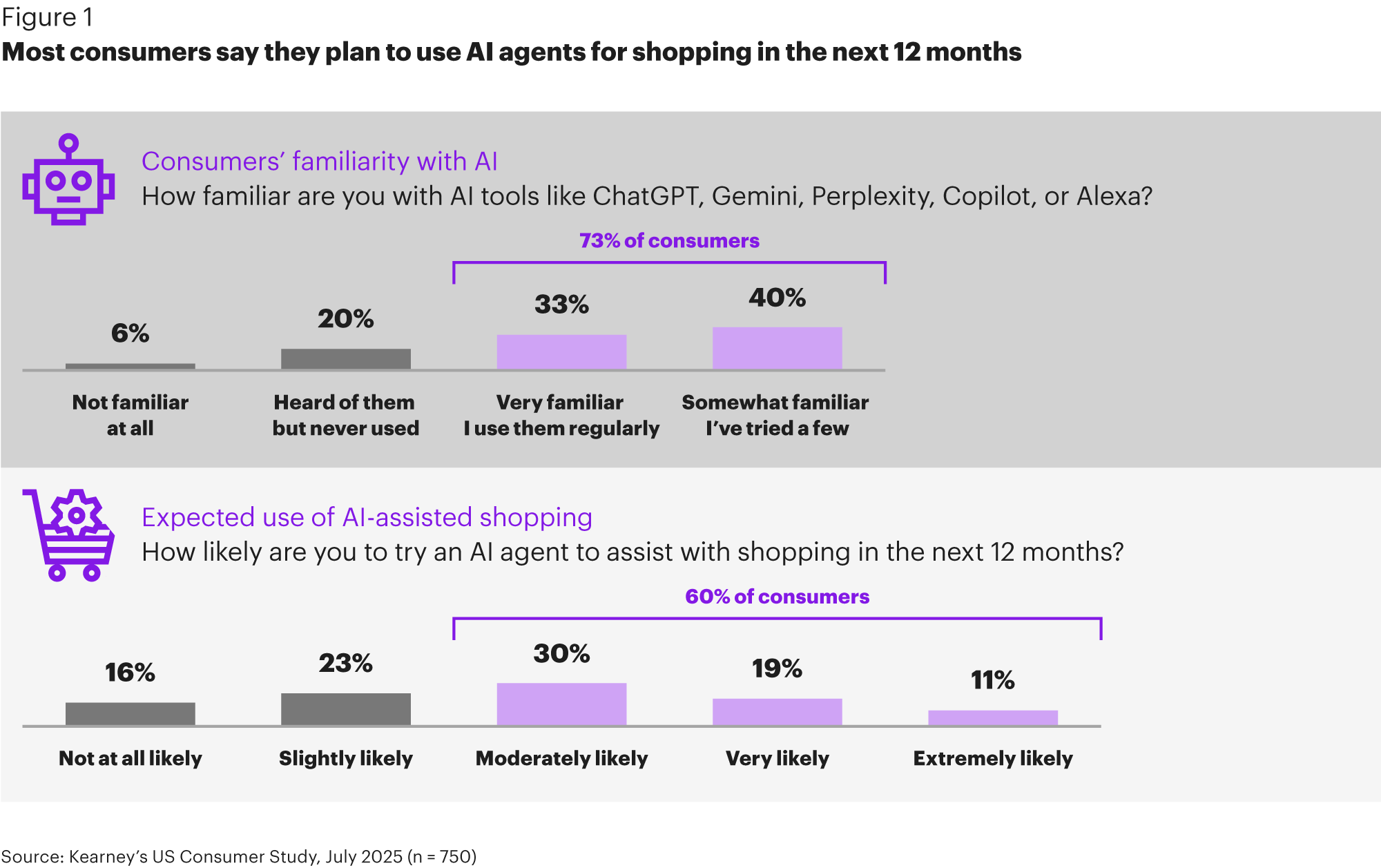
Rising Consumer Expectations: The 2025 Kearney report, "Agentic Commerce: From Brand Loyalty to Bot Logic," found that over 60% of shoppers anticipate using agentic AI by 2026. This reflects a fundamental reorientation of consumer priorities, with convenience, speed, competitive pricing, and trust now often outweighing platform loyalty. Shoppers are increasingly willing to delegate product comparison and purchase execution to AI agents capable of sifting through multiple platforms, analyzing reviews, and identifying optimal deals more efficiently than manual browsing. This redefines the competitive landscape, shifting it from direct retailer-versus-retailer competition to a contest within AI-driven discovery ecosystems.
-
Explosive Market Growth Forecasts: Industry analysts predict immense economic opportunities. Another McKinsey report estimates that agentic commerce could unlock an orchestrated revenue opportunity of $900 billion to $1 trillion in the US B2C retail market alone by 2030. Globally, this figure could range from a staggering $3 trillion to $5 trillion. These projections underscore the potential for agentic commerce to fundamentally reshape shopping experiences and generate massive economic value.
Foundational Technologies: Protocols and Payments
The realization of agentic commerce relies heavily on a burgeoning ecosystem of protocols, frameworks, APIs, and secure payment systems. These enable AI agents to interact with diverse digital commerce platforms seamlessly and securely.
The Model Context Protocol (MCP), for instance, is a foundational concept enabling AI models to connect with external systems, databases, and applications via a standardized communication layer. It creates a common operating language, allowing AI agents to access information and execute actions consistently without requiring bespoke integrations for every AI model and software platform. Building on this, commerce-specific protocols are emerging:
-
Agentic Commerce Protocol (ACP): Introduced by Stripe in collaboration with OpenAI, ACP is an open standard designed to standardize how AI agents interact with e-commerce systems for product discovery, checkout, and payment. Its objective is to move AI beyond recommendations to actual transaction completion within conversational interfaces. Early implementations are already visible, with ChatGPT users in the U.S. able to purchase from Etsy merchants directly through Stripe-powered checkout. Shopify integrations are anticipated, signaling a major shift towards seamless, agent-friendly shopping journeys. The open-standard approach is crucial, fostering broader adoption across developers, merchants, and platforms rather than creating a closed ecosystem.
-
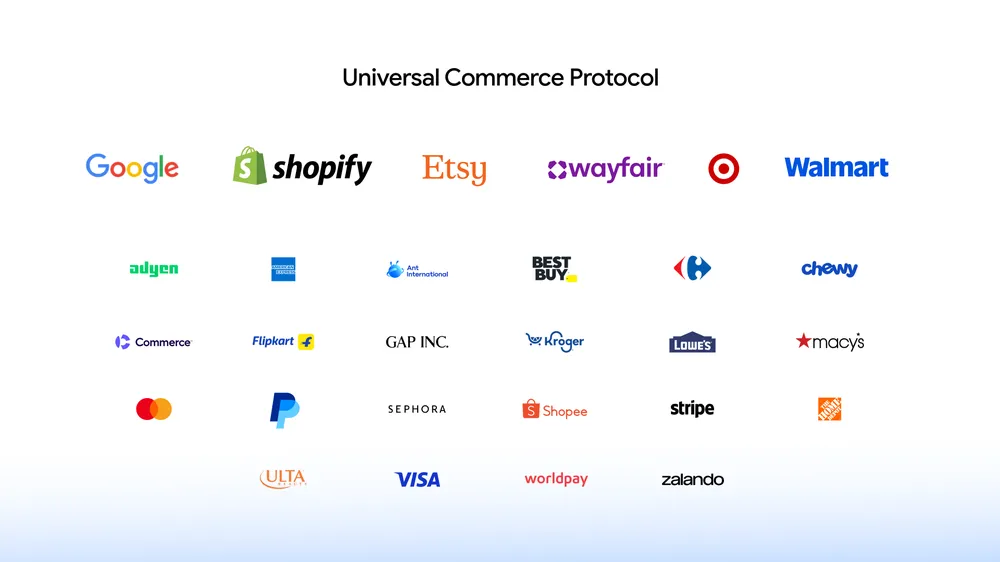
Universal Commerce Protocol (UCP): Google’s UCP aims to solve the complex challenge of interoperability among millions of AI agents, retailers, marketplaces, and payment providers. It establishes a common language for agentic commerce, providing a shared framework for efficient communication throughout the entire shopping lifecycle. UCP’s broad scope covers product discovery, inventory checks, price comparisons, order placement, and even post-purchase activities like returns and customer service. Google co-developed UCP with major industry players like Shopify, Etsy, Wayfair, Target, and Walmart, and it has garnered support from payment giants such as Mastercard, Visa, Stripe, and American Express. UCP is designed to be compatible with other emerging AI standards like Agent2Agent (A2A) and Agent Payments Protocol (AP2), ensuring businesses can integrate agentic capabilities without overhahauling existing systems. This makes UCP a foundational infrastructure for scalable agentic commerce across the digital economy.
-
Mastercard Agent Pay: Focusing on the critical aspect of trust and secure payment execution, Mastercard Agent Pay provides the infrastructure for AI agents to complete transactions within user-defined permissions, authentication requirements, and spending controls. It aims to create verified, traceable, and authorized payment flows, preventing unrestricted access to payment credentials. A significant development is its integration with PayPal’s wallet infrastructure, allowing AI agents to securely complete transactions for PayPal users while upholding established security and trust mechanisms. This collaboration is vital for moving agent-driven payments from experimental environments to broad, real-world adoption across a vast ecosystem of merchants and consumers.
Together, ACP, UCP, and Agent Pay form a complementary foundation. ACP facilitates agent-merchant interaction and purchase completion, UCP provides the common language for scalable interoperability, and Agent Pay ensures secure, authorized transactions, collectively bringing AI-driven shopping closer to mainstream reality.
Early Implementations and Industry Adoption
The theoretical framework of agentic commerce is rapidly translating into practical applications:
- Amazon’s "Buy for Me": This feature allows Amazon’s AI agents to purchase products from third-party websites when items are unavailable on Amazon, showcasing autonomous purchasing beyond a single platform.
- Google’s AI-Powered Shopping Experiences: Google is actively testing AI systems that monitor prices and automatically purchase products when they meet user-defined conditions, such as a specific price drop or discount threshold.
- B2B Applications: Beyond consumer retail, businesses are deploying AI agents to monitor inventory levels, automatically reorder supplies when stock runs low, and manage procurement workflows, streamlining operations and reducing human error.
- ChatGPT’s Direct Purchases: The ability for ChatGPT users to directly purchase from Etsy merchants via Stripe-powered checkout is a landmark implementation of ACP, demonstrating the integration of transaction capabilities within conversational AI.
The broad industry backing for UCP, involving major retailers, e-commerce platforms, and payment providers, further solidifies the commitment to building a cohesive, interoperable agentic commerce ecosystem.

Implications for Consumers: A New Paradigm of Shopping
For consumers, agentic commerce promises a revolution in convenience and personalization:
- Unprecedented Efficiency: Reduced research time, elimination of tab-hopping and manual comparisons.
- Hyper-Personalization: Tailored recommendations based on deep understanding of preferences, budget, and past behavior.
- Automated Purchases: Routine reorders, price monitoring, and automatic purchasing when conditions are met.
- Time Savings: Freeing up cognitive load and time previously spent on shopping tasks.
- Proactive Support: Continuous assistance throughout the product lifecycle, from purchase to post-sale care.
However, potential drawbacks include:
- Trust and Security Concerns: Reluctance to grant AI agents purchasing authority and access to payment credentials.
- Potential for Overconsumption: Ease of purchase might lead to less thoughtful spending.
- Loss of Browsing Enjoyment: For some, the discovery and browsing process is part of the shopping pleasure.
- AI Bias: The risk of AI agents reflecting inherent biases in their data, potentially limiting product diversity or promoting certain brands.
Implications for Businesses: Navigating the Agentic Future
For enterprises, agentic commerce presents both immense opportunities and significant challenges:
- Enhanced Discoverability: Products with well-structured, machine-readable data, accurate inventory, and transparent pricing will be favored by AI agents. This necessitates significant investment in data optimization and SEO for agents.
- Shift in Competitive Landscape: Competition may shift from brand loyalty to "bot logic," where an agent’s ability to find the best value or fit overrides direct brand affinity.
- Streamlined Operations: Automation of repetitive workflows, faster decision-making in procurement and inventory management.
- New Customer Engagement Models: Engaging with AI agents rather than directly with consumers requires new marketing and communication strategies.
- Investment in AI-Ready Infrastructure: Businesses will need to invest in new protocols, APIs, and AI-compatible commerce experiences.
- Potential Loss of Direct Customer Relationships: Brands might lose direct engagement opportunities if AI agents handle most customer interactions.
- Fraud Prevention and Security: New vectors for fraud and the imperative for robust security measures for agent-driven transactions.
- Measuring ROI: Justifying investments in agentic commerce infrastructure will depend on measurable returns, which are still being quantified.
Challenges and the Road Ahead
Despite rapid technological advancements, the widespread adoption of agentic commerce is far from guaranteed. Key questions and challenges persist:
- Consumer Trust: Will consumers truly feel comfortable ceding purchasing authority and payment access to AI agents? Building this trust will require transparent operations, robust security, and clear user control mechanisms.
- Return on Investment (ROI): Businesses face uncertainty regarding the measurable returns on significant investments in new protocols, structured data, and AI-ready commerce experiences.
- Solving Real Problems: Is autonomous shopping a solution to a genuine problem, or does it merely add another layer of complexity, potentially facilitating impulse buying rather than thoughtful consumption?
- Security and Fraud Prevention: The increasing autonomy of AI agents creates new vulnerabilities that require sophisticated security protocols and continuous monitoring.
- AI Bias: Ensuring that AI agents make fair, unbiased recommendations, free from discriminatory patterns inherent in training data, is paramount.
- Platform Dependency and Interoperability: While protocols like UCP aim for openness, the risk of platform dominance or lock-in remains a concern if major players dictate standards.
- Loss of Direct Relationships: Brands must find new ways to build and maintain customer relationships if AI agents become the primary interface.
- Regulatory Frameworks: Governments and regulatory bodies will need to address issues surrounding consumer protection, data privacy, and accountability in agent-driven transactions.
Agentic commerce represents an exciting and potentially disruptive direction for digital shopping. Its long-term success will hinge on its ability to demonstrably create value for consumers through unparalleled convenience and personalization, while also offering tangible benefits and manageable challenges for merchants and the broader e-commerce ecosystem. The journey from localized stores to borderless e-commerce has been transformative; the path to agentic commerce promises an equally profound, albeit complex, reshaping of how we buy and sell.