rifanmuazin
The realm of paid media has long been a proving ground for strategic agility and swift decision-making. In recent years, this pace has accelerated dramatically, with machine learning and artificial intelligence fundamentally reshaping how advertising campaigns are conceived, executed, and optimized. As we look towards 2026, the critical question for brands is no longer if they should embrace automation, but rather what aspects of their paid media strategies are best suited for algorithmic execution and where human insight and creativity remain indispensable. This evolution marks a significant shift from the era of manual bid management and extensive spreadsheets to a sophisticated, hybrid model where technology augments, rather than replaces, human expertise.
The Unfolding Narrative of Paid Media Evolution
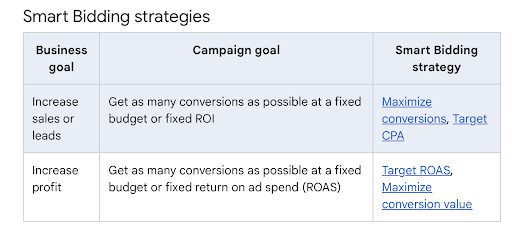
For seasoned professionals in the pay-per-click (PPC) advertising space, the transition has been palpable. The early days were characterized by the laborious management of rules-based bid managers and the meticulous manipulation of data within endless Excel spreadsheets. This foundational stage laid the groundwork for increasingly sophisticated automated solutions. The subsequent wave saw the introduction of platform-native automation tools, such as Google Ads’ Enhanced CPC, Target CPA, and Target ROAS, which began to offload some of the more granular optimization tasks.
This evolution culminated in the widespread adoption of full-funnel systems capable of managing the entire advertising lifecycle – from buying and placement to intricate optimization across multiple channels – often with minimal direct human intervention. The integration of advanced machine learning models has become a cornerstone of this transformation.
Google’s Smart Bidding, for instance, has cemented this paradigm shift. By leveraging millions of real-time signals to predict conversion likelihood at the auction level, it has moved the focus from manual adjustments to model-driven goal achievement. Similarly, Meta’s Advantage+ campaigns have consolidated audience selection, placement optimization, and creative testing under a single, automated umbrella, streamlining campaign management for advertisers.
This technological leap was facilitated by two primary drivers: the exponential growth in available data and the parallel advancements in machine learning algorithms. The sheer volume of user interactions, browsing behaviors, and purchase signals provides an unprecedented dataset for algorithms to learn from. Concurrently, the sophistication of AI has enabled these algorithms to process this data, identify complex patterns, and make predictive adjustments with a speed and scale unattainable by human teams alone.

The benefits of this automation are undeniable. Advertisers can achieve greater efficiency by automating repetitive tasks, allowing human resources to be reallocated to more strategic initiatives. Campaign performance can be significantly enhanced through real-time, data-driven optimizations that respond instantaneously to market fluctuations. Furthermore, automation enables a broader reach and more personalized targeting, as algorithms can segment audiences and deliver tailored messages at scale.
However, this increased automation has also introduced a growing "black box" phenomenon. The inherent complexity of advanced algorithms can sometimes obscure the precise reasoning behind specific optimizations, leading to reduced transparency. This necessitates a more deliberate approach to defining campaign objectives and meticulously tracking outcomes, ensuring that automated systems are aligned with overarching business goals.
This transformation is not confined to major platforms like Google, Meta, and Microsoft, nor is it limited to the vast programmatic advertising ecosystem. Even small and medium-sized businesses (SMBs) are increasingly leveraging automation to gain a competitive edge in their paid media efforts.
Adrian Iorga, Founder and President of Stairhopper Movers, a company that utilizes software automation for its PPC campaigns, offers a practical perspective. "Automation excels at processing vast amounts of data and making rapid bid adjustments," Iorga states. "However, you still need humans to ensure those decisions align with what the business actually needs. The campaigns that perform best have automation handling the repetitive tasks while strategists focus on creative messaging and audience insights." This sentiment underscores the emerging consensus: the most successful paid media strategies in the coming years will be those that effectively blend automated efficiency with human strategic oversight.
Strategic Automation: Identifying the Right Tasks for Machines
The efficacy of paid media automation hinges on its deliberate and strategic application, rather than a blanket implementation. The objective is not to cede control but to harness automation as a powerful tool within a data-driven framework, enabling machines to handle high-volume optimization tasks while human strategists concentrate on achieving outcomes that truly matter to the business.
Current Automation Landscape:
Today’s baseline automations effectively address much of the routine "busy work" associated with paid media management. This includes:
- Automated Bidding: Algorithms dynamically adjust bids in real-time based on the likelihood of conversion, aiming to maximize ROI or achieve specific cost-per-acquisition goals.
- Audience Expansion and Targeting: AI-powered tools can identify and reach new, relevant audiences beyond initial targeting parameters, often uncovering valuable segments that might have been overlooked.
- Dynamic Creative Optimization (DCO): Automation selects and combines various creative elements (headlines, images, calls-to-action) to deliver the most relevant ad variation to individual users.
- Budget Pacing and Allocation: Systems can automatically adjust ad spend across campaigns and ad groups to ensure optimal performance and prevent overspending or underspending.
- Performance Monitoring and Reporting: Automated dashboards and alerts provide real-time insights into campaign performance, flagging anomalies or opportunities for optimization.
The fundamental principle underlying this automation across various industries is straightforward: delegate repeatable optimization processes to intelligent systems, while empowering human experts to define what constitutes success and guide the strategic direction.
Consider a manufacturing company advertising complex industrial equipment like Vertical Lift Modules. While automation can efficiently manage bidding strategies, test different creative iterations, expand audience reach, and optimize campaign delivery, its success is contingent upon a clear definition of high-value actions. This means precisely defining what constitutes a qualified lead, such as a demo request, an offline sales conversion, or a consultation booking.
In an era of increasing privacy regulations and diminished user-level data, platforms are becoming more reliant on modeling to attribute conversions. This places a premium on accurate goal-setting, robust offline conversion tracking, and rigorous validation of campaign effectiveness through methods like geo-targeted lift tests and Marketing Mix Modeling (MMM). These practices are crucial for ensuring that automated systems remain aligned with tangible business outcomes.
The Horizon of 2026: Enhanced Predictive Capabilities and Cross-Channel Coordination
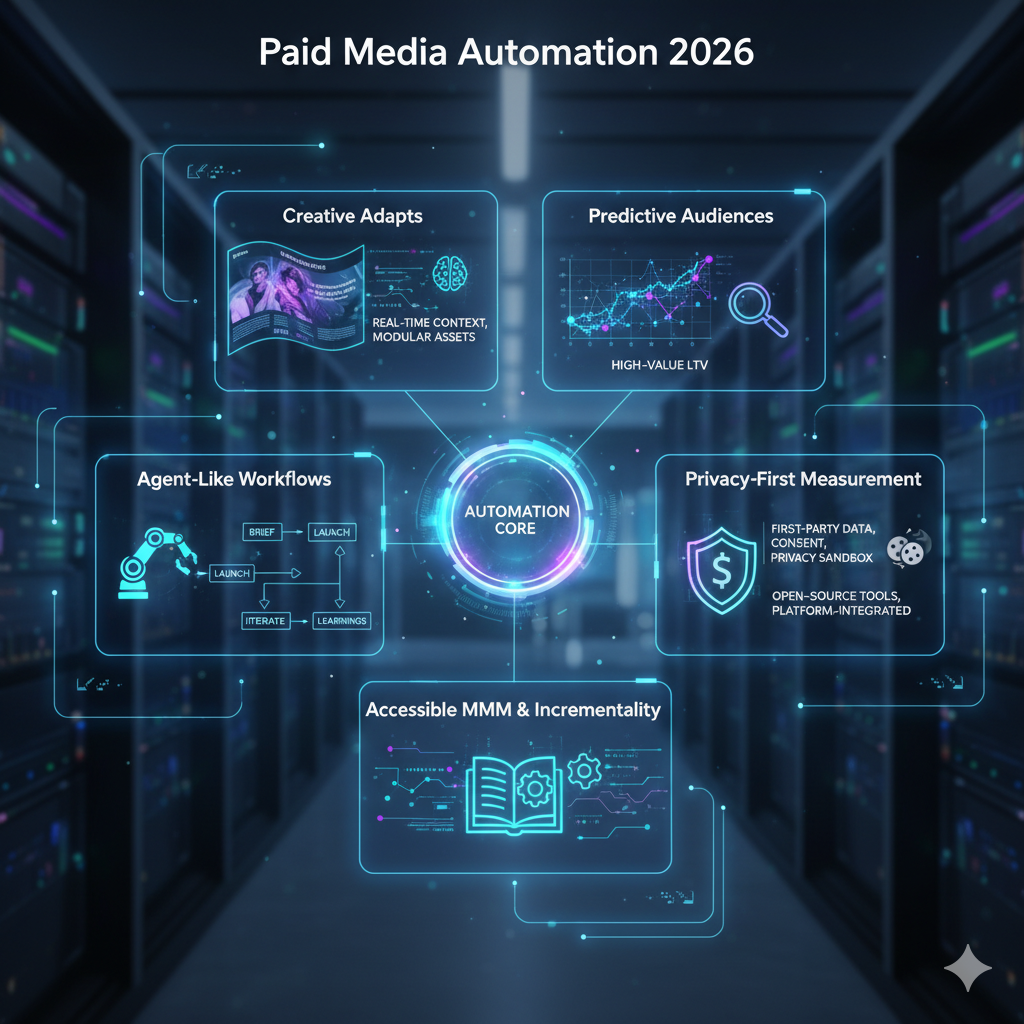
The trajectory of paid media automation in the coming years points beyond mere acceleration of bidding processes. The next phase will feature smarter systems capable of anticipating user behavior and delivering highly personalized experiences in real-time. Moreover, it will involve sophisticated cross-channel coordination that operates with a degree of autonomy, reducing the need for explicit, step-by-step instructions.
Anticipated advancements by 2026 include:
- Predictive Audience Segmentation: AI will move beyond historical data to predict future user needs and intent, allowing for proactive engagement with potential customers.
- Hyper-Personalized Creative Delivery: Beyond DCO, automation will enable the creation of truly bespoke ad experiences, adapting not just creative elements but also messaging and offers based on a deep understanding of individual user context.
- Intelligent Cross-Channel Orchestration: Automated systems will be capable of coordinating paid media efforts across search, social, display, video, and other channels, ensuring a cohesive and synergistic customer journey without explicit manual programming for each interaction.
- Automated Campaign Structuring and Testing: Advanced AI may assist in automatically generating campaign structures, identifying testing hypotheses, and executing experiments to uncover optimal strategies.
- Enhanced Budget Optimization and Forecasting: Machine learning models will become more adept at predicting future media costs and campaign performance, enabling more accurate budgeting and resource allocation.
The future of campaign management will increasingly resemble a supervisory role. Strategists will define overarching objectives, establish clear constraints, and set creative boundaries, then monitor performance and make strategic course corrections. Performance tracking will evolve to integrate modeled conversions, consent-aware analytics, and periodic holdout tests to rigorously verify that automated systems are driving incremental business growth.
Furthermore, automation in 2026 will extend beyond campaign execution into the operational layers that support paid media workflows. For instance, contract management software, integrating with advertising platforms, can automate the generation of insertion orders, streamline approval processes, ensure compliance checks, and manage renewal tracking across various agencies and media partners. This will significantly reduce the administrative friction that often impedes campaign launch and execution.
By automating these administrative burdens, teams can accelerate campaign deployment and maintain robust governance. This allows human capital to remain focused on core competencies such as strategic planning, creative ideation, performance oversight, and other critical business functions.
The Enduring Importance of Human Oversight
Despite the pervasive march of automation, certain facets of paid media will continue to demand a holistic, human-centric approach. This encompasses the ability to harmonize performance objectives with brand context and long-term strategic impact.
Business strategy, creative direction, and ethical judgment are inherently human domains, requiring an understanding of nuance, cultural context, and complex trade-offs that machines are not yet equipped to fully comprehend. This ensures that automation serves as a tool to advance business priorities rather than operating in an isolated, potentially misaligned manner.
Key areas that will likely remain under human stewardship include:
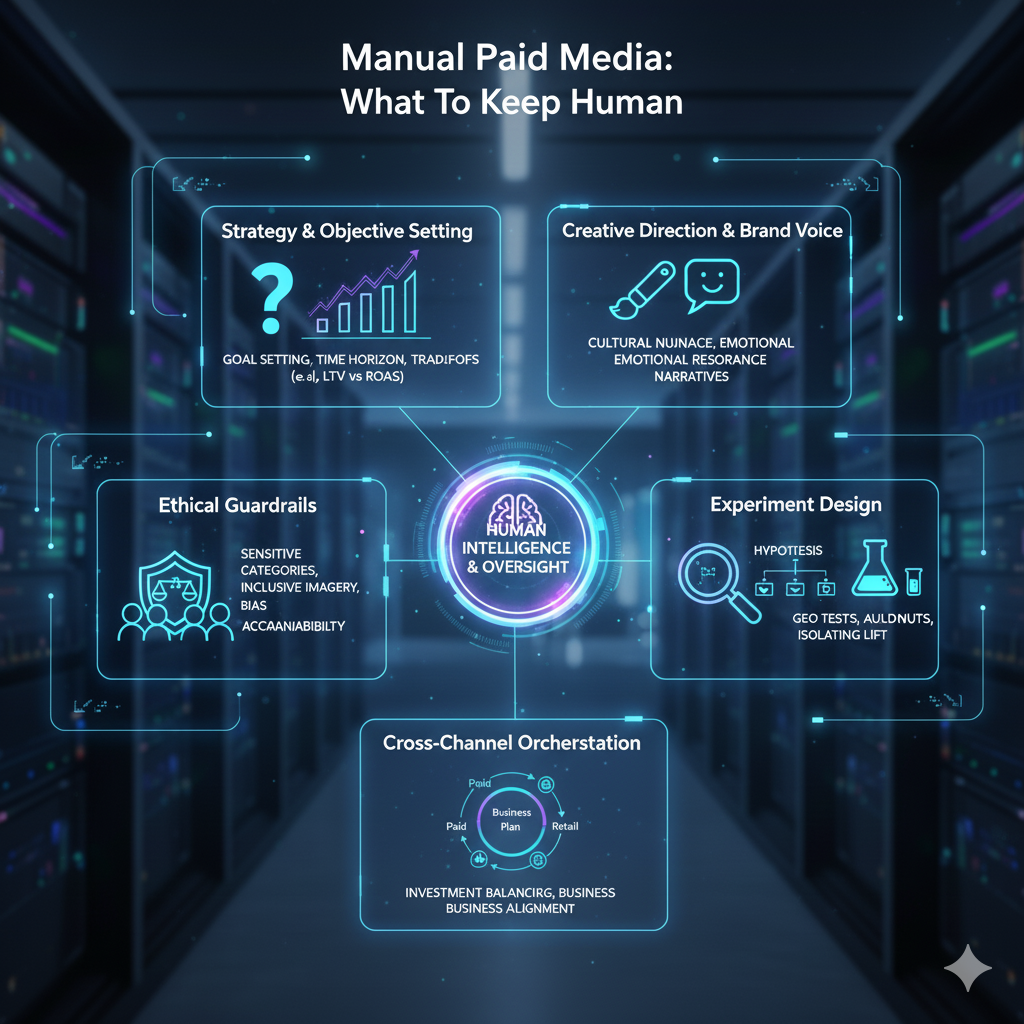
- Strategic Objective Setting: Defining overarching business goals and translating them into actionable paid media objectives requires deep market understanding and foresight.
- Brand Narrative and Messaging: Crafting a compelling brand story, ensuring consistent messaging, and developing creative that resonates emotionally with target audiences are fundamentally human endeavors.
- Audience Value Frameworks: Identifying and prioritizing high-value audience segments, understanding their lifetime value, and developing strategies to acquire and retain them involves strategic judgment.
- Experiment Design and Interpretation: While automation can execute tests, the conceptualization of meaningful experiments, the formulation of hypotheses, and the nuanced interpretation of results often require human insight.
- Ethical Guardrails and Brand Safety: Ensuring that advertising practices are ethical, compliant with regulations, and protect brand reputation necessitates human oversight and judgment.
- Complex Problem-Solving and Crisis Management: Addressing unforeseen challenges, navigating market disruptions, or managing brand crises requires human adaptability and critical thinking.
This is precisely where human intuition plays a crucial role. Data can illuminate what has occurred, but judgment is essential for understanding why it happened and determining the optimal course of action. A machine might relentlessly pursue low-cost conversions within a saturated audience, potentially leading to diminishing returns. A human strategist, however, can recognize the signs of brand fatigue, understand the impact on customer perception, and strategically pivot messaging or implement frequency caps before performance deteriorates significantly.
A Compelling Case Study:
The necessity of manual oversight is particularly pronounced in niche or high-consideration product categories, such as the installation of safety fencing for swimming pools. In this domain, client trust, the provision of comprehensive educational information, and adherence to local safety regulations are as critical as traditional performance metrics.
As a strategist, the responsibility falls on humans to determine how safety messaging is framed, manage ad frequency to avoid inducing fear-based fatigue, and ensure seamless integration between paid media efforts, organic content, and offline sales initiatives. This human judgment shapes the narrative and pacing of campaigns in ways that automation alone cannot replicate, fostering trust and driving informed purchasing decisions.
Constructing the Hybrid System: A Blueprint for Success
The optimal approach to navigating the evolving paid media landscape in 2026 involves a clear demarcation of responsibilities: automate high-volume, data-rich, low-risk tasks, and retain human oversight for high-context, brand-sensitive, or high-stakes decisions. Implementing this hybrid system requires a structured approach:
- Develop a Decision Matrix: Create a clear framework to guide teams in identifying which tasks are best suited for automation and which demand human intervention. This matrix should consider factors such as data availability, risk level, strategic impact, and the need for nuanced interpretation.
- Prioritize Strategic Human Input: Allocate human resources to tasks that require strategic thinking, creative ideation, complex problem-solving, and ethical judgment. This includes setting campaign objectives, defining target audience value, crafting brand messaging, and designing overarching strategies.
- Leverage Automation for Efficiency: Deploy automated tools for repetitive, data-intensive tasks such as bid management, audience targeting, budget pacing, and micro-creative testing. This frees up human capacity for higher-value activities.
- Establish Robust Performance Measurement: Implement comprehensive tracking mechanisms that combine automated data with human-derived insights. This includes utilizing modeled conversions, consent-aware analytics, and periodic holdout tests to validate the true incremental impact of automated campaigns.
- Foster Continuous Learning and Adaptation: The paid media landscape is dynamic. Teams must cultivate a culture of continuous learning, regularly assessing the effectiveness of their hybrid approach and adapting their strategies as technology and market conditions evolve. This includes staying abreast of new platform capabilities and emerging AI trends.
- Integrate Human Oversight into Automated Workflows: Build feedback loops where human strategists review automated outputs, provide strategic direction, and intervene when necessary. This ensures that automation remains aligned with evolving business goals.
- Define Clear Roles and Responsibilities: Clearly delineate the responsibilities of both human team members and automated systems to avoid confusion and ensure accountability.
The key to success in 2026 will be the ability to discern when to empower machines and when to assert human control. Developing a decision matrix can assist teams in identifying high-value manual interventions, while simultaneously allowing automation to efficiently manage bid optimization and audience targeting. These principles are equally relevant when selecting a PPC agency, ensuring that the chosen partner understands and can implement this hybrid approach effectively.
The Evolving Partnership: Where Human and Machine Converge
The demarcation between human and machine capabilities in paid media will continue to shift. However, the fundamental principle remains constant: leverage machines for their strengths in pattern recognition at scale and rapid iteration, and empower humans for their unique abilities in strategic thinking, storytelling, and upholding ethical standards.
By 2026, the automation of repetitive tasks – including bidding, pacing, inventory allocation, micro-creative testing, and predictive segmentation – will become standard practice. Conversely, high-impact areas such as brand narrative development, objective setting, audience value framework creation, experiment design, and the establishment of ethical guardrails will remain firmly within the human domain.
Achieving this delicate balance is not about choosing sides; it’s about building sophisticated teams where automation serves as the powerful engine, and human strategists act as the skilled navigators. This symbiotic relationship transforms a mere ad system into a potent force for sustainable business growth. To gain deeper insights into the evolving world of paid media and stay ahead of the curve, subscribe to weekly blog updates and join the ongoing conversation shaping the future of advertising.