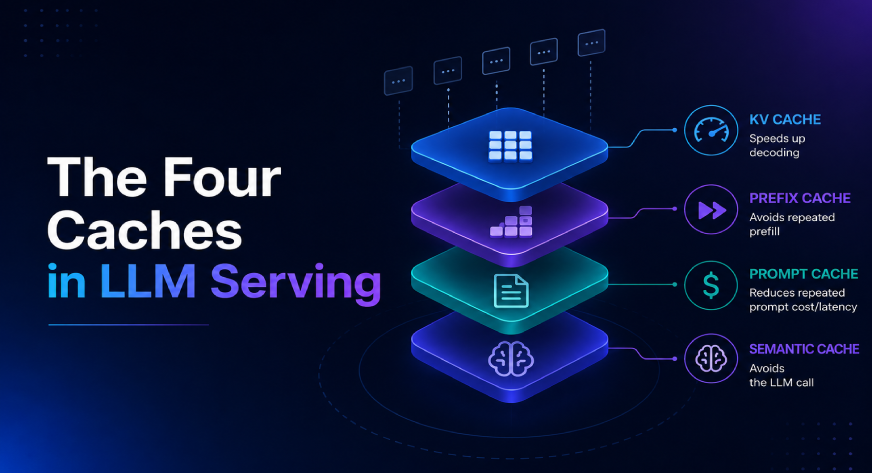
The rapid expansion of Large Language Model (LLM) applications into enterprise-grade workflows has brought the dual challenges of inference latency and operational costs to the forefront of the artificial intelligence industry. As these applications grow more sophisticated—incorporating expansive system instructions, multi-turn conversation histories, and massive retrieved document sets—the sheer volume of tokens processed per request has skyrocketed. A single query may now involve millions of context tokens, many of which are redundant across different sessions. To mitigate the "token tax" associated with reprocessing identical information, the industry has turned to a multi-layered caching architecture. This technical evolution is not defined by a single method but rather by a hierarchy of four distinct techniques: Key-Value (KV) caching, prefix caching, prompt caching, and semantic caching.
Understanding the progression of these technologies requires an analysis of the modern LLM serving stack. In the early stages of generative AI deployment, systems were often naive, recomputing the entire mathematical state of a prompt for every new token generated. Today, sophisticated inference engines like vLLM and TensorRT-LLM utilize advanced memory management to ensure that no computation is performed twice if the result can be stored and retrieved. This shift is critical for maintaining the viability of real-time AI agents and high-throughput enterprise services.
The Foundation of Autoregressive Inference: KV Caching
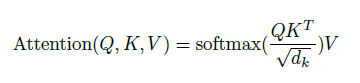
The most fundamental optimization in generative AI is the KV (Key-Value) cache. Modern LLMs, such as the GPT-4 and Llama 3 families, are autoregressive, meaning they generate responses one token at a time. For every new token produced, the model must consider every preceding token to maintain context and coherence. This is achieved through the Transformer architecture’s attention mechanism, which calculates how the current token relates to its predecessors.
During this process, the model generates "Key" and "Value" tensors—mathematical representations of the tokens’ positions and meanings. Without a KV cache, the model would be forced to recompute these tensors for every single token in a sequence. If a model is generating a 500-token response, a naive approach would require the model to perform the math for token 1 five hundred times, and for token 2 four hundred and ninety-nine times. This leads to an exponential increase in computation as the sequence length grows.
KV caching solves this by storing the previously computed tensors in the GPU’s high-bandwidth memory (HBM). Once a token is processed, its Key and Value states are "pinned" in the cache. When the model moves to the next generation step, it simply fetches these stored states and only performs new calculations for the most recent token. This transition from $O(n^2)$ complexity to $O(n)$ complexity for the decoding phase is what makes modern LLM interactions feel fluid rather than staggered. However, the KV cache is typically ephemeral and tied to a specific active request; once the session ends, the memory is usually cleared to make room for the next user.
Scaling Efficiency Across Requests: Prefix Caching
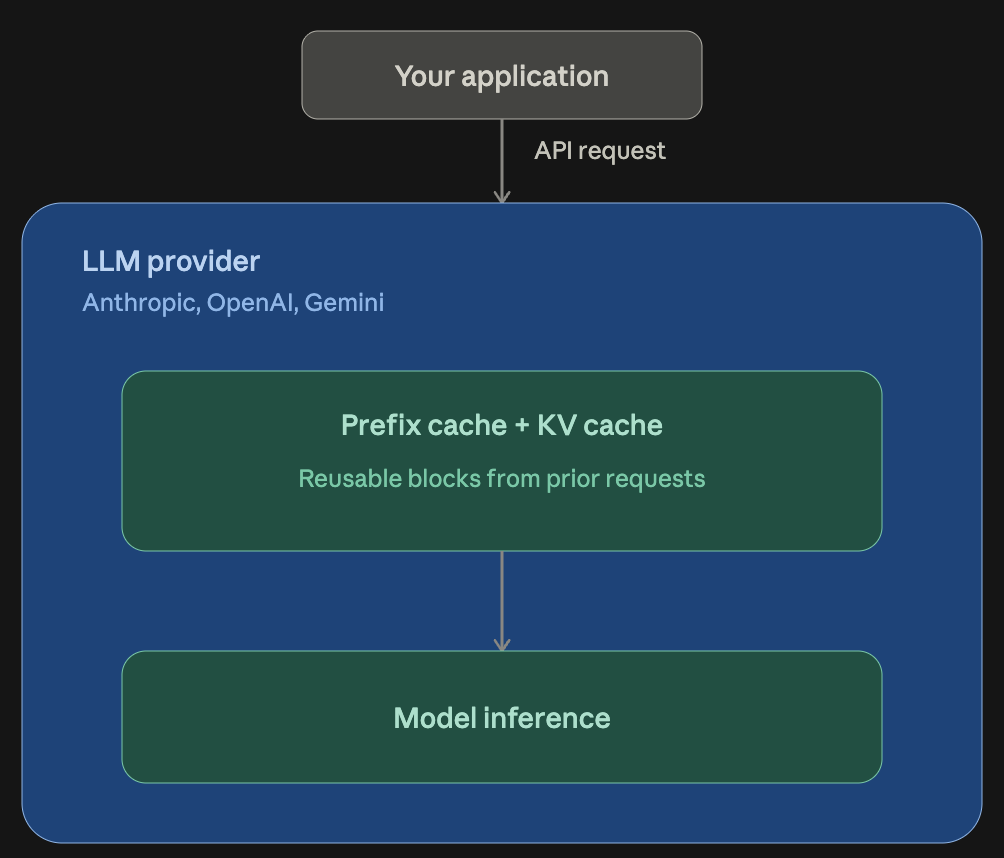
While KV caching optimizes the internal generation of a single response, prefix caching addresses redundancy across different users and sessions. In many enterprise applications, such as customer support bots or coding assistants, the first few thousand tokens of a prompt are often identical across every request. These "prefixes" usually contain system instructions, company policies, or large blocks of documentation.
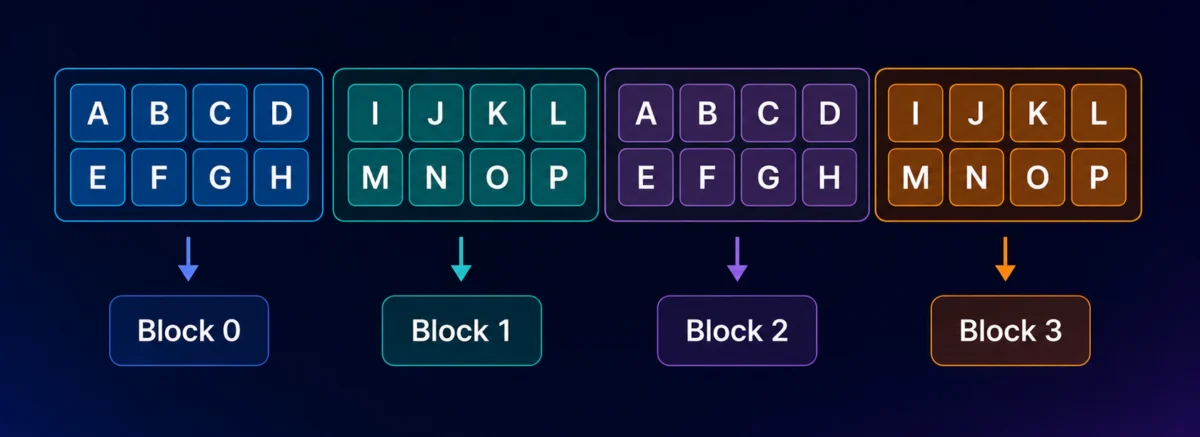
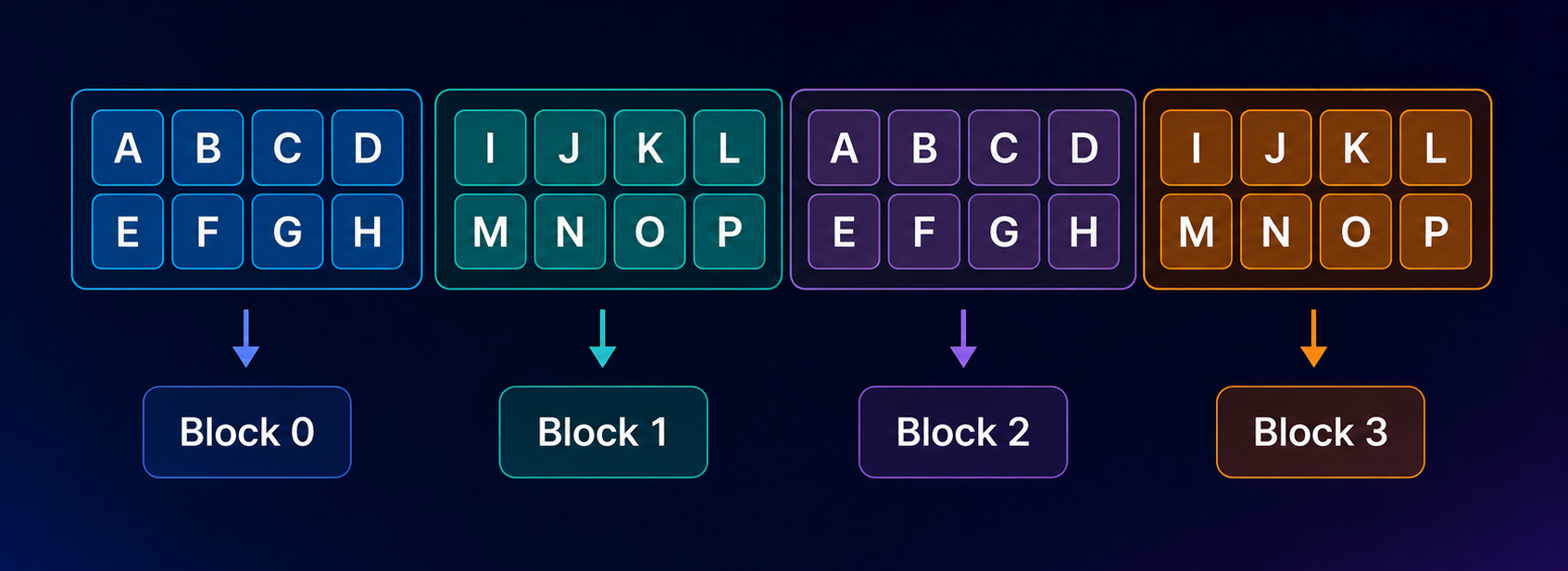
Prefix caching allows the inference engine to recognize these shared segments and reuse the KV states computed for a previous user. This technique relies on a sophisticated block-based memory management system, often referred to as PagedAttention. The system divides the prompt into fixed-size blocks of tokens (e.g., blocks of 16 or 32 tokens). Each block is hashed based on its content and its specific position in the sequence.
When a new request arrives, the engine performs a hash lookup. If the first three blocks of the new prompt match the first three blocks of a previously processed prompt, the engine simply loads the KV states for those 48 or 96 tokens from the cache. This bypasses the "prefill" phase—the initial heavy computation required to digest the prompt—drastically reducing Time to First Token (TTFT). For applications using "Long Context" (100k+ tokens), prefix caching can reduce the prefill time from several seconds to a few milliseconds.
The Commercial Layer: Provider-Side Prompt Caching
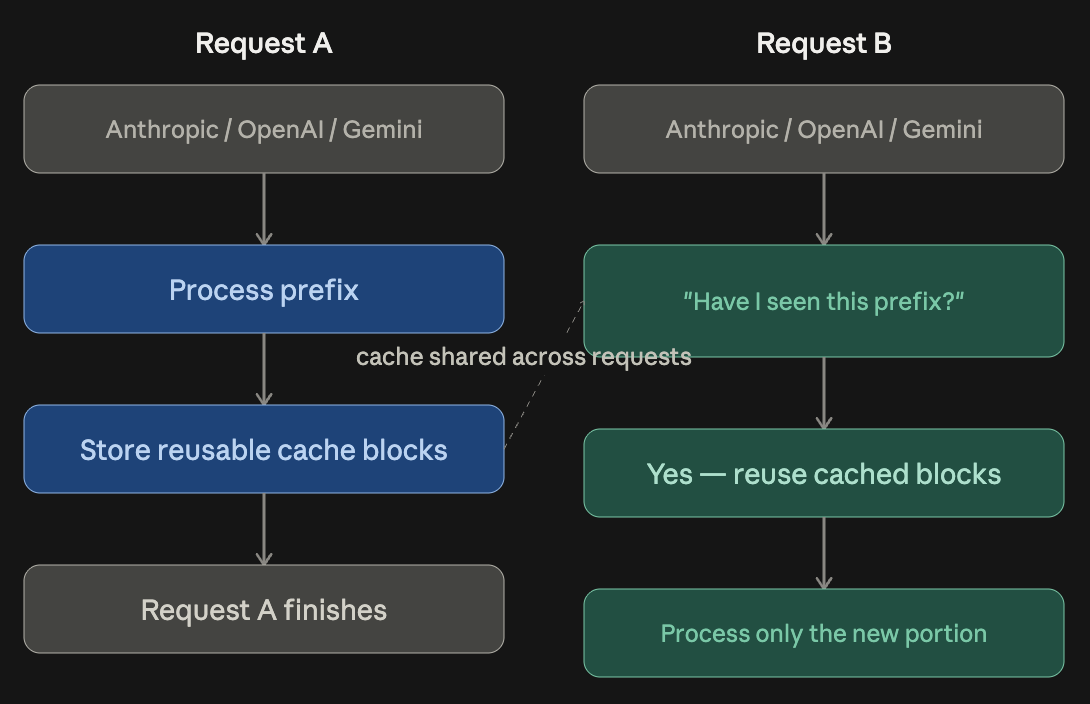
As the market for Model-as-a-Service (MaaS) has matured, API providers like OpenAI, Anthropic, Google, and DeepSeek have integrated caching directly into their billing and delivery models. This is known as prompt caching. Unlike prefix caching, which is an architectural choice for those hosting their own models, prompt caching is a commercial feature that allows developers to save money on repetitive input.
The economic impact of prompt caching is significant. For instance, DeepSeek recently disrupted the market by offering cache hits at a fraction of the cost of standard tokens (0.008x the price). Other major players followed suit, with OpenAI and Anthropic offering roughly 90% discounts on cached content.
However, prompt caching is highly sensitive to the order of operations. To trigger a cache hit, the shared content must be at the very beginning of the prompt. Even a minor change—such as adding a timestamp or a unique user ID at the start of the instructions—can invalidate the entire cache, forcing the provider to reprocess the entire prompt at full price. Consequently, developers have had to re-architect their prompt engineering to ensure that static data (documentation and instructions) is placed at the top, while dynamic data (the user’s specific query) is placed at the bottom.
Eliminating Inference: The Role of Semantic Caching
The most radical form of optimization is semantic caching. While the previous three methods focus on making the model’s math more efficient, semantic caching aims to avoid calling the model entirely. This technique operates on the principle that many users ask questions that are semantically identical, even if the wording differs.
A semantic cache does not look for exact string matches. Instead, it converts incoming queries into high-dimensional vectors, or "embeddings," which represent the underlying meaning of the text. These vectors are stored in a vector database. When a new query arrives, the system performs a similarity search. If the new query is 98% similar to a previous question that has already been answered, the system simply returns the stored answer from the database.
For example, "How do I reset my password?" and "What is the process for changing my login credentials?" would trigger a semantic cache hit. This bypasses the GPU entirely, reducing the cost to near zero and the latency to the speed of a standard database lookup. The trade-off, however, is accuracy. If the similarity threshold is set too low, the system might provide an answer to a related but different question, leading to "hallucinations by retrieval."
Timeline of Innovation in LLM Caching
The evolution of these techniques has followed the rapid scaling of model capabilities:
- Late 2022: The launch of ChatGPT popularized the "streaming" response, made possible by basic KV caching.
- Mid 2023: The introduction of vLLM and PagedAttention at UC Berkeley revolutionized how memory is allocated, making prefix caching viable for multi-tenant environments.
- Early 2024: Anthropic and OpenAI introduced formal API support for prompt caching, acknowledging the enterprise need for long-context stability.
- Late 2024 – Present: The "Price Wars" began, with providers like DeepSeek and Kimi using aggressive caching strategies to lower the barrier to entry for massive-scale AI agents.
Broader Implications and Industry Impact
The convergence of these four caching layers is fundamentally changing the economics of AI. In the early days of the LLM boom, the primary concern was "Compute" (FLOPs). Today, the bottleneck has shifted to "Memory Bandwidth" and "Cache Management."
For businesses, the implications are twofold. First, the cost of maintaining a sophisticated AI agent has dropped by orders of magnitude for those who can maintain stable prompt prefixes. Second, the user experience has shifted from a clunky, "typing" effect to near-instantaneous responses. This is particularly vital for the next generation of "Voice AI" and "Action Agents," where a latency of even one second can break the illusion of human-like interaction.
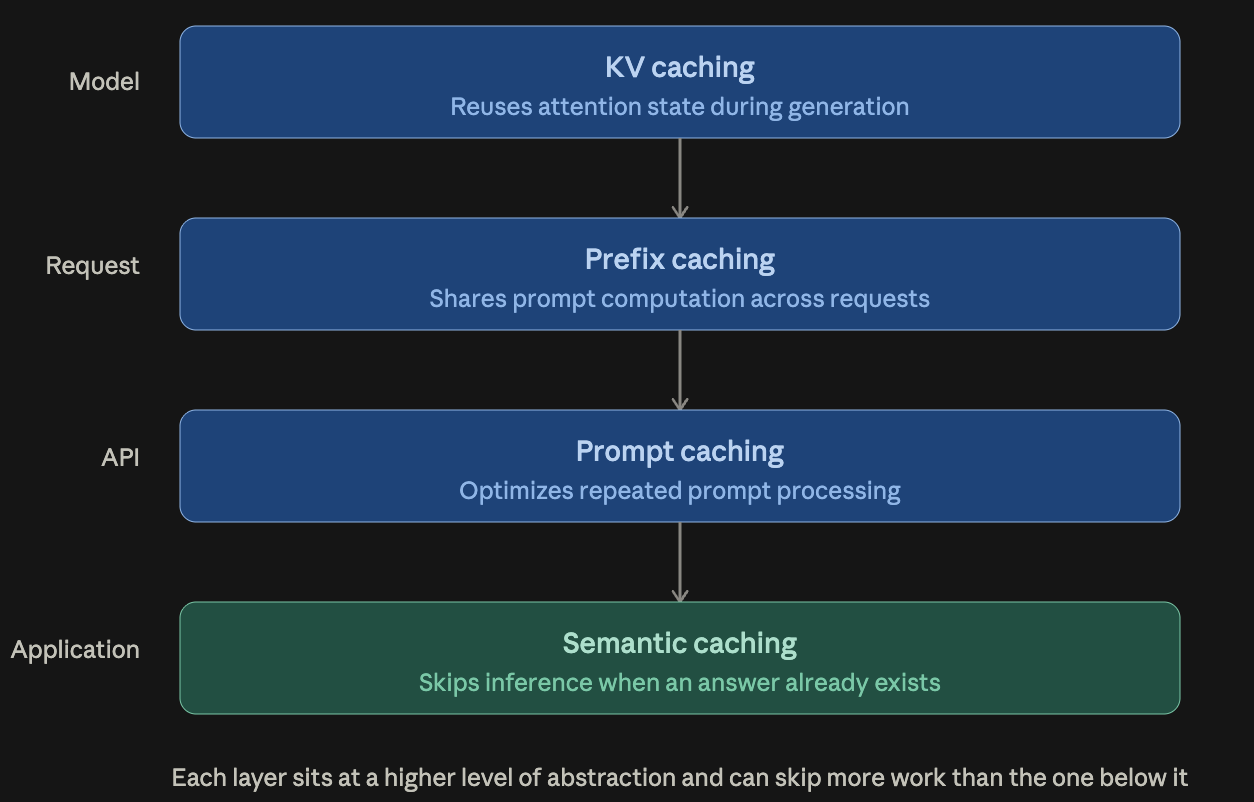
Furthermore, the rise of caching is influencing how models are trained. We are seeing a move toward "Long Context" models that can handle millions of tokens. These models would be unusable without the caching hierarchy described above, as the cost to re-read a 2-million-token book for every question would be prohibitive.
In conclusion, the mastery of LLM inference is no longer just about the size of the model or the quality of the weights. It is increasingly about the intelligence of the surrounding infrastructure. By strategically deploying KV, prefix, prompt, and semantic caches, developers can ensure that their AI applications are not only smarter but also faster and more sustainable. As the industry moves toward agentic workflows that require constant "thinking" and "reasoning," these caching techniques will remain the silent engines of the AI revolution.