TikTok USDS JV, the entity responsible for managing the U.S. operations of the globally popular short-form video platform TikTok, is slated to close its Nashville office on October 5, 2026, resulting in the layoff of approximately 250 employees. This strategic move, which primarily impacts the company’s moderation staff, was first reported by The New York Times, and is framed by the company as an effort to streamline operations and better align its teams for long-term growth. The decision sends ripples through the tech industry, raising questions about the future of human content moderation and the evolving operational strategy of TikTok’s U.S. division, particularly in the context of ongoing national security scrutiny.
The Genesis of TikTok USDS JV: Project Texas and National Security Concerns
The establishment of TikTok USDS JV (United States Data Security Joint Venture) is deeply rooted in the complex geopolitical and regulatory landscape surrounding TikTok. For years, the U.S. government has expressed significant national security concerns over TikTok’s ownership by ByteDance, a China-based company. These concerns primarily revolve around the potential for the Chinese government to access U.S. user data or influence content on the platform, issues that have led to calls for a nationwide ban or forced divestiture of TikTok’s U.S. assets.
In response to these pressures, TikTok initiated "Project Texas" in 2020. This ambitious and costly undertaking aimed to create a robust firewall around U.S. user data and operations, effectively isolating them from ByteDance and any potential foreign government influence. As part of Project Texas, TikTok USDS JV was formed, partnering with Oracle as a trusted third-party technology provider. The JV’s mandate was to oversee all aspects of TikTok’s U.S. business, including data storage, content recommendation algorithms, and, critically, content moderation. This structure was designed to reassure U.S. authorities that American user data would be stored on Oracle servers in the U.S., accessible only by U.S.-based personnel, and that content moderation decisions would be made independently of ByteDance’s influence. The Nashville office played a vital role within this new framework, housing a portion of the platform’s local moderation team, integral to upholding community guidelines and safeguarding the user experience within the U.S. market.
The Role of the Nashville Office in Content Moderation
The Nashville office, established as a key operational hub for TikTok USDS JV, was home to a dedicated team of content moderators. These individuals were on the front lines of ensuring the safety and integrity of the platform for its over 200 million U.S. users. Their responsibilities encompassed reviewing user-generated content for violations of TikTok’s community guidelines, which range from hate speech and harassment to graphic violence and misinformation. Human moderators are crucial for discerning context, nuance, and cultural specificities that automated systems often miss. They are tasked with making difficult judgment calls, often under immense pressure, to protect users from harmful content while upholding freedom of expression. The presence of a localized moderation team, particularly within the Project Texas framework, was seen as an important step towards demonstrating a commitment to U.S.-centric operations and addressing specific regional content challenges. The closure of this office, therefore, signifies a significant shift in the operational strategy for this critical function.
Details of the Layoffs and Employee Impact
The announcement of the Nashville office closure and the subsequent layoffs arrived abruptly for the affected employees. According to reports, staff members received emails on Wednesday morning, notifying them of the decision. Several workers, who requested anonymity due to the sensitive nature of the situation, reported being immediately logged out of their company devices, a standard procedure in such mass layoffs to secure company assets and data. These employees were also informed that they would receive severance packages, a common practice to mitigate the immediate financial impact of job loss.
The sudden nature of the layoffs, coupled with the immediate revocation of access, can be a disorienting and stressful experience for employees. While severance offers some financial cushion, the loss of 250 jobs represents a considerable impact on individuals and their families, particularly in a competitive job market. The Nashville tech scene, while growing, will absorb these displaced workers, many of whom possess specialized skills in content review and platform safety. The emotional toll of such a corporate restructuring, including uncertainty about future career paths and the disruption to professional communities, is often profound. The decision to consolidate operations suggests a move away from distributed moderation teams, potentially impacting the localized understanding and rapid response capabilities that human teams provide.
Official Rationale and Corporate Strategy

In its statement to The New York Times, TikTok USDS JV articulated that the decision to shutter its Nashville office was made "in an effort to streamline operations and better align its teams for long-term growth." While such corporate phrasing is common in restructuring announcements, it invites deeper analysis into the underlying strategic imperatives. "Streamlining operations" typically refers to efforts to reduce redundancies, improve efficiency, and cut costs. In the context of content moderation, this could imply centralizing moderation efforts in fewer, larger hubs, or significantly increasing reliance on technological solutions.
The phrase "better align its teams for long-term growth" suggests a strategic reorganization aimed at optimizing resource allocation to support future business objectives. This could mean a shift towards a more integrated global or regional moderation strategy, rather than maintaining a separate, dedicated office for a specific geographic region within the U.S. The company has not provided explicit details regarding the impact of this closure on its overall moderation efforts or how it plans to replace the labor capacity lost from the Nashville team. This lack of transparency leaves room for speculation regarding the specific nature of the alignment and its implications for the quality and thoroughness of content moderation moving forward.
The Evolving Landscape of Content Moderation: Human vs. AI
Content moderation is one of the most challenging and resource-intensive aspects of operating a large-scale social media platform. The sheer volume of content uploaded daily, especially on platforms like TikTok with hundreds of millions of users generating billions of videos, makes purely human moderation impractical. This necessitates a hybrid approach, combining automated detection systems with human review. The debate between the efficacy and ethics of human versus artificial intelligence (AI) in content moderation has intensified in recent years, particularly with rapid advancements in AI and machine learning.
Human moderators bring crucial qualities to the task: nuanced understanding of context, cultural sensitivity, empathy, and the ability to interpret complex situations that AI algorithms often struggle with. They can identify subtle forms of harassment, understand sarcasm, and make judgment calls on borderline content that requires human discernment. However, human moderation is also prone to error, burnout, and psychological trauma due to exposure to disturbing content. It is also inherently slower and more expensive to scale.
AI, on the other hand, offers unparalleled speed and scalability. Algorithms can scan vast quantities of content almost instantaneously, identifying patterns associated with violations. AI can be particularly effective in detecting clear-cut violations like spam, nudity, or graphic violence when trained on massive datasets. However, AI often lacks the contextual understanding of humans, leading to false positives (removing benign content) or false negatives (missing subtle violations). The ethical implications of AI making decisions that impact free speech and community standards are also a significant concern. The closure of the Nashville office, particularly given the emphasis on "streamlining," strongly suggests a strategic pivot towards greater automation in TikTok’s content moderation strategy.
TikTok’s Recent Moderation Efforts and Data
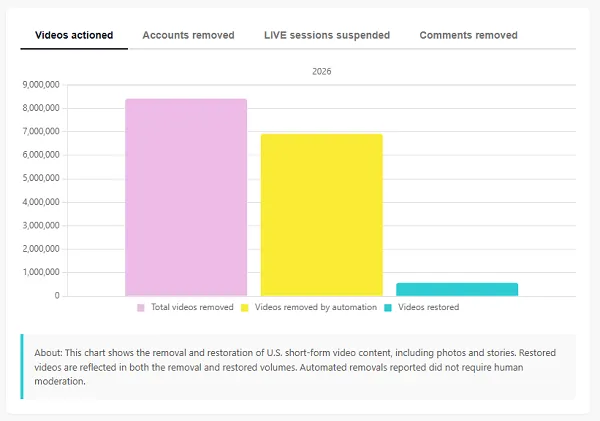
Just last month, TikTok USDS JV released its inaugural platform security and community guidelines reports, providing a glimpse into the scale of its moderation efforts. These reports, covering the period from January 22 to March 31 of the current year, detailed the work undertaken by its moderation team to reduce user exposure to potentially harmful content. The data revealed that TikTok USDS removed more than 8.4 million videos from the platform within this timeframe. This figure underscores the immense volume of content that requires scrutiny on a daily basis.
Crucially, the report highlighted the significant role of automated detection in these removals: approximately 82% of the removed videos were initially flagged and taken down by AI systems. Human moderators then worked to clarify and confirm potential violations, particularly for more complex or borderline cases. This data points to an already heavy reliance on AI in TikTok’s moderation workflow. The ability of AI to swiftly process and identify a large majority of problematic content likely contributes to the company’s confidence in scaling back its human moderation footprint in specific locations. If AI systems can effectively handle the bulk of initial detection and even removal, the need for large, geographically dispersed human teams might be reassessed for efficiency.
The Intensifying Role of Artificial Intelligence
Given the data from TikTok’s own reports and the company’s stated rationale for streamlining operations, the advancing capabilities of artificial intelligence are a highly plausible explanation for the staffing changes in Nashville. As AI models for content analysis, natural language processing, and image/video recognition become more sophisticated, their ability to identify and act on policy violations improves dramatically. AI can learn from past moderation decisions, adapt to new forms of harmful content, and operate 24/7 without the risk of burnout or emotional distress.

For a company managing the scale of TikTok, investing in advanced AI for content moderation can lead to substantial cost savings and increased efficiency. If AI tools can reliably undertake tasks previously performed by human operators, it allows companies to reallocate human resources to more complex, nuanced, or strategic moderation challenges, such as policy development, appeals, or handling high-profile cases that absolutely require human judgment. This shift is not unique to TikTok; it is a broader trend across the social media industry, where platforms are continually exploring how AI can augment or replace human moderation to manage the ever-growing torrent of user-generated content. However, the ethical considerations remain paramount: ensuring AI systems are fair, unbiased, and capable of understanding the diverse cultural and linguistic contexts of a global user base.
Broader Implications for Project Texas and U.S. Operations
The closure of the Nashville office and the reduction of human moderation staff within TikTok USDS JV carry significant implications for Project Texas, the initiative designed to insulate TikTok’s U.S. operations from foreign influence. Project Texas was, in large part, an effort to build trust with U.S. lawmakers and national security officials by demonstrating a commitment to U.S.-centric operations and data security. A key component of this was the establishment of U.S.-based teams responsible for critical functions like content moderation.
While the company asserts that this move is for "streamlining operations," it raises questions about the perceived robustness of Project Texas. If content moderation is increasingly reliant on AI, the development, training, and oversight of these AI systems become crucial. Where are these AI systems being developed? Who is overseeing their algorithms to ensure they are free from potential influence? The relocation or consolidation of human moderation teams also warrants scrutiny regarding where these teams are now based and their reporting structures. For Project Texas to maintain its credibility, the operational independence and security of all critical functions, including advanced AI moderation, must be unequivocally demonstrated. This restructuring could be interpreted by some as a cost-cutting measure that potentially undermines the localized control and human oversight that Project Texas aimed to establish, or, conversely, as an evolution of the project to incorporate cutting-edge technology more efficiently within its secure framework.
Economic and Social Impact
The layoff of 250 employees represents a tangible economic impact on the individuals affected and the local economy of Nashville. While the tech sector in Nashville has been expanding, a sudden influx of displaced workers can strain local job markets. These workers possess valuable skills, but finding comparable roles quickly can be challenging. Beyond the direct economic impact, there is a social dimension to such corporate decisions. Tech companies, particularly those with a significant public profile like TikTok, play a role in the economic vitality and employment landscape of the cities where they operate. The closure of an office can affect local businesses that rely on the patronage of the company and its employees.
This event also contributes to a broader trend of layoffs seen across the tech industry in recent years. Many companies, after periods of rapid expansion, are now recalibrating their workforces and operational strategies in response to economic pressures, changing market conditions, and advancements in automation. The content moderation sector, in particular, is undergoing a significant transformation, with platforms grappling with the immense scale of their responsibility and the potential for technological solutions to alleviate some of the burden.
Future Outlook for TikTok’s U.S. Operations
The closure of the Nashville office marks a notable inflection point in TikTok USDS JV’s operational strategy within the U.S. While the company remains a dominant force in the social media landscape, serving over 200 million users in the U.S., its corporate structure and operational execution continue to evolve under intense scrutiny. The move signals a potential consolidation of content moderation functions, likely leveraging existing hubs or establishing new, more centralized locations equipped with advanced AI tools.
The future success of TikTok USDS JV, and by extension Project Texas, will hinge on its ability to demonstrate effective content moderation that is both efficient and robust, while simultaneously addressing national security concerns. The balance between human oversight and AI automation will be critical. As TikTok continues to navigate the complexities of regulatory demands, geopolitical tensions, and rapid technological advancements, its operational decisions, such as the Nashville office closure, will be closely watched as indicators of its long-term strategy and commitment to its U.S. user base and the regulatory environment. This event underscores the dynamic nature of the tech industry, where strategic pivots and technological integration constantly reshape employment landscapes and operational models.