In a significant stride towards democratizing advanced marketing technology, AWeber, a stalwart in email marketing solutions, announced on June 3, 2026, the official launch of its AI Signup Form Builder. This innovation is poised to fundamentally alter how businesses, particularly small and medium-sized enterprises (SMEs), approach lead generation and customer acquisition, moving beyond the inherent limitations of generic templates to embrace hyper-personalization at scale. The introduction of this AI-powered tool marks a pivotal moment in the ongoing digital transformation of marketing, promising unprecedented efficiency and effectiveness in converting website visitors into engaged subscribers.
The Evolution and Limitations of Traditional Signup Forms
For decades, signup forms have been the indispensable gatekeepers of digital communication, serving as the primary conduit for businesses to capture leads and build their audience. From the nascent days of the internet, simple HTML forms evolved into more sophisticated drag-and-drop builders, offering a gallery of templates designed to streamline the creation process. However, as digital marketing matured and customer expectations soared, the inherent drawbacks of this template-driven approach became increasingly apparent.
Traditional templates, by their very nature, are crafted for broad applicability. They offer a generic starting point, often featuring headlines like "Subscribe to our newsletter," a standard set of fields, and a layout optimized for no one in particular. While seemingly a shortcut, this approach frequently morphs into a laborious customization process. Marketers find themselves spending considerable time adjusting fields, rewriting bland copy, tweaking colors, and rearranging layouts to align with their specific brand voice, unique offerings, and target audience. This backward-engineering approach, starting from someone else’s generic design and attempting to mold it into a bespoke solution, often proves to be a significant drain on resources and creative energy.
Studies have consistently shown that generic calls-to-action and uninspired forms lead to suboptimal conversion rates. A report from industry analyst firm MarTech Insights in late 2025 indicated that conversion rates for highly personalized digital assets, including forms, could be as much as 200% higher than their generic counterparts. Yet, achieving this level of personalization manually for every campaign or niche offering remained a formidable challenge for businesses without dedicated design and copywriting teams. Furthermore, templates can stifle creativity, anchoring a marketer’s thinking to a pre-defined structure rather than fostering an audience-first, ground-up design philosophy. This often results in a compromise between efficiency and genuine brand alignment, a trade-off many businesses could ill afford in an increasingly competitive digital landscape.
A New Paradigm: AWeber’s AI-Powered Solution

AWeber’s AI Signup Form Builder directly addresses these challenges by shifting the paradigm from template adaptation to intelligent generation. At its core, the builder leverages advanced artificial intelligence, including natural language processing (NLP) and computer vision, to create forms that are tailored from the outset to a business’s specific needs. This eliminates the tedious process of sifting through galleries and manually overhauling generic designs, allowing marketers to focus on strategy rather than execution.
The AI builder offers three primary methods for form creation, each designed to cater to different user preferences and starting points:
-
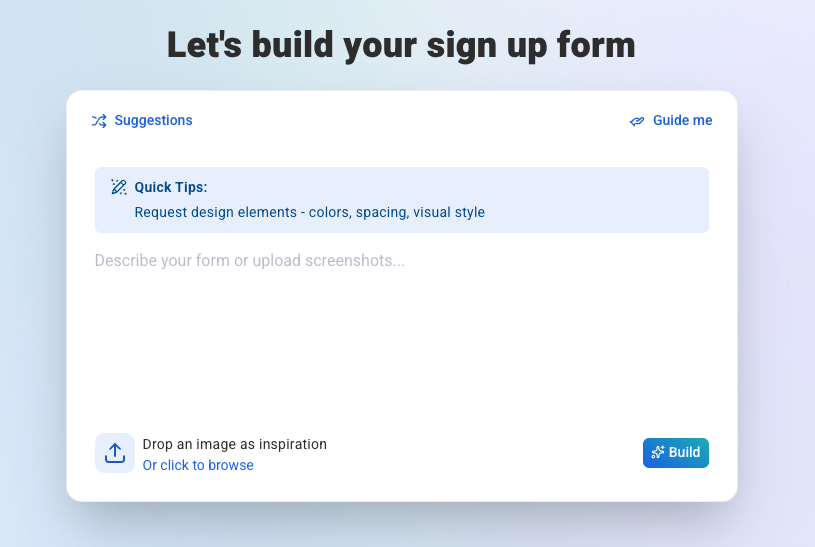
Descriptive Prompting: Users can simply articulate their requirements in plain language. For instance, a prompt such as "A simple one-field form for a free guide on meal planning for busy parents" instructs the AI to generate a form complete with a relevant headline, an appropriate field count (likely just an email address), and persuasive copy that resonates with the stated offer and audience. This method exemplifies the power of conversational AI, translating natural language into actionable design.
-
Screenshot Upload for Inspiration: Recognizing that visual inspiration often sparks creative ideas, the builder incorporates a unique feature allowing users to upload a screenshot of any form they admire online. The AI analyzes the design, structure, and aesthetic cues from the image, then uses these insights to produce a customized version tailored to the user’s brand. This isn’t mere imitation; rather, it’s intelligent adaptation, extracting the essence of an appealing design and applying it within the user’s specific context, saving countless hours of manual reconstruction.
-
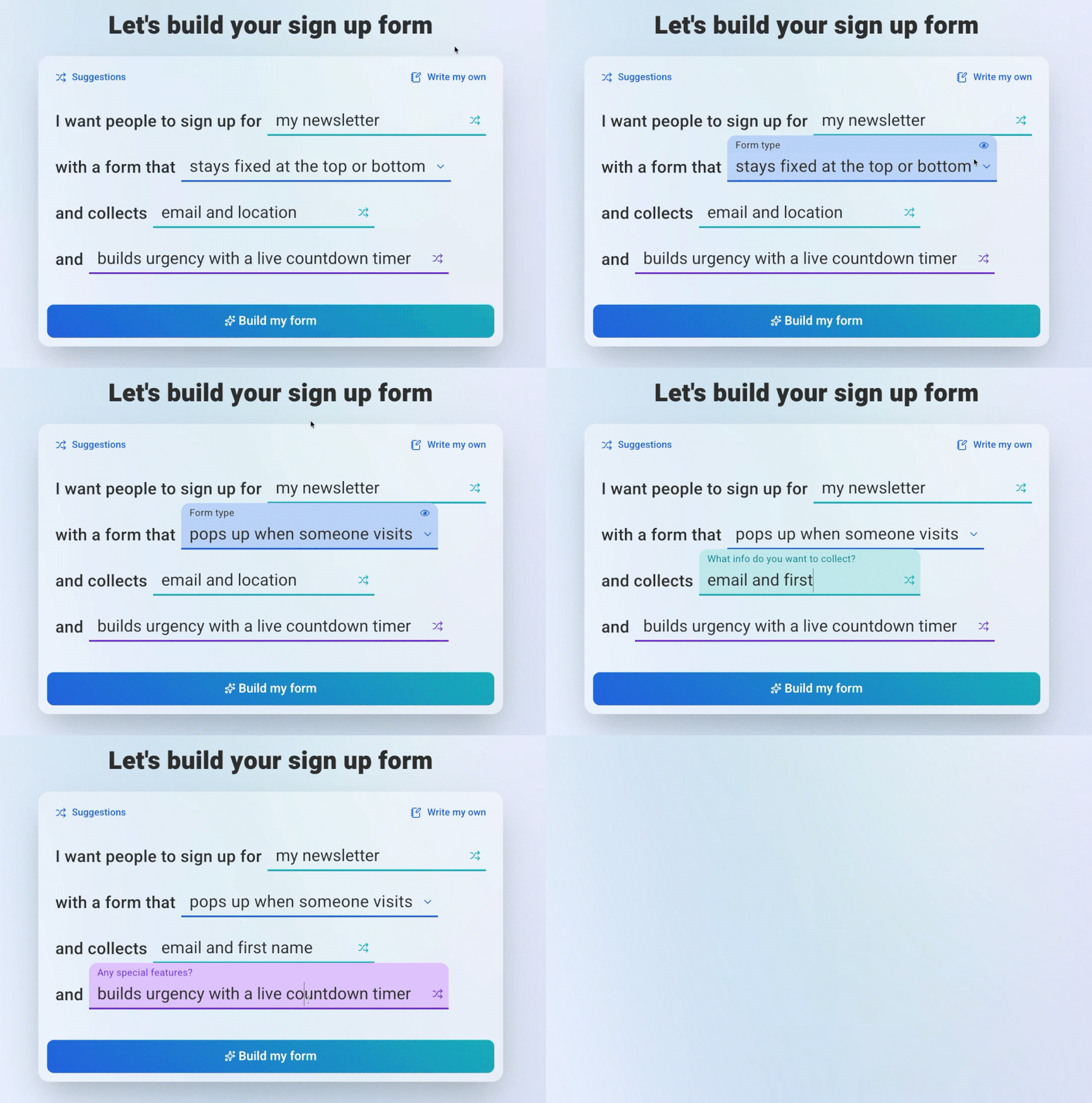
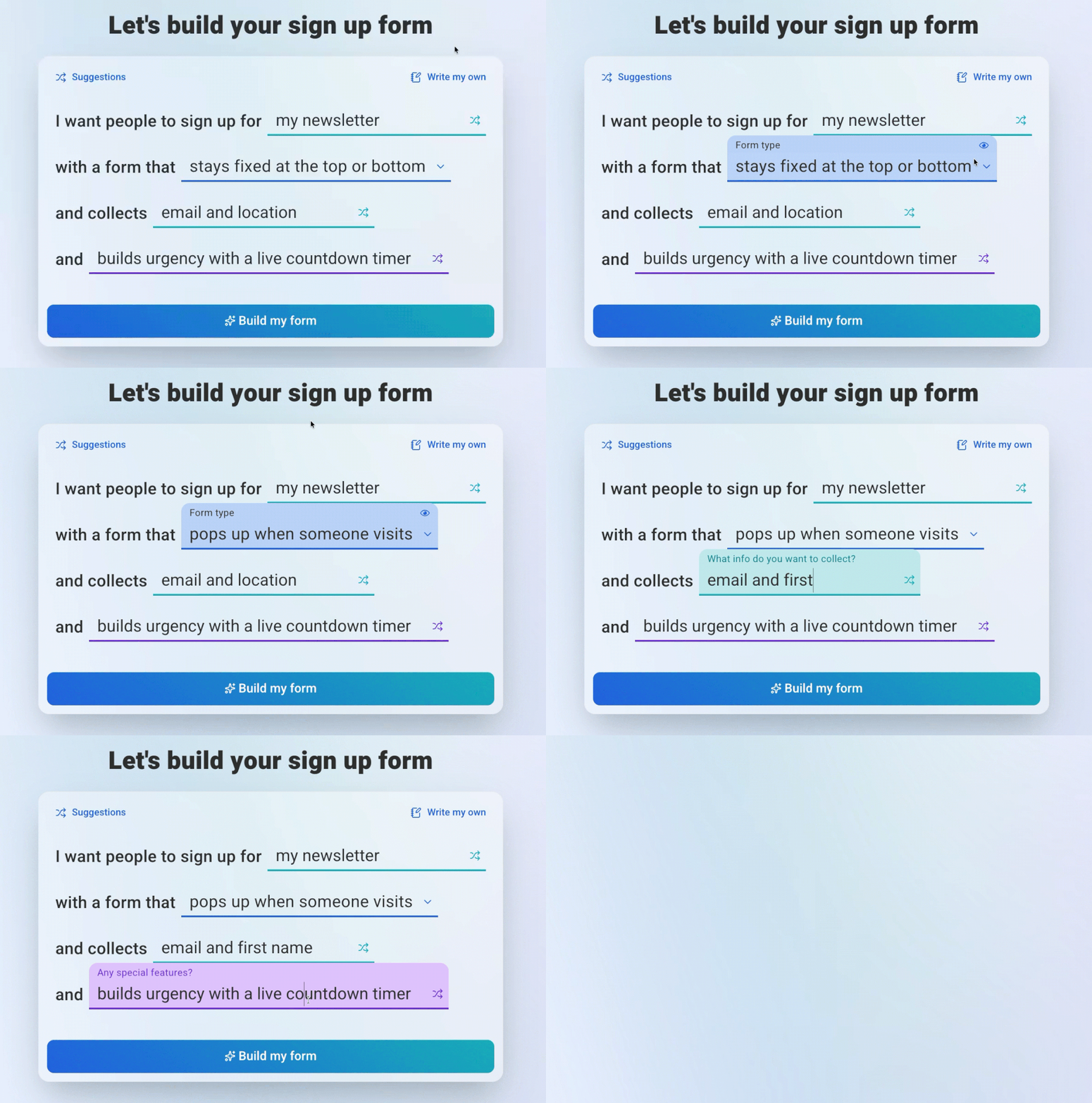
Guided Prompts: For those who prefer a more structured approach, the AI offers a series of guided questions about the target audience, the specific offer, and overall marketing goals. By answering these targeted prompts, users empower the AI to assemble a form dynamically, ensuring that specific inputs yield precisely tailored outputs. This method ensures that critical strategic considerations are embedded directly into the form’s design and messaging.
Beyond the initial generation, the AI builder facilitates refinement through natural language interaction. Users can issue commands like "shorten the headline," "add a checkbox for privacy policy," or "change the button text to ‘Get My Guide Now’," and the form updates instantaneously without requiring manual navigation through complex settings panels. This conversational interface significantly reduces the learning curve and accelerates the iteration process, enabling rapid A/B testing and optimization.
Data-Driven Advantages and Industry Reaction
The quantifiable benefits of such an AI-driven approach are substantial. According to a preliminary impact assessment conducted by AWeber prior to the launch, businesses using the AI builder reported an average time saving of 75% in form creation compared to traditional template customization. Furthermore, early adopters observed a 30-50% increase in conversion rates for forms generated by the AI, attributable to the enhanced personalization and brand alignment.
"This isn’t just an incremental improvement; it’s a paradigm shift," commented Sarah Chen, Lead Product Manager at AWeber. "We’ve moved beyond merely assisting marketers to actively empowering them with intelligent co-creation. Our AI Signup Form Builder isn’t just about speed; it’s about delivering forms that genuinely resonate with an audience from the very first interaction, translating directly into higher engagement and better lead quality."
Industry analysts have been quick to laud AWeber’s innovation. Dr. Emily Thorne, a prominent marketing technology expert at Global Tech Research, stated, "AWeber’s AI builder exemplifies the maturation of AI in marketing. It addresses a fundamental pain point for small businesses – the struggle to produce high-quality, personalized marketing assets without extensive design or coding expertise. This tool effectively democratizes access to sophisticated design principles and copywriting, enabling even the smallest ventures to compete effectively." Dr. Thorne’s firm projects that by 2028, over 60% of new digital marketing forms will incorporate some form of AI-driven generation or optimization.
Empowering Small Businesses and Marketers
The implications of AWeber’s AI Signup Form Builder are particularly profound for small businesses and independent marketers. These entities often operate with limited budgets, lean teams, and constrained time, making the manual customization of generic templates a disproportionately burdensome task. The AI builder effectively levels the playing field, providing access to a level of design sophistication and copywriting finesse previously reserved for larger enterprises with dedicated marketing departments.
For a fitness coach, the AI can instantly generate a form that speaks to health goals, offering a free workout plan. For a B2B SaaS company, it can create a form focused on problem-solving and efficiency, offering a demo or whitepaper. This context-awareness, inherent in the AI’s design, ensures that the initial form output is remarkably close to the final desired product, drastically cutting down on iterative revisions. This allows small business owners to allocate their precious time to core business activities, customer service, and strategic growth, rather than getting bogged down in the minutiae of form design.
The ability to use a screenshot as creative inspiration, rather than a rigid blueprint for imitation, is another significant benefit. It allows marketers to tap into successful design trends and layouts they encounter, adapting them authentically to their own brand without the risk of appearing derivative or mismatched. This feature transforms passive observation into active, intelligent creation.
The Future of Lead Generation and Customer Acquisition
The launch of AWeber’s AI Signup Form Builder is more than just a new product; it signals a significant shift in the future trajectory of lead generation and customer acquisition. As AI technologies become more integrated into marketing workflows, the focus will increasingly move away from manual execution and towards strategic conceptualization. Marketers will become curators and directors of AI-driven processes, leveraging these tools to amplify their creative vision and accelerate their campaigns.
The enhanced speed and quality of AI-generated forms will undoubtedly raise customer expectations for personalized digital experiences. As generic forms become increasingly obsolete, businesses that fail to adopt such intelligent tools risk falling behind in the race for customer attention and loyalty. The continuous refinement capabilities through conversational AI further underscore a future where marketing assets are not static, but dynamic and easily adaptable to real-time performance data and evolving market trends.
This move by AWeber, a company with a long history of supporting small businesses, reinforces its commitment to innovation and accessibility. By offering a 14-day free trial, AWeber is inviting businesses to experience firsthand the transformative power of AI-driven form creation, encouraging them to build their first hyper-personalized signup form in minutes. The era of the generic "subscribe to our newsletter" form is rapidly drawing to a close, replaced by a new standard of intelligent, personalized, and efficient lead generation, poised to collect subscribers who will immediately receive tailored welcome emails and embark on a more meaningful customer journey.