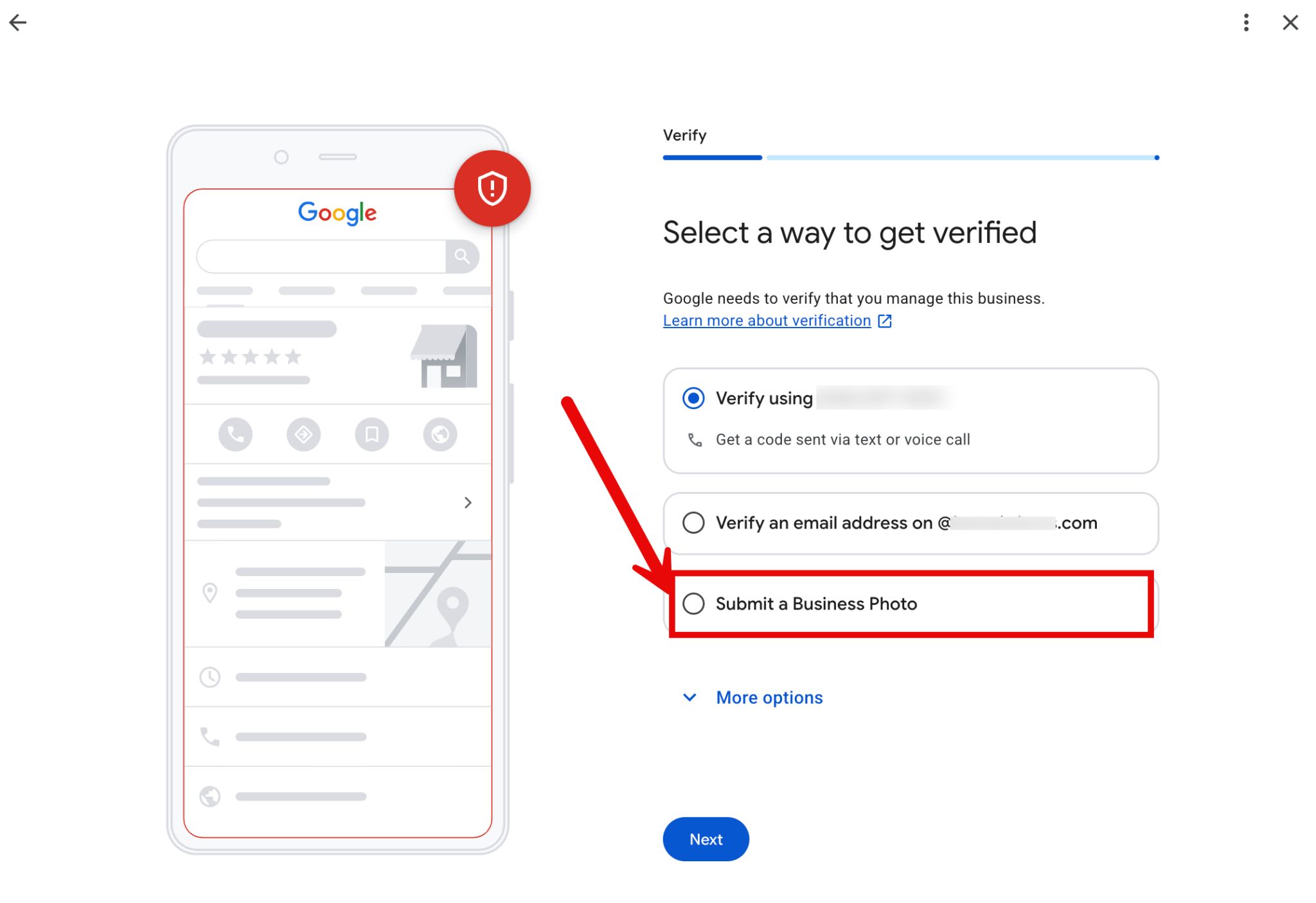
Google Business Profiles (GBP) appears to be rolling out a significant update to its business verification processes, introducing a fifth method that allows businesses to verify their physical location by submitting a photograph. This new option, observed by industry experts, marks a potential evolution in how Google ensures the authenticity and accuracy of business listings on its pervasive platform, Google Maps. The existing verification methods include phone or text, email, live video call, and the traditional postcard by mail, each presenting its own set of advantages and challenges for businesses seeking to establish a credible online presence.
The emergence of this "Submit a business photo" option was first brought to light by Ben Fisher, a prominent figure in the local SEO community, who shared his discovery on LinkedIn. Fisher noted the appearance of this new method as a verification option within Google Business Profiles, remarking that it "could be a pretty significant change" in the landscape of GBP verification. Initially, Google’s official support documentation had not been updated to reflect this new method, leading to speculation that it might be in a testing phase or a gradual rollout. However, subsequent observations, also shared by Fisher, provided critical details regarding the specific requirements for the submitted photos, clarifying the parameters Google expects businesses to adhere to for successful verification.
The Mechanics of Photo Verification: Detailed Requirements
According to the insights gathered from early observations, the photo verification method is designed to provide clear, irrefutable visual evidence of a business’s physical existence and branding. The core requirements stipulate that the submitted photograph must distinctly show the business name printed on permanent fixtures, such as a prominent signboard. Furthermore, the photo must capture the entire storefront in a single frame, offering a comprehensive view of the business’s exterior. This approach mirrors, in part, the stringent visual evidence collection required during a live video call verification, where a Google representative guides the business owner through showcasing their premises. The emphasis on permanent fixtures and a full storefront view is crucial for Google to ascertain that the business is legitimate, physically present at the claimed address, and publicly identifiable. This method aims to deter fraudulent listings and enhance the overall integrity of Google Maps data.
Contextualizing Google Business Profiles: The Backbone of Local Search
Google Business Profiles serve as the cornerstone of local search and discovery, providing essential information about businesses to millions of users daily. For consumers, GBP listings offer quick access to critical details such as business hours, address, phone number, website, customer reviews, and photos, all directly within Google Search and Maps. For businesses, a verified and optimized GBP listing is indispensable for visibility in local search results, driving foot traffic, phone calls, and website visits. Studies consistently show that businesses with complete and accurate GBP listings are significantly more likely to be viewed as reputable and attract more customer engagement. The reliance on accurate GBP data underscores Google’s continuous efforts to refine its verification processes, ensuring that the information presented to users is trustworthy and reflects real-world entities.
The evolution of GBP, formerly Google My Business, has been marked by a sustained commitment to data quality and user experience. From its inception, the platform has aimed to bridge the gap between online search and offline commerce, empowering local businesses to connect with their communities. However, the open nature of the internet also presents challenges, notably the proliferation of spam, fake listings, and misleading information. These issues not only erode user trust but also create unfair competition for legitimate businesses. Consequently, Google has continually iterated on its verification methods, seeking to strike a balance between ease of use for genuine businesses and robust protection against malicious actors.
The Verification Landscape: Existing Methods and Their Challenges
Before the introduction of photo verification, businesses had four primary routes to confirm their identity and location with Google:
-
Phone or Text: This method typically involves Google sending a verification code via a phone call or SMS to the business’s listed phone number. While often quick and convenient, it relies on the business having a functional and dedicated phone line, which may not always be the case for new or home-based businesses. It also carries a risk if the phone number is easily spoofed or not directly controlled by the legitimate business owner.
-
Email: Similar to phone verification, an email with a verification code is sent to the email address associated with the business. This method is generally straightforward but assumes the business owner has active access to the specified email, and it might be less secure against sophisticated impersonation attempts.
-
Postcard by Mail: Historically, this has been Google’s most reliable and widely used method, especially for businesses without a readily verifiable phone or email. A postcard containing a unique verification code is sent to the physical business address. The physical delivery aspect makes it difficult for fraudulent entities to intercept. However, this method is often the slowest, taking several days or even weeks for the postcard to arrive, causing delays for businesses eager to get their listings live.
-
Live Video Call: Introduced as a more robust and interactive method, live video verification involves a Google representative conducting a real-time video call with the business owner. During the call, the owner is asked to show proof of their location (e.g., street signs, permanent business signage), proof of their ownership (e.g., business documents, equipment), and their operational area. This method offers a high level of security and accuracy but requires scheduling, a stable internet connection, and the owner’s direct participation, which can be time-consuming.
Each of these methods has its strengths and weaknesses, and the optimal choice often depends on the specific circumstances of the business and its owner. The introduction of photo verification suggests an attempt to offer another robust, yet potentially more asynchronous and less labor-intensive, alternative to the live video call.
Why a Photo Verification? The Rationale Behind the Change
Google’s decision to introduce photo verification is likely driven by several strategic objectives aimed at improving the overall integrity and efficiency of its local search ecosystem:
-
Enhanced Anti-Spam Measures: Fraudulent business listings remain a persistent challenge for Google. Spammers often create fake businesses or hijack legitimate ones to manipulate search rankings, mislead consumers, or engage in illicit activities. Photo verification, particularly with its requirements for permanent signage and full storefront views, provides a tangible and difficult-to-fake piece of evidence that a business genuinely exists at a given location. Unlike a phone number or email, which can be easily acquired or spoofed, a physical sign and storefront are much harder to fabricate convincingly.
-
Improved Data Accuracy: Beyond outright fraud, inaccurate business information can stem from outdated data, unintentional errors, or incomplete listings. By requiring a current photo, Google can verify not only the existence of a business but also its current appearance and branding, helping to ensure that the information presented on Maps is up-to-date.
-
Streamlined User Experience for Legitimate Businesses: While live video verification is secure, its real-time nature can be a bottleneck for both Google and businesses. Scheduling, time zone differences, and connectivity issues can prolong the process. Photo verification, being an asynchronous method, allows businesses to submit evidence at their convenience, potentially speeding up the verification process for many. It offers a middle ground between the slow postcard method and the demanding live video call.
-
Scalability: As the number of businesses seeking to list on Google Maps continues to grow globally, Google needs verification methods that are scalable. Reviewing submitted photos, potentially with the aid of AI and machine learning for initial screening, could be more efficient than conducting millions of live video calls.
Industry Reactions and Expert Perspectives
The local SEO community and business owners generally welcome new verification options that simplify the process while maintaining security. Ben Fisher’s initial reaction, highlighting its "significant change" potential, reflects the industry’s continuous search for more efficient ways to manage GBP listings.
Local SEO professionals are likely to view photo verification as a valuable addition, especially for businesses that struggle with the traditional postcard delays or the scheduling complexities of live video calls. It offers another pathway, potentially reducing the friction associated with getting a new listing verified or regaining control of an existing one. However, experts will also scrutinize the implementation details, such as the clarity of instructions, the speed of review, and Google’s consistency in applying the rules. Questions may arise regarding the nuances for home-based businesses, service-area businesses, or businesses located within larger commercial complexes without prominent street-facing signage.
For business owners, the prospect of a simpler, faster verification method is appealing. Many small business owners are time-constrained and often find the initial setup of their online presence daunting. A clear, photo-based verification could reduce frustration and accelerate their ability to leverage Google Maps for customer acquisition. However, businesses in less visible locations or those operating purely online but claiming a physical address might find the "permanent fixture" and "entire storefront" requirements challenging.
Implications for Local Businesses
The introduction of photo verification carries several implications for local businesses:
- Potential for Faster Onboarding: For many businesses, particularly those with clear street frontage and signage, this method could significantly reduce the time it takes to get their GBP listing live, enabling them to appear in local search results sooner.
- Reduced Friction: Businesses that have struggled with other verification methods (e.g., lost postcards, missed phone calls, scheduling conflicts for video calls) now have an additional, potentially more convenient, option.
- Emphasis on Physical Presence: The requirements reinforce Google’s commitment to verifying genuine physical locations. Businesses operating from shared office spaces, virtual offices, or residential addresses without distinct external signage might find this method unsuitable or more challenging, potentially pushing them towards other verification types or necessitating a re-evaluation of their GBP strategy.
- Best Practices for Signage: The new method might indirectly encourage businesses to ensure their physical signage is clear, professional, and accurately reflects their business name, as this becomes a direct verification point.
- Continued Need for Multi-Method Understanding: Businesses and their marketing partners will need to understand all available verification methods and choose the most appropriate one based on their specific circumstances, location type, and operational model.
Broader Impact on Google Maps and Local Search Ecosystem
On a broader scale, the successful implementation of photo verification could lead to a cleaner, more reliable Google Maps experience. By making it harder for illegitimate businesses to gain verification, Google can:
- Increase User Trust: Consumers rely on Google Maps for accurate information. Reduced spam and verified listings enhance this trust, making Maps an even more valuable resource for local discovery.
- Improve Search Result Quality: With more accurate data, Google’s algorithms can deliver more relevant and helpful local search results, benefiting both users and legitimate businesses.
- Combat Review Spam: Fake listings are often associated with review spam, where businesses generate fake positive reviews for themselves or negative reviews for competitors. By curbing fake listings, Google can also indirectly combat review manipulation.
- Inform Future Verification Strategies: The performance of photo verification will likely inform Google’s ongoing development of new methods and refinement of existing ones, pushing the boundaries of automated and semi-automated verification.
Future Outlook and Google’s Ongoing Evolution
Google’s continuous experimentation with verification methods underscores its commitment to maintaining the integrity of its vast database of local businesses. As technology evolves, particularly in areas like image recognition and AI-powered data analysis, it is plausible that future verification methods will become even more sophisticated, efficient, and tailored to various business types.
While the "Submit a business photo" option is currently being observed and may still be in a testing or gradual rollout phase, its introduction signifies a proactive step by Google to address the evolving challenges of local business verification. It offers a promising blend of visual evidence and asynchronous submission, potentially setting a new standard for how businesses prove their authenticity on one of the world’s most critical digital platforms. Businesses are advised to stay informed about these changes and adapt their verification strategies to leverage new opportunities while adhering to Google’s evolving guidelines for a robust and trustworthy online presence.