The landscape of artificial intelligence research in 2026 has undergone a fundamental transformation, moving decisively away from the era of static large language models (LLMs) toward the era of autonomous agents. While the industry spent much of 2024 and 2025 debating the reasoning capabilities of models like GPT-4 and Claude 3, the current year marks a paradigm shift where the primary concern is no longer what a model "knows," but what an agent can "do." Researchers are now grappling with the complexities of long-horizon execution, real-world environmental volatility, and the necessity of self-correction without human intervention.
As the industry matures, the definition of success has evolved. A model is no longer evaluated solely on its ability to pass a standardized academic test; instead, it is judged on its ability to navigate live websites, manage multi-step professional workflows, and verify its own outputs against strict constraints. This shift represents the "Agentic Turn," where AI is viewed not as a digital encyclopedia, but as a functional participant in the global economy.
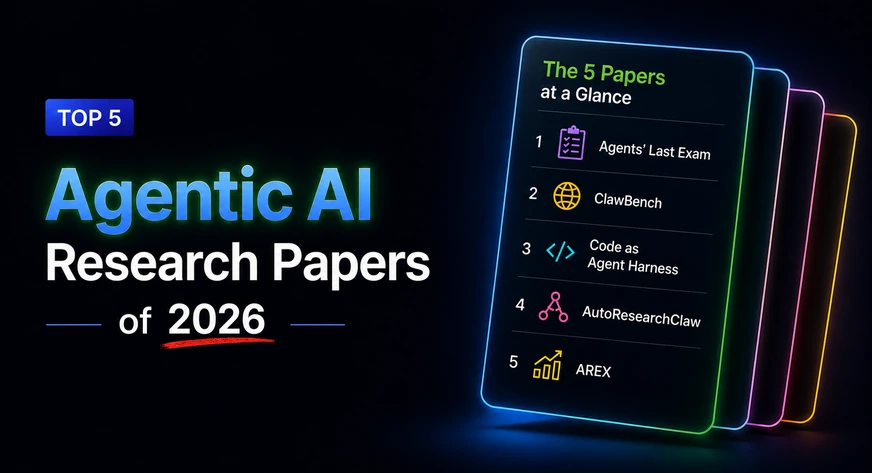
To understand the current state of the art, five specific research papers published this year provide a comprehensive map of the challenges and solutions defining the field. These works range from new, high-stakes evaluation frameworks to the architectural blueprints of self-improving research systems.
1. Agents’ Last Exam: Redefining Professional Competence
The first major milestone of 2026 is the release of "Agents’ Last Exam" (ALE). For years, benchmarks like MMLU (Massive Multitask Language Understanding) served as the gold standard for AI intelligence. However, as models began to "ceiling out" on these tests, a gap emerged between high test scores and actual workplace utility. ALE was designed specifically to bridge this gap.
Developed through a massive collaborative effort involving over 250 industry experts across 13 sectors—including aerospace engineering, corporate law, clinical pathology, and supply chain management—ALE consists of 1,000+ tasks that mirror actual professional workflows. Unlike previous benchmarks that focused on single-turn Q&A, ALE requires agents to execute "long-horizon" tasks that may take hours or even days to complete.
The Methodology of Economic Value
The core philosophy of ALE is "economic deliverability." The benchmark does not ask if a model can explain a legal concept; it asks if an agent can conduct a discovery process, organize 500 documents, flag inconsistencies, and produce a draft that meets the specific jurisdictional requirements of a high-court filing.
The research findings within the ALE paper were sobering for many developers. While the top-tier models of 2026 show remarkable proficiency in short-term logic, their success rate drops precipitously as the number of required steps increases beyond twenty. This "probability of failure" compounding is the primary hurdle ALE identifies for the next generation of enterprise agents.

2. ClawBench: Navigating the Chaos of the Live Web
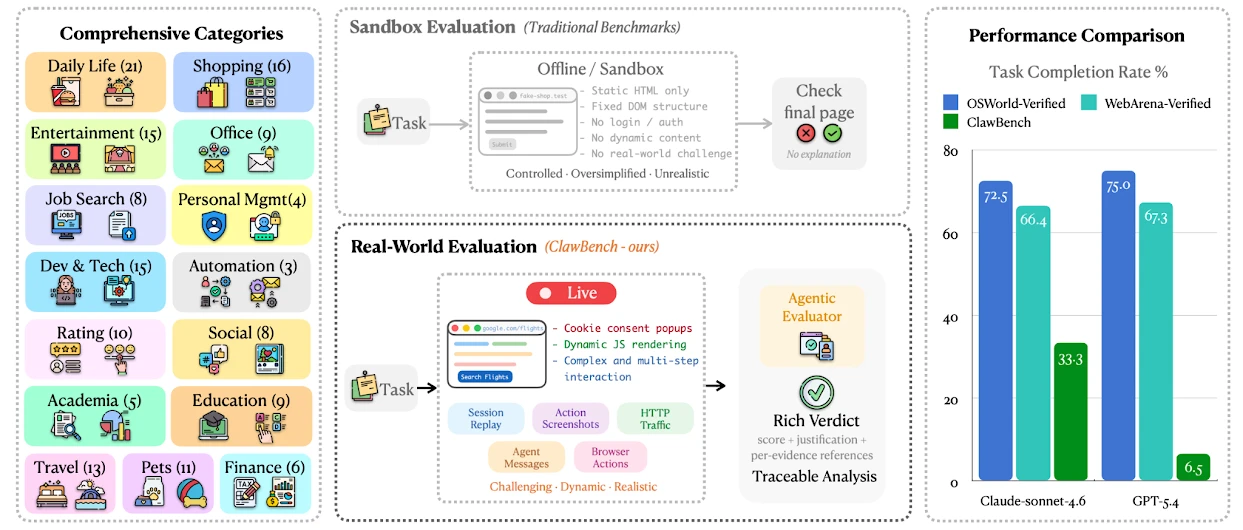
If ALE tests the "brain" of the agent, ClawBench tests its "eyes and hands." Published in mid-2026, ClawBench addresses the "Museum Replica" problem—the tendency for AI agents to be trained and tested on static, local versions of websites that do not reflect the reality of the internet.
The live web is a hostile environment for an AI. It is filled with dynamic pop-ups, changing Document Object Models (DOMs), authentication hurdles, and "bot-mitigation" software. ClawBench evaluates 153 everyday tasks across 144 live platforms, ranging from booking complex multi-city travel itineraries to managing corporate payroll systems.
Addressing Environmental Volatility
The ClawBench researchers discovered that agents which performed perfectly in sandboxed environments failed nearly 60% of the time when faced with real-world friction. The paper identifies "DOM Drift"—the frequent updates to website code—as a primary cause of agent failure.
The significance of ClawBench lies in its insistence on "live" testing. It has forced developers to move away from rigid, pre-programmed scripts toward "visual-spatial reasoning," where agents must look at a screen and understand UI elements just as a human would, rather than relying on underlying code that may change without notice.
3. Code as Agent Harness: The New Infrastructure of Autonomy
As agents become more complex, the "prompt" is no longer a sufficient way to control them. "Code as Agent Harness" argues that the future of AI agency lies in using code as the fundamental substrate for reasoning and action. In this framework, the AI model is just one component of a larger "harness" written in a programming language like Python or Rust.
This paper outlines a three-layer architecture that is becoming the standard for 2026 agent design:
- The Reasoning Layer: Where the model plans its next steps.
- The Tool-Integration Layer: Where the model interacts with APIs, databases, and browsers.
- The Verification Layer: A hard-coded or model-driven "check" that ensures the output meets the user’s safety and quality requirements.
The Shift to Harness Engineering
The primary takeaway from this research is that "prompt engineering" is being replaced by "harness engineering." A capable model can still be a failure as an agent if the runtime environment around it is brittle. By using code to maintain state and memory, developers can create agents that "remember" where they are in a 100-step process even if the underlying model experiences a temporary hallucination.
4. AutoResearchClaw: Scientific Discovery Through Multi-Agent Debate
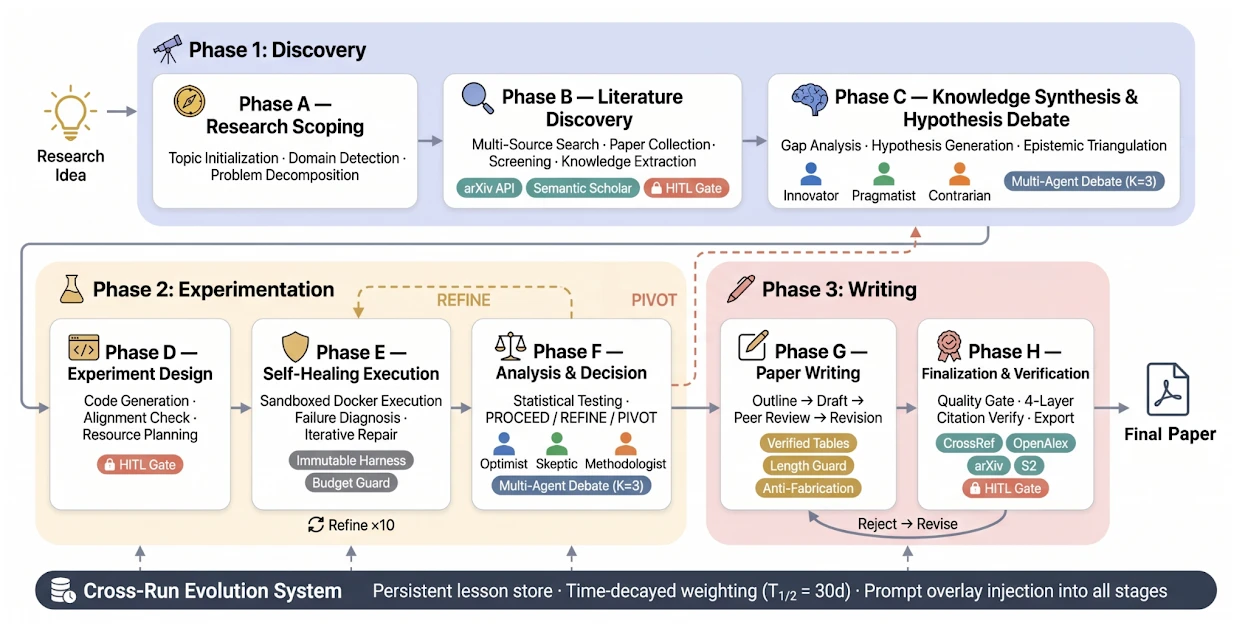
While most agents are designed for administrative or clerical tasks, AutoResearchClaw focuses on the highest level of human cognitive labor: scientific research. This system is not just a search engine; it is an autonomous research pipeline that can design experiments, analyze data, and write peer-review-quality papers.

What sets AutoResearchClaw apart is its use of "adversarial multi-agent debate." Instead of one agent performing the research, the system initiates a "debate" between several agent personas—a Lead Researcher, a Skeptic, and a Data Verifier.
Self-Healing and Human Collaboration
One of the most innovative features of AutoResearchClaw is its "self-healing" mechanism. If an agent attempts to run a simulation or a data analysis script and it fails, the system does not stop. It analyzes the error, repairs the code, and tries again. Furthermore, it incorporates "Human-in-the-Loop" checkpoints, allowing human scientists to provide guidance at critical junctures, which the agent then carries as "lessons" into future iterations. This has led to a significant reduction in the time required for literature reviews and initial hypothesis testing in fields like material science and pharmacology.
5. AREX: The Path to Recursive Self-Improvement
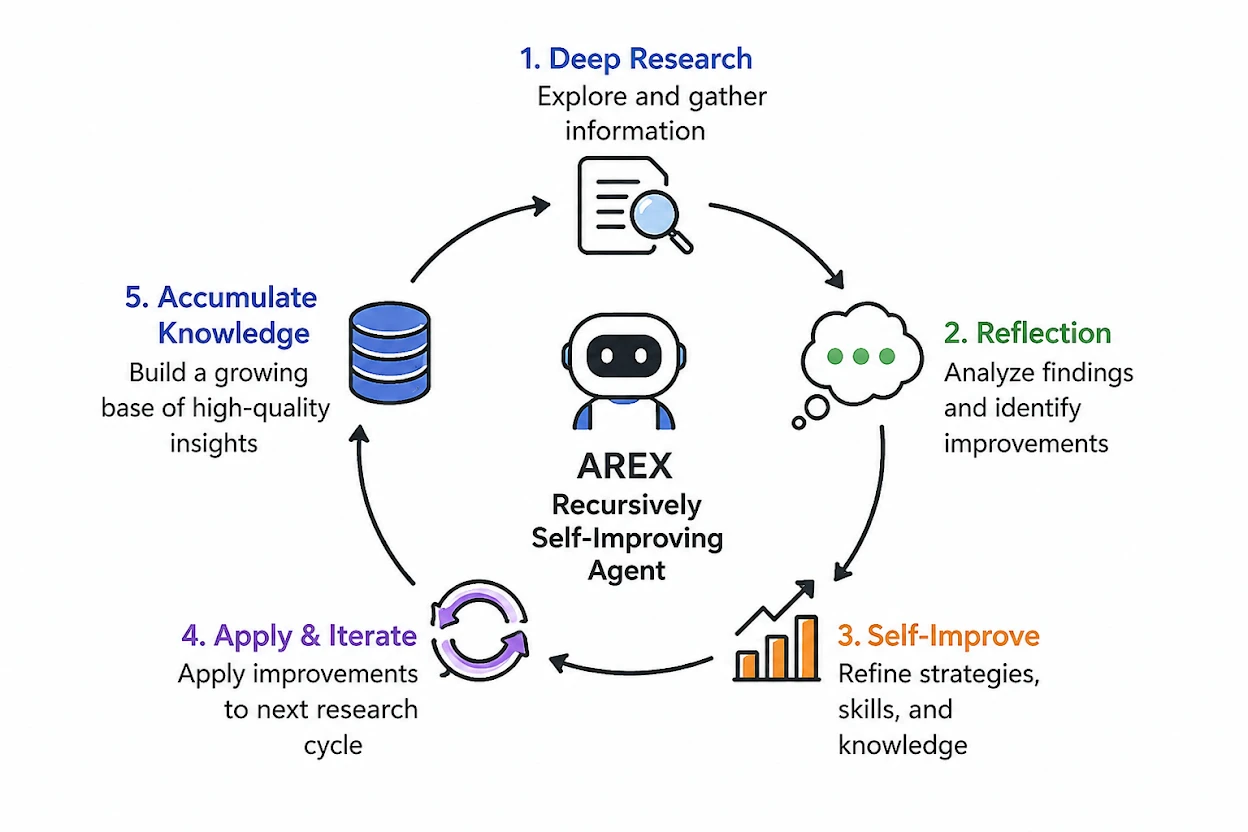
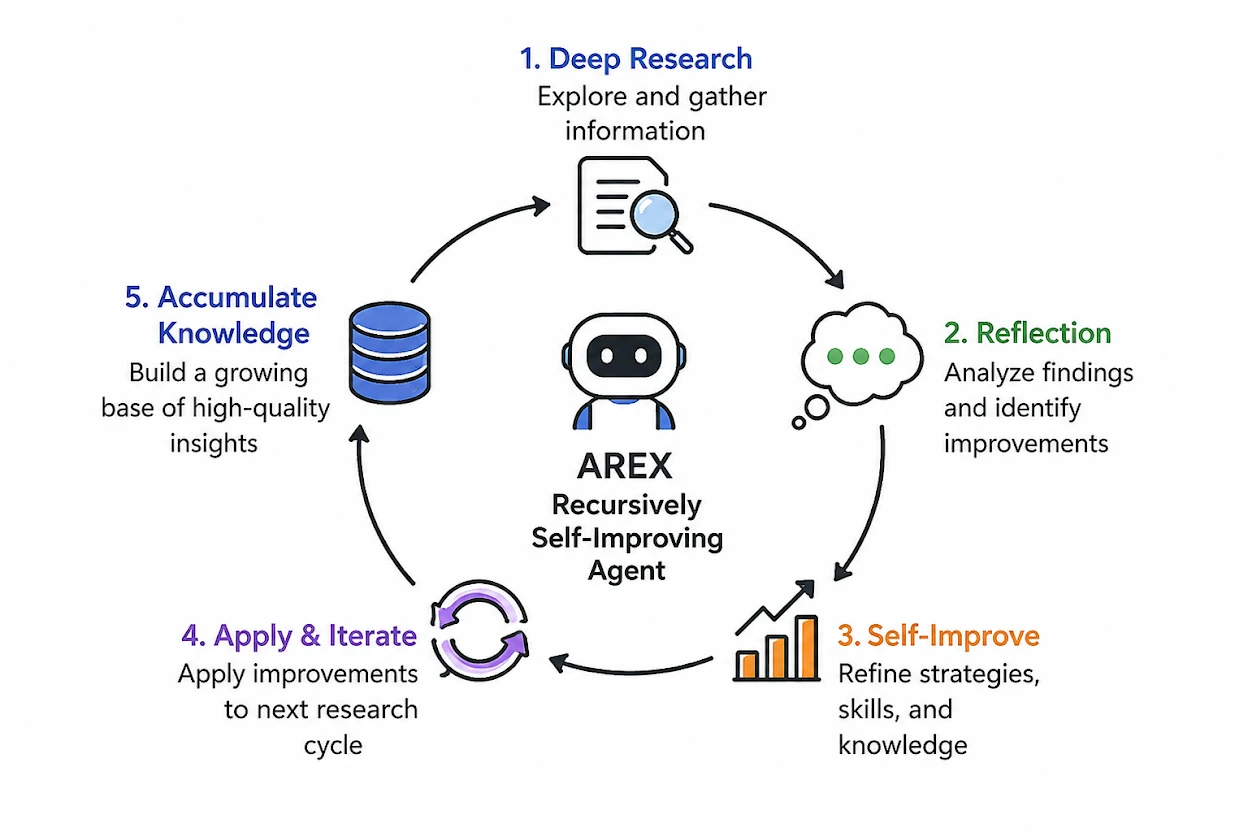
The final paper in this quintet, AREX (Agentic Research and Execution), addresses the efficiency problem of deep research. In 2025, if an agent spent ten hours researching a topic and found an error in the ninth hour, it often had to restart the entire process. AREX introduces a "recursive self-improvement" loop that separates the act of finding information from the act of verifying it.
Constraint-Wise Auditing
AREX uses a method called "Constraint-Wise Auditing." When a user asks a complex question, AREX breaks the query into dozens of specific constraints. As it gathers data, a secondary "Auditor Agent" checks each piece of evidence against those constraints. If a specific constraint remains unsupported, AREX triggers a "targeted follow-up," focusing its compute power only on the missing link rather than re-searching the entire topic.
This "narrowing of uncertainty" allows AREX to become more accurate the longer it runs. It represents the first viable model for "Deep Research" where the agent’s confidence level is mathematically tied to the density of its verification loops.
Chronology of Development: 2023–2026
To understand why these papers matter today, one must look at the timeline of the "Agentic Revolution":
- 2023: Focus was on "Chatbots." The goal was human-like conversation and passing the Turing Test in a narrow sense.
- 2024: The rise of "Tool Use." Models were given access to calculators and basic search engines (RAG – Retrieval Augmented Generation).
- 2025: The "Agentic Prototype" phase. Early agents could perform simple tasks but lacked "persistence" and would often get stuck in loops.
- 2026: The "Professional Autonomy" phase. The research highlighted above shows a move toward systems that can manage their own failures and operate in the messy, uncurated real world.
Broader Impact and Implications for the Global Economy
The shift toward agentic AI as described in these papers has profound implications for the workforce and the tech industry. As "Agents’ Last Exam" suggests, the barrier to AI replacing or augmenting professional roles is no longer a lack of knowledge, but a lack of "reliability over time."
As these research findings are integrated into commercial products, we can expect:
- A Shift in Compute Demand: Compute will move away from "training" and more toward "inference-time reasoning." Systems like AREX prove that "thinking longer" (spending more compute at the moment of the request) is often more valuable than having a larger pre-trained model.
- The Rise of Verification Services: As agents become more autonomous, a new industry of "Agent Auditing" is emerging to ensure these systems don’t "go rogue" or make catastrophic errors in high-stakes environments like finance or medicine.
- New Programming Paradigms: "Code as Agent Harness" suggests that the next generation of software engineers will spend more time building environments for AI to live in than writing the logic themselves.
The research of 2026 confirms that the age of the "smart chatbot" is over. We have entered the age of the "digital colleague"—a system that doesn’t just talk about work, but actually finishes the job. The five papers analyzed here provide the blueprint for this transition, moving AI from a novelty tool to an essential infrastructure of modern life.