The digital marketing industry is currently facing a significant methodological crisis as practitioners struggle to reconcile high-speed business demands with the rigorous requirements of scientific experimentation. While A/B testing—technically defined as a randomized controlled trial—serves as the backbone of modern conversion rate optimization (CRO), a growing body of evidence suggests that the statistical frameworks used by the majority of marketers are nearly half a century behind those employed in fields such as clinical medicine, genetics, and physics. This gap in sophistication has led to a proliferation of "illusory findings," where companies base multi-million dollar product decisions on data that lacks the necessary statistical integrity to guarantee success.
At the heart of this issue is a fundamental misunderstanding of classical frequentist statistics. Most A/B testing literature and software tools rely on the Student’s T-test or similar significance tests, which were designed for agricultural and industrial experiments where data is collected and analyzed at a single, predetermined point in time. However, the reality of digital marketing involves real-time dashboards and constant pressure to deliver results, leading to a phenomenon known as "data peeking." Industry experts warn that without a transition to more flexible frameworks, such as the AGILE statistical approach, the field of CRO risks losing its credibility as a data-driven discipline.
The Three Pillars of Statistical Failure in Modern Testing
The misalignment between theory and practice manifests in three primary areas: the misuse of significance tests, the neglect of statistical power, and the inherent inefficiency of fixed-sample designs.
1. The Perils of Data Peeking and Significance Inflation
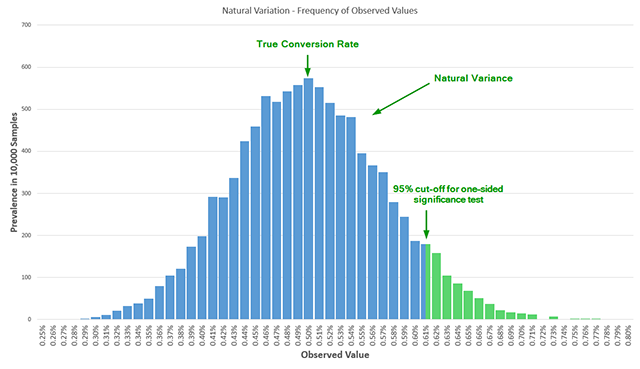
In a standard A/B test, statistical significance is used to estimate the probability that an observed difference in conversion rates is due to random chance rather than a genuine improvement. A common threshold is 95% confidence, implying a 5% false-positive rate. However, this threshold is only valid if the analysis is conducted exactly once, after a pre-calculated sample size has been reached.
In practice, stakeholders often monitor results daily. When a variant shows an early lead, there is immense pressure to stop the test and "call a winner" to capture revenue faster. Conversely, if a test looks like it is losing money, it is often terminated prematurely to mitigate risk. This "data-driven optional stopping" invalidates the mathematics of the test. Statistical simulations show that peeking at the data just five times during an experiment increases the actual error rate from the nominal 5% to over 16%. Peeking ten times can inflate the error rate to 25%, meaning one in every four "winners" is actually a result of random noise. This phenomenon, often referred to as "Garbage In, Garbage Out" (GIGO), results in companies implementing changes that do not actually improve the bottom line, despite what the dashboard indicates.
2. The Invisible Threat of Underpowered Experiments
While much attention is paid to false positives (Type I errors), the industry largely ignores false negatives (Type II errors), which occur when a test fails to detect a real improvement. Statistical power is the probability that a test will detect an effect if one truly exists. A review of influential A/B testing literature published between 2008 and 2014 revealed that out of seven major books, only one addressed statistical power in a meaningful context.
Running a test with low power is akin to using a low-resolution microscope to look for bacteria; even if the bacteria are there, you simply cannot see them. Many free online calculators default to 50% power, which essentially makes the experiment no better than a coin toss. When a test is underpowered, a "null" result is often misinterpreted as proof that a change doesn’t work, when in reality, the sample size was simply too small to provide a definitive answer. This leads to "opportunity cost" where potentially lucrative innovations are discarded and buried.
3. Structural Inefficiencies in Classical Designs
Classical fixed-sample tests are inherently rigid. They require researchers to commit to a specific sample size regardless of how strong the data appears mid-way through the trial. In the context of A/B testing, this creates a dilemma: if a new landing page is performing 20% better than the control, the business is effectively losing money every day it continues to send 50% of its traffic to the inferior version just to satisfy a pre-set sample size. This inefficiency is a primary driver of the "peeking" behavior that ruins the statistical validity of the tests in the first place.
A Chronology of Experimental Methodology
The evolution of experimental design provides context for why digital marketing has remained stagnant while other fields have progressed.
- 1920s–1930s: Ronald Fisher and the duo of Jerzy Neyman and Egon Pearson develop the foundations of frequentist statistics and hypothesis testing. These methods were designed for agriculture, where "results" (crop yields) could only be measured at the end of a growing season.
- 1960s–1970s: Medical researchers realize that fixed-sample tests are unethical in clinical trials. If a new drug is clearly saving lives, it is unethical to continue giving a placebo to the control group. This leads to the development of "Sequential Analysis" and "Group Sequential Designs."
- 2000s: The dawn of the digital A/B testing era. Early tools adopt the 1920s-era Fisher/Neyman-Pearson models because they are computationally simple and easy to explain to non-statisticians.
- 2010s: The "Replication Crisis" hits social sciences and medicine, raising awareness about p-hacking and the dangers of multiple comparisons.
- 2017–Present: Introduction of more robust frameworks like the AGILE method and Bayesian alternatives by major platforms like Optimizely and VWO, signaling a slow shift toward more modern practices.
Supporting Data: The Impact of Methodology on ROI
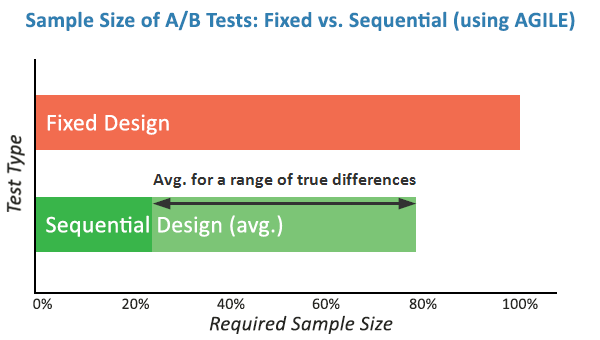
The financial implications of methodological choices are stark. According to simulations conducted by proponents of the AGILE method, switching from a fixed-sample approach to a sequential approach with interim monitoring can yield efficiency gains of 20% to 80%.
For example, consider a company with a baseline conversion rate of 2% aiming to detect a 10% relative lift with 90% power. A classical test requires 88,000 users per variant. If the true lift is actually 15%, an AGILE test could potentially reach a definitive conclusion with only 40,000 users. This allows the company to implement the winning variant 55% faster, significantly accelerating the "time-to-revenue."
Conversely, the data on "futility stopping" shows that AGILE methods allow practitioners to abandon losing tests early with a statistical guarantee. In a fixed-sample test, a practitioner must wait for the full 88,000 users even if the variant is clearly performing 20% worse than the control. Under AGILE, the test can be stopped for "futility," saving thousands of potential conversions that would otherwise have been lost to an inferior variant.
The AGILE Solution: A New Framework for CRO
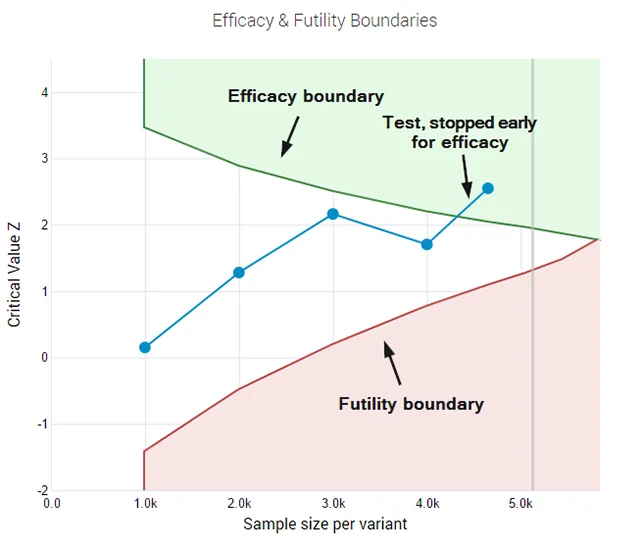
The AGILE statistical approach, inspired by clinical trial methodologies, offers a solution to the "peeking" dilemma. It utilizes "error-spending functions" to distribute the allowable false-positive rate across multiple checkpoints throughout the experiment.
Instead of a single "all or nothing" analysis at the end, AGILE allows for several interim analyses. At each checkpoint, the test can result in one of three outcomes:
- Stop for Efficacy: The variant is a clear winner; implement it immediately.
- Stop for Futility: The variant is unlikely to ever reach significance; abandon it and move to the next idea.
- Continue Testing: The data is currently inconclusive; continue collecting samples until the next checkpoint.
By formalizing the process of "peeking," AGILE maintains the integrity of the 95% confidence threshold while providing the flexibility that business environments demand.
Industry Reactions and Expert Analysis
The shift toward AGILE and sequential testing has met with mixed reactions from the marketing community. While data scientists at tech giants like Microsoft, Netflix, and Amazon have long used similar "Sequential Probability Ratio Tests" (SPRT), smaller agencies and in-house teams have been slower to adapt.
"Many practitioners are afraid that more complex statistics will make their jobs harder to explain to executives," says one senior CRO strategist. "There is a comfort in the simplicity of a single p-value, even if that p-value is technically a lie because of how the data was monitored."
However, analysts suggest that the "Winner’s Curse"—the phenomenon where implemented winners fail to produce the expected revenue gains in the long term—is finally forcing a reckoning. As ad costs rise and margins thin, companies can no longer afford the luxury of sloppy experimentation.
Broader Impact and Implications
The adoption of more rigorous statistical standards in A/B testing represents a maturation of the digital marketing industry. It moves the discipline away from "growth hacking" and toward "growth engineering."
The implications extend beyond just conversion rates. As machine learning and AI-driven personalization become more prevalent, the need for clean, statistically sound training data becomes paramount. If the "winners" fed into an AI model are actually false positives, the model’s predictive power will be compromised.
Furthermore, the AGILE method encourages a culture of "failing fast." By providing a mathematical framework for stopping unsuccessful tests, it empowers teams to take more risks. If the cost of a failed experiment is reduced by 50% through early stopping, a team can afford to run twice as many experiments, ultimately increasing the velocity of innovation.
In conclusion, the transition from 1920s-era classical statistics to modern, AGILE methodologies is not merely a technical upgrade; it is a necessary evolution for any organization that claims to be data-driven. By aligning statistical methods with the reality of the digital landscape, practitioners can finally deliver on the promise of A/B testing: a truly scientific way to drive business growth.