The landscape of digital marketing and conversion rate optimization (CRO) has undergone a fundamental transformation over the last 24 months. Artificial intelligence, once a speculative future technology, has become a ubiquitous component of the daily workflow for marketing teams globally. Today, AI is routinely deployed to draft advertising copy, synthesize market research, brainstorm creative concepts, and automate repetitive manual tasks. For experimentation and growth teams, this technological shift has been particularly pronounced, yet it has also introduced a set of systemic inefficiencies that are only now being addressed by industry leaders.
As experimentation programs scale, the pressure to deliver rapid insights has led many teams to adopt a "copy-paste" workflow. After a multivariate or A/B test concludes, practitioners often export raw data, capture screenshots of variations, and manually input performance notes into general-purpose Large Language Models (LLMs) such as ChatGPT or Claude. The objective is clear: use AI to make sense of complex data sets and generate the next iteration of test hypotheses. However, industry experts and platform developers are beginning to highlight a critical flaw in this approach. General-purpose AI tools, while powerful, operate in a vacuum. They lack visibility into the specific nuances of a test setup, including traffic allocation, audience segmentation, and the historical context of previous campaigns. This disconnect is driving a new mandate in the SaaS space: for AI to be truly effective in experimentation, it must be natively integrated into the testing platform itself.
The Limitations of General-Purpose AI in Specialized Experimentation
The initial appeal of using external AI tools for experiment analysis lies in their perceived speed. On the surface, the process appears efficient: a user provides a summary of a test, and the AI returns a polished interpretation. However, the journalistic reality of this workflow reveals significant "cracks" in the foundation of the data. To get a high-quality answer from a generic AI, a practitioner must first manually compile an exhaustive list of variables, including campaign objectives, secondary metrics, statistical significance thresholds, and specific business constraints.
The risk of omission is high. If a key detail—such as a specific technical glitch in a mobile variation or a nuance in the audience filter—is left out, the AI will still provide a confident response. This phenomenon, often referred to as "hallucination with confidence," can lead teams to pursue flawed hypotheses based on incomplete context. Furthermore, even when an external AI provides a valid insight, a "workflow wall" inevitably appears. The user must manually transition back to their testing platform to configure the next experiment, define the audience, and set up the metrics. This fragmentation between the data source, the analytical engine, and the execution tool creates a drag on organizational velocity, ultimately limiting the scale of experimentation programs.
A Strategic Consolidation: The Formation of Wingify
In a move that signals a major shift in the experimentation market, two of the industry’s most prominent players, AB Tasty and VWO, have announced they are joining forces under a single unified brand: Wingify. This merger represents a consolidation of decades of expertise in the CRO and customer experience (CX) sectors. AB Tasty, historically known for its strong presence in the European market and its robust enterprise-level feature set, and VWO, recognized globally for its ease of use and comprehensive optimization suite, are now positioning themselves as a singular powerhouse.
This merger is not merely a corporate restructuring but a strategic alignment intended to solve the "context gap" in experimentation AI. Prior to this consolidation, both companies had made significant strides in independent AI development. AB Tasty had introduced "Evi," an AI assistant designed to streamline testing workflows, while VWO had launched "Copilot," an optimization tool aimed at enhancing hypothesis generation. The formation of Wingify allows for the synthesis of these technologies into a singular, more potent intelligence layer known as Wandz.
Introducing Wandz: The Intelligence Layer of the Modern Experimentation Stack
Wandz is the culmination of Wingify’s vision to weave artificial intelligence into the entire lifecycle of an experiment. Unlike the third-party AI bots that require manual data entry, Wandz is designed as a native intelligence layer that exists within the experimentation environment. It has direct access to the platform’s "data lake," meaning it understands the exact parameters of every test without human intervention.
The integration of Wandz marks a shift from "advisory AI" to "actionable AI." It is present at every stage, from the initial campaign setup and audience targeting to the final results analysis and the generation of the next logical hypothesis. By living inside the platform, Wandz can draw on real-time traffic splits, primary and secondary metrics, and variation descriptions to provide insights that are grounded in the specific reality of the user’s digital property.
Bridging the Gap Between Data and Actionable Insight
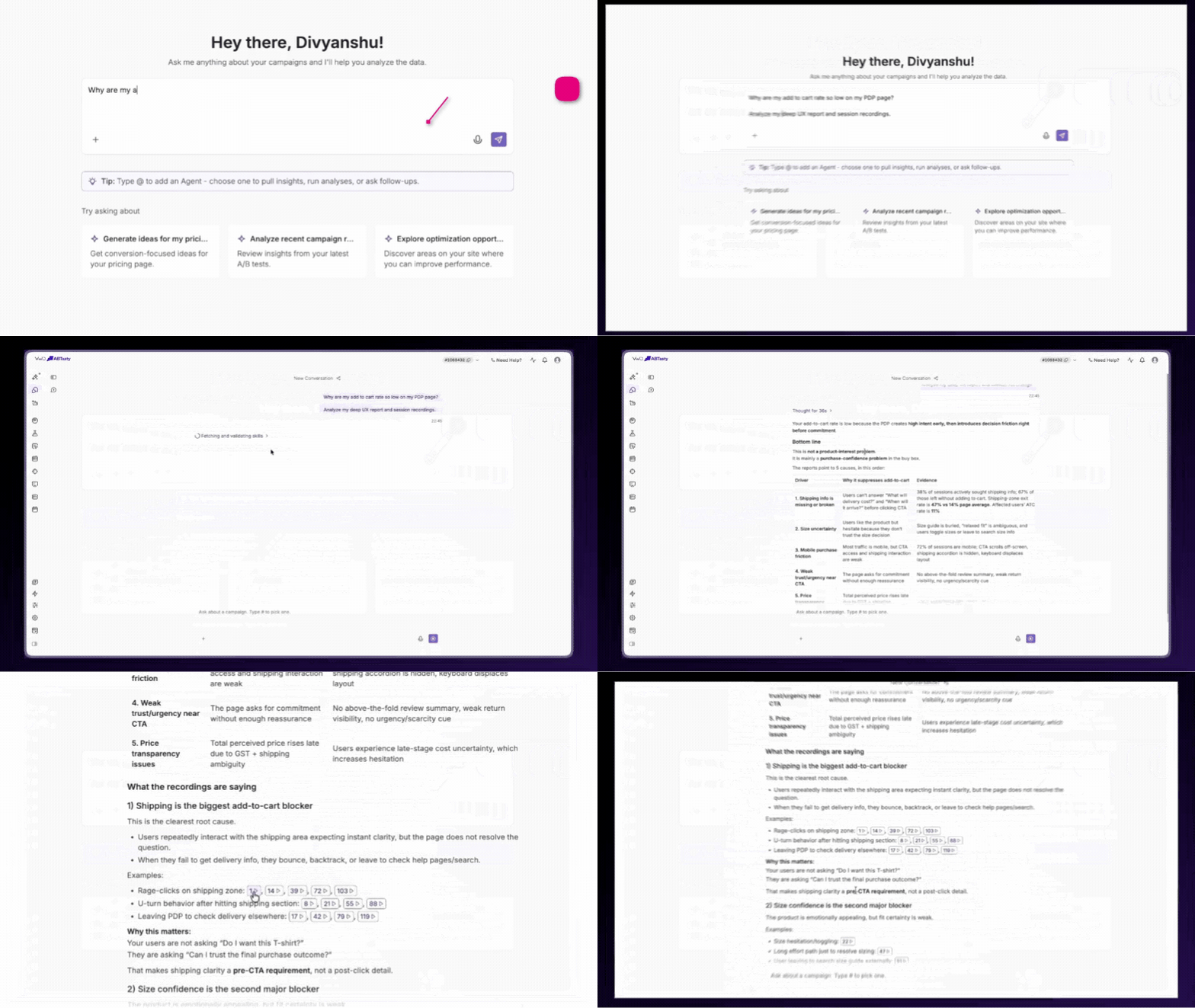
One of the primary advantages of an integrated AI like Wandz is the ability to interact with data using natural language. Instead of navigating complex reporting dashboards to find a specific data point, teams can ask direct questions within the platform interface. Inquiries such as "Why did the checkout page variation perform better for mobile users in North America?" or "What was the correlation between the hero image change and the secondary add-to-cart metric?" can be answered instantaneously.
Because Wandz is connected to the full context of the experimentation environment, it can surface details that external tools simply cannot see. It knows the "why" behind the "what." It understands the hypothesis that was being tested and can compare current results against historical benchmarks within the same account. This level of context ensures that the AI’s responses are not just fast, but accurate and relevant to the specific business goals of the organization.
AI as a Quality Assurance and Configuration Sentinel
Beyond analysis, the integration of AI into the testing platform provides a critical layer of Quality Assurance (QA). One of the most common reasons for failed experiments is improper configuration—incorrect audience targeting, mismatched traffic allocation, or poorly defined success metrics. Wandz acts as an automated reviewer, scanning campaign settings before they go live.
If a configuration is likely to lead to statistically insignificant results or if the audience segment is too narrow to reach a conclusion within the desired timeframe, the AI can flag these issues for the user. This proactive intervention reduces the "waste" associated with flawed tests. Furthermore, Wandz powers an AI Editor that allows users to make adjustments to their digital properties using natural language instructions. While the AI facilitates the execution, the human practitioner remains in full control, reviewing and approving every change to ensure brand consistency and technical integrity.
The Shift Toward Verticalized AI in Digital Marketing
The emergence of Wandz and the Wingify merger reflect a broader trend in the technology sector: the rise of "Vertical AI." While horizontal AI tools like ChatGPT provide general utility across all industries, vertical AI is purpose-built for a specific domain—in this case, experimentation and conversion optimization.
Industry analysts suggest that the next phase of AI adoption will be defined by how well these tools integrate with proprietary data. In the context of CRO, the value of AI is directly proportional to its proximity to the data source. By embedding AI where the data lives, Wingify is addressing the primary concern of enterprise organizations: the need for data security and contextual accuracy. When data is exported to external AI tools, it often loses its "metadata"—the hidden layers of information that explain the conditions under which the data was collected. Native integration preserves this metadata, allowing for a higher degree of analytical sophistication.
Implications for Conversion Rate Optimization and Global Business
The implications of this integrated approach extend beyond the technicalities of A/B testing. For global enterprises, the ability to move from data to insight to action within a single platform translates to a significant competitive advantage. In a market where consumer preferences shift rapidly, the "velocity of experimentation" is often the deciding factor in market leadership.
By reducing the friction inherent in the analytical process, tools like Wandz allow teams to run more tests with higher confidence. This, in turn, leads to a better understanding of the customer journey and a more personalized user experience. The merger of AB Tasty and VWO into Wingify creates a unified entity capable of supporting this high-velocity experimentation on a global scale, providing the infrastructure necessary for brands to transition from "guesswork" to "evidence-based" decision-making.
Conclusion: The Future of Integrated Decision-Making
The popularity of general-purpose AI tools has proven that there is a massive appetite for intelligence-driven workflows. However, as the experimentation discipline matures, the limitations of fragmented, "copy-paste" processes are becoming untenable. The future of the industry lies in the seamless integration of intelligence and execution.
The launch of Wandz within the Wingify platform serves as a blueprint for this future. By bringing AI to the data, rather than sending data to the AI, organizations can unlock a level of insight that was previously inaccessible. This transition marks the end of the era of isolated AI and the beginning of a new chapter where intelligence is an inherent, inseparable part of the experimentation process. For marketing and growth teams, the message is clear: to achieve the best results, the brain of the operation must live where the heart of the data resides.

 Dwi Wanna
 Reynand Wu