The integration of artificial intelligence into enterprise data workflows has transitioned from a visionary roadmap item to a core operational priority for data teams in 2024 and 2025. As organizations deploy AI agents to automate complex data analysis—transforming multi-day manual reporting into two-minute natural language conversations—the industry has encountered a significant bottleneck: the reliability of the underlying data foundation. When AI agents are directed toward raw database tables or outdated metadata, they frequently produce "hallucinations"—answers that are linguistically confident but mathematically incorrect. To mitigate these risks, a new technical paradigm has emerged, centered on the deployment of governed semantic views within the Snowflake Data Cloud. This framework ensures that AI orchestrators, such as Snowflake’s Cortex Analyst, are grounded in certified business logic rather than inferred patterns.
The Crisis of Trust in Enterprise AI
The excitement surrounding generative AI in business intelligence is tempered by three primary failure patterns observed during the transition from pilot programs to production environments. First is the "Logic Mismatch," where an agent uses a mathematically valid but contextually incorrect join or filter, such as calculating revenue without accounting for regional tax variations. Second is "Metadata Decay," where the agent relies on column descriptions that have not been updated to reflect recent schema changes. Third is the "PII Leakage" risk, where an unconstrained agent inadvertently surfaces sensitive personal identifiable information because it lacked a governance layer to mask specific attributes.
Industry data suggests that these issues are not peripheral. According to research from Gartner, through 2026, over 75% of generative AI projects in the enterprise will fail to move past the proof-of-concept stage due to concerns over data quality and governance. The root cause of these failures is often the absence of a standardized, enforced process for creating, reviewing, and versioning semantic definitions. While many tools focus on the speed of authoring these views, speed and governance exist on different axes; an organization can generate definitions rapidly while possessing zero oversight into their accuracy.
The Evolution of the Semantic Layer
A semantic layer acts as a critical intermediary between the raw data warehouse and the end consumer, whether that consumer is a human analyst, a static dashboard, or an autonomous AI agent. Without this layer, a simple question—such as "What was the total number of active members in Q1?"—can yield five different answers from five different departments. Each team might apply different filters or define "active" based on disparate criteria, such as login frequency versus subscription status.
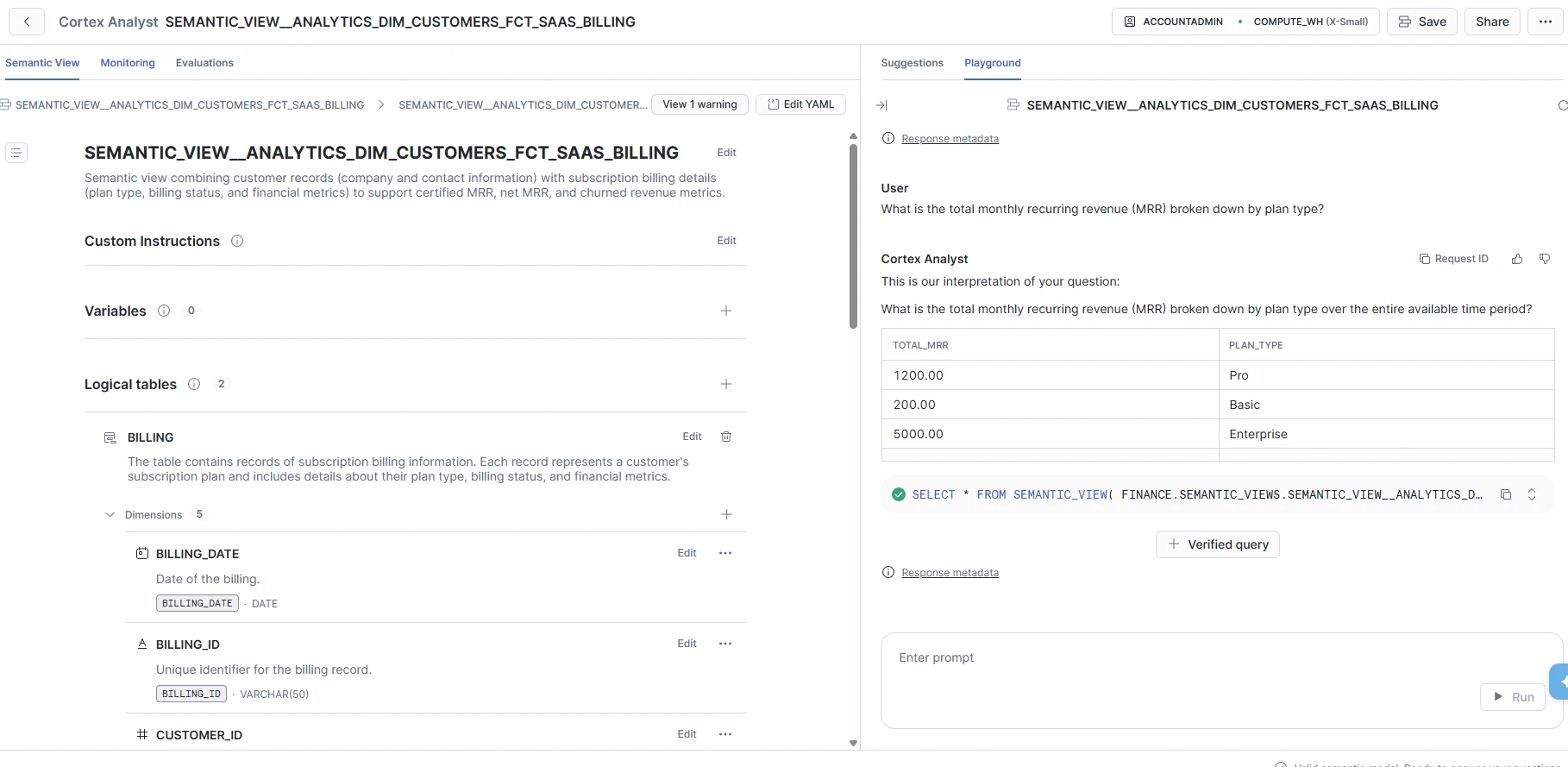
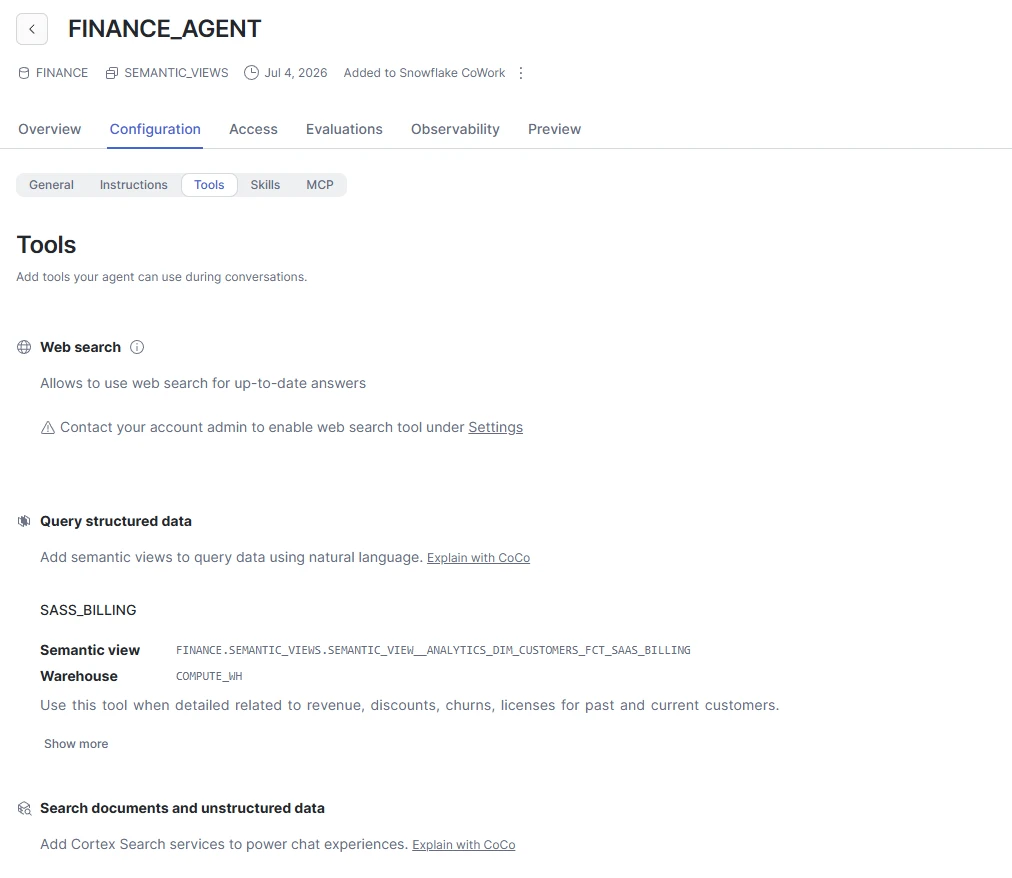
In the Snowflake ecosystem, the semantic layer is implemented as a "semantic view." This is a schema-level object stored directly in the database that models entities, their relationships, and business metrics. By defining a metric like "Net Revenue" once as a specific SQL expression—for example, SUM(gross_revenue * (1 - discount))—the organization ensures that every downstream application uses the exact same logic. This architecture underpins Snowflake CoWork (formerly Snowflake Intelligence) and Cortex Analyst, providing a "single source of truth" that bridges the gap between business terminology and technical database schemas.
A Five-Pillar Framework for Governed Semantic Generation
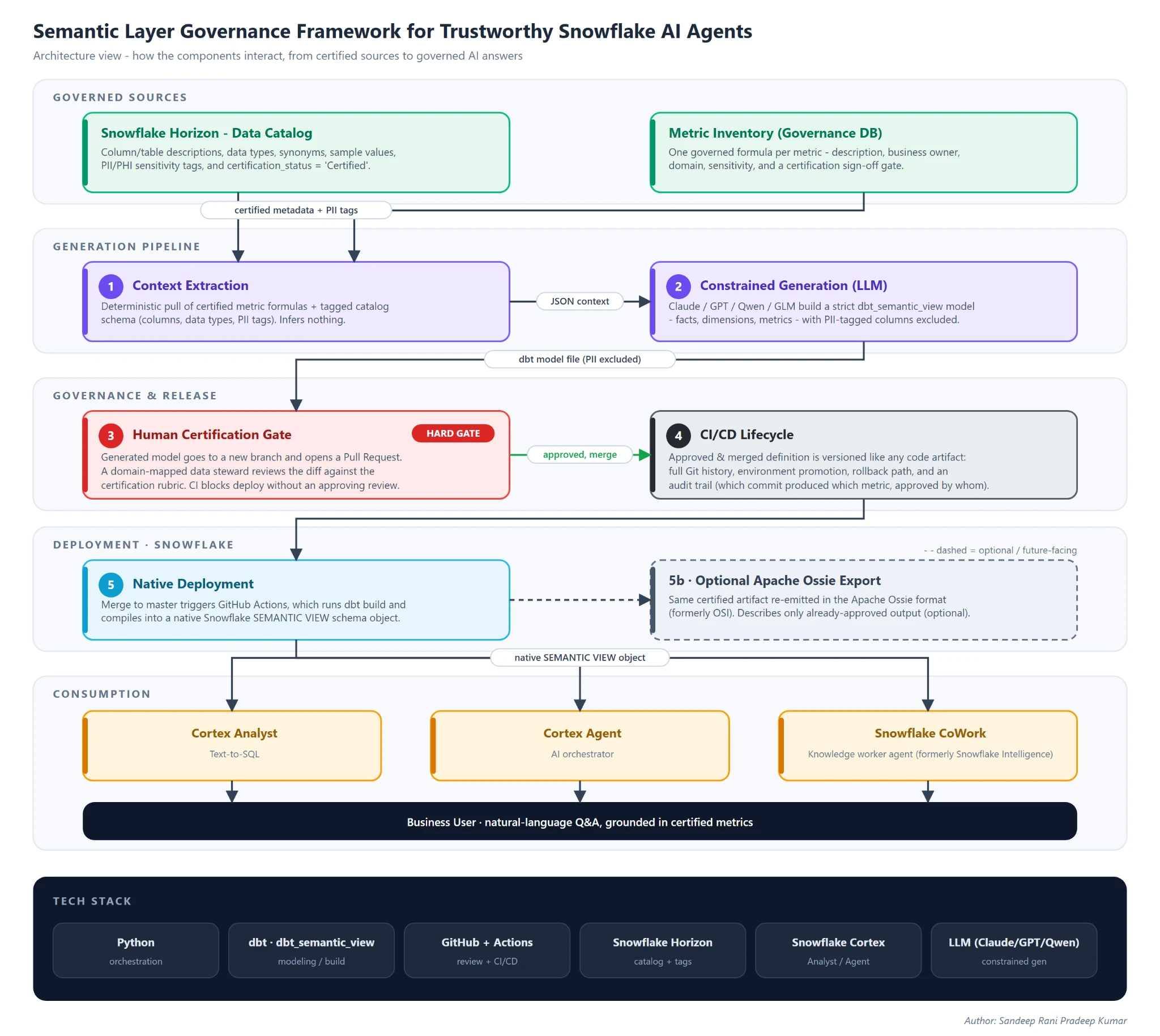
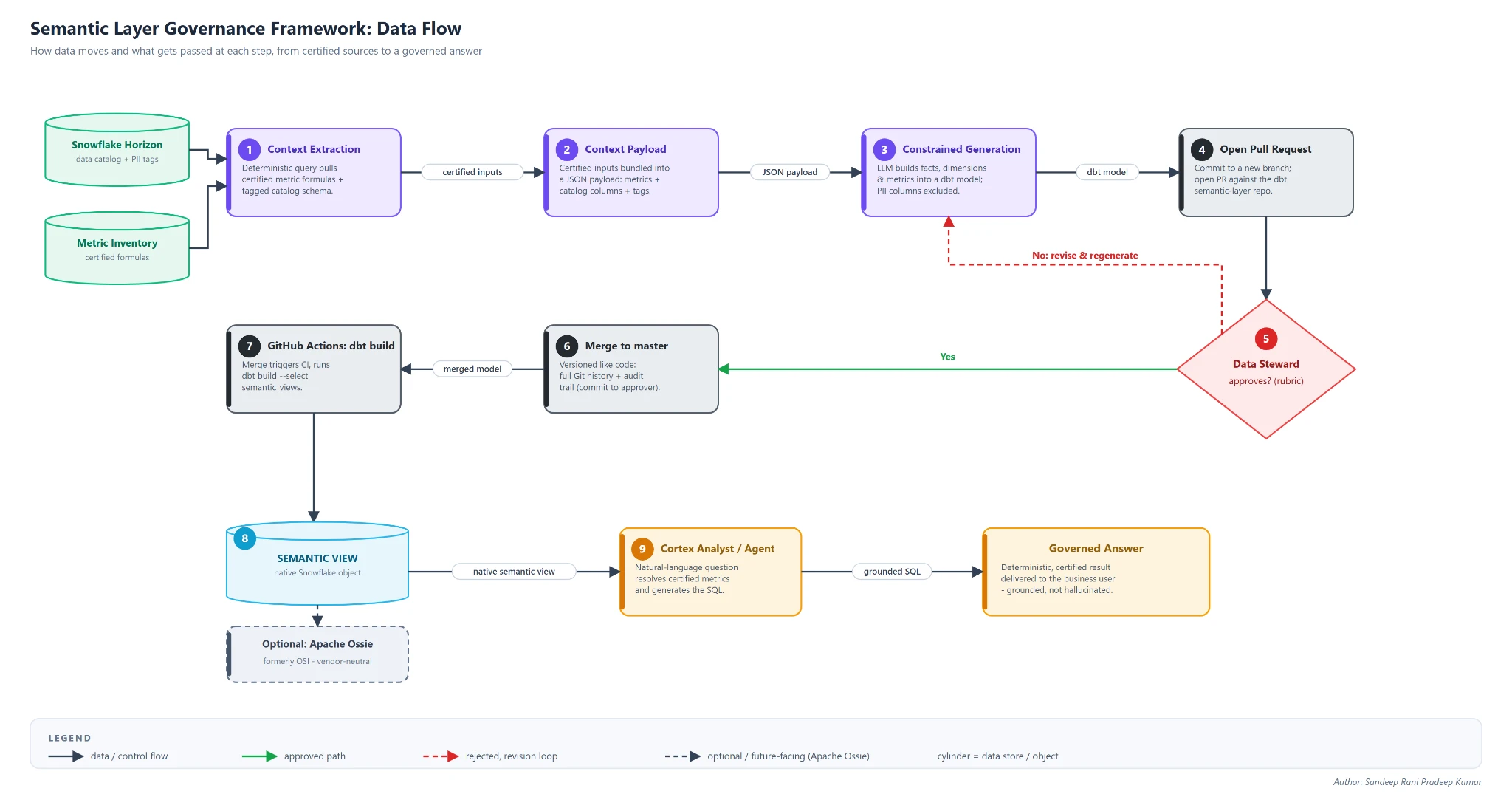
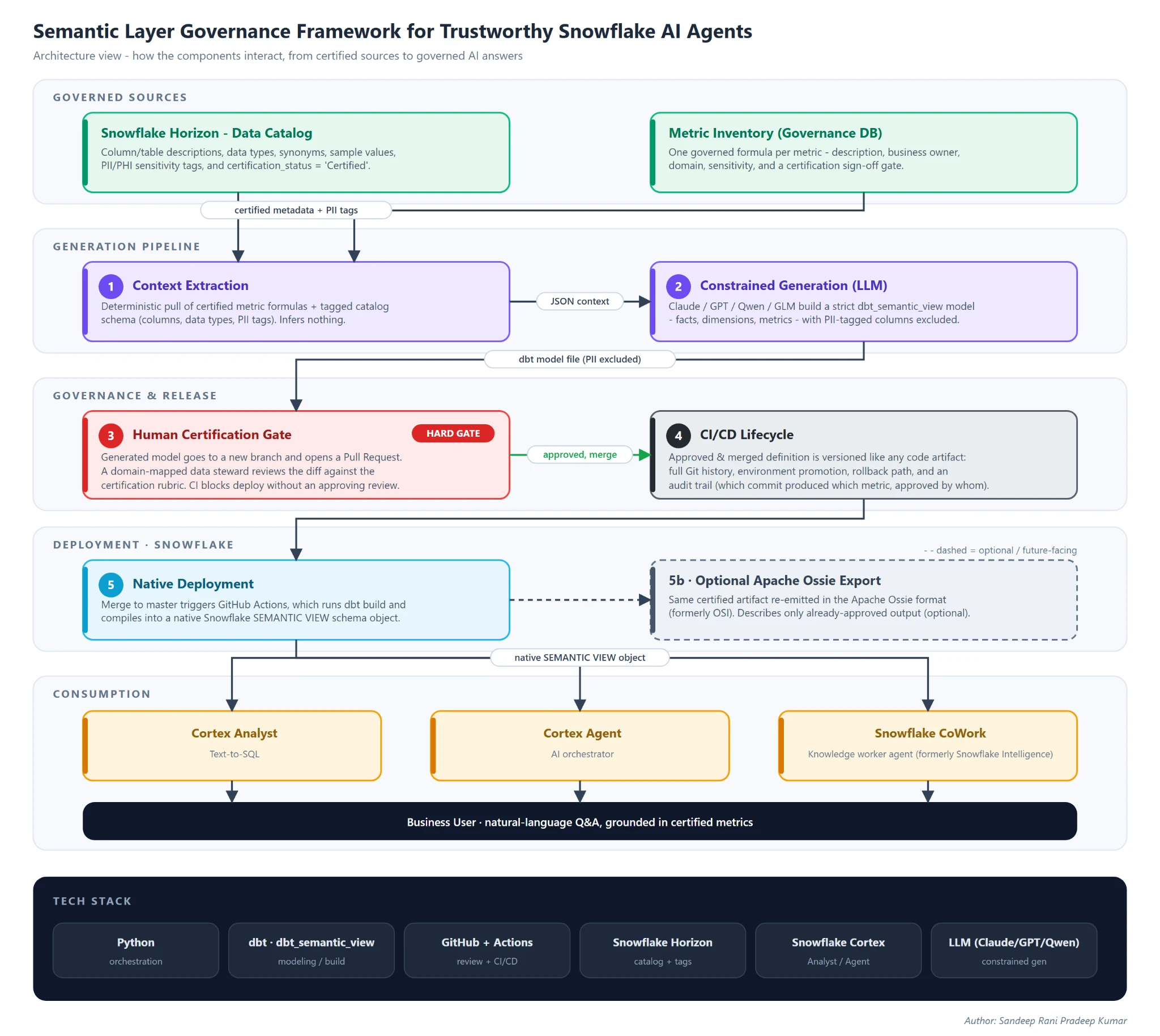
To move beyond ad-hoc modeling, organizations are adopting a governance harness that treats semantic view generation as a software release process rather than a one-off exercise. This framework consists of five distinct components designed to enforce rigor at every stage of the lifecycle.
1. Deterministic Context Extraction
The process begins with the extraction of metadata from Snowflake Horizon and a centralized metric inventory. Unlike usage-inference approaches that guess logic based on query history, this step is strictly deterministic. It retrieves only "Certified" metric formulas and tagged schemas. By pulling real-time tags from Snowflake Horizon, the system identifies which columns are designated as PII or restricted, ensuring that the AI agent’s "worldview" is pre-filtered for compliance before it even begins to process a user’s question.
2. Constrained LLM Generation
Once the context is extracted, a Large Language Model (LLM)—such as Claude, GPT-4, or Snowflake’s Arctic—is used to convert the metadata into a formatted dbt (data build tool) model. The critical control here is constraint. The system prompt restricts the LLM’s output to a strict schema and prevents it from inventing new logic. The LLM acts as a translator, mapping existing certified definitions into the required syntax for the dbt_semantic_view package. This automation typically achieves 95% accuracy while significantly reducing the manual labor required for complex SaaS billing datasets or multi-table joins.
3. The Human Certification Gate
Despite the efficiency of LLMs, production environments cannot tolerate even a 1% error rate in financial or operational metrics. Consequently, the generated definition is never automatically merged into the production branch. Instead, it is submitted as a pull request (PR) to a version-controlled repository. A designated data steward—the individual responsible for that specific data domain—must review the code diff against a certification rubric. This "hard gate" ensures that a human remains in the loop to verify that the logic aligns with executive-level definitions of business performance.
4. CI/CD Lifecycle and Versioning
By integrating the semantic layer into a standard Git-based CI/CD (Continuous Integration/Continuous Deployment) pipeline, organizations gain an audit trail that is impossible to maintain with manual SQL edits. Every change to a metric is recorded, showing exactly who approved the change and why. If an AI agent begins producing unexpected results after an update, the data team can perform a "rollback" to a previous, stable version of the semantic view, maintaining operational continuity.
5. Native Deployment and Open Standards
The final step is the compilation of the dbt model into a native Snowflake SEMANTIC VIEW object. This allows Snowflake’s internal tools to query the data with zero latency. Furthermore, forward-thinking organizations are beginning to export these artifacts in the Apache Ossie (formerly Open Semantic Interchange) format. Ossie is a vendor-neutral, Apache-incubator project that allows semantic definitions to be shared across different platforms, preventing "vendor lock-in" and ensuring that the same business logic can be used by agents running on other cloud providers or local environments.
Chronology of Technical Advancements in Snowflake AI
The path to this governed framework has been marked by several key milestones in the Snowflake ecosystem:
- June 2023: Snowflake announces the acquisition of Neeva, signaling a pivot toward generative AI and natural language search.
- May 2024: The launch of Snowflake Cortex brings managed LLMs directly into the Data Cloud, allowing for text-to-SQL capabilities.
- July 2024: Snowflake Horizon is enhanced to provide more robust data privacy and tagging features, essential for the extraction phase of the governance framework.
- Late 2024: The introduction of Cortex Analyst allows for the first native integration of semantic views, moving away from "black box" AI queries.
- July 2026 (Projected/In-Context): The renaming of the Open Semantic Interchange (OSI) to Apache Ossie marks the maturation of open standards for metric sharing.
Cross-Platform Integration and Current Limitations
While the internal Snowflake ecosystem is robust, the portability of these semantic views to third-party Business Intelligence (BI) tools remains a work in progress. Current integration statuses vary significantly across the industry:
- Tableau: Supports the export of semantic views as Tableau Data Sources (.tds), allowing for consistent metric reuse.
- Sigma: Currently in beta for consuming Snowflake semantic views, though limitations remain regarding complex joins and inherited semantics.
- Omni: Offers a native two-way integration, representing the most advanced third-party adoption to date.
- Power BI: Direct consumption of Snowflake semantic views is currently unsupported, though bridge technologies like AtScale’s XMLA bridge are in private preview to address this gap.
These limitations highlight the importance of the "Component 5b" strategy: maintaining a vendor-neutral export format like Apache Ossie to ensure that the work put into governing data for Snowflake AI agents can eventually benefit the entire enterprise software stack.
Impact and Implications for the Modern Data Team
The shift toward governed AI agents represents a fundamental change in the role of the analytics engineer. No longer are these professionals merely "plumbers" moving data from point A to point B; they are becoming "knowledge engineers" who define the linguistic and logical framework within which AI operates.
The broader implication is the democratization of data. When an AI agent is properly grounded in a governed semantic layer, the "barrier to entry" for data-driven decision-making drops precipitously. A regional manager can ask, "Why did our churned revenue spike in the Northeast last month?" and receive an answer that is not only immediate but carries the same certification as an official quarterly report.
Ultimately, agent quality is a governance problem, not just a technical one. A semantic view is only as trustworthy as the process that created it. By implementing a framework that combines automated generation with human oversight and version control, organizations can finally realize the promise of AI-driven analytics without sacrificing the accuracy that business leadership demands. As Snowflake continues to evolve its AI orchestrators, the semantic layer will remain the bedrock upon which the future of autonomous enterprise intelligence is built.