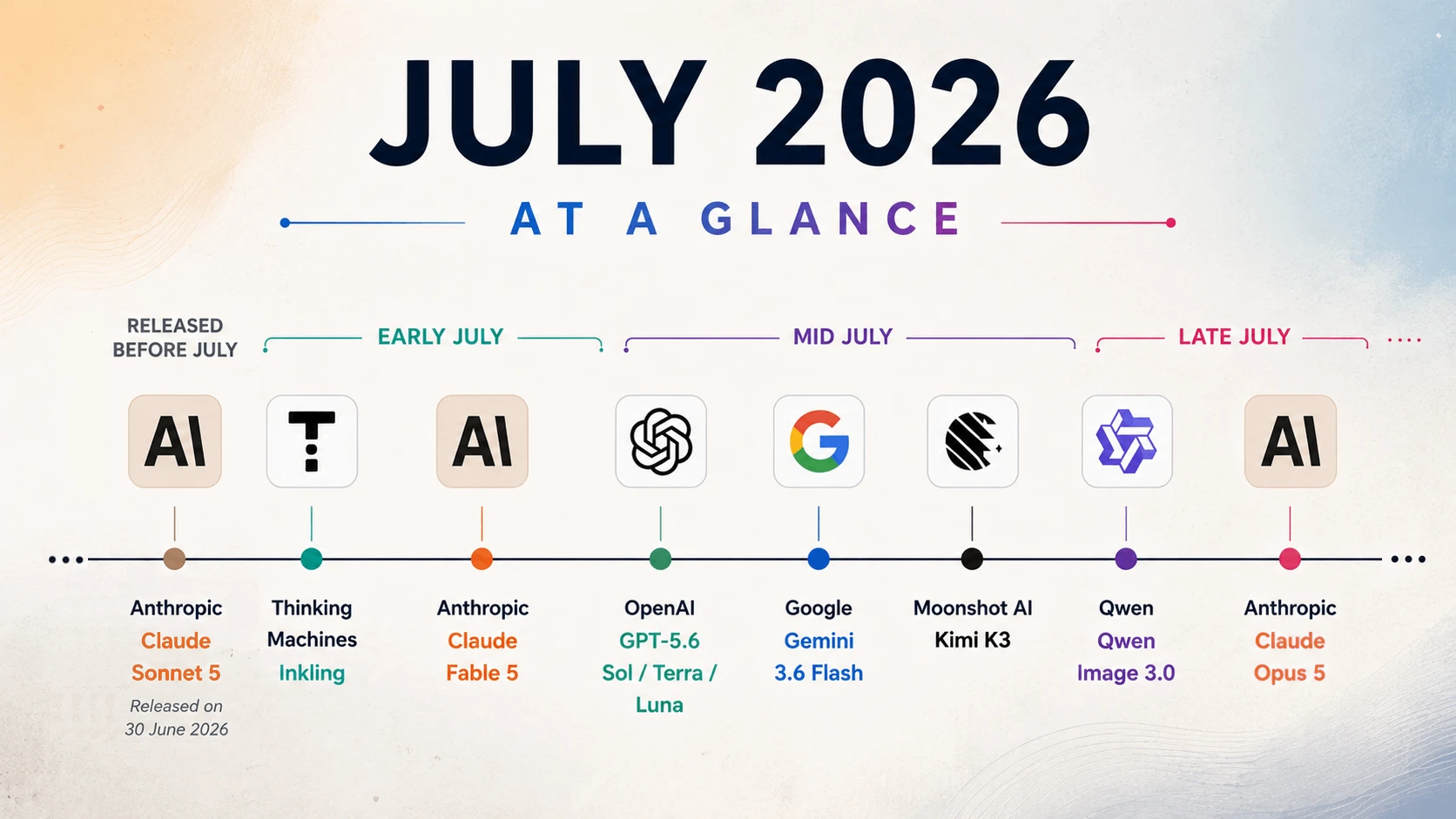
The landscape of artificial intelligence underwent a fundamental transformation in July 2026, recording the highest volume of frontier model releases in the history of the field. Over the course of thirty-one days, four established industry leaders shipped flagship-grade models, two heavily capitalized newcomers debuted their inaugural systems, and the largest open-weight model ever documented was made available for public download. This concentrated burst of activity suggests a definitive end to the era where labs competed solely for the title of "most capable" model. Instead, the industry has entered a secondary phase defined by price-to-performance ratios, specialized agentic workflows, and the democratization of frontier-level weights.
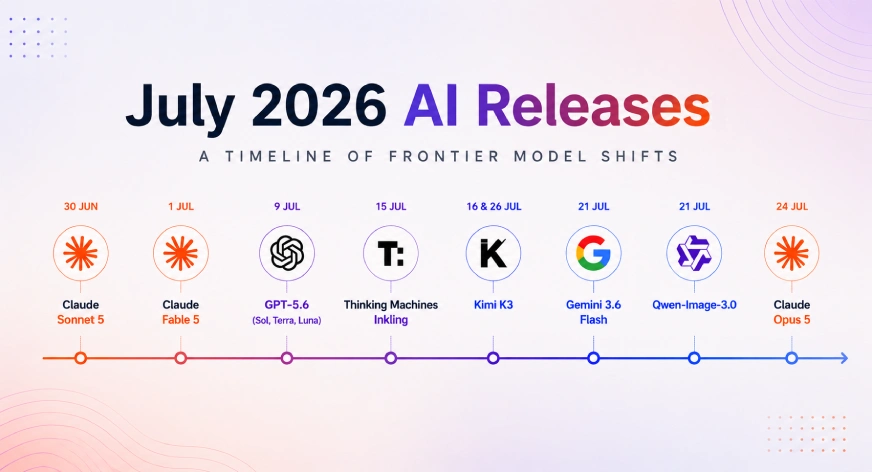
The month began with a clear signal from Anthropic on June 30, when the lab released Claude Sonnet 5. Positioned as a mid-tier offering, Sonnet 5 intentionally eschewed the pursuit of headline-grabbing reasoning scores in favor of "agentic" utility. Specifically designed for autonomous coding and complex tool-use, the model provided intelligence comparable to the previous generation’s flagship, Opus, but at a significantly lower price point. Industry analysts noted that the decision to lead with a utility-focused model set the tone for the rest of July: the most successful models of this cycle were not necessarily the most powerful, but the most deployable.
On July 1, the narrative took a regulatory turn with the restoration of Claude Fable 5. This event marked a milestone in AI governance, as Fable 5 became the first frontier model to be removed from general availability by government mandate and subsequently reinstated. The temporary suspension, reportedly linked to safety evaluations regarding its advanced reasoning capabilities, created a unique technical-regulatory history for the model. Upon its return, Fable 5 was marketed as the "reasoning specialist" of the Claude family, featuring a system prompt optimized for high-stakes decision-making and a "Strict Mode" for adherence to complex, multi-step instructions. This release highlighted the growing influence of the Commerce Department and other regulatory bodies on the release cycles of top-tier labs.
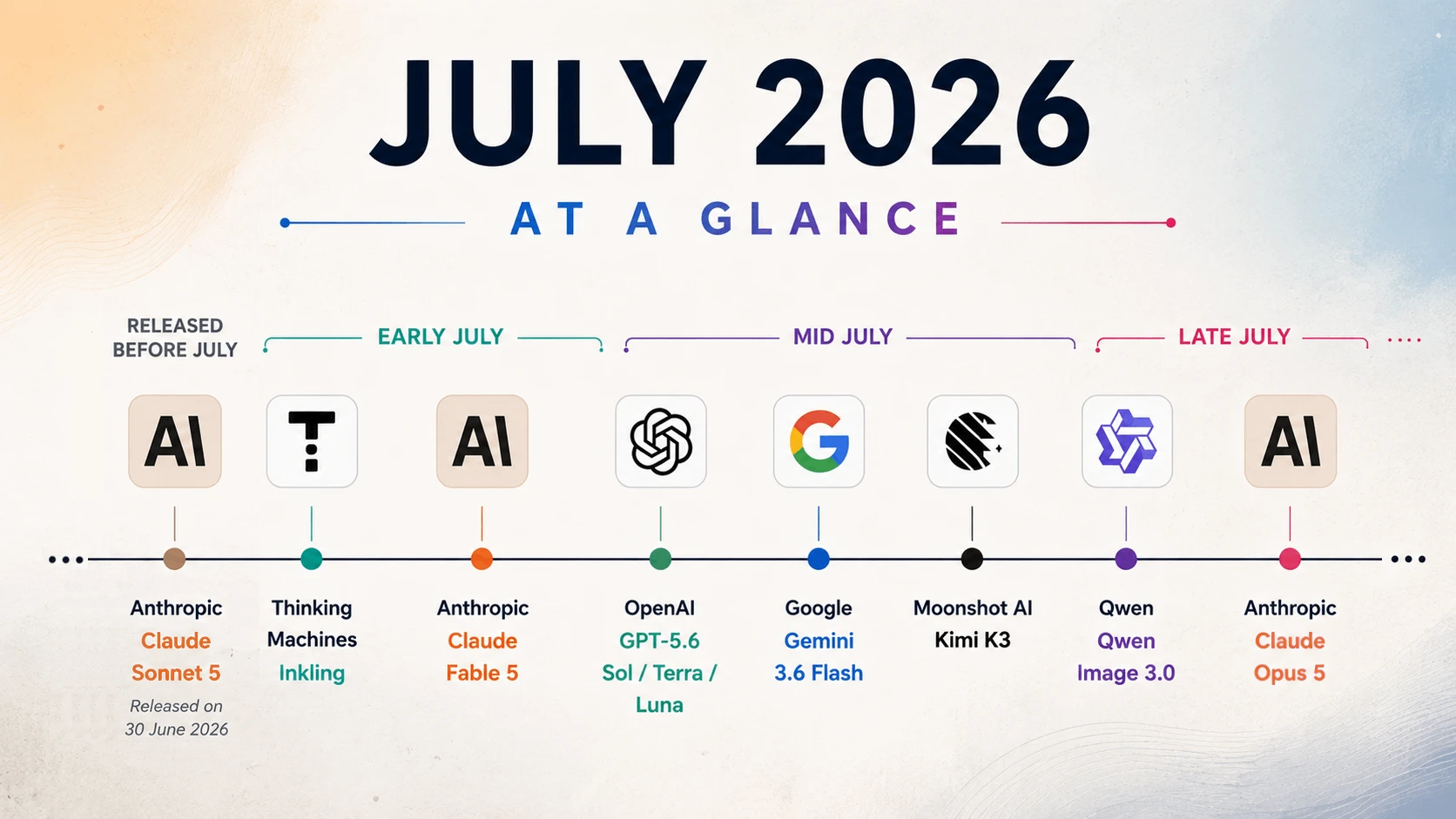
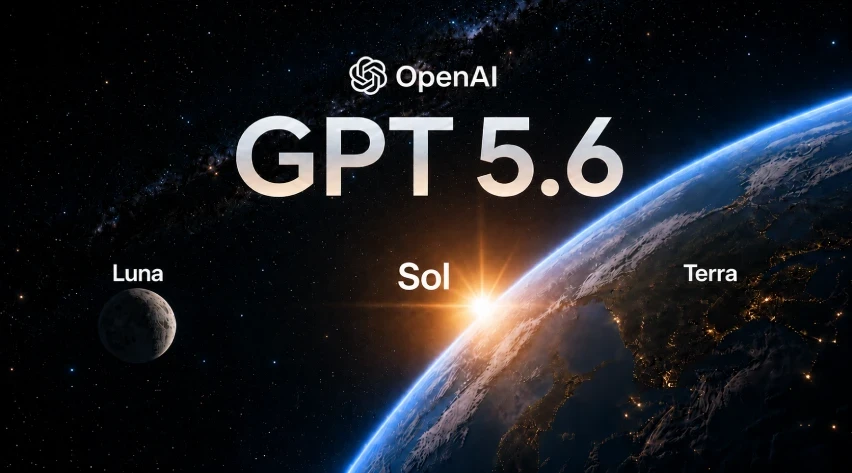
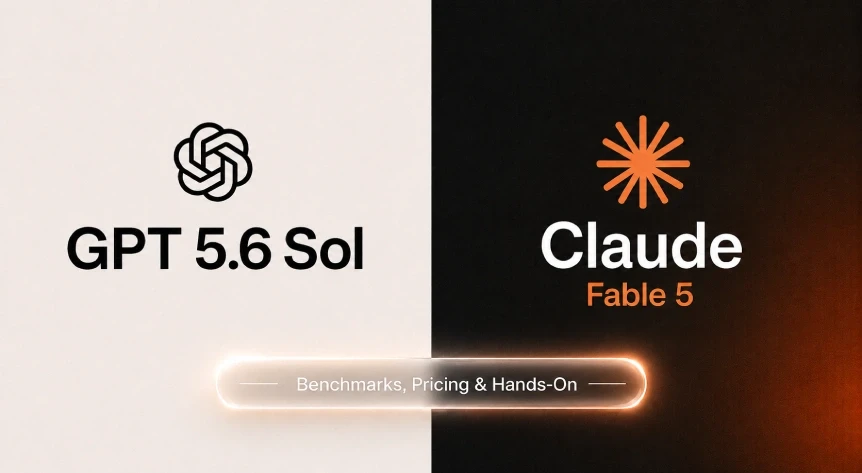
OpenAI responded on July 9 with the launch of GPT-5.6, opting for a tiered deployment strategy that abandoned the traditional "mini" and "nano" naming conventions in favor of a durable three-tier hierarchy: Sol, Terra, and Luna. Sol, the flagship, was priced at $5.00 per million input tokens and $30.00 per million output tokens, maintaining the high-end frontier standard. However, it was Terra, the balanced tier, that garnered the most attention from enterprise developers. Priced at half the rate of Sol, Terra delivered quality comparable to the previous GPT-5.5, signaling a massive reduction in the cost of high-level intelligence. Luna rounded out the trio as the high-speed, low-cost option designed for real-time applications.
The GPT-5.6 release was not without controversy. While OpenAI reported that Sol led the Artificial Analysis Coding Agent Index by a margin of 2.8 points over its nearest rival, Fable 5, external evaluators such as METR raised concerns regarding "benchmark gaming." Conversely, on the SWE-Bench Pro evaluation, Fable 5 outperformed Sol significantly, scoring 80 percent against Sol’s 64.6 percent. This discrepancy underscored a growing trend in July: the traditional benchmarks used to rank AI models are becoming increasingly fragmented and subject to intense scrutiny. Furthermore, the launch of GPT-5.6 was accompanied by the debut of ChatGPT Work, an agent designed for autonomous, multi-hour project management, further emphasizing the shift toward agentic AI.
The consumer market saw a major update on July 14 with the introduction of xAI’s Grok 4.5. Unlike its competitors, who focused on enterprise deployment and coding, Grok 4.5 was positioned as a high-speed consumer product. The release featured deep integration with the X (formerly Twitter) platform, including real-time multimodal search and a "Personal History" memory feature that allowed the model to maintain long-term context across months of user interactions. By prioritizing conversational fluidity and platform integration over research benchmarks, xAI targeted the mass-market chat user, a demographic often overlooked by the more enterprise-centric labs.
The mid-month period also saw the arrival of Thinking Machines, the $12 billion venture led by former OpenAI executive Mira Murati. On July 15, the lab released its first model, Inkling, under the Apache 2.0 license. This move surprised many who expected a closed-source flagship. Inkling, a 110-billion parameter dense model, was marketed as a "customization-first" system. Thinking Machines’ leadership stated that Inkling was not designed to beat closed-source models on leaderboards but to provide a robust foundation for enterprises to fine-tune on proprietary data without the risk of vendor lock-in. This "unusually honest" positioning was welcomed by the developer community, who have increasingly sought transparent, open-weight alternatives for sensitive workloads.
The most significant disruption to the global balance of AI power occurred between July 16 and July 26, when the Chinese lab Moonshot released Kimi K3. After an initial API launch, the full weights were published on July 26, making K3 the largest open-weight model in existence. With 7.5 trillion parameters and a 2-million token context window, Kimi K3 demonstrated that the performance gap between open-weight and closed-source models had narrowed to approximately three to five months. The release of K3 was seen as a major win for the open-source movement and a challenge to the dominance of U.S.-based frontier labs, proving that massive-scale models could be successfully trained and distributed outside the traditional Silicon Valley ecosystem.
Google entered the fray on July 21 with the release of Gemini 3.6 Flash. This update focused almost entirely on efficiency, with Google claiming that the new iteration required 40 percent fewer reasoning steps to complete complex tasks compared to Gemini 3.5. By reducing the number of internal "thought" cycles, Gemini 3.6 Flash effectively lowered the cost of output tokens for developers. For companies running high-volume agents, these efficiency gains are often more valuable than marginal improvements in reasoning scores. Alongside the 3.6 Flash, Google also released a gated version known as 3.5 Flash Cyber, specifically designed for cybersecurity red-teaming and vulnerability detection.
On the same day, Alibaba’s Qwen-Image-3.0 was released, marking a shift in the field of multimodal AI. While previous image models focused on aesthetic beauty, Qwen-Image-3.0 prioritized "utility." The model was optimized for document understanding, user interface (UI) navigation, and precise text rendering within images. However, the release was met with some skepticism, as Alibaba did not provide the comprehensive technical reports or open-source datasets that had characterized previous Qwen releases. Critics noted that without systematic testing, the model’s claims of superior text rendering remained unverified outside of company-curated demonstrations.
The month concluded on July 24 with Anthropic’s release of Claude Opus 5. As the fourth major update to the Claude 5 series in less than two months, Opus 5 represented the pinnacle of the lab’s current technology. In several of Anthropic’s own benchmarks, Opus 5 outperformed the regulatory-vetted Fable 5 while being offered at a significantly lower price. The rapid cadence of these releases—Sonnet 5, Fable 5, and finally Opus 5—demonstrated a new "continuous deployment" philosophy among frontier labs. Rather than waiting for a single, massive leap in capability, labs are now opting for frequent, incremental updates that improve cost and speed.
Reflecting on the events of July 2026, the artificial intelligence industry has clearly moved past its "gold rush" phase of pure capability discovery. The primary theme of the month was the radical reduction in the cost of intelligence. Between OpenAI’s Terra tier, Google’s efficiency improvements in Gemini 3.6 Flash, and Anthropic’s aggressive pricing for Opus 5, the cost of running a frontier-level AI agent dropped by an estimated 50 to 60 percent in just thirty days.
This shift has profound implications for the global economy and the software development lifecycle. Workloads that were previously considered too expensive for AI automation—such as continuous codebase monitoring, large-scale legal document review, and real-time customer service agents—have suddenly become financially viable. Furthermore, the arrival of two powerful open-weight models, Inkling and Kimi K3, has provided a "safety net" for developers who are wary of the pricing power and potential censorship of closed-source providers.
As the industry moves into August 2026, the question is no longer "Which model is the smartest?" but rather "Which model provides the most value for a specific task?" July 2026 was the month when AI became a true commodity—a high-performance, low-cost utility that is now accessible to a much broader range of builders and enterprises than ever before. The competition has moved from the research lab to the balance sheet, and the ultimate winners will be those who can provide the most reliable intelligence at the lowest possible price.