The landscape of artificial intelligence is shifting from generalized conversational interfaces toward specialized, agentic workflows designed to solve specific organizational challenges. As enterprises integrate Large Language Models (LLMs) into their daily operations, a recurring bottleneck has emerged: the inefficiency of repetitive prompting. Teams often find themselves manually inputting the same validation rules, company standards, and formatting instructions into every new session with Claude. To address this, Anthropic has introduced Custom Skills, a framework that allows users to package reusable instructions, scripts, and reference files into a portable format that Claude automatically invokes when relevant.
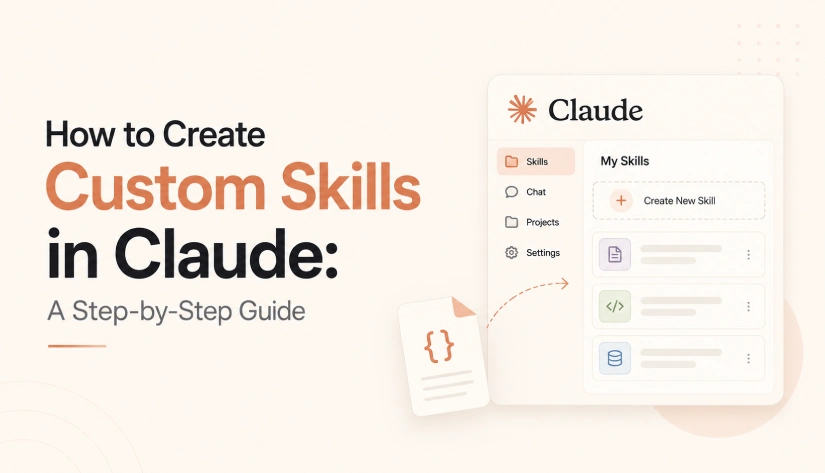
This evolution represents a significant milestone in the "Agentic AI" era, where the model no longer waits for granular direction but instead recognizes a task and deploys the appropriate "skill" to execute it. By adhering to the Agent Skills open standard, Anthropic ensures that these capabilities are not locked into a single interface but are instead portable across Claude Code, the Claude Agent SDK, and the Claude Developer Platform.
The Architectural Foundation of Custom Skills
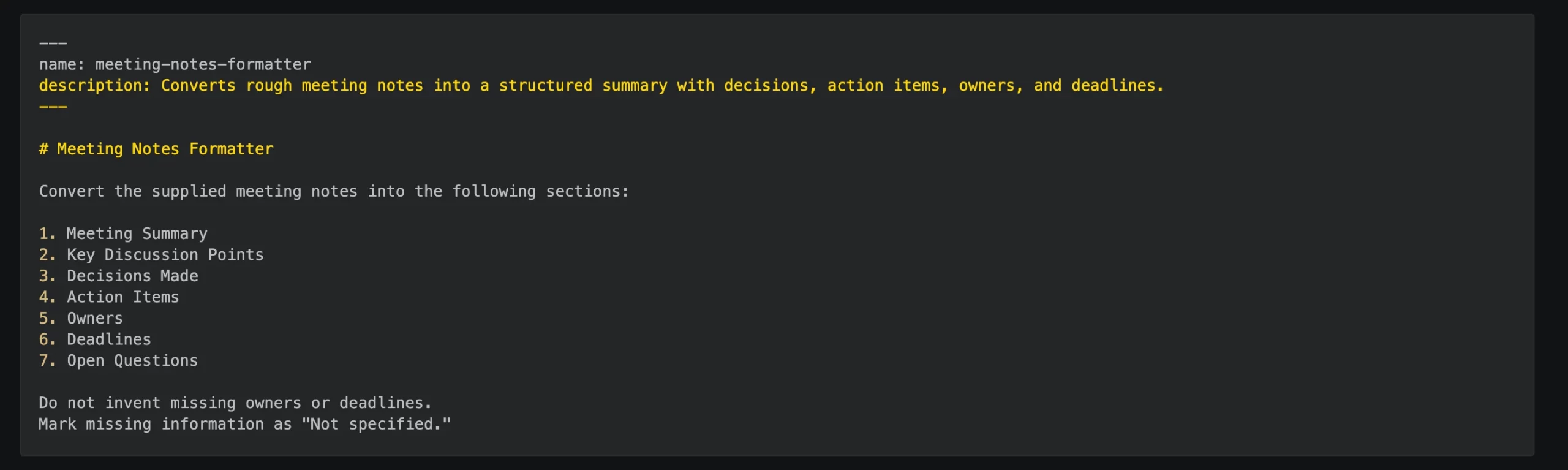
At its core, a Claude Skill is defined as a directory containing a set of instructions. While a skill can be complex, involving multiple scripts and data files, the only mandatory component is a file named SKILL.md. This file serves as the entry point, containing YAML frontmatter for metadata and Markdown for the operational logic.

The introduction of the Agent Skills open standard (agentskills.io) is a strategic move by Anthropic to foster an ecosystem where AI behaviors are transparent and interchangeable. This standard allows developers to define a skill’s name, description, and workflow in a way that different AI agents can interpret. For organizations, this means that a "Code Review" skill developed for a command-line interface can theoretically function within a web-based chat environment or an integrated development environment (IDE) without requiring a complete rewrite of the underlying logic.
The Convergence of Commands and Skills
Previously, users of Claude Code—Anthropic’s experimental CLI tool—relied on "Custom Commands" stored in specific hidden directories. In a move toward architectural unified, Anthropic has merged these concepts. Traditional command files located in .claude/commands/ and new skill directories in .claude/skills/ now operate under the same logic.

If a user creates a skill named deploy, they can invoke it manually using the /deploy command, or Claude can proactively suggest its use if it detects a deployment-related task. This convergence simplifies the user experience, allowing for a gradual transition from manual command execution to automated agentic assistance.
The Mechanism of Progressive Disclosure
One of the primary challenges in AI development is managing the "context window"—the amount of information a model can process at one time. Loading every possible instruction and reference file into every conversation would quickly exhaust this limit and lead to performance degradation.
Claude Skills solve this through a three-stage process known as progressive disclosure:
- Discovery Phase: At the start of a session, Claude only reads the metadata of available skills—specifically the
nameanddescription. It uses this high-level information to determine if a skill matches the user’s intent. - Instruction Loading: Once a match is confirmed, Claude loads the full content of the
SKILL.mdfile. This provides the rules, constraints, and step-by-step workflow for the specific task. - Resource Activation: Supporting files, such as Python scripts or CSV templates, are only accessed when the workflow explicitly calls for them. This "just-in-time" loading ensures that the model remains focused and efficient, consuming context tokens only for the data strictly necessary for the task at hand.
Strategic Integration: When to Use Code vs. Markdown
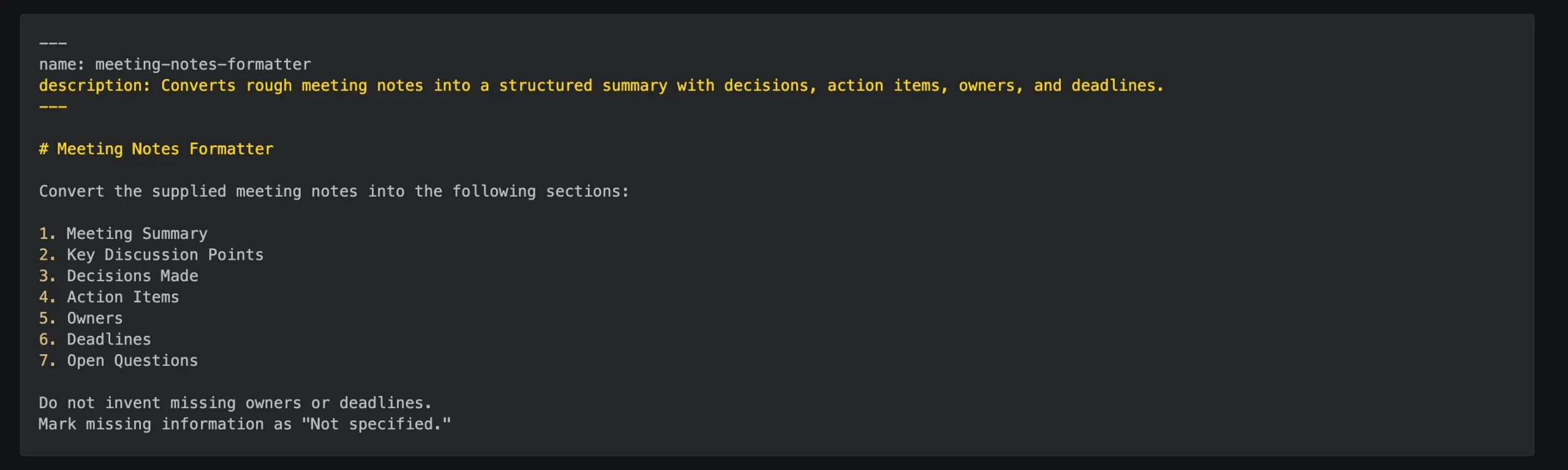
A common misconception among early adopters is that creating an AI skill requires extensive programming knowledge. In reality, a basic skill can be entirely text-based. For example, a skill designed to format meeting notes into a specific corporate template requires nothing more than Markdown instructions.

However, code becomes essential when the task moves from "interpretation" to "execution." Industry experts suggest a simple dichotomy: use Markdown for qualitative rules (e.g., "ensure the tone is professional") and use code for deterministic operations (e.g., "calculate the average value of column X").
By delegating calculations and data processing to languages like Python or Bash, the AI avoids common pitfalls such as hallucinations in arithmetic. This hybrid approach—using the LLM for reasoning and traditional code for computation—is becoming the gold standard for reliable AI agents.

Technical Implementation: Building a Data Quality Auditor
To illustrate the power of this framework, consider the development of a "Data Quality Auditor" skill. This tool is designed to analyze CSV datasets for inconsistencies, missing values, and structural errors—a common task for data scientists that is often repetitive and prone to oversight.
Step 1: Directory Configuration
The skill is organized within a dedicated folder, typically located at .claude/skills/data-quality-auditor/. This directory houses the SKILL.md file, a scripts/ folder for Python logic, and a references/ folder for organizational data standards.

Step 2: Defining the Logic in SKILL.md
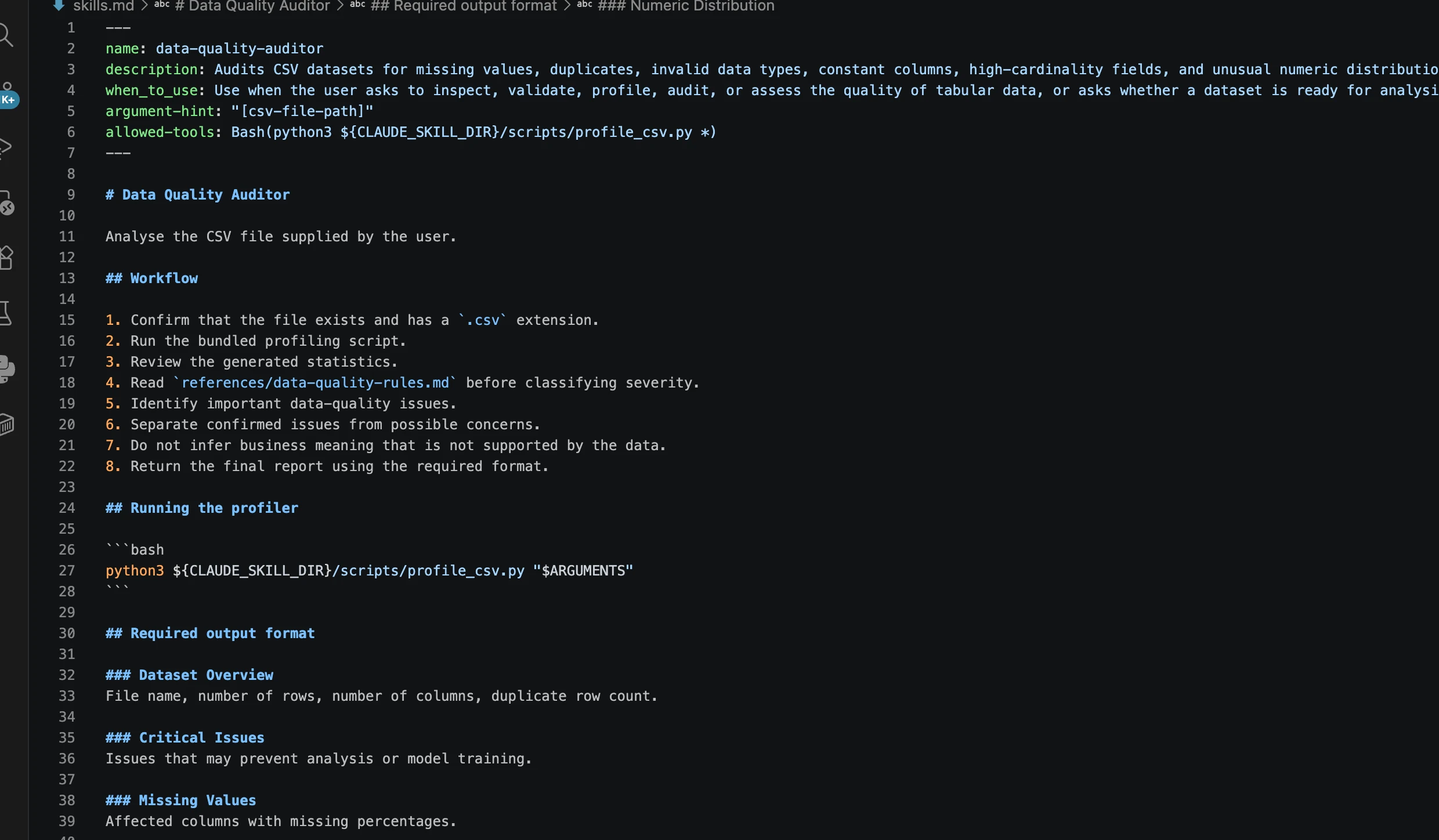
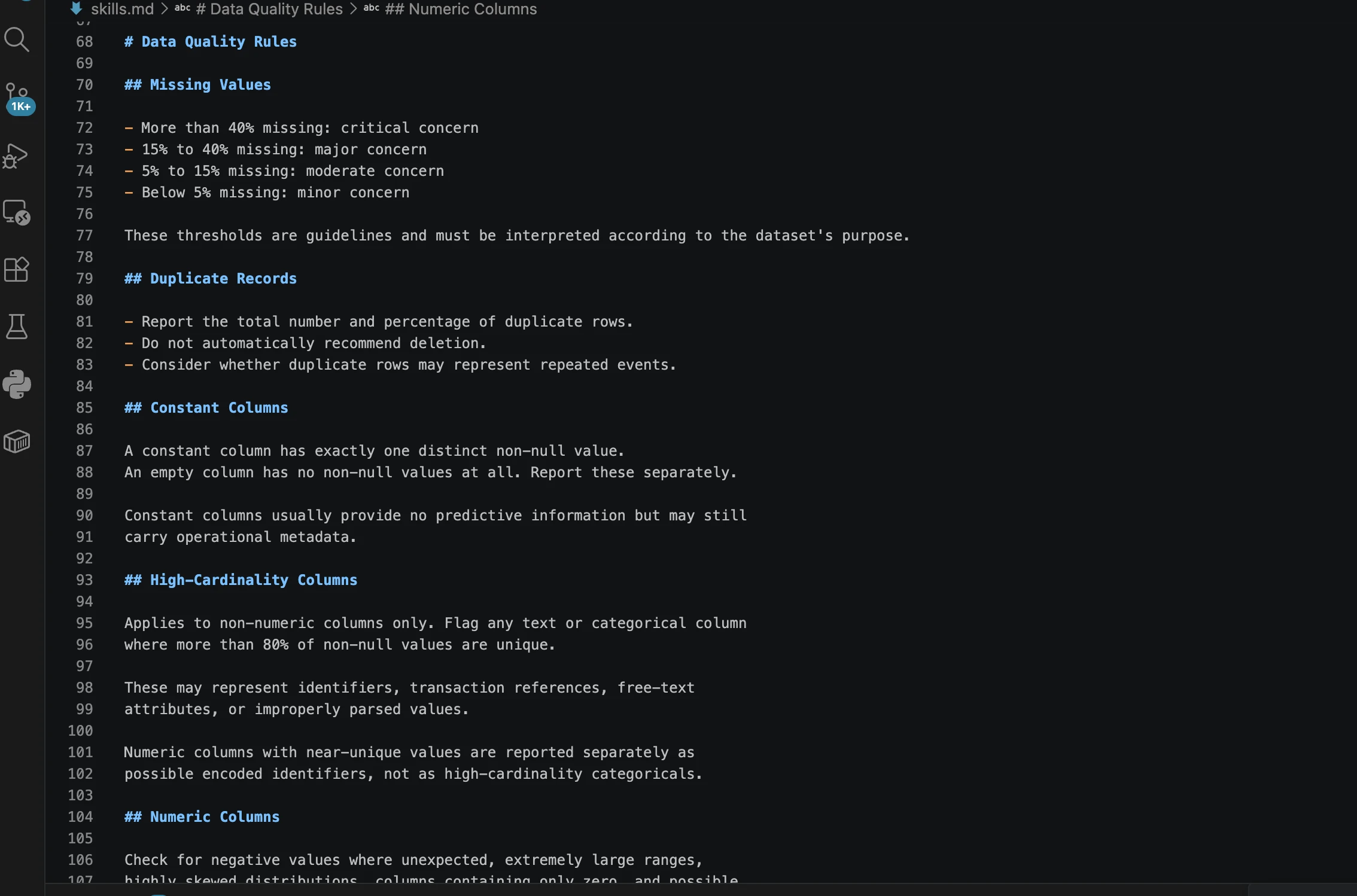
The SKILL.md file includes frontmatter that tells Claude exactly when to trigger the skill. A description like "Analyzes CSV files for data quality issues and provides a structured report" serves as the trigger. Within the body of the Markdown, instructions direct Claude to execute a specific Python script and then interpret the resulting JSON output against a set of predefined "Data Quality Rules."
Step 3: Deterministic Processing via Python
The Python script handles the heavy lifting. Using libraries like Pandas, the script performs row and column counts, detects duplicates, and identifies "high-cardinality" columns (columns with too many unique values, which can disrupt machine learning models). By returning this data in a structured JSON format, the script provides a "ground truth" that Claude can then use to write a human-readable executive summary.

Step 4: Deployment and Permissions
In environments like Claude Code, security is paramount. The skill configuration uses an allowed-tools field to grant Claude permission to run the specific Python script without prompting the user for approval every time. This creates a seamless experience while maintaining a "least-privilege" security model.
Comparative Analysis: Desktop vs. CLI Environments
While the core logic of skills is portable, the implementation details vary between the Claude.ai web/desktop applications and the Claude Code CLI.

In the web application, skills are often uploaded as zipped packages. There is a strict 200-character limit for descriptions, necessitating concise, high-impact summaries to ensure the model recognizes the skill’s utility. Furthermore, web-based skills require the "Analysis Tool" (code execution) to be enabled in the project settings.
Conversely, Claude Code offers more flexibility. It supports advanced frontmatter fields like effort levels (low to max), which control how much reasoning the model applies to a task, and context: fork, which allows a "sub-agent" to run a task in the background while the user continues their primary conversation. This background processing is a critical feature for long-running tasks like codebase indexing or complex data audits.

Enterprise Implications and Productivity Gains
The broader impact of Custom Skills on enterprise productivity cannot be overstated. According to early internal benchmarks from organizations adopting agentic workflows, the time spent on "boilerplate" tasks—setting up environments, explaining formats, and correcting repetitive errors—can be reduced by up to 40%.
Standardization of Output
By using skills, a Chief Data Officer can ensure that every data audit performed by any team member follows the exact same validation logic. This eliminates the "snowflake" problem, where different analysts produce inconsistent reports based on their individual prompting styles.
Knowledge Retention
Custom Skills act as a form of "executable documentation." Instead of a new hire reading a 50-page PDF on coding standards, they can simply use a /review skill that has those standards baked into its logic. The AI becomes the guardian of organizational knowledge, applying it consistently across every interaction.
The Rise of the Sub-Agent
The most advanced application of this technology is the "Sub-agent" model. By configuring a skill with context: fork, an enterprise can deploy specialized mini-agents that handle specific parts of a project. For instance, while a developer is writing a new feature, a sub-agent skill could be running in the background, auditing the data structures being used and flagging potential security vulnerabilities in real-time.
Future Outlook: The Path Toward Autonomy
As Anthropic continues to refine the Claude Skill framework, the industry expects a move toward even greater autonomy. Future iterations may include "Skill Discovery" protocols where different AI agents can negotiate and share skills dynamically across different platforms.
The current trajectory suggests that the distinction between a "software application" and an "AI skill" will continue to blur. For developers and organizational leaders, the message is clear: the value of AI is no longer just in its ability to generate text, but in its ability to master specific, repeatable, and high-value skills that drive business outcomes. By adopting the Custom Skills framework today, organizations are building the foundation for a truly automated, agent-driven future.