The landscape of generative artificial intelligence has shifted from mere text generation to a sophisticated ecosystem of specialized agentic workflows. As of August 2026, the primary challenge facing professional writers and developers is no longer the ability to produce content, but rather the elimination of "AI slop"—the repetitive, overly polite, and structurally predictable prose that has come to characterize unrefined large language model (LLM) outputs. With the widespread adoption of Claude Code and the Model Context Protocol (MCP), the focus has turned toward "Skills": modular, repository-based instructions that allow Claude to perform specific, high-level writing tasks with human-like nuance.
While the GitHub marketplace is saturated with tools designed for code refactoring and status report automation, a distinct category of repositories has emerged dedicated exclusively to the craft of writing. These repositories are judged not by their general utility, but by their ability to transform generic AI output into high-fidelity prose. Based on GitHub data as of August 5, 2026, five specific writing skills have risen to prominence, reflecting a broader industry trend toward verification-heavy, anti-slop writing pipelines.
The Evolution of the AI Writing Crisis
The rise of these specialized skills is a direct response to the "Great Slop Crisis" of 2025, where search engines and social platforms became inundated with content that, while grammatically correct, lacked the density and rhythm of human thought. Early AI writing was characterized by specific markers: excessive use of em-dashes, a penchant for "chatty" rhetorical openers, and a refusal to take definitive stances.
By mid-2026, the Model Context Protocol (MCP) allowed users to bridge the gap between static prompts and dynamic agentic behavior. Instead of telling an AI to "write better," writers began installing version-controlled "Skills" into their local environments. These skills function as system-level constraints that force the model to adhere to specific linguistic theories, editorial rubrics, and structural deconstructions.
1. Humanizer: The Gold Standard for Linguistic Authenticity
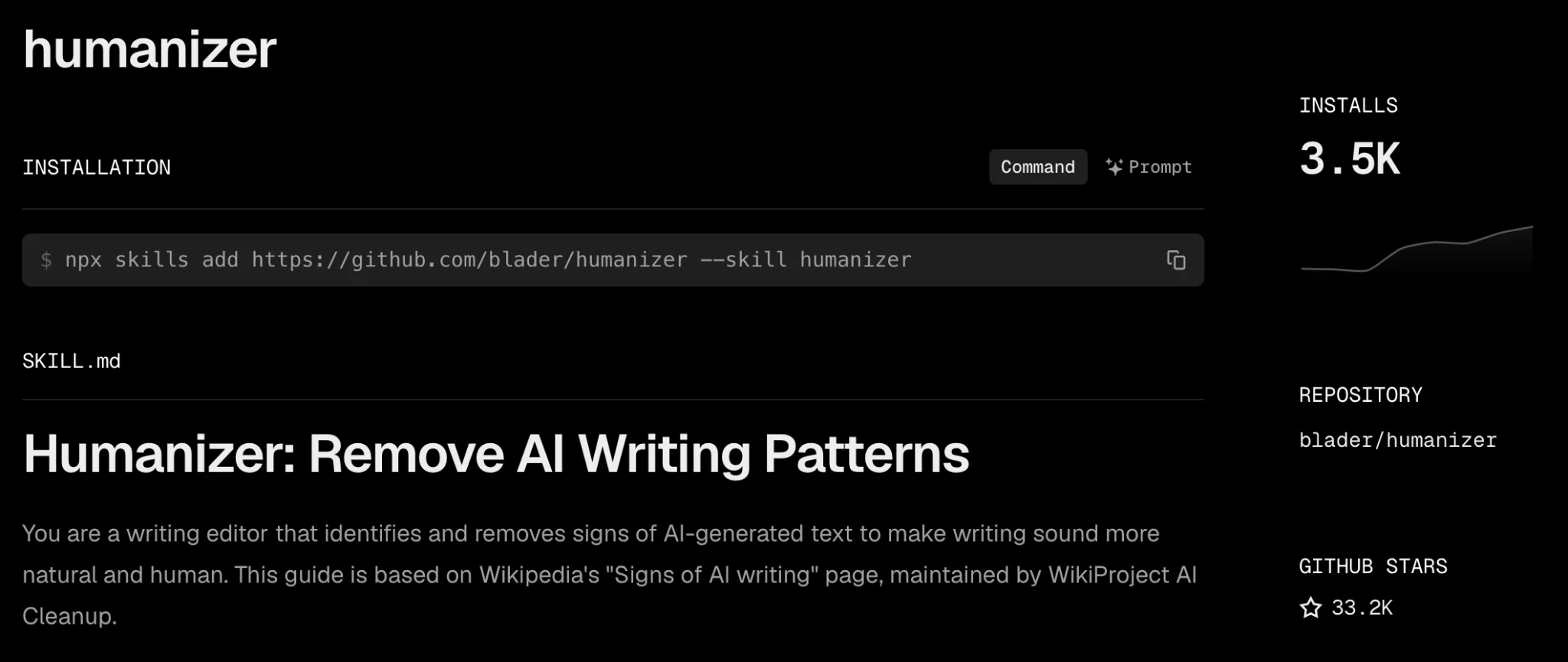
With 33,700 stars, the blader/humanizer repository stands as the most influential writing tool in the Claude ecosystem. Unlike previous attempts at "humanizing" AI text—which often relied on adding intentional typos or slang—humanizer is built on a foundation of forensic linguistics.
The tool utilizes thirty-three distinct patterns derived from the Wikipedia "Signs of AI Writing" guide, a community-maintained document that catalogs the tell-tale markers of LLM-generated prose. The skill operates by identifying and rectifying specific rhythmic failures. For instance, it targets "subjectless fragments" and "manufactured punchlines" that frequently appear at the end of AI-generated paragraphs.
One of the most significant features of humanizer is its treatment of punctuation. While standard LLMs often over-rely on em-dashes to connect disparate thoughts, humanizer implements a "rationing" system, forcing the model to use more complex sentence structures or simple periods to create a varied pace. This focus on rhythm over mere vocabulary is what distinguishes the 2026 era of AI writing from the more primitive "word-swapping" tools of 2024.
2. Stop-Slop: The Defensive Writing Framework
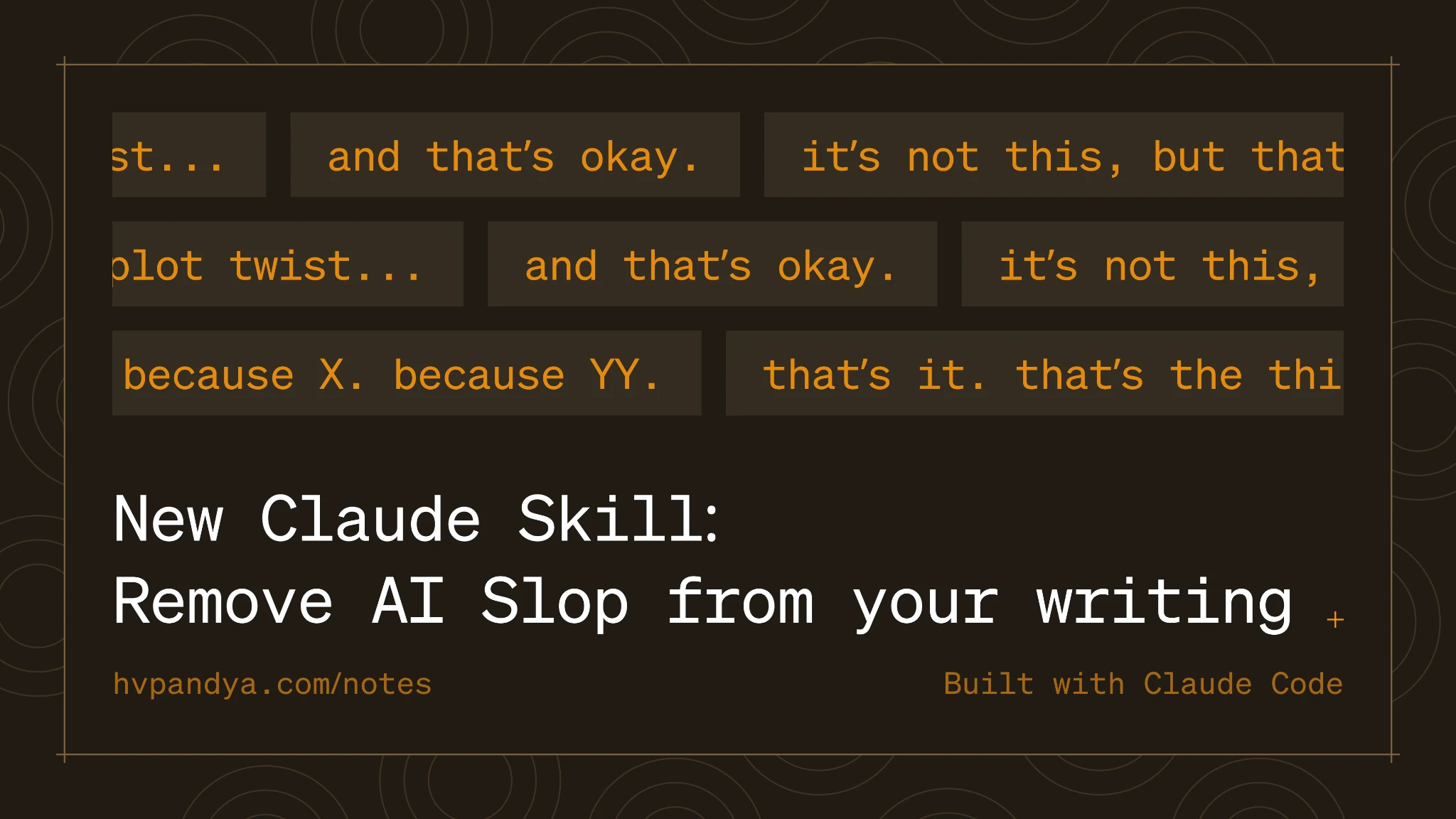
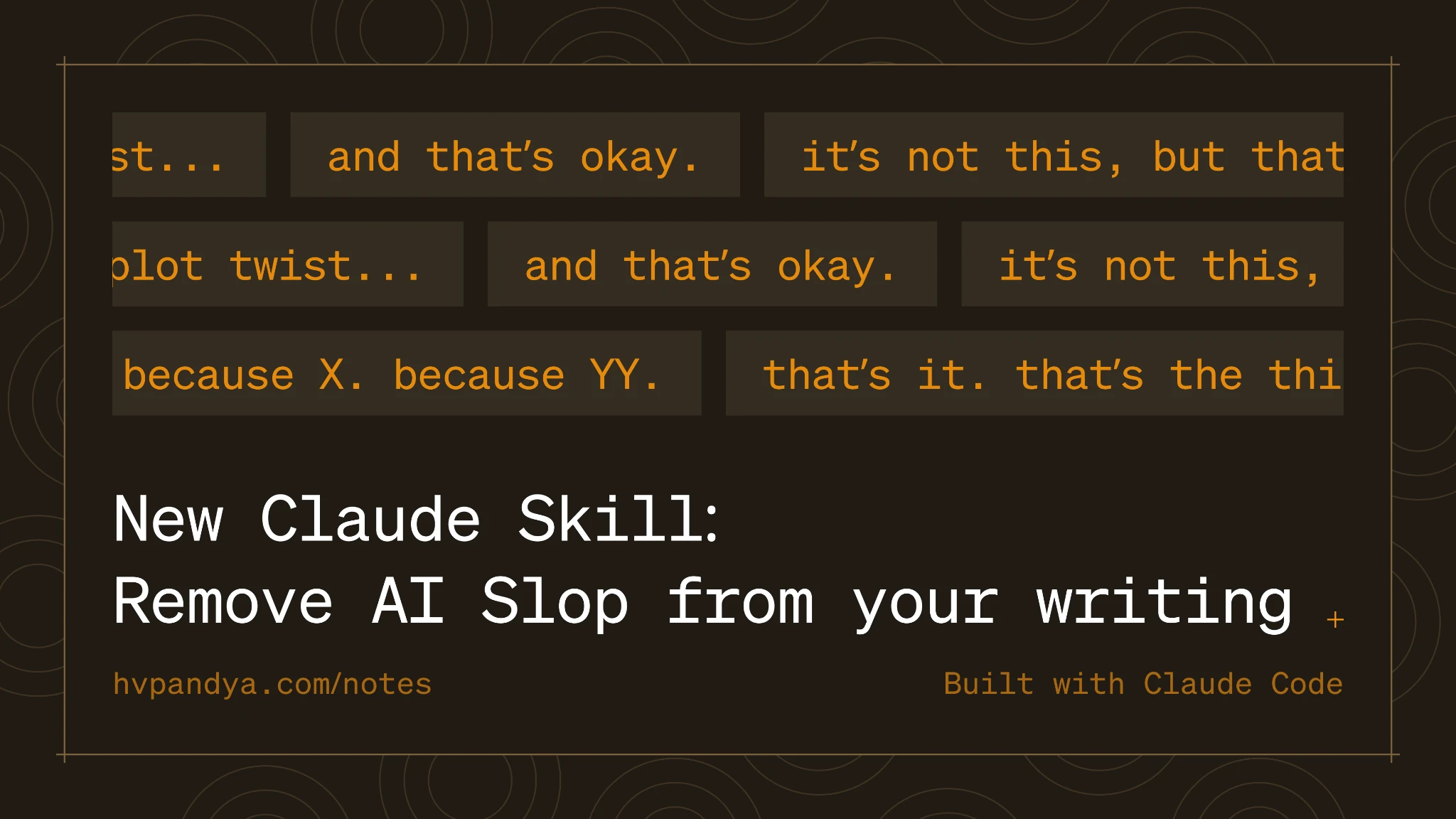
Ranked second with 15,199 stars, hardikpandya/stop-slop takes a more clinical, scoring-based approach to writing. The repository consists of a core SKILL.md file and reference datasets that act as a "blacklist" for the model.
The philosophy behind stop-slop is that the best way to make an AI sound human is to stop it from trying to "sound human." When a model attempts to mimic human warmth, it often falls into a valley of uncanny politeness. Stop-slop prevents this by enforcing a strict scoring rubric. After drafting a piece of text, the skill requires the model to self-audit based on five criteria:
- Directness: The elimination of "fluff" and throat-clearing introductions.
- Rhythm: The variation of sentence lengths.
- Trust: The use of concrete data over vague generalizations.
- Authenticity: The avoidance of "marketing speak."
- Density: The information-to-word ratio.
The model assigns a score from 1 to 10 for each category. If the total score falls below 35 out of 50, the skill triggers an automatic revision cycle. This internal verification loop ensures that the user never sees the initial, lower-quality "slop" draft.
3. AI-Research-SKILLs: Academic Rigor and Technical Precision
For the scientific and technical community, Orchestra-Research/AI-Research-SKILLs (11,400 stars) has become the essential toolkit for literature surveys and paper submissions. While the repository contains numerous engineering tools for model quantization and training, its writing sub-categories are particularly noteworthy.
The writing component of this repository is designed to handle the full lifecycle of a research paper. It includes specific modules for:
- Literature Synthesis: Moving beyond simple summaries to identify "gaps" in current research.
- Formal Proof Transcription: Ensuring that mathematical notation remains consistent throughout a document.
- Peer-Review Simulation: An agentic flow where the model "critiques" its own writing from the perspective of a hostile reviewer.
This repository reflects the growing demand for AI tools that can handle high-stakes technical documentation without the risk of hallucination or stylistic "drift" that often plagues general-purpose models.
4. Oh-Story-Claudecode: Narrative Deconstruction and Fiction
In the realm of creative writing, worldwonderer/oh-story-claudecode (5,080 stars) represents a departure from the "prompt-a-story" method. Originally developed for the highly competitive Chinese web fiction market, the English adaptation has become a favorite for serial fiction writers.
The core innovation of oh-story-claudecode is its "pipeline" approach: trend scouting, deconstruction, and then writing. Instead of asking Claude to "write a story about a detective," the user points the skill toward an existing successful work. The skill then performs a "structured teardown," identifying the pacing, character archetypes, and plot beats that made the original work successful.
This deconstruction is saved as a reusable library. When the writing phase begins, the model drafts against this specific structural framework rather than its own internal defaults. This ensures that the resulting fiction maintains a consistent "shape" and avoids the meandering, aimless quality of standard AI storytelling.
5. Claude-Blog: The Content Strategy Engine
Finally, AgriciDaniel/claude-blog (1,579 stars) targets the professional content marketing industry. It is the most complex of the five, utilizing five distinct agents to manage the "blog lifecycle," including topic cluster identification and content decay detection.
The standout feature of claude-blog is its "delivery contract." Every piece of content is scored against a 100-point rubric across five "gates." If a draft fails to meet a 90-point threshold, the system blocks the output and re-runs the drafting process up to three times. This "verification pattern" applies the logic of software unit testing to prose. By making the user the final reviewer rather than the first, it significantly reduces the cognitive load associated with high-volume publishing.
Implementation and Technical Integration
Installing these skills within the Claude Code environment is a standardized process. Users clone the desired repository into their local skills directory:
git clone https://github.com/<owner>/<repo> ~/.claude/skills/<name>
Once installed, these skills are automatically detected by Claude Code. The model reads the SKILL.md or configuration files within these directories to understand the new constraints and capabilities it must apply during a session. This modularity allows writers to "stack" skills—for example, combining humanizer with claude-blog to ensure that high-volume marketing content remains stylistically authentic.
Industry Implications and Future Outlook
The popularity of these repositories signals a fundamental shift in the AI industry. In 2023 and 2024, the goal was "generative breadth"—the ability for a model to write anything. In 2026, the goal is "editorial depth"—the ability for a model to adhere to rigorous, human-defined standards of quality.
Data from GitHub suggests that "anti-slop" skills are currently the most sought-after tools in the LLM space. This is likely because the markers of AI writing are now well-documented. As Wikipedia’s WikiProject AI Cleanup continues to catalog these patterns, the "answer key" for fixing AI writing becomes more factual and less subjective.
For professional writers, the implication is clear: the role is evolving from "creator" to "architect." By curating a library of high-quality skills and managing the verification gates, writers can produce work that is indistinguishable from—or in some cases, superior to—manual drafting. However, this requires a technical fluency in managing repositories and understanding the underlying mechanics of model prompts.

As we move toward 2027, it is expected that these skills will become even more specialized. We are already seeing the emergence of "legal-brief-claudecode" and "medical-journal-humanizer." The era of the general-purpose "Write an essay" prompt is over; the era of the precision-engineered writing agent has begun. For those looking to stay relevant in a landscape saturated with AI, the ability to deploy and refine these skills is no longer optional—it is the baseline for professional excellence.