A critical functionality within Google Search and Google News, the "Filter by Recent" tool, experienced a widespread outage for several hours, preventing users from accurately sorting search results by temporal relevance. This significant technical glitch affected both desktop and mobile platforms, causing considerable frustration among individuals, professionals, and organizations who rely on up-to-the-minute information. The issue, which manifested as an inability to apply filters such as "Past hour," "Past 24 hours," or "Past week," rendered the search engine incapable of delivering truly current content, a cornerstone of its utility in the modern digital landscape.
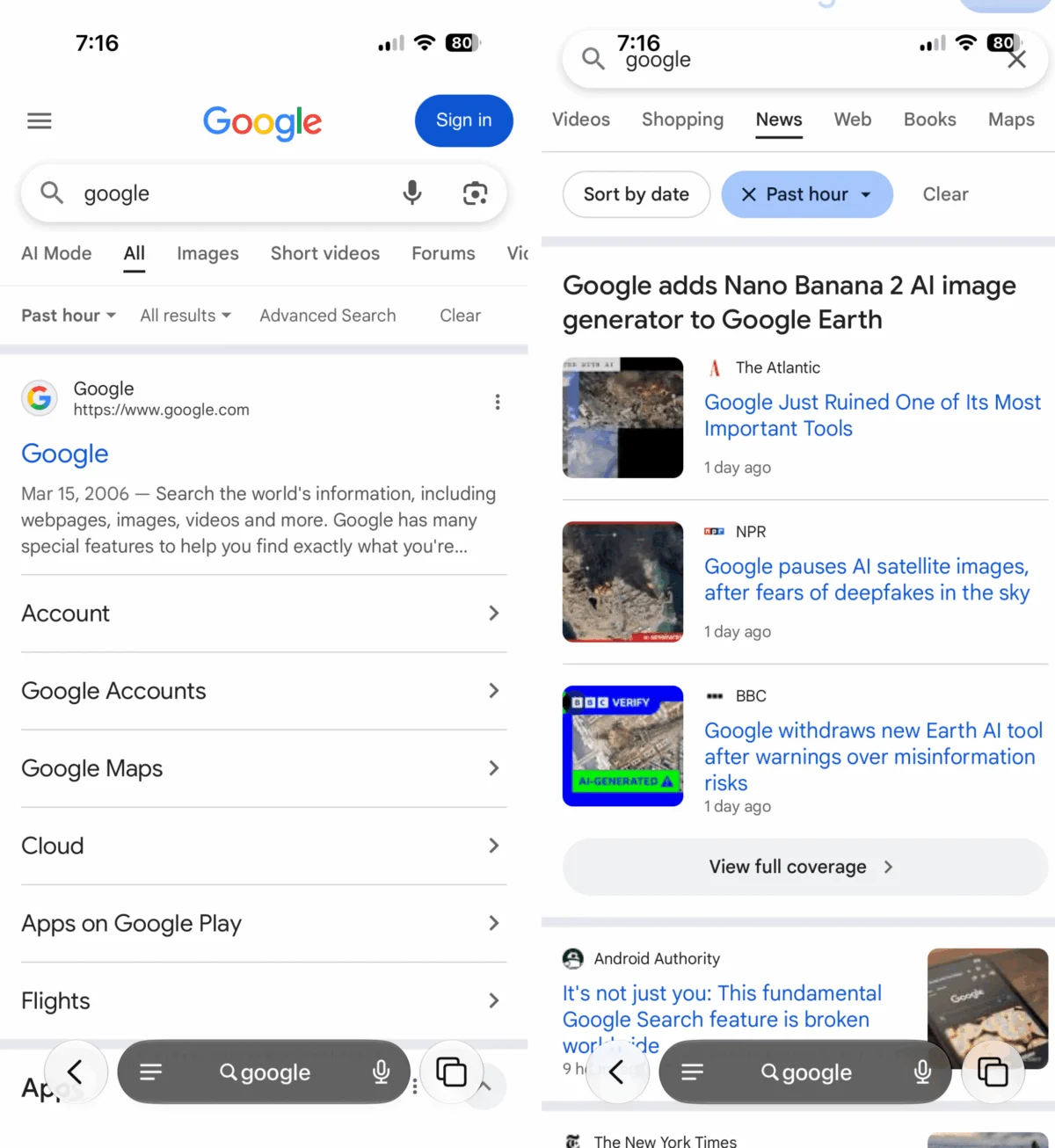
The problem first surfaced during the early hours of what appears to be August 1, 2026, according to internal tracking and user reports. Users attempting to refine their search queries using the "Tools" option and then selecting any of the "Recent" timeframes found that the system failed to respect their chosen filter. Instead, search results remained broadly sorted by Google’s standard relevance algorithms, often presenting information that was hours, days, or even weeks old, despite explicit instructions for recency. This was particularly evident when attempting to filter for the "Past hour" on terms like "[google]," where the returned results clearly predated the specified timeframe, as demonstrated by screenshots provided by affected users. The disruption extended across various Google services, including the dedicated Google News tab, a vital resource for journalists, researchers, and the general public seeking breaking stories and evolving events.
The Crucial Role of Real-Time Search in the Digital Age
The "Filter by Recent" feature is not merely a convenience; it is an indispensable tool for a vast spectrum of internet users. In an era defined by rapid information dissemination and constant updates, the ability to pinpoint the most current data is paramount. For journalists, it is essential for tracking breaking news stories as they unfold, monitoring public reactions, and ensuring factual accuracy in reporting. Financial analysts depend on real-time search to follow market fluctuations, company announcements, and economic indicators that can shift within minutes. Similarly, researchers and academics often need the latest publications or discussions on a particular topic, making the recency filter critical for staying abreast of developments.

Beyond professional use, everyday users frequently leverage this feature for a myriad of purposes: checking live sports scores, monitoring social media trends, finding updates on local events, or simply ensuring they are viewing the most current information available on a fast-evolving topic. A failure in this mechanism, therefore, represents a significant impediment to efficient information gathering and can lead to misinformed decisions or the consumption of outdated content. The incident underscores the profound reliance the global population places on Google’s search infrastructure for timely and accurate information.
Chronology of the Outage and User Reactions
The first signs of the bug emerged and rapidly escalated into widespread reports across major social media platforms and online forums. By [Insert approximate time based on "several hours" and "August 1, 2026"], complaints began to flood platforms like Reddit, X (formerly Twitter), and LinkedIn. Users expressed significant frustration, detailing how their workflow was disrupted and their ability to perform critical tasks hindered.
- Initial Reports (Early August 1, 2026): Users start noticing the "Filter by Recent" option failing to apply correctly on both Google Search and Google News, regardless of whether they were on desktop or mobile devices.
- Escalation of Complaints (Mid-August 1, 2026): Social media platforms become a hub for user grievances. Threads on Reddit, such as one titled "Searching for recent results on Google has ceased," gained traction, with numerous individuals confirming the issue. X saw a flurry of posts tagging Google accounts, highlighting the breakdown of a core search function. LinkedIn users, particularly those in professional roles, also shared their experiences, emphasizing the impact on their work.
- Google’s Acknowledgment (August 1, 2026, time approximate): Rajan Patel, a prominent figure at Google, officially acknowledged the problem via X. In a concise statement, he tweeted, "Apologies. We’re debugging now and try to get it working ASAP." This confirmation from an official source validated user concerns and indicated that Google’s engineering teams were actively engaged in diagnosing and resolving the bug.
- Workaround Identified: During the outage, some users discovered a partial workaround: navigating to the "Tools" option and then selecting "Sort by date" instead of "Recent." While this allowed for a chronological ordering of results, it lacked the granular control and immediate applicability of the "Recent" filters (e.g., "Past hour," "Past 24 hours"), limiting its effectiveness for truly real-time information needs.
- Resolution (August 2, 2026, time approximate): Approximately one day after the initial reports, Rajan Patel provided an update, confirming the issue had been resolved. His tweet stated, "The team shipped a fix this morning. Appreciate your patience. The weekend slowed things down a bit." This indicated that the bug had persisted for a significant duration, spanning roughly 24 hours or more, and that the timing of the weekend may have contributed to the prolonged resolution time.
Technical Complexity and System Reliability
The incident serves as a stark reminder of the immense technical complexity involved in maintaining a global search engine like Google. Indexing the entirety of the internet and making it searchable in real-time, with granular filtering capabilities, requires an extraordinarily robust and intricate infrastructure. Google processes trillions of queries annually, constantly updating its index with billions of new and modified web pages. A minor glitch in any part of this vast system can have widespread repercussions.

The "Filter by Recent" feature relies on Google’s ability to not only crawl and index content but also to assign precise timestamps and maintain an updated chronological record for every piece of information. When this indexing or retrieval mechanism encounters an error, the ability to sort by recency is compromised. Debugging such a system, especially one operating at Google’s scale, can be challenging, requiring engineers to pinpoint the exact point of failure within a labyrinthine network of servers, algorithms, and data centers. Patel’s comment about the "weekend slowing things down a bit" suggests that staffing levels or the availability of specific expert teams might have been a factor in the time taken to deploy a fix, highlighting the human element even in highly automated systems.
Broader Implications for Information Access and Trust
The temporary failure of a core search function like "Filter by Recent" carries broader implications beyond mere inconvenience. In an age increasingly plagued by misinformation and the rapid spread of unverified content, the ability to access credible, up-to-date information is more critical than ever. When Google, the primary gateway to information for billions, falters in this regard, it can inadvertently contribute to the propagation of outdated narratives or make it harder for users to discern the most current and accurate facts.
Such incidents, while eventually resolved, can subtly erode public trust in the reliability of digital platforms. Users depend on Google to be an unwavering source of truth and efficiency. Any perceived lapse, even a temporary one, can raise questions about the resilience of its systems and its commitment to delivering an uncompromised search experience. For businesses, especially those in fast-moving sectors like e-commerce, media, or finance, even a few hours of inability to track recent trends or news can translate into missed opportunities or misinformed strategies.
Furthermore, the event underscores the potential vulnerabilities inherent in relying heavily on a single dominant platform for critical information access. While Google’s ubiquity offers unparalleled convenience, it also concentrates a significant point of failure. When Google experiences an issue, the ripple effect is felt globally, impacting a vast array of activities dependent on its services.

Looking Ahead: Maintaining Search Integrity
The swift resolution of the "Filter by Recent" bug by Google’s engineering team demonstrates the company’s commitment to maintaining the integrity and functionality of its core services. However, the incident serves as a valuable case study in the ongoing challenges of managing a global-scale digital infrastructure. As the internet continues to grow in complexity and the demand for instant, accurate information intensifies, the pressure on search engines to perform flawlessly will only increase.
For Google, continuous investment in robust monitoring systems, rapid incident response protocols, and redundant architectures will be paramount. For users, while workarounds like "Sort by date" can offer temporary relief, the expectation remains that core functionalities like "Filter by Recent" should operate without interruption, ensuring that the digital world remains navigable and transparent. The incident, though brief, highlighted the delicate balance between advanced technology and human reliance, reinforcing the indispensable role Google plays in connecting users with the most current and relevant information available on the web.