The digital landscape is undergoing a seismic shift, driven by the rapid integration of artificial intelligence into the search experience. What was once a niche curiosity is now a dominant force, fundamentally altering how consumers discover products and how businesses must adapt their online strategies. Data indicates that the adoption of AI-powered search is accelerating at an unprecedented pace, compelling marketers and technologists alike to re-evaluate their approach to organic search optimization.
The Surge in AI Search Adoption
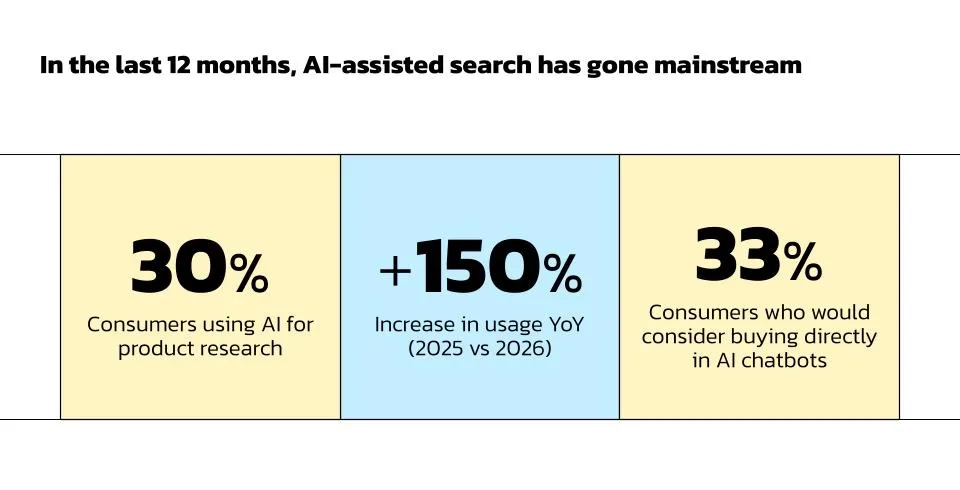
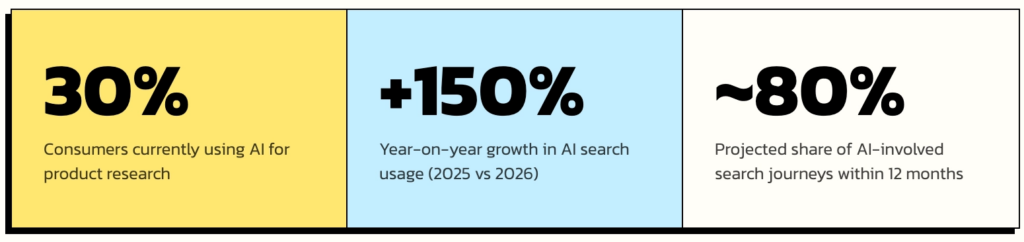
Recent data reveals a dramatic increase in consumer engagement with AI for product research. A mere year ago, only 12% of consumers utilized AI in this capacity. Today, that figure has more than doubled to 30%. This growth is further amplified by the increasing prevalence of AI-generated content directly within traditional search results. Currently, approximately 40% of Google searches now feature an "AI Overview," presenting users with AI-synthesized answers without them explicitly opting for an AI-driven search experience.
When these two trends are combined – active AI search usage and passive exposure to AI Overviews – the share of search journeys involving AI in some form now approaches a staggering 60%. Industry projections from Brainlabs suggest this figure could climb to 80% within the next twelve months, assuming current growth rates persist. This trajectory signals a profound and immediate impact on nearly every aspect of organic search strategy.
Brainlabs’ research categorizes consumers into three distinct groups based on their search habits. "Traditionalists," comprising about 69% of users, continue to rely exclusively on established search engines. The most dynamic segment is the "Augmenters," representing approximately 30% of consumers. These users seamlessly integrate both traditional search engines and AI platforms into a single research journey, particularly for complex queries. They haven’t abandoned their familiar tools but have augmented them with AI to enhance their information-gathering process. A minimal segment, fewer than 1%, are classified as "Dissenters," exclusively utilizing AI platforms for their searches. The significant growth observed within the "Augmenter" group underscores the evolving nature of consumer search behavior, highlighting a preference for a hybrid approach that leverages the strengths of both traditional and AI-powered search.
AI SEO: A New Paradigm, Not Just a Rebrand
The emergence of AI search necessitates a redefinition of Search Engine Optimization (SEO). While current strategies may not require a complete overhaul, the divergence between traditional SEO and AI-driven search is widening rapidly. It’s crucial to recognize that "AI search" is not a monolithic entity; at least four major platforms currently operate with distinct models, guidelines, and unique relationships with search engine indexes.
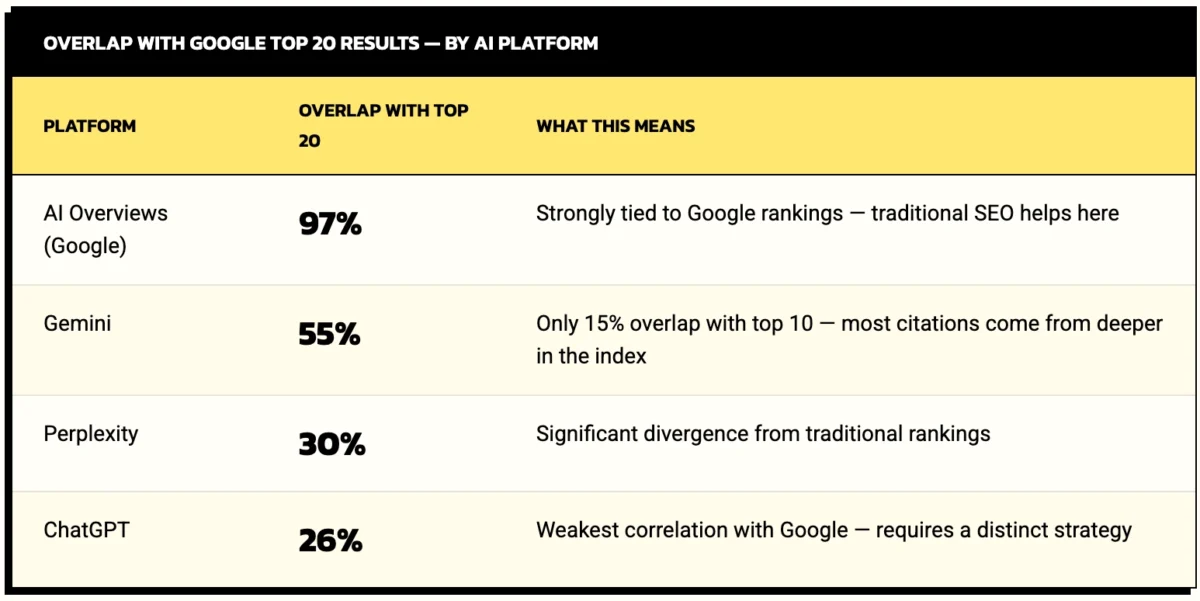
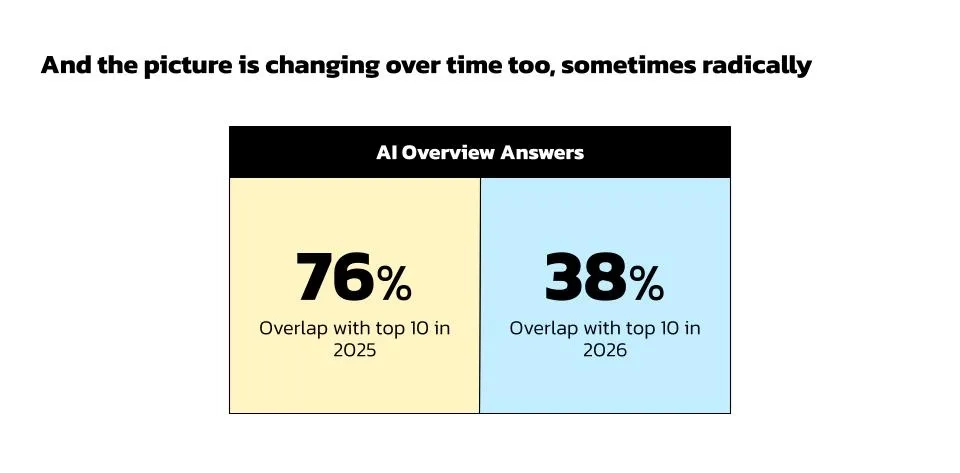
A particularly revealing statistic pertains to Google’s own AI product, Gemini. Data indicates that Gemini cites pages from Google’s top 10 search results only 15% of the time. This stands in stark contrast to the traditional SEO focus on achieving top-10 rankings. An SEO strategy built solely around this metric proves insufficient for platforms like Gemini or ChatGPT, whose citation patterns differ significantly. Furthermore, the overlap between AI Overviews and Google’s top 10 results has halved, decreasing from 76% to approximately 38% in 2026, underscoring the diminishing relevance of solely relying on traditional ranking signals for AI visibility.
Understanding How LLMs Select Citations
To effectively navigate the AI search landscape, understanding the underlying mechanisms by which Large Language Models (LLMs) generate responses and select citations is paramount. This process is fundamentally different from how traditional search engines rank pages.
The first step in an LLM’s process is "grounding." Upon receiving a prompt, the AI assesses whether it needs to access external data or can rely solely on its pre-existing training data. For most product research queries, external data is essential.
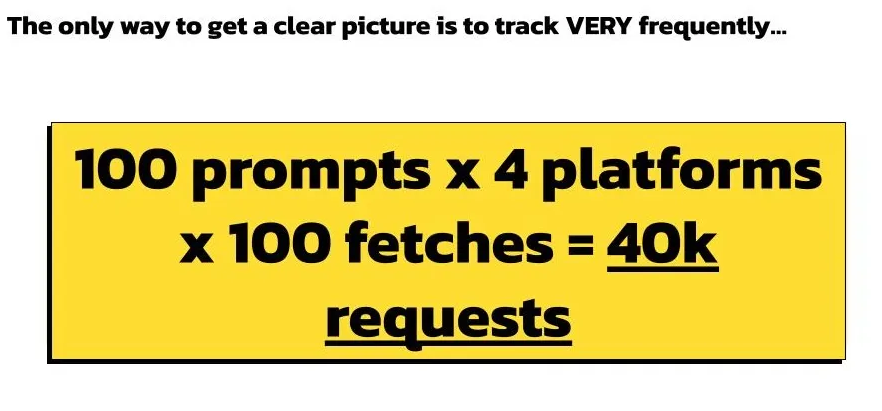
Next, the LLM engages in "query fan-out." It breaks down the original prompt into dozens of related micro-questions. For intricate prompts, a multitude of these micro-queries can be processed simultaneously.
This is followed by a "deep index search." For each micro-query, the LLM scours Google’s index, extending its search beyond the top 10 results to encompass the top 100 and beyond. This expansive search range represents a significant departure from traditional SEO practices.
The "content selection" phase involves the LLM identifying specific elements within search results. It prioritizes direct answer blocks, headings that directly match the micro-question, hard statistical data, and freshness signals such as a recent "last updated" date.
Finally, a "comparison and validation" process occurs. Sources that exhibit low consensus or are not perceived as high-authority references are filtered out. Crucially, a page that directly answers a specific micro-question with precision can outperform higher-authority pages that embed their answers within more general editorial content.
To optimize for these LLM citation preferences, three approaches have demonstrated consistent success. Firstly, understanding and addressing the "query fan-out" by building FAQ sections around the micro-questions generated by LLMs can lead to measurable increases in citations. Secondly, conducting "embedding similarity analyses" to gauge how closely content aligns with what LLMs are currently citing has resulted in an average 140% increase in AI citations in client tests. Thirdly, treating content freshness as a technical imperative, with monthly refreshes of high-demand pages for time-sensitive topics, is becoming a minimum requirement.
The Challenge of Measuring AI Search Performance
Accurately measuring the performance of AI search remains a significant challenge due to the limited availability of first-party data from major AI platforms. While Google and Bing have begun providing some data on AI performance through tools like Google Search Console’s Generative AI report, this information is currently restricted to impressions, lacking the granular query and click data essential for informed optimization decisions. Impressions and page performance offer a baseline and indicate trends, but crucial questions persist regarding customer search intent, follow-up questions, and search behavior within standalone AI applications like Gemini. Consequently, reliance on third-party measurement solutions remains a necessity.
The prevailing method involves converting keyword data into likely prompts, tracking these in third-party AI tracking tools, and monitoring brand visibility over time as a proxy for real-world performance. However, this data can be exceptionally noisy. Across different LLM models, only 23% of citations remain active after 14 days. There is approximately 45% agreement among platforms regarding which brand to recommend first, and fewer than 5% of query sets exhibit perfect consensus across all major platforms. This inherent variability makes precise measurement and direct attribution difficult.

Despite these challenges, practical measurement approaches are emerging. These include setting up AI referral tracking in platforms like Google Analytics 4 (GA4), focusing on two to three priority categories, and tracking a manageable set of 50 to 100 related prompts at a low frequency. While imperfect, this data provides directional insights.
Agentic Search: The Next Frontier
The current AI search paradigm, where AI acts as a layer atop traditional search, is poised for another significant transformation. Sundar Pichai, CEO of Google, has articulated a vision of search evolving into an "agent manager," where AI agents autonomously conduct research, make decisions, and even facilitate transactions on behalf of consumers. This emerging "agentic model" promises an experience where AI agents can research, filter recommendations, and complete purchases within seconds, all without the user leaving the AI platform. Early indicators of this shift are already visible, with platforms like ChatGPT introducing "Instant Checkout" and Google developing its "Universal Commerce Protocol."
The fundamental requirement for these agents remains the need for reliable information. The critical question for businesses is: what content and data sources will these future AI agents trust enough to cite and act upon?
Preparing for this agentic future requires proactive strategies. This includes developing content that is not only informative but also structured for easy consumption by AI agents, emphasizing data accuracy, and building trust through transparency and authoritative sourcing. Furthermore, businesses should consider how their products and services can be integrated into automated transaction pathways facilitated by AI agents.
Where to Begin in the AI Search Era
The immediate priority for businesses is to establish robust measurement frameworks. Implementing AI referral tracking in GA4 and focusing on key categories and prompts will provide essential directional data. Concurrently, auditing priority content against the signals favored by LLMs – such as freshness dates, direct-answer formatting, structured data, and heading-level relevance to potential micro-questions – is critical. Targeted content refreshes based on these principles can offer tangible insights into citation rate improvements before scaling efforts.
Ultimately, the window to proactively adapt to the evolving AI search landscape is narrowing. The divergence between traditional SEO and AI SEO is accelerating, and businesses that begin building the necessary capabilities now will be best positioned to thrive in the coming years. The future of search is here, and it is intelligent, autonomous, and rapidly reshaping consumer behavior and business strategy.