Over the past few months, a notable shift has been observed in how artificial intelligence platforms source information, particularly in the B2B sector. While traditional and AI-powered search engines previously prioritized established institutions like Gartner, McKinsey, and peer-reviewed journals, a new pattern indicates the rising prominence of individual professional voices on platforms such as LinkedIn. This development has sparked a compelling inquiry into the potential of Answer Engine Optimization (AEO) on LinkedIn for independent professionals and solopreneurs seeking to enhance their digital visibility and competitive edge.
The phenomenon was initially identified through routine research for clients. Queries on AI platforms like Perplexity for B2B reports or actionable insights frequently yielded source lists that, after featuring major publications and consulting giants, surprisingly included LinkedIn articles and posts authored by individual professionals. These individuals, often without extensive public followings, were nonetheless being recognized by AI for their specialized contributions. This observation prompted an experiment to determine if LinkedIn could be strategically leveraged for AEO, offering solopreneurs a unique avenue to compete against larger agencies and enterprises in the evolving search landscape.
The Rise of Answer Engine Optimization (AEO) in B2B
Answer Engine Optimization (AEO) represents the next frontier in digital marketing, building upon the principles of traditional Search Engine Optimization (SEO) but tailored for the conversational and summary-driven nature of AI-powered search. Unlike SEO, which primarily aims to rank websites high in search results, AEO focuses on optimizing content to be directly cited or summarized by AI models when answering user queries. This shift is critical as an increasing number of B2B buyers integrate AI tools into their research processes. According to Loginix, a staggering 73% of B2B buyers now utilize AI tools for preliminary research, signifying a profound change in how professional services and insights are discovered.
The emergence of AEO is a direct response to the proliferation of large language models (LLMs) and conversational AI interfaces like ChatGPT, Perplexity, Gemini, and Google AI Mode. These platforms don’t merely present links; they synthesize information from various sources to provide direct answers, often citing their sources. For solopreneurs, who traditionally struggle to outrank large corporations and agencies in conventional search engine results due to vast resource disparities, AEO presents an unprecedented opportunity. By strategically optimizing their professional profiles and content on platforms favored by AI, individual experts can achieve a level of visibility previously unattainable.
![Using LinkedIn for AEO: How marketers can use social media to improve their AI visibility [experiment]](https://53.fs1.hubspotusercontent-na1.net/hubfs/53/AEO-for-LinkedIn-piece-1-20260826-6108454.webp)
LinkedIn’s Emerging Role as an AI-Source Hub
LinkedIn, as the world’s largest professional networking platform, is uniquely positioned to become a significant source for AI-driven answer engines. Its rich repository of professionally curated profiles, articles, posts, and company pages offers a verified and specialized dataset. AI models are increasingly valuing content that demonstrates authority, relevance, and real-world expertise – attributes inherent in a well-maintained LinkedIn presence. The platform’s emphasis on professional identity, verified experience, and peer endorsements lends credibility to the content published there, making it an attractive resource for AI models seeking reliable information.
The original observation highlighted that AI platforms were not just surfacing content from high-profile thought leaders but also from "regular professionals." This indicates that AI algorithms are sophisticated enough to identify valuable, niche expertise regardless of the author’s immediate popularity. This democratizing aspect of AEO on LinkedIn could empower a vast segment of the professional workforce, particularly solopreneurs and freelancers, to gain visibility for their specialized skills and insights. The structured nature of LinkedIn profiles, with clear sections for experience, skills, and publications, also makes it easier for AI to parse and categorize information, further enhancing its appeal as a data source.
The Solopreneur’s Experiment: A Detailed Methodology
To systematically test the hypothesis that LinkedIn content can boost AEO for solopreneurs, an experiment was designed focusing on a specific, under-marketed service area: "case study writing." As a solopreneur who had historically relied on referrals, industry groups, cold outreach, and general LinkedIn engagement for lead generation, the objective was to determine if direct AEO strategies could add LLM searches to this mix.
![Using LinkedIn for AEO: How marketers can use social media to improve their AI visibility [experiment]](https://no-cache.hubspot.com/cta/default/53/9dd5e54b-fbef-4dd0-bc44-1689feb1ea18.png)
Baseline Establishment: The initial phase involved establishing a clear baseline of AI visibility. Given the solopreneur’s inconsistent posting history on LinkedIn (with the last article published in 2016), it was anticipated that baseline visibility would be low. The HubSpot AEO tool was employed for this purpose. Within ten minutes, the platform was configured with brand details, domain, services, and ideal customer profile (ICP). Competitors in the "case study writer" niche were also added. Prompts were then brainstormed, encompassing both branded queries (e.g., "Can you recommend a case study writer for X industry?") and unbranded queries (e.g., "What are best practices for writing a case study?"). HubSpot AEO then ran these searches across ChatGPT, Perplexity, and Gemini. The initial results revealed a meager 0.11% visibility across the chosen prompts, confirming the need for strategic intervention.
Methodology for Optimization: With a quantifiable baseline and a clear goal, a three-week optimization strategy was implemented:
-
LinkedIn Profile Optimization: The first step involved a thorough review and strategic optimization of the solopreneur’s LinkedIn profile. The phrase "case study writer" was prominently integrated into multiple sections, including the headline, summary, and experience descriptions. This was crucial for signaling to AI models that the profile holder’s background and expertise directly aligned with the target service area. The aim was to ensure that any AI scanning the profile would clearly understand the core offering.
-
Targeted Content Publication: Over the three-week period, a focused content strategy was executed. This involved publishing two LinkedIn articles and two distinct posts, all centered around the topic of case studies. HubSpot AEO provided high-level topic suggestions, which were then developed into original content. The articles specifically addressed "case study best practices" and "lessons learned as a case study writer," drawing directly from personal experience to ensure authenticity and unique insights (no AI writing was used for these pieces). Each article was accompanied by a cover image, a concise introductory post, and a professional bio. Active engagement with comments and interactions on these posts was also maintained to enhance visibility and demonstrate expertise.
-
Progress Monitoring: The experiment’s progress was meticulously monitored on a weekly basis. This included tracking changes in metrics reported by HubSpot AEO and conducting manual incognito searches on ChatGPT, Perplexity, and Google AI Mode to observe real-time responses to the chosen prompts. This dual approach allowed for both quantitative tracking and qualitative assessment of AI citation behavior.
![Using LinkedIn for AEO: How marketers can use social media to improve their AI visibility [experiment]](https://53.fs1.hubspotusercontent-na1.net/hub/53/hubfs/Frank%20H/AEO-for-LinkedIn-piece-2-20260826-896145.webp?width=1999&height=1085&name=AEO-for-LinkedIn-piece-2-20260826-896145.webp)
Key Findings and Outcomes
The three-week experiment yielded significant insights, demonstrating the nuanced behavior of various AI platforms and the potential for solopreneurs to improve their AEO.
Slight Increase in Citations: For the initial two weeks of content publication, the number of AI citations remained largely unchanged. However, by the third week, a discernible shift occurred. Brand visibility on Gemini increased to 0.95%, indicating a positive, albeit modest, impact. While visibility on ChatGPT and Perplexity remained relatively flat, the overall brand mention citations and owned domain citations, when compared against competitors, saw a notable increase from 2% to 5.3%. This suggests a lag effect in AI indexing and citation, and that sustained effort beyond three weeks is likely necessary for broader impact.
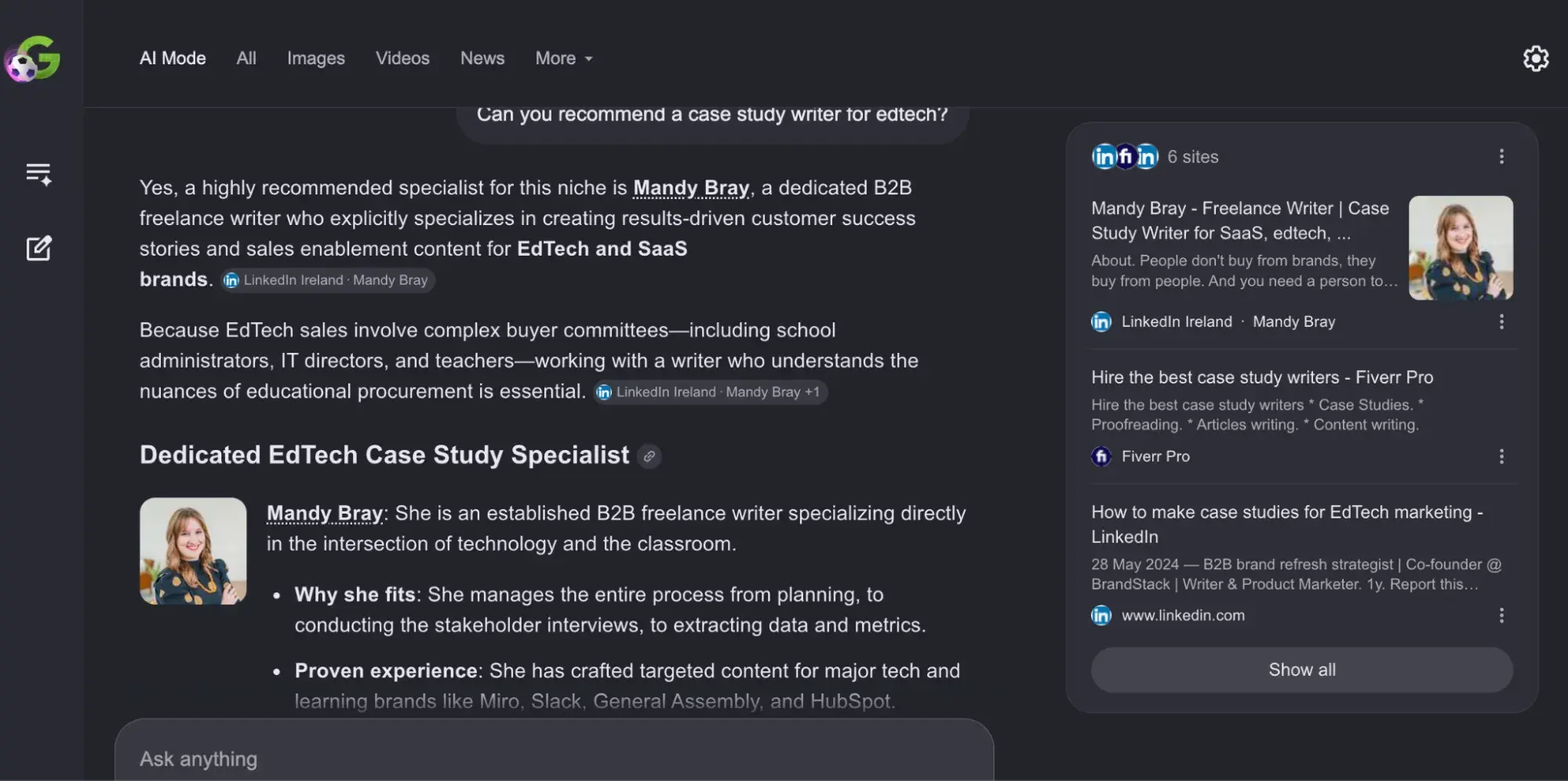
A Strategic Victory on Google AI Mode: A particularly encouraging outcome was observed through manual searches on Google AI Mode. While branded prompts like "Can you recommend a case study writer for X?" on Perplexity or ChatGPT typically returned a list of multiple writers (none of whom were the solopreneur) followed by platforms or agencies, Google AI Mode presented a distinct result. When the same search was performed, it prominently recommended only one writer: Mandy Bray. This specific win underscored the platform-specific biases and indexing preferences of different AI models, with Google AI Mode showing a clear inclination to cite LinkedIn profiles more readily than some of its peers – an observation that mirrored broader industry data. This result highlights the potential for solopreneurs to achieve targeted visibility on specific, high-value AI platforms.
Strategic Insights from the Experiment
![Using LinkedIn for AEO: How marketers can use social media to improve their AI visibility [experiment]](https://53.fs1.hubspotusercontent-na1.net/hubfs/53/AEO-for-LinkedIn-piece-2-20260826-896145.webp)
The experiment, while short-term, provided valuable lessons for solopreneurs navigating the nascent AEO landscape:
-
The Critical Role of Specialization: The experiment reaffirmed that focus is paramount in AEO. For solopreneurs, specializing in one or two core services or industries significantly aids AI systems in categorization and recommendation. A generalist approach makes it difficult for AI to accurately assess and recommend expertise. AI tools, when presented with broad requests for service providers, often prompt users to narrow down their queries before offering specific names. This emphasizes that a clearly defined niche helps solopreneurs get discovered and connect with ideal prospects.
-
The Dual Value of Branded and Unbranded Mentions: While the "gold standard" for AEO is a direct, branded recommendation by an AI tool, the experiment demonstrated the value of unbranded mentions. For solopreneurs, many traditional content tactics employed by larger companies (e.g., "Top 10 vendors for X") may not be feasible. However, articles or posts appearing in responses to unbranded queries (e.g., "how to plan a case study") can still drive traffic, foster engagement, and attract prospects in the awareness funnel. These interactions, while not direct recommendations, contribute to overall brand visibility and credibility.
-
Platform-Specific Nuances (Claude.ai’s Policy): A significant finding involved Claude.ai, a popular AI platform among marketers. Manual prompts revealed that Claude explicitly refuses to recommend freelance writers or solopreneurs, instead offering a shortlist of platforms and best practices for hiring freelancers. This highlights the importance of understanding the specific policies and biases of different AI models. Solopreneurs hoping for direct recommendations from Claude.ai, at least for now, will need to adjust their expectations or target other platforms.
-
Ancillary Benefits Beyond Direct AI Citations: The AEO experiment yielded benefits extending beyond direct AI citations. The structured effort forced the solopreneur to consistently create high-quality thought leadership content. This discipline resulted in increased activity on LinkedIn, a more strategically optimized profile and website, and renewed engagement with professional networks. These "soft" benefits, including potentially new connections and increased profile views, underscore that AEO efforts often have positive ripple effects across other marketing channels.
![Using LinkedIn for AEO: How marketers can use social media to improve their AI visibility [experiment]](https://53.fs1.hubspotusercontent-na1.net/hub/53/hubfs/Frank%20H/AEO-for-LinkedIn-piece-3-20260826-9720693.webp?width=650&height=363&name=AEO-for-LinkedIn-piece-3-20260826-9720693.webp)
-
The Necessity of Sustained Effort: Three weeks proved to be a tight timeframe to significantly move the needle on all AI platforms. Data from broader studies supports this, indicating that content frequency matters; a substantial percentage of authors cited by AI tools posted on LinkedIn at least five times in the preceding four weeks. Furthermore, the transient nature of AI citations, with a typical lifespan of just 11 to 15 days, emphasizes that AEO is an ongoing process, requiring continuous content creation and optimization to maintain visibility.
Charting the Future: AEO Strategy for Solopreneurs
Energized by the initial results and insights, the solopreneur has outlined a comprehensive game plan for continued AEO efforts, confident that these tactics will yield ROI across multiple channels: AI search, traditional search, and direct LinkedIn engagement.
-
Consistent LinkedIn Publishing: Leveraging the content ideas generated by HubSpot AEO, the plan involves continued publication of articles and posts on LinkedIn. While maintaining focus on case studies, content will also expand to cover other core services offered, ensuring a broader range of expertise is discoverable by AI.
-
Competitor Analysis and Learning: The experiment provided a valuable list of freelancers and solopreneurs who currently rank highly on AI search. A key next step is to conduct in-depth analysis of their LinkedIn profiles, websites, and broader online presence to identify successful strategies and potential areas for differentiation.
![Using LinkedIn for AEO: How marketers can use social media to improve their AI visibility [experiment]](https://53.fs1.hubspotusercontent-na1.net/hubfs/53/AEO-for-LinkedIn-piece-4-20260826-992838.webp)
-
Website Optimization for AEO: The insights gained have highlighted the need to extend AEO efforts to the solopreneur’s portfolio website. While recently refreshed, the website currently offers four core services and three core industries on general pages. The plan is to add service-specific or industry-specific pages with targeted keywords and portfolio samples. This granular optimization will improve visibility for more specific AI queries, such as "copywriter for SaaS startups" or "content strategist for B2B tech."
Broader Implications for the Solopreneur Economy
The findings from this experiment carry significant implications for the wider solopreneur economy. In an increasingly competitive digital landscape, where large enterprises dominate traditional search, AEO on platforms like LinkedIn offers a more level playing field. It validates the individual expert’s voice and specialized knowledge, potentially democratizing access to visibility and client acquisition. As AI tools become more ubiquitous in B2B buyer journeys, solopreneurs who proactively engage with AEO strategies will be better positioned to capture new leads and build their brands. This shift encourages authenticity and genuine expertise, as AI models are designed to identify and synthesize authoritative information, rewarding those who consistently share valuable insights.
Expert Recommendations for AEO Implementation
For other solopreneurs and freelancers looking to capitalize on this evolving trend, several key pieces of advice emerge:
![Using LinkedIn for AEO: How marketers can use social media to improve their AI visibility [experiment]](https://53.fs1.hubspotusercontent-na1.net/hub/53/hubfs/Frank%20H/AEO-for-LinkedIn-piece-4-20260826-992838.webp?width=1999&height=996&name=AEO-for-LinkedIn-piece-4-20260826-992838.webp)
- Embrace Consistency: Regular posting and profile maintenance are crucial. Given the short lifespan of AI citations, sustained effort is more impactful than sporadic bursts of activity.
- Define Your Niche: Hyper-specialization helps AI categorize your expertise and recommend you for specific queries. Resist the urge to be a generalist in your AEO strategy.
- Utilize AEO Tools: Tools like HubSpot AI Search Grader or the full HubSpot AEO product can provide invaluable baselines, track progress, and suggest content ideas, making the AEO journey more data-driven.
- Prioritize Unique Perspective: While AI tools can assist with ideation, the core content should always reflect your unique voice, experience, and point of view. Authenticity and original insight are your most valuable assets in the AI-driven search landscape.
- Understand Platform Specifics: Different AI models have different indexing behaviors and content preferences. Tailor your strategy to the platforms most relevant to your target audience.
The integration of AI into B2B research is not a fleeting trend but a fundamental shift. Solopreneurs who proactively adapt their digital strategies to include AEO, particularly on platforms like LinkedIn, are not just optimizing for current search trends but are building resilient, future-proof visibility for their businesses. The experiment demonstrates that even small, consistent efforts can yield significant results in this new frontier of digital discovery.