The digital landscape is undergoing a profound transformation as artificial intelligence (AI) answer engines increasingly become the primary interface for consumer product research and information discovery. With roughly 58% of consumers now utilizing AI tools like ChatGPT, Perplexity, and Google AI Overviews weekly for product research, a figure that continues to climb rapidly, content and SEO professionals face a critical strategic question: what is the enduring relationship between backlinks and Answer Engine Optimization (AEO), and does this necessitate a complete overhaul of traditional authority-building playbooks? The immediate answer suggests a shift in emphasis: contextually relevant backlinks retain significant value, often surpassing high-volume, low-relevance links for AEO purposes. However, their role is now part of a much broader, more complex narrative of digital authority.
The Ascent of AI Answer Engines: A Paradigm Shift in Search
The emergence of AI-powered answer engines marks a significant departure from the traditional "10 blue links" search results that have dominated the internet for decades. This shift is driven by advancements in large language models (LLMs) and a growing user preference for direct, synthesized answers rather than a list of websites to sift through. Google’s introduction of AI Overviews, alongside the rapid adoption of standalone AI chat platforms, signifies a pivotal moment. Users are no longer just searching for information; they are seeking definitive answers, explanations, and even recommendations, often without needing to click through to an external website. This evolution fundamentally alters how brands achieve visibility and establish credibility online.
Historically, search engine optimization (SEO) has revolved around algorithms that prioritized factors like keyword density, internal linking, and, most crucially, backlinks. Backlinks, acting as "votes of confidence" from one website to another, were a cornerstone of PageRank and subsequent algorithmic iterations, signaling a domain’s authority and trustworthiness. A link from a highly trusted domain was a powerful endorsement, weighted by the linking domain’s own authority, the relevance of its content, and the anchor text used. While AI answer engines do not entirely abandon this foundational logic of off-page SEO, they layer a sophisticated new set of evaluation criteria on top. When an AI system constructs a response, it doesn’t merely tally backlink counts; instead, it seeks to identify the most reliable and authoritative sources to ground its generated answer, moving beyond quantitative link metrics to qualitative signals of expertise and trustworthiness. This necessitates a re-evaluation of how digital authority is built and measured, giving rise to specialized tools designed to track this new form of AI visibility.
Redefining Authority: Backlinks in the Age of AEO
In the AEO landscape, backlinks continue to hold sway, yet their influence is profoundly reshaped. SEO remains the bedrock upon which any successful AI search strategy must be built, but the quality and relevance of links now matter far more than sheer volume. As Nathaniel Miller, Head of Marketing at Ashbrook Technologies, observed in a podcast interview, "The companies ranking highest across AI platforms tend to be the ones with both strong authority and strong backlink profiles." He emphasized that "if you’re not getting qualified traffic from that link, it’s basically a logo slap. The real value is in relevance and authority – not just size."
This distinction is crucial. Traditional SEO often rewarded links from high-Domain Authority (DA) sites, regardless of their precise topical relevance. For AEO, however, the semantic alignment between the linking source and a brand’s specific topic cluster is paramount. A high-DA link from an irrelevant site offers minimal semantic signal to an AI, whereas a link from a niche blog with deep topical expertise can significantly reinforce entity authority and trust.
Consider the nuanced impact of different link types:
- High-DA, low-relevance link: While highly influential in classic SEO for domain authority boosts, its AEO influence is low due to a weak semantic signal.
- High-DA, high-relevance link: Commands very high influence in both classic SEO and AEO.
- Industry publication link: High influence in classic SEO, and even higher in AEO, especially if the publication is a recognized grounding source for AI.
- Niche blog link with strong topical depth: Moderate in classic SEO, but high in AEO, as semantic adjacency reinforces entity authority.
- Directory or aggregator link: Low to moderate in classic SEO, but minimal in AEO due to lack of specific contextual relevance.
- Co-citation in expert roundup: Indirect influence in classic SEO, but high in AEO, as it positions a brand alongside recognized authorities.
Beyond direct hyperlinks, the concept of mentions and co-citations has gained equal, if not greater, importance. An unlinked brand mention, where a brand name appears in a credible source without a hyperlink, acts as a powerful signal to AI systems. It indicates that a source references the brand within a specific topical context. When such mentions occur repeatedly across diverse and credible sources, they contribute to a cumulative authority that significantly influences the likelihood of a brand being cited in AI-generated answers. Charlie Graham, founder of RivalSee, highlighted this phenomenon on the Found in AI podcast, noting that approximately 85% of brands mentioned in ChatGPT responses lack a direct citation link. This suggests that users encounter the brand name, remember it, and then search for it independently – a downstream effect that serves as a tangible, albeit indirect, authority signal, often invisible to traditional analytics.
Beyond the Link: The New Pillars of AI Visibility
AEO fundamentally extends SEO, building upon its foundations while adapting to an environment where the user interface and evaluation criteria have evolved. While SEO primarily targets ranking in search results to drive clicks and traffic, AEO focuses on becoming a trusted source that an AI system quotes, paraphrases, or cites directly. This divergence in objectives leads to distinct strategies for content structure, success metrics, and optimization priorities.
Key signals, beyond traditional backlinks, now significantly influence AEO citation:
- Unlinked Brand Mentions: These occur when a brand name appears in credible sources without a hyperlink. AI systems utilize these mentions to map brands to specific topic clusters, building "entity authority" that makes a brand an obvious citation choice. The more frequently a brand is mentioned in relevant, authoritative contexts, the stronger its entity association becomes.
- Co-citations: This involves a brand being mentioned alongside other recognized brands or sources within the same content, again, without necessarily linking. For AI engines, co-citations are potent semantic signals, implying that a brand belongs in the same authoritative company as its co-cited peers. This is an often-underestimated AEO tactic.
- Entity Clarity: An entity in AI search refers to a clearly defined, consistently described concept, brand, or person. As Lars Lofgren, SEO consultant, emphasized, AI engines are essentially mapping relationships among all crawlable information. Brands with strong entity clarity – consistent naming, structured data (Organization/Person/sameAs schema), and a clear area of expertise across all channels – are far more likely to be cited. Any ambiguity or inconsistency in a brand’s identity can act as a "silent AEO killer," as AI systems are hesitant to cite sources they cannot confidently identify and verify.
- Interplay with Backlinks: No single signal operates in isolation. The most successful brands in AEO demonstrate a synergistic combination of authoritative links, consistent brand mentions, strong co-citation associations, and a clearly defined entity. As Miller aptly stated, "If your content isn’t great, no number of backlinks will help." Quality content remains the ultimate foundation upon which all these signals are built.
Crafting Content for AI Citation
AI systems retrieve information from indexed content, and content that is easily parsed, clearly organized, and directly answers questions is systematically more likely to be cited. Therefore, structuring content specifically for AI consumption is paramount.
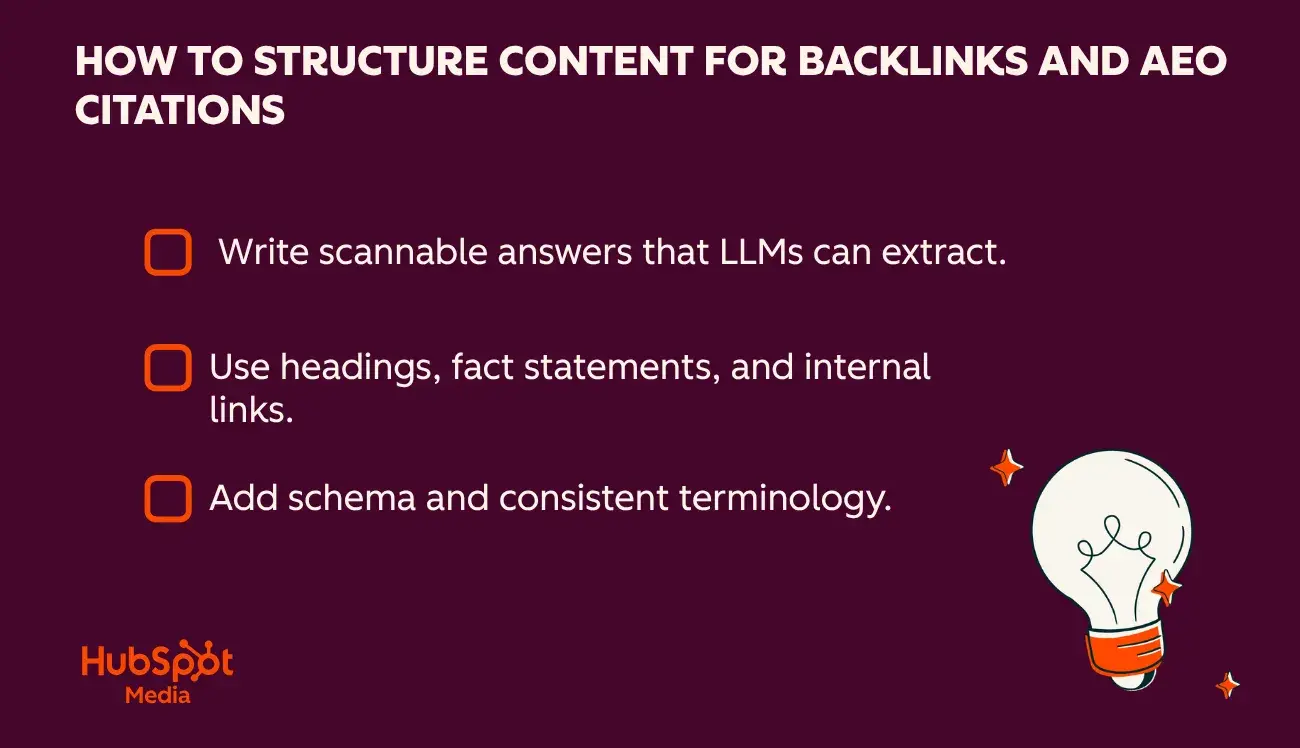
- Write Scannable, LLM-Extractable Answers: Each major section of a page should contain a direct, self-contained answer to the question implied by its heading. The strategy is "answer first, evidence second." Leading with the answer, then supporting it with context, data, or examples, significantly increases the likelihood of an LLM extracting and citing that content. This involves using clear, concise language, avoiding jargon where possible, and structuring information for easy readability.
- Utilize Headings, Fact Statements, and Internal Links: Strategic use of H2/H3 headings breaks content into digestible chunks. Prominently featuring fact statements (e.g., "A recent study found X%…") allows for easy extraction. A dense and relevant internal linking structure around a topic cluster signals topical depth and authority to AI crawlers, reinforcing the "Structure" component of the Freshness, Structure, Authority (FSA) framework.
- Implement Schema Markup and Consistent Terminology: Schema markup provides machine-readable metadata that clarifies a page’s purpose and structure for both traditional search and AI systems. Valuable schema types for AEO include Organization, Person, Product, FAQPage, HowTo, and Article schema. Beyond structured data, maintaining consistent terminology across all brand channels – website, social media, external mentions – is critical. If a brand uses multiple terms for the same concept, AI systems struggle to build a clear entity association, hindering citation potential.
Strategic Adaptation: Building AEO-Salient Mentions and Links Across Platforms

Effective AEO strategies integrate link building and mention building into a single, cohesive effort. Every outreach action should be designed to generate both a structural link signal and a brand mention that AI systems can index.
- Prioritize AI-Friendly Content Formats: Certain content formats are disproportionately favored for AI citations. These include comprehensive guides, FAQs, comparison tables, data-driven reports, and structured "how-to" articles. For original research, a dedicated "Key Findings" section at the top with three to five clearly labeled statistics significantly boosts extractability and citation likelihood.
- Earn Relevant Links and Co-citations with Original Research and Digital PR: Original research is arguably the most efficient way to generate both high-quality backlinks and co-citations. A well-executed study or data report provides other publishers with a compelling reason to link to a brand as a primary source. The subsequent media coverage often mentions the brand alongside other respected voices, creating valuable co-citation signals. Beyond research, digital PR – securing earned media placements, providing expert commentary to industry publications, and appearing on podcasts – is a powerful backlink strategy that concurrently delivers link authority and authentic brand mentions. As Miller noted, "Digital PR is the fastest way to start building momentum," capable of generating a backlink, a brand mention, and a co-citation from a single, well-placed expert quote.
- Participate Where Answers Form: AI systems do not solely index brand-owned content; they draw from authoritative conversations across various platforms. Active participation in these channels expands a brand’s footprint across sources that AI systems are trained to trust. This includes contributing expert commentary to industry forums, publishing thought leadership on platforms like LinkedIn, and participating in Q&A services such as Qwoted and HARO. Building relationships within these communities fosters organic mentions and external citations.
Measuring Success in the AEO Era: The Repeatable Loop
To make measurable progress in AEO, brands must adopt a disciplined approach to experimentation and measurement. Without a clear feedback loop between content publication, shifts in authority signals, and actual AI citations, optimization efforts remain guesswork. The "Loop Marketing" framework, which posits that every content and outreach action should feed data back into the next iteration, is particularly relevant here.
- Benchmark AI Visibility and Citations: Before any optimization, establish a baseline. This involves identifying current AI citation frequency, mapping the content that is (or isn’t) being cited, and understanding which types of queries trigger these citations. Tools that track AI visibility alongside traditional search performance are invaluable, offering a unified dashboard for SEO and AEO metrics.
- Tie Changes to Content and Outreach Activity: For measurement to be truly useful, changes in AI visibility must be directly attributable to specific content or outreach actions. This requires meticulous logging of activities: when a new piece of content is published, an old one updated, a backlink secured, or a brand mention earned. Over time, patterns will emerge, revealing which content types, outreach strategies, and authority-building efforts yield the most significant AEO impact.
- Report What to Scale and What to Stop: The final stage in this iterative loop is translating measurement into actionable prioritization decisions. Regular monthly reviews should address critical questions: Which content is driving the most AI citations? Which authority signals (links, mentions, entity clarity) are showing the strongest correlation with improved AEO? What specific content or outreach efforts should be scaled up, and which should be deprioritized? This continuous feedback loop transforms AEO from a reactive task into a compounding, strategic advantage.
The Complementary Future of SEO and AEO
The notion of a conflict between backlinks and AEO is a false dichotomy. Instead, they represent different, yet integrated, layers of the same authority infrastructure. Backlinks continue to provide the structural credibility necessary for content to be indexed, trusted, and used as a grounding source by AI systems. Concurrently, brand mentions, co-citations, entity clarity, and meticulously structured content build the broader signal intelligence that informs an AI system that a brand is a reliable and authoritative source for a given answer.
The content teams achieving tangible progress in AI visibility today are not abandoning their existing SEO programs. Rather, they are refining them, making them more precise, more entity-aware, and more consistently structured to meet the demands of this evolving search paradigm. As AI continues to reshape how users discover information, a holistic strategy that harmonizes the enduring power of relevant backlinks with the emerging imperatives of AEO will define digital success.