The rapid proliferation of Large Language Models (LLMs) has fundamentally altered the landscape of software engineering, leading to a widespread misunderstanding of the distinction between traditional automation and true agentic artificial intelligence. Across global engineering teams, a recurring pattern has emerged: a developer integrates a series of LLM calls within a loop, incorporates external tools, and classifies the resulting system as an "AI agent." While these systems frequently perform with high efficacy during controlled demonstrations, they often undergo catastrophic failure upon deployment into production environments. These failures—ranging from infinite loops and redundant customer communications to the complete bypass of critical logic—stem from a failure to distinguish between deterministic workflows and adaptive agentic behavior. Understanding the boundary where automation ends and agentic AI begins is no longer a theoretical exercise but a technical necessity for building reliable, scalable, and cost-effective enterprise systems.
The Evolution of Workflow Logic: From Cron Jobs to Autonomous Agents
To understand the current friction in AI development, one must examine the chronology of system design. For decades, software engineering relied on "Basic Automation," characterized by predefined, rules-based logic. These systems, such as cron jobs or ETL (Extract, Transform, Load) pipelines, operate on a "if-this-then-that" basis. They are highly predictable, auditable, and efficient, but they are also fragile. A minor change in input format, such as a renamed column in a CSV file, typically results in a system crash because the automation lacks the capacity to reason about the change.
The advent of LLMs in late 2022 introduced "LLM-assisted Automation." In this phase, developers began inserting LLMs into specific nodes of a fixed workflow to handle unstructured text or classification tasks. However, the sequence of steps remained hardcoded. The current "Agentic Era," which gained momentum in 2024, attempts to move beyond these fixed sequences. True agentic AI is designed to be goal-oriented rather than process-oriented. Instead of following a map, an agent is given a destination and must navigate the terrain dynamically, adjusting its route based on real-time observations and environmental feedback.
Defining the Divergence: Automation vs. Agentic AI
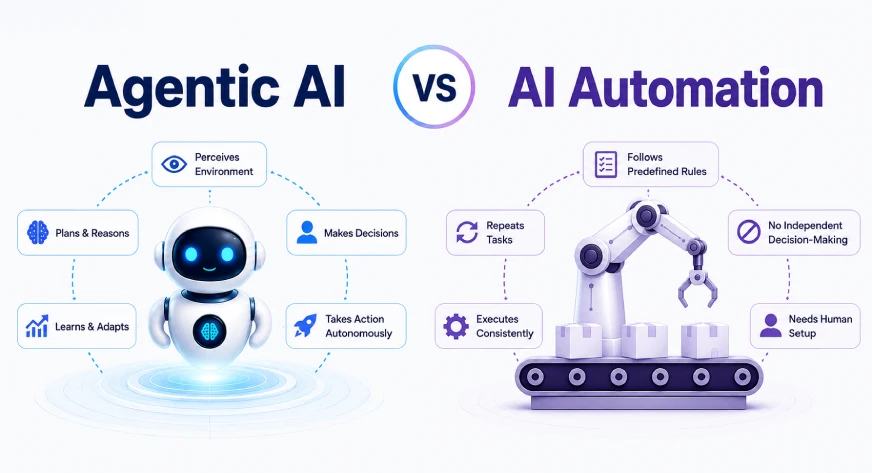
The fundamental difference between these two paradigms lies in how they handle uncertainty and decision-making. Automation is built for stability in a controlled environment, whereas agentic AI is built for adaptability in an unpredictable one.
Deterministic Rules vs. Dynamic Goals
Automation executes a sequence of predefined steps. If a developer programs a system to process an invoice, the system follows steps A, B, and C in order. Agentic AI, conversely, is assigned a goal—such as "reconcile this account"—and decides which steps are necessary based on the current state of the data. If the agent encounters a missing document, it does not simply throw an error; it may search an email archive or query a database to find the missing information before proceeding.

Fixed Logic vs. Contextual Reasoning
Traditional automation operates on static logic that cannot adapt beyond its programmed parameters. Agentic AI utilizes "Reasoning" (often via frameworks like ReAct: Reason + Act) to evaluate context. It maintains a "memory" of previous actions and their outcomes, allowing it to learn from failed attempts within a single session and pivot to a more effective strategy.
Predictability vs. Flexibility
Automation is highly deterministic; given the same input, it will always produce the same output. This makes it ideal for compliance and financial reporting. Agentic AI is inherently less predictable because its pathing is decided at runtime. While this introduces a layer of complexity in debugging, it provides the flexibility required for complex problem-solving, such as software debugging or multi-step market research.
The Four Levels of System Agency
To assist engineering teams in classifying their builds, industry analysts have identified four distinct levels of agency. Misidentifying a system’s level is the primary cause of production-stage failures.
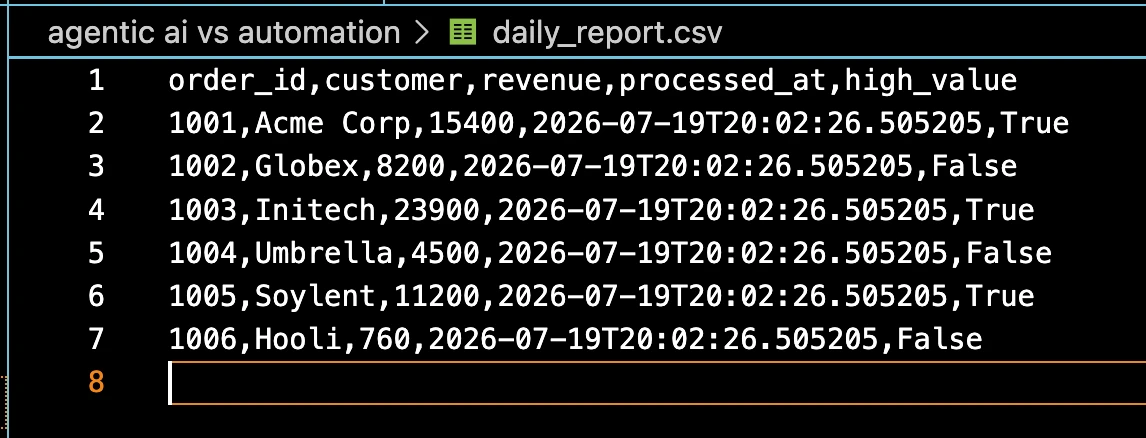
- Level 1: Basic Automation: These are systems with no LLM involvement, such as a legacy script that generates a daily sales report. They are fast and cheap but entirely rigid.
- Level 2: LLM-Assisted Automation: The system follows fixed steps, but uses an LLM for a specific task, such as summarizing a support ticket. This is often marketed as an "agent" but remains a "fancier vending machine."
- Level 3: Partially Agentic: The system is given a goal and a set of tools. The LLM decides which tool to use and in what order, but the overall scope is narrow. This is the current "sweet spot" for many enterprise applications.
- Level 4: Fully Agentic: The agent sets its own sub-goals, potentially builds its own tools or scripts, and operates with minimal human intervention over extended periods. Examples include autonomous coding assistants that can manage an entire repository.
Case Study Analysis: Customer Support Implementations
The distinction between these paradigms is best illustrated through a comparative analysis of a customer support ticket handler.
The Automation Approach
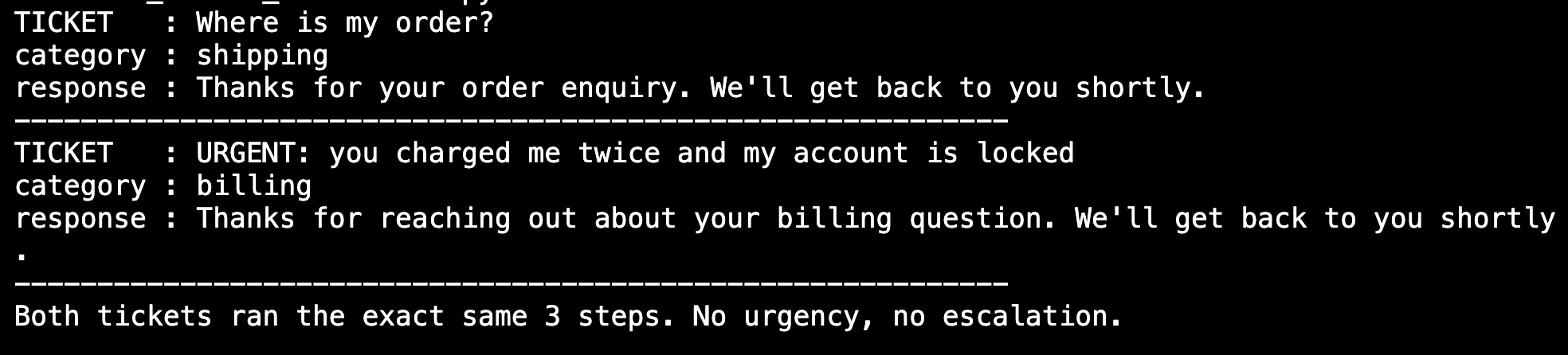
In an automated version, the system is a linear pipeline. It classifies a ticket as "Billing," selects a "Billing Template," fills in the user’s name, and sends the response. This system is efficient for high volumes of simple queries. However, if a customer sends a complex message—such as "I was overcharged, and now my account is locked, and I need this fixed before my meeting in an hour"—the automation will likely fail. It might only address the "Billing" aspect while ignoring the "Locked Account" and "Urgency" factors, leading to customer frustration.
The Agentic Approach
An agentic system views the same ticket as a problem to be solved. It reads the text and "reasons" that it needs to perform three actions: check the billing history, check the account status in the admin tool, and escalate the ticket to a human manager due to the urgent tone. The agent decides the sequence: it checks the account first, finds the lock, unlocks it using a provided API tool, and then drafts a personalized response explaining that the overcharge is being investigated. The path is not hardcoded; it is a direct response to the specific nuances of the input.

Why "Agents" Fail in Production: The Reliability Crisis
The "production gap" occurs when developers attempt to use Level 2 or 3 logic to solve Level 4 problems. Several technical factors contribute to these failures:
- The Happy Path Fallacy: During development, "agents" are often tested against "happy path" inputs where the logic flows smoothly. In production, "edge cases" are the norm. An agent without robust guardrails may enter a "hallucination loop," where it repeatedly tries the same failing action because it lacks the logic to recognize it is stuck.
- Context Window Drifts: As an agent performs multiple steps, its "memory" or context window fills up. If not managed correctly, the agent may lose sight of the original goal, leading to "drifting" where it begins performing irrelevant tasks.
- Tool Over-Reliance: Many systems fail because the LLM chooses the wrong tool for a task or provides the tool with incorrectly formatted data. Without a deterministic validation layer, these errors propagate through the system.
Strategic Implications and Implementation Recommendations
For organizations looking to deploy AI effectively, the recommendation from industry experts is to "start with automation and earn your way to agency."
When to Choose Automation
Automation remains the superior choice for tasks where the process is well-defined and the cost of error is high. This includes financial auditing, data migration, and regulatory reporting. The predictability of these systems ensures that they remain auditable and compliant with corporate governance standards.
When to Choose Agentic AI
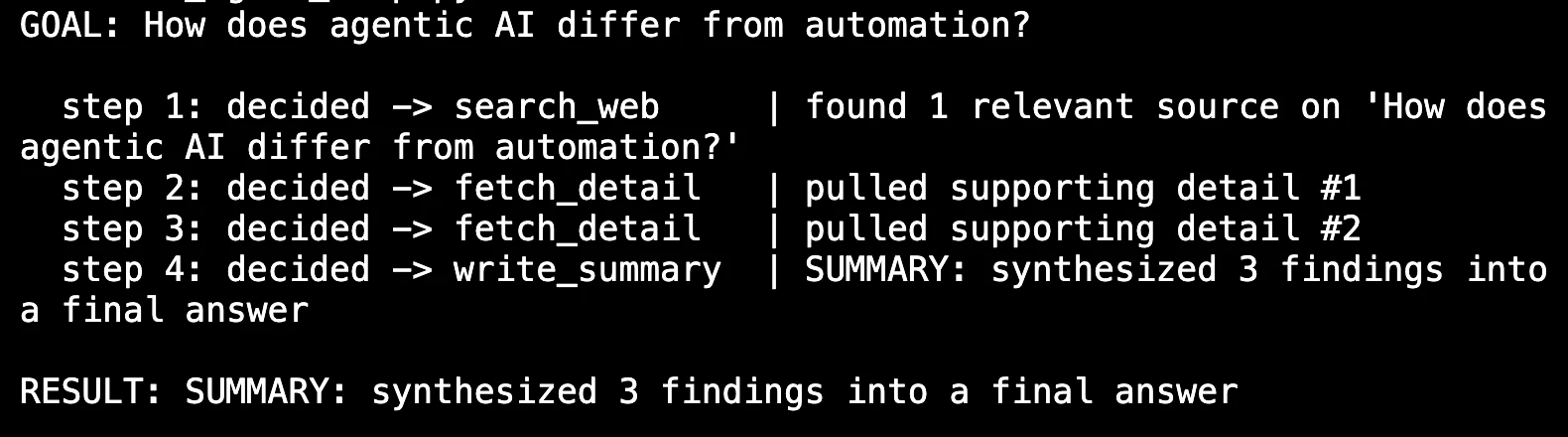
Agency should be reserved for tasks where the input is highly variable and the path to a solution cannot be mapped in advance. This includes open-ended research, complex customer negotiations, and creative problem-solving.
Building Hybrid Systems
The most successful enterprise implementations are currently hybrid. They utilize deterministic automation for the "skeleton" of the workflow and inject agentic behavior only at specific decision nodes where flexibility is required. This "constrained agency" allows for the benefits of LLM reasoning while maintaining the guardrails necessary for production stability.
Conclusion
The transition from automation to agentic AI represents a shift from "programming" to "steering." While the allure of autonomous agents is significant, the reality of production environments demands a disciplined approach to system architecture. Engineering teams must move away from the "loop-and-prompt" method of building agents and instead focus on robust state management, comprehensive logging of reasoning paths, and strict boundary definitions. By recognizing that automation and agentic AI are complementary tools rather than competing philosophies, organizations can build systems that are not only impressive in a demo but resilient in the face of real-world complexity. The future of AI is not just about making machines smarter; it is about knowing when to give them the wheel and when to keep them on the tracks.