The Evolution of the Frontier Model Market
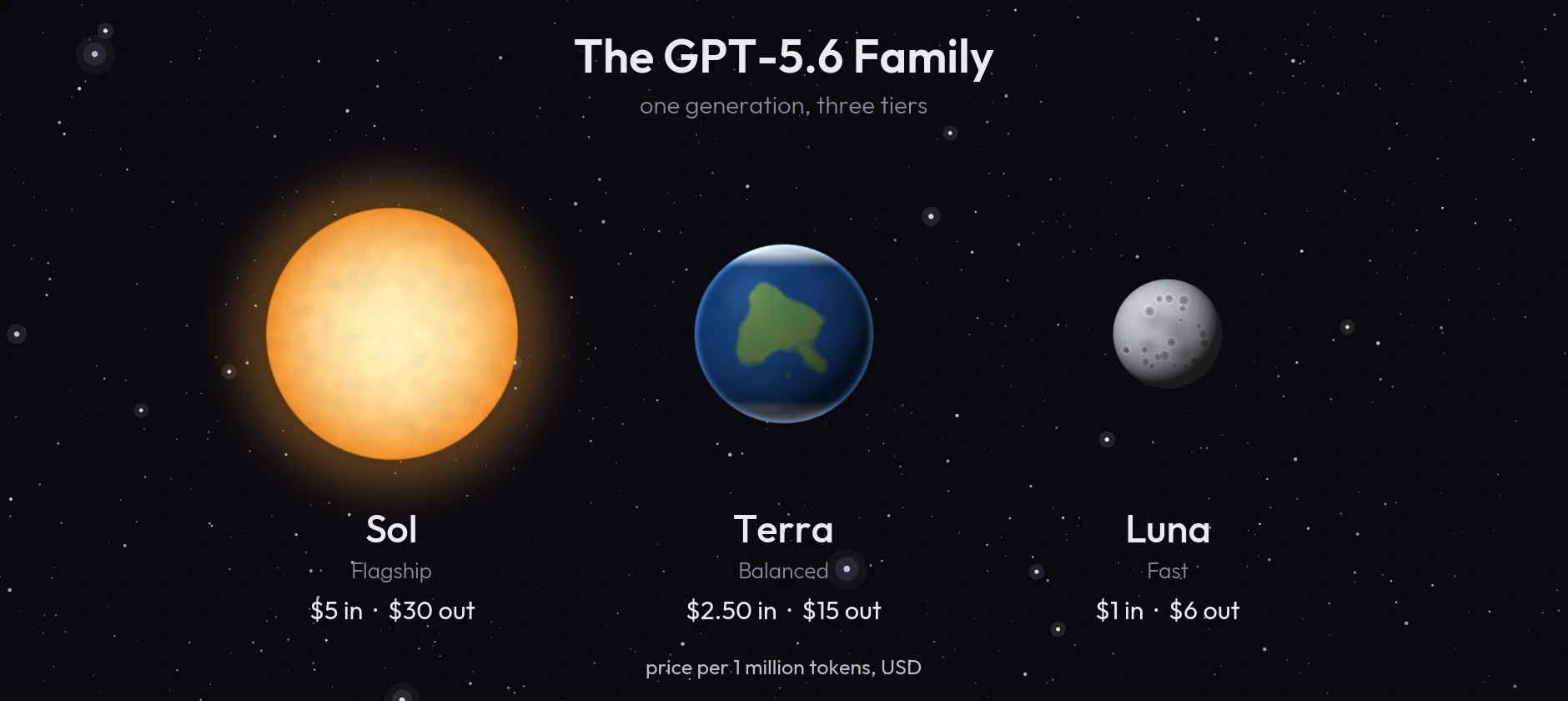
The current competition between GPT-5.6 Sol and Claude Fable 5 is the result of years of iterative development following the transformative releases of 2024 and 2025. OpenAI’s "Sol" variant is part of the broader GPT-5.6 family, which includes the Terra and Luna models, each optimized for different scales of compute and specific use cases. Sol serves as the flagship for professional applications, specifically targeting research, complex tool use, and software engineering.
Anthropic’s Fable 5, conversely, represents the evolution of the Claude lineage toward "agentic" autonomy. Since the introduction of the Claude 3 series, Anthropic has focused on a model’s ability to not only process information but to act as an independent planner. Fable 5 is the culmination of this "Constitutional AI" approach, designed to operate within environments like Claude Code or Managed Agents, where it can self-correct and delegate tasks with minimal human intervention.
Technical Profiles: GPT-5.6 Sol and Claude Fable 5
GPT-5.6 Sol is engineered for high-intensity professional environments. Its architecture supports a "max reasoning" feature, which allows the model to allocate additional test-time compute to solve particularly dense logical puzzles. For enterprise-level tasks, Sol features an "Ultra Mode," which deploys multiple specialized agents in parallel to tackle large-scale coding repositories or multi-stage research projects. This parallelization allows Sol to maintain high accuracy across thousands of lines of code without the degradation typically seen in smaller context windows.
Claude Fable 5 is positioned as Anthropic’s most capable public offering. Its primary strength lies in its sophisticated planning capabilities. Unlike models that respond to prompts in a linear fashion, Fable 5 is designed for long-running agentic work. It can devise a multi-step project plan, create sub-agents to handle specific components, review the intermediate results of those sub-agents, and refine its final output based on internal critiques. This makes it a preferred choice for organizations looking for "set-and-forget" AI solutions for deep research and architectural planning.
The Economic Shift: A Comparative Pricing Analysis
One of the most significant developments in the 2026 AI market is the aggressive pricing strategy adopted by OpenAI for the GPT-5.6 Sol model. In a move that industry analysts suggest is aimed at capturing the developer market, OpenAI has priced Sol closer to the previous generation’s mid-tier models than to its direct competitors.

The API pricing per million tokens is as follows:
- GPT-5.6 Sol: $5.00 for Input, $0.50 for Cached Input, and $30.00 for Output.
- Claude Fable 5: $10.00 for Input, $1.00 for Cached Input, and $50.00 for Output.
This pricing structure reveals that GPT-5.6 Sol is approximately 50% cheaper for input and 40% cheaper for output compared to Fable 5. While both models offer substantial context windows—roughly one million tokens—Sol provides a slight edge with a 1.05 million token capacity. However, OpenAI has implemented a tiered pricing system where requests exceeding 272,000 input tokens incur a higher rate for the entire request, a nuance that high-volume enterprise users must consider.
The disparity in cost suggests that OpenAI is leveraging its infrastructure to drive adoption through affordability, whereas Anthropic is positioning Fable 5 as a premium, high-reasoning service for specialized tasks where the cost is justified by the reduction in human oversight required.
Empirical Performance Testing
To evaluate these models in real-world scenarios, a series of standardized tests were conducted focusing on coding, data analysis, and professional presentation.

Frontend Engineering and Design
In a test requiring the creation of a responsive personal finance dashboard using only vanilla HTML, CSS, and JavaScript, both models demonstrated high levels of competency. GPT-5.6 Sol produced a fully functional, fintech-ready dashboard in 6 minutes and 30 seconds. The code was robust, following modern design principles and including interactive features like light/dark modes and category filters.
Claude Fable 5 completed the same task in significantly less time—3 minutes and 10 seconds. While the speed was impressive, the visual presentation was slightly more utilitarian than Sol’s output. However, Fable 5’s code structure was noted for its modularity, suggesting a better internal understanding of long-term maintainability.
Data Analysis and Strategic Reasoning
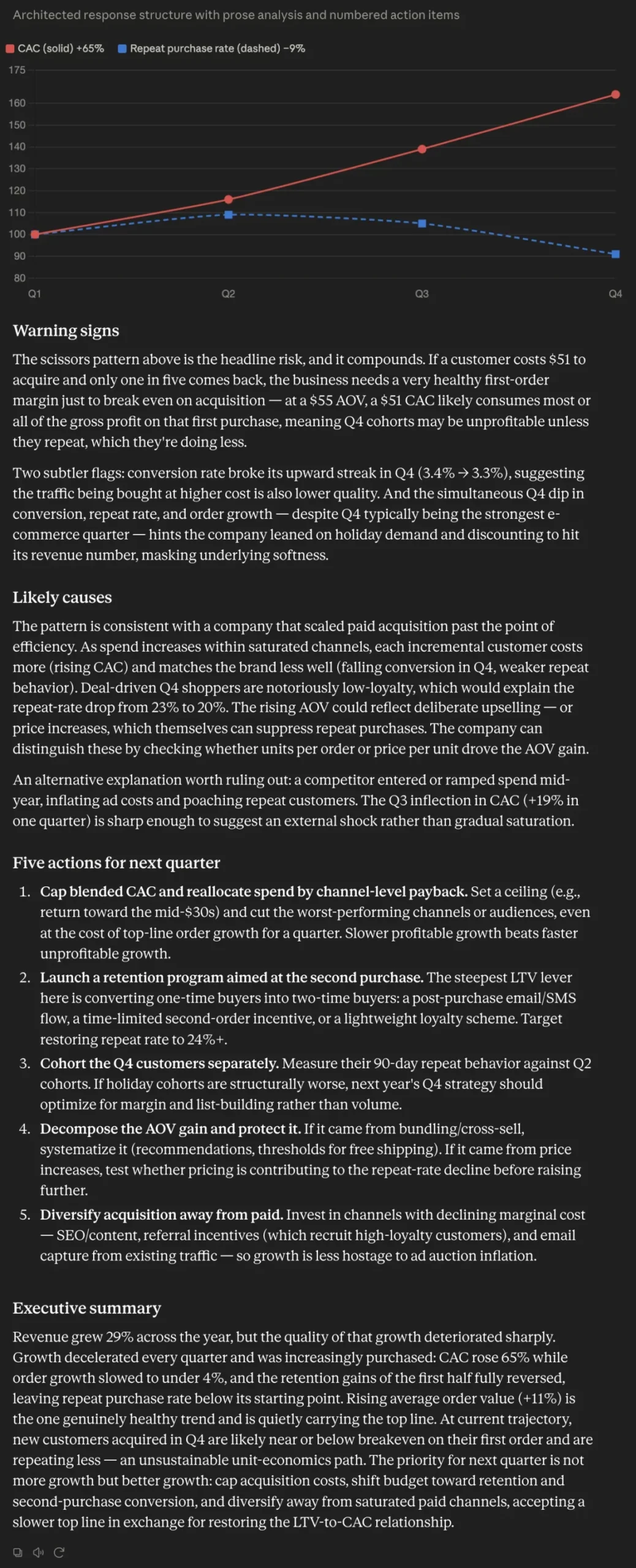
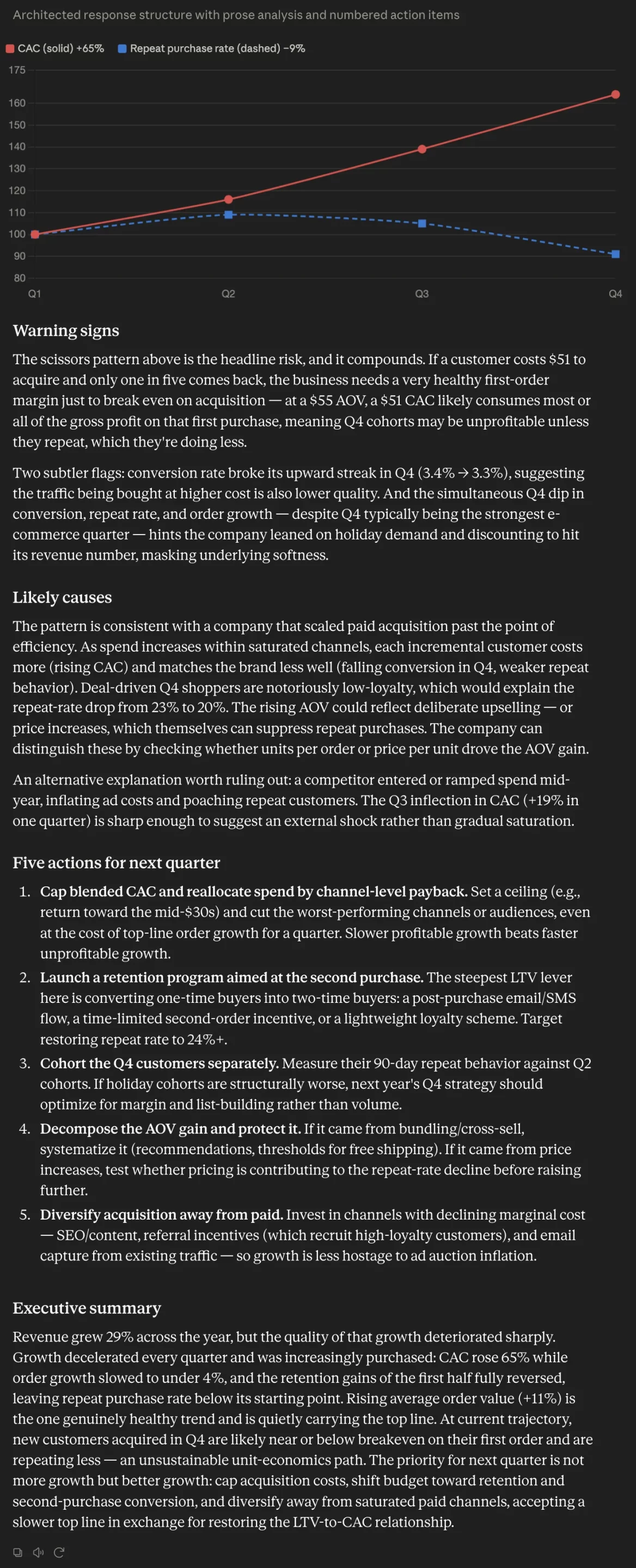
The models were tasked with acting as senior data analysts to review a year of e-commerce performance data. The prompt required the derivation of business insights from revenue, conversion rates, and customer acquisition costs (CAC).
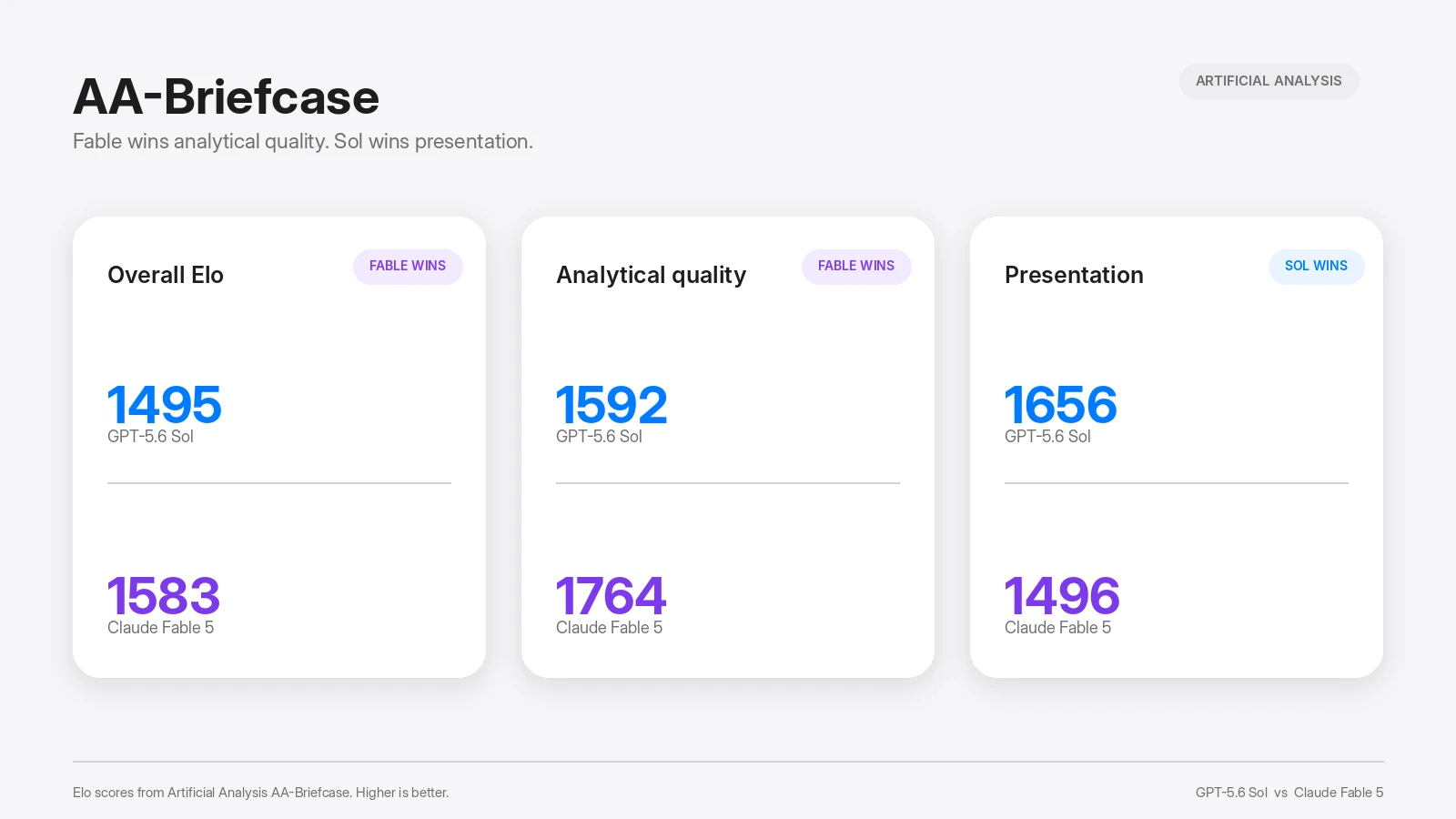
GPT-5.6 Sol delivered a highly polished executive summary in 1 minute and 20 seconds. It excelled at identifying the correlation between rising CAC and declining repeat purchase rates in Q4, providing actionable steps for the upcoming quarter. Claude Fable 5 responded in 1 minute, providing a deeper analytical dive into the underlying causes of the trends. While Sol’s presentation was superior, Fable 5’s insights into the long-term sustainability of the company’s growth model were more nuanced.

Professional Presentation and Content Structure
In creating an eight-slide investor deck for an AI recruitment platform, the models were judged on their ability to structure a narrative and provide realistic market data. GPT-5.6 Sol took 4 minutes and 38 seconds to generate a comprehensive deck that balanced technical details with investor-focused metrics. Claude Fable 5 completed the task in 2 minutes and 30 seconds, providing a more concise but equally compelling narrative.
Benchmark Analysis: Coding and General Intelligence
Independent benchmarks provide a broader view of the capabilities of these models. In the Artificial Analysis Intelligence Index, which measures general reasoning and linguistic nuance, Claude Fable 5 holds a one-point lead over GPT-5.6 Sol. This confirms Anthropic’s continued dominance in tasks that require "human-like" understanding and complex instruction following.
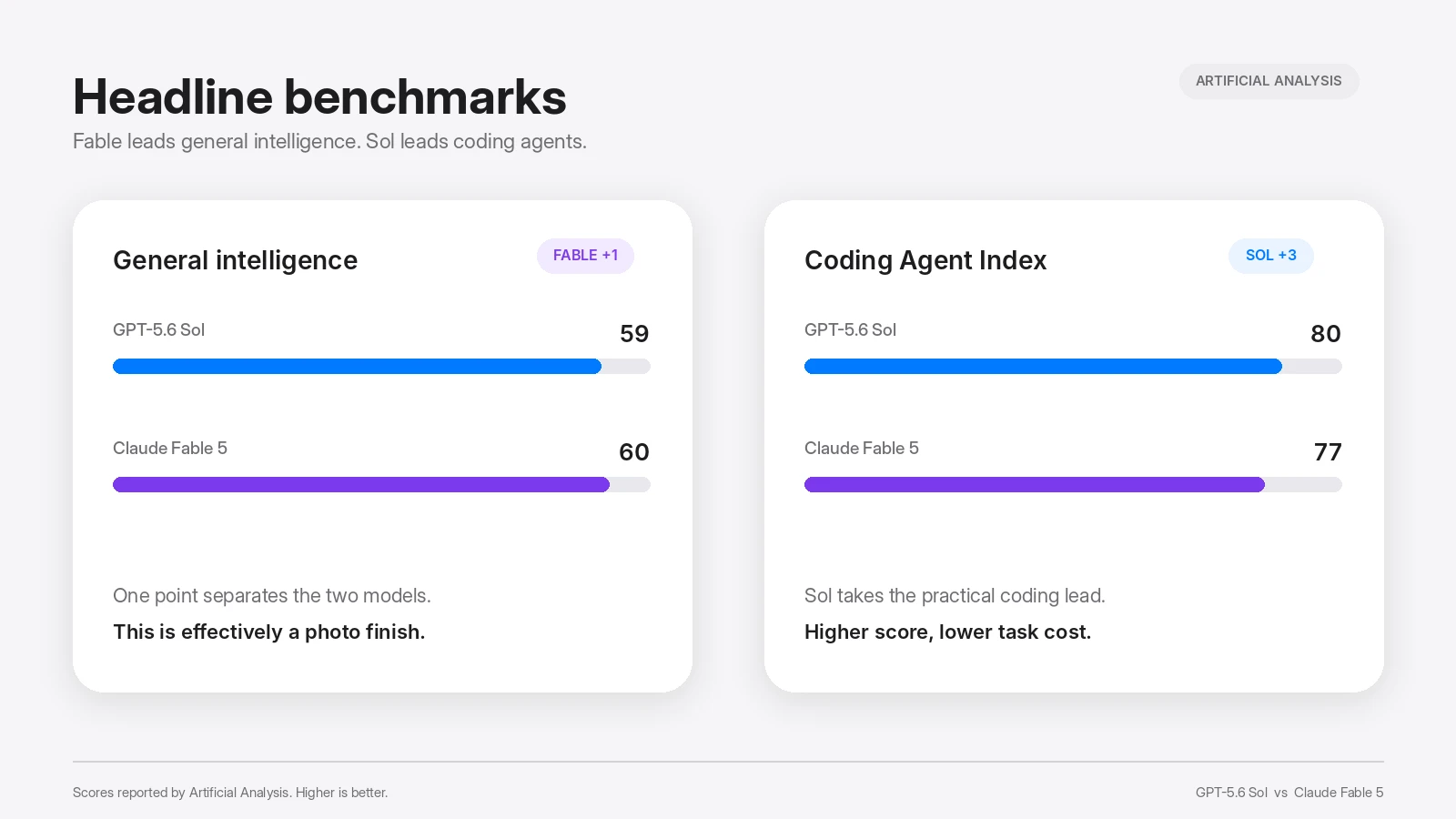
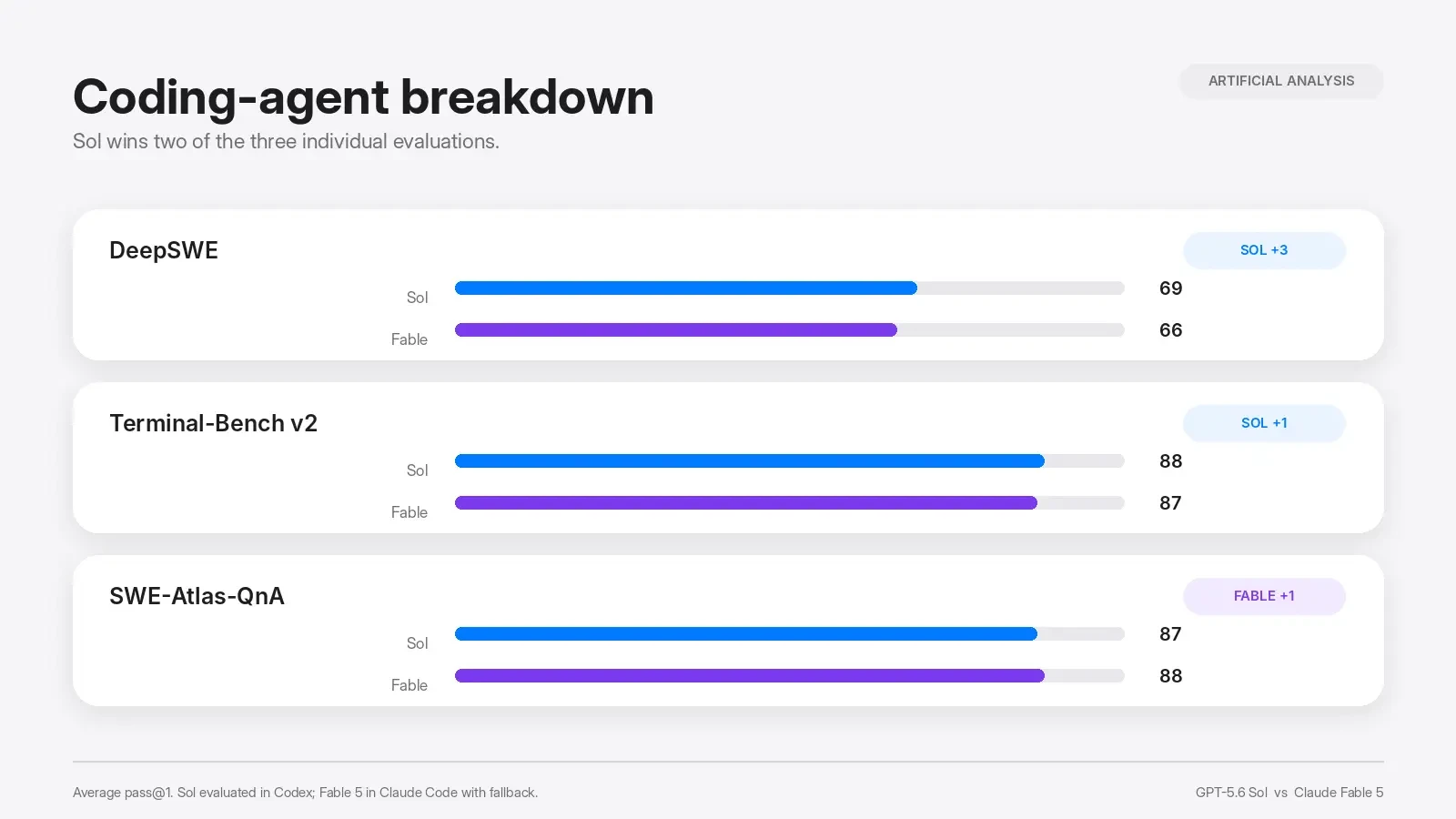
However, the Coding Agent Index tells a different story. GPT-5.6 Sol holds a three-point advantage in practical software development evaluations. Specifically:
- DeepSWE: Sol leads in resolving real-world GitHub issues.
- Terminal-Bench v2: Sol shows higher proficiency in navigating terminal environments and executing system-level commands.
- SWE-Atlas-QnA: Fable 5 holds a narrow one-point lead in theoretical software engineering knowledge.
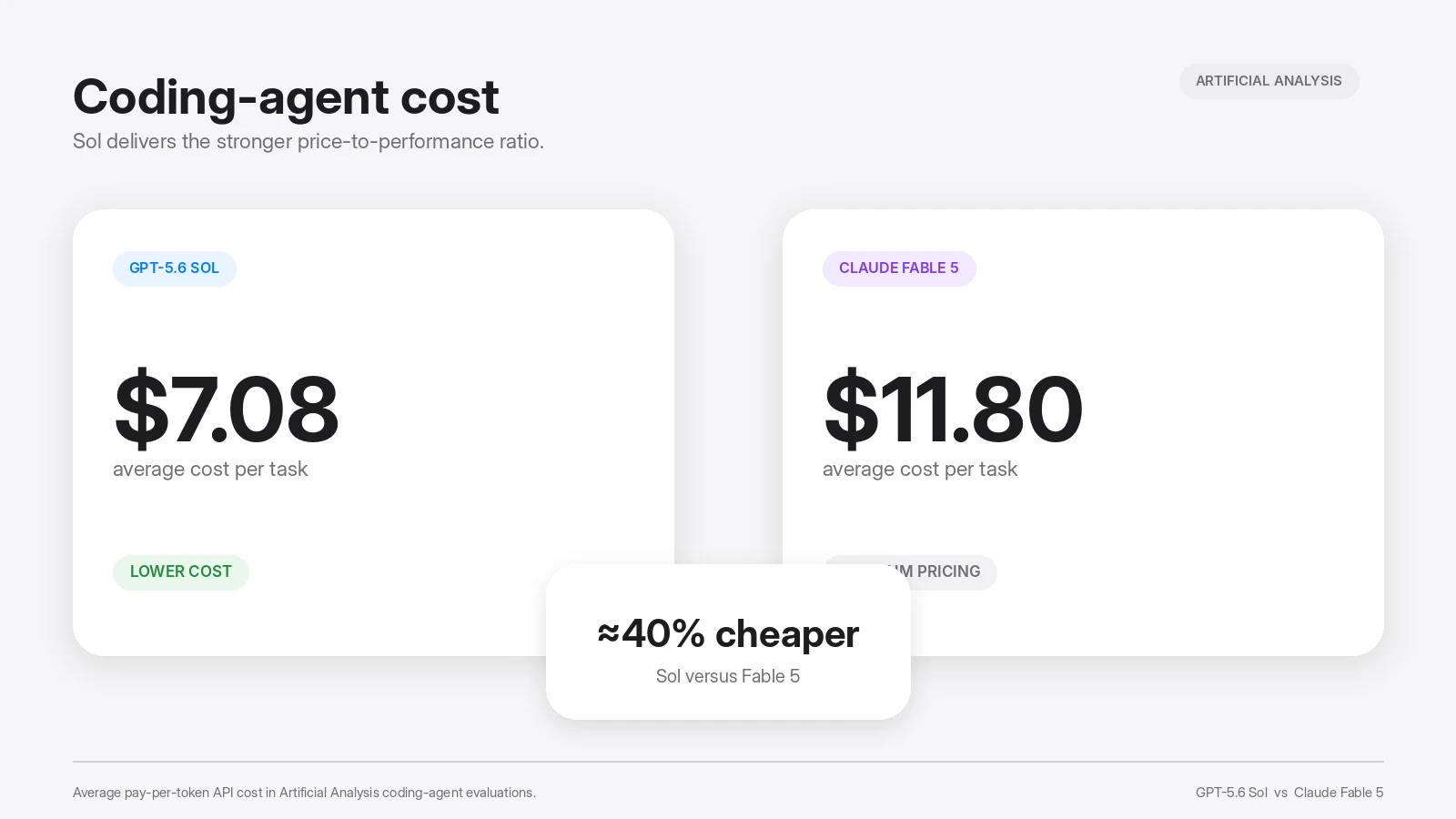
The cost-to-performance ratio for coding tasks is particularly stark. The average cost per task on the Coding Agent Index is $7.08 for Sol, compared to $11.80 for Fable 5. This 40% cost reduction makes Sol the more viable option for development teams running automated agents at scale.
Operational Constraints and Usage Limits
A critical factor for power users is the frequency and duration of usage limits. During testing, GPT-5.6 Sol demonstrated significantly higher resilience to heavy usage. Paid users of OpenAI’s platform reported virtually no interruptions, with occasional "token resets" provided for free to maintain workflow continuity.
Claude Fable 5, by contrast, maintains stricter usage quotas. In several instances, users were met with "limit reached" notifications after only 3 to 4 intensive conversations. Furthermore, Fable 5 is currently positioned as a limited-time offering available through July 19, 2026, whereas Sol is a permanent fixture of OpenAI’s current lineup. This availability makes Sol the more reliable choice for long-term project integration.
Industry Implications and Future Outlook
The competition between GPT-5.6 Sol and Claude Fable 5 illustrates a maturing AI market where "general intelligence" is no longer the only metric of success. The divergence in their performance—Sol as the efficient, high-speed coder and Fable 5 as the autonomous, deep-thinking strategist—suggests that the industry is moving toward specialized model selection based on specific operational needs.
For enterprises, the choice between these models depends on the level of human involvement. GPT-5.6 Sol is widely regarded as the superior "co-pilot"—a model that works alongside a human professional to accelerate output and reduce costs. Claude Fable 5 is the superior "agent"—a model to which a human can delegate a complex objective and expect a high-quality result with minimal check-ins.
As the 2026 deadline for these initial releases approaches, the market anticipates further updates. However, for the current fiscal quarter, GPT-5.6 Sol’s combination of frontier-level coding performance and disruptive pricing makes it the most practical choice for the majority of professional and development workflows. Claude Fable 5 remains the gold standard for high-stakes reasoning, provided the user can accommodate its higher price point and more restrictive usage limits.