


The landscape of digital optimization has shifted from a discretionary activity to a fundamental requirement for competitive survival. As organizations strive to enhance user experience and maximize conversion rates, the central dilemma remains whether to invest in internal software tools or to outsource experimentation to specialized A/B testing services. This choice represents more than a simple procurement decision; it defines an organization’s long-term relationship with its data, its speed of innovation, and its internal culture of experimentation. While software tools empower internal teams to run and manage experiments autonomously, service-based models provide expert-led frameworks that prioritize immediate results and specialized knowledge.
The Evolution of the Experimentation Landscape
To understand the current choice between services and software, it is necessary to examine the chronology of digital experimentation. In the early 2000s, A/B testing was a manual, resource-intensive process reserved for tech giants like Google and Amazon. It required significant engineering effort to split traffic and track results. The decade following 2010 saw the “SaaS revolution,” which introduced visual editors and simplified scripts, allowing marketers to launch tests without deep coding knowledge.
Today, the market has matured into a sophisticated ecosystem where “feature experimentation” and “full-stack testing” are the standards. According to industry benchmarks, companies that embrace a high-velocity testing culture—running dozens of experiments simultaneously—see significantly higher growth rates than those relying on sporadic testing. This evolution has created two distinct paths: the “Do-It-Yourself” path supported by robust software platforms and the “Expert-Guided” path facilitated by Conversion Rate Optimization (CRO) agencies.
Defining the Core Differences: Ownership vs. Expertise
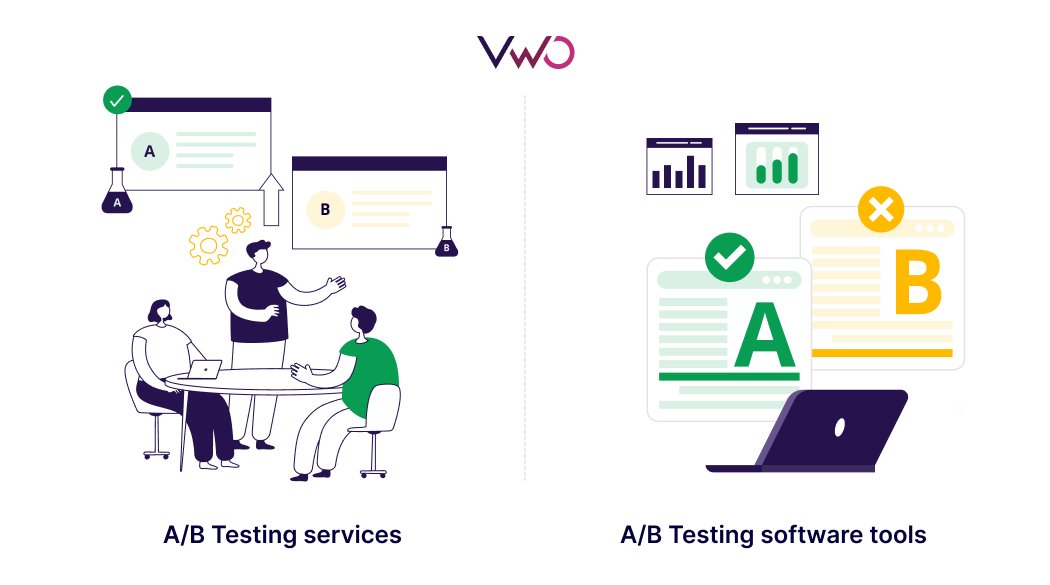
The primary distinction between these two models lies in the ownership of the experimentation engine. Software tools, such as VWO, provide the infrastructure for an organization to build its own testing capability. When a company adopts a software-first approach, it retains full control over hypothesis generation, implementation, and data interpretation. This model is designed for scalability and long-term institutional knowledge.
Conversely, A/B testing services—typically offered by specialized agencies—provide a turnkey solution. The agency manages the entire lifecycle of an experiment, from identifying friction points in the user journey to designing the variations and performing the statistical analysis. For organizations lacking the internal headcount or the technical maturity to manage a platform, these services offer a shortcut to professional-grade experimentation.
Strategic Comparison of Operational Factors
When evaluating these models, several strategic factors must be considered to determine alignment with business goals:
1. Ownership and Institutional Knowledge
Software tools ensure that the “experimentation brain” resides within the company. Every test, whether a win or a loss, contributes to a growing database of insights about user behavior. In the service model, expertise often remains with the agency. If the contract ends, the organization may find itself with a vacuum of knowledge regarding why certain changes were successful.
2. Scalability and Velocity
Internal tools allow for high-velocity testing once the internal processes are mature. Teams can launch experiments across web, mobile, and server environments without waiting for external approval cycles. Agencies, while fast at the start, are ultimately limited by the scope of their contract and their own internal bandwidth.
3. Data Governance and Security
For industries such as FinTech and Healthcare, data sovereignty is paramount. Internal software tools allow for tighter control over user data and compliance with regulations like GDPR and CCPA. While agencies use compliant tools, the extra layer of third-party involvement can complicate data governance protocols.

4. Cost Structure and ROI
Software typically follows a subscription-based pricing model, where the cost per experiment decreases as the team’s efficiency grows. Agencies operate on retainers or project fees, which can be significantly higher upfront but may offer a better ROI for companies that would otherwise spend months trying to hire and train an internal team.
The Case for Software: Building a Culture of Innovation
For organizations with a dedicated product or growth team, a comprehensive experimentation platform is more than a utility—it is a de-risking mechanism for every code release. Modern platforms offer advanced features that go beyond simple split tests:
- Feature Management: Engineering teams use feature flags to perform controlled rollouts, ensuring that new updates can be instantly toggled off if they negatively impact performance.
- Behavioral Context: Leading tools integrate heatmaps and session recordings directly with test variations. This allows teams to see why a variation failed, rather than just seeing that it did.
- AI-Powered Optimization: The integration of machine learning allows for real-time personalization and automated hypothesis generation, lowering the barrier to entry for complex testing.
Lucia van den Brink, Founder of The Initial, emphasized the cultural impact of this model in a recent industry discussion: “The biggest change when experimentation is owned versus outsourced is that it empowers teams to do their best work. It gives designers, developers, and product teams the power to verify their ideas and influence what happens next.”
The Case for Services: Rapid Results and Specialized Skillsets
Hiring an A/B testing agency is often the most logical step for organizations that have high traffic and a healthy budget but lack the technical infrastructure. The benefits of this model include:
- Immediate Access to Specialists: Agencies provide a ready-made team of strategists, developers, and data scientists.
- Proven Frameworks: Professional services bring years of experience from different industries, allowing them to apply “best-in-class” methodologies to a new client’s problems immediately.
- Organizational Buy-in: By delivering quick wins and measurable ROI, agencies can help justify the future investment in a permanent internal experimentation team.
However, the downsides include a potential lack of deep product context. External partners may not fully grasp the nuances of a specific brand’s long-term values, leading to “winning” tests that might inadvertently harm the brand’s voice or long-term customer loyalty.
Decision Framework: Which Path to Choose?
Organizations can use the following criteria to determine their ideal model:
Traffic Volume: High-traffic sites can reach statistical significance quickly, making the investment in a dedicated software platform highly efficient. Low-traffic sites may need the surgical precision of an agency to design tests that yield meaningful results from smaller datasets.
Experiment Complexity: If the roadmap includes server-side testing or complex algorithm changes, an internal software tool is usually necessary to integrate with the existing tech stack. If the focus is primarily on front-end UI/UX improvements, an agency can handle the workload with minimal internal disruption.
Budgetary Predictability: Companies seeking predictable annual costs often prefer software subscriptions. Those with project-based budgets or a need for rapid, short-term growth may find the agency retainer model more suitable.
The Hybrid Approach: The Modern Industry Standard
In practice, the decision is rarely binary. Many of the world’s most successful digital organizations utilize a hybrid model. They purchase a robust experimentation platform (the software) to ensure data ownership and technical integration, while simultaneously hiring an agency (the service) to bootstrap the program.

Under this arrangement, the agency helps build the initial testing roadmap and establishes the workflows. Over time, as the internal team learns the platform and the methodology, the agency’s role shifts from execution to high-level strategy, or the contract is phased out entirely as the internal team reaches maturity.
Real-World Impact: The Vandebron Case Study
The effectiveness of having the right infrastructure was recently demonstrated by Vandebron, a Dutch green energy provider. The company utilized the VWO platform to identify a specific friction point in their sign-up flow. By analyzing user behavior analytics alongside A/B testing data, they discovered that a date-of-birth field was causing significant user drop-off.
By implementing a simplified input method validated through an experiment, Vandebron achieved a 16.3% increase in sign-up conversions. This case highlights how quickly internal teams can act when they have direct access to behavioral insights and testing tools without the lag time of external communication.
Conclusion and Future Outlook
The choice between A/B testing services and software tools ultimately depends on an organization’s growth stage and strategic priorities. Software tools offer the path to long-term autonomy, data ownership, and a deeply embedded culture of experimentation. Services offer the path of speed, specialized expertise, and immediate impact.
As Artificial Intelligence continues to permeate the experimentation space, the gap between these two models may narrow. AI-driven tools are making it easier for non-experts to run sophisticated tests, potentially reducing the reliance on external agencies for execution. However, the need for human strategy—understanding the “why” behind the data—remains a constant. Whether through a tool or a service, the organizations that prioritize a rigorous, data-driven approach to their digital experience will continue to outperform their competitors in an increasingly crowded marketplace.







