rifanmuazin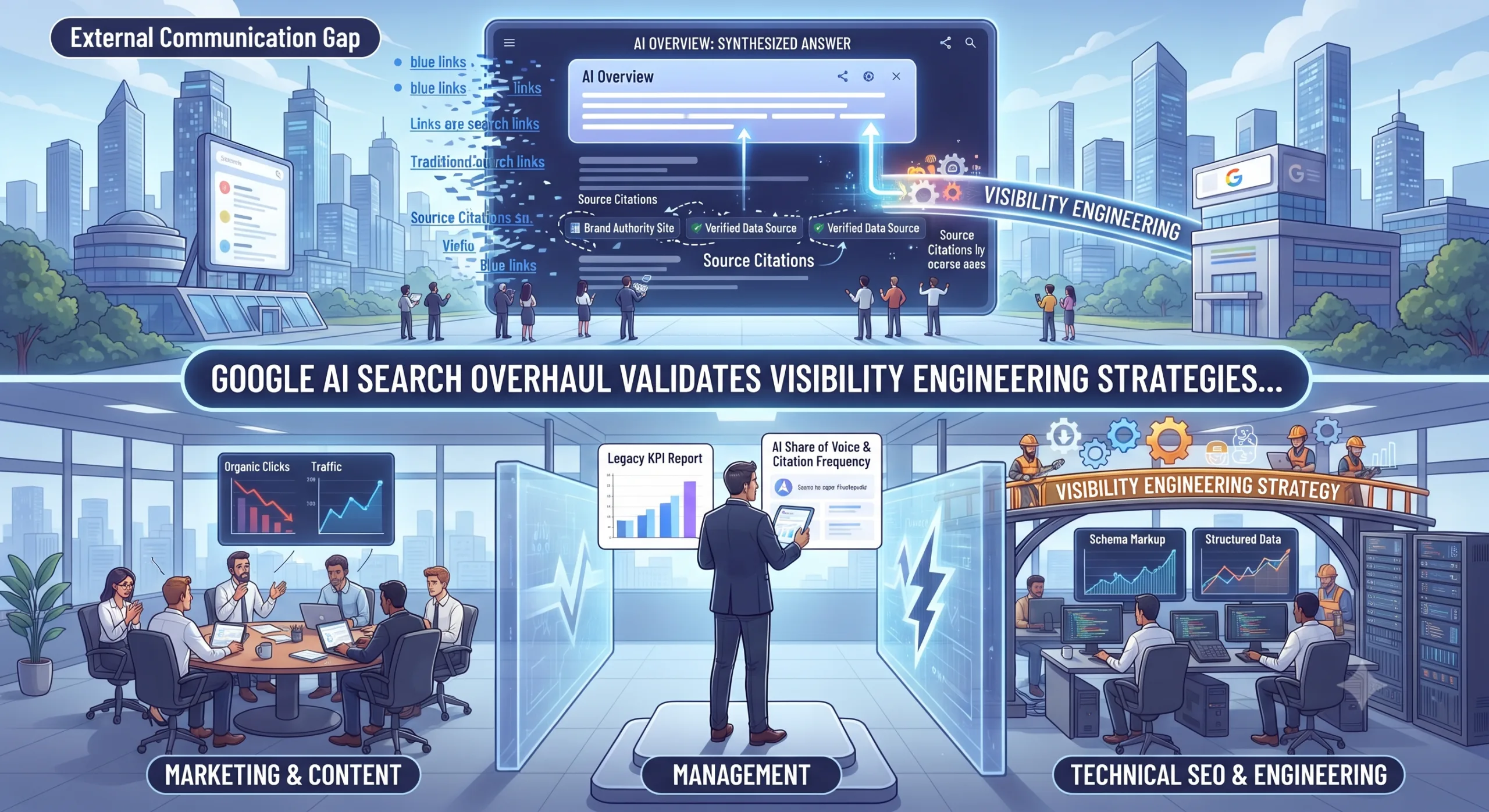
The digital landscape has undergone a seismic shift. In 2026, the era of the “ten blue links” is effectively a relic of the past, replaced by an ecosystem defined by synthesis, immediacy, and AI-generated intelligence. Google’s AI Search overhaul—centered on AI Overviews (AIO)—has not merely updated search engine results; it has fundamentally rewritten the rules of digital discovery.
For brands and marketers, this transition has exposed a critical disconnect: as external search behaviors evolve toward zero-click consumption, many organizations are struggling with internal communication gaps, failing to bridge the divide between technical SEO, content strategy, and executive-level understanding. In this environment, “Visibility Engineering” has emerged as the essential framework for survival and growth.
The New Reality: Visibility Is No Longer a Ranking Game
For years, search engine optimization (SEO) was a pursuit of ranking #1. Today, that objective is increasingly decoupled from actual traffic. As AI Overviews appear for 47–64% of search queries, users are frequently satisfied by the synthesized answer provided directly on the Search Engine Results Page (SERP).
This shift has resulted in a 20–40% decline in organic traffic for informational queries across many sectors. However, this is not the “death of search”—it is the maturation of it. The new currency of digital visibility is citation.
Visibility Engineering—the practice of optimizing for inclusion within these AI-synthesized responses—has become the logical evolution of SEO. Unlike traditional SEO, which focuses on keyword placement and backlinks to rank a link, Visibility Engineering focuses on:
-
Entity Authority: Establishing the brand as a primary source of truth that LLMs trust.
-
Structured Data Optimization: Providing the machine-readable context required for AI to accurately index and cite information.
-
Answer-First Architecture: Structuring content to be easily extracted and repurposed by AI models without sacrificing the depth that drives user trust.
The Communication Gap: Why Organizations Are Falling Behind
While the technical requirements for AI-age visibility are becoming clearer, a profound internal communication gap is hindering progress. Many organizations are operating with a siloed mindset, where technical SEO teams understand the threat of AIOs, but executive leadership remains anchored to legacy metrics like “organic clicks” or “keyword ranking”.
1. The Executive Misalignment
C-level executives often view declining organic sessions as a failure of marketing execution rather than a structural shift in search architecture. When leadership demands more traffic without acknowledging that a significant percentage of potential traffic is now being captured by the AI interface itself, it forces teams to churn out “commodity content” that satisfies old search patterns but lacks the citation-worthy depth required for AI inclusion.
2. The Strategy Disconnect
There is a frequent disconnect between content teams and technical engineers. Content teams may produce high-quality, thought-leadership pieces, but if the site’s technical infrastructure does not support crawlability or if the schema markup is absent, that content remains “invisible” to the LLMs powering the search experience.
3. The Trust Gap: The “Receipt” Problem
Externally, there is a growing gap in trust. With only 28% of U.S. searchers trusting AI-generated answers, users are increasingly performing “verification searches”. They want receipts—official sources, links to primary data, and evidence-based content. Brands that ignore this need for transparency, focusing only on the “answer” and not the “source,” are failing to capture the high-intent audience that is willing to click through to a trusted destination.
Bridging the Gap Through Visibility Engineering
To navigate these challenges, companies must transition from being “content creators” to “information architects.” Visibility Engineering provides the roadmap to bridge these internal and external gaps.
Prioritize “Citation-Worthy” Content
AI models favor content that provides unique value—proprietary data, expert analysis, and original statistics. By moving away from surface-level, AI-replicable summaries and toward high-density, authoritative content, brands ensure they are the ones cited by Google’s algorithms, not merely summarized.
Adopt a Unified Measurement Framework
Organizations must redefine success. Instead of measuring only clicks, teams should track:
-
Citation Frequency: How often does the brand appear in AI-generated answers for core industry terms?
-
Share of Voice in AI: How does the brand’s presence in AI summaries compare to competitors?
-
Branded Search Volume: A key indicator that AI-referred users are moving from the AI answer to the brand’s site to verify or purchase.
Operationalizing Trust
Closing the external communication gap—the lack of consumer trust in AI—is a major opportunity. Brands that prioritize “official source” status—by displaying clear bylines, dated updates, and methodology sections—create a “halo effect” of credibility. When a user sees an AI answer and looks for a source to trust, a well-engineered site acts as the verified receipt, converting a skeptical researcher into a loyal visitor.
The Path Forward: Integration, Not Isolation
The Google AI search overhaul is a validation of the necessity of Visibility Engineering. It forces marketers, developers, and executives to work in lockstep. The silos that once separated SEO from PR, and data analysis from content creation, must be dismantled.
In this new ecosystem, content is the product, and search visibility is the distribution network. The brands that win in 2026 and beyond will be those that accept that the search interface is no longer a static list, but a fluid, intelligent conversation. By treating AI visibility as a core business asset—one that requires ongoing investment, technical rigor, and a commitment to radical transparency—companies can turn the disruption of the AI overhaul into their most significant competitive advantage.
The gap is not just in technology; it is in strategy. The solution is to stop competing for the click and start competing for the citation, effectively engineering a brand presence that is not just seen, but trusted, verified, and indispensable.